
A hyphen, a short dash, and a long dash look almost alike, yet they do completely different jobs. One joins words, one marks ranges, and one interrupts a sentence for emphasis. Parentheses, meanwhile, tuck extra information quietly to the side. These marks give writers precise control over how a sentence flows, and English tests check whether you can tell them apart.
This article covers Topic 7.6: Dashes, Hyphens, and Parentheses in Unit 7, Punctuation and Mechanics. The topic asks you to use hyphens in compound words and modifiers, use dashes to set off or emphasize information, and use parentheses for supplementary details.
By the end, you should be able to:
- Use hyphens correctly in compound modifiers, numbers, and prefixes.
- Distinguish the hyphen, the en dash, and the em dash.
- Use em dashes in pairs or alone to set off information.
- Choose among commas, dashes, and parentheses for interrupting information.
Three Marks, Three Jobs
| Mark | Appearance | Main Job |
|---|---|---|
| Hyphen | The shortest line, made with one keystroke | Joins words or word parts |
| En dash | About the width of a capital N | Shows ranges of numbers or dates |
| Em dash | About the width of a capital M, the longest of the three | Sets off or emphasizes information |
On many keyboards, writers type two hyphens to stand for an em dash, and word processors often convert them automatically.
Hyphens
Compound modifiers before a noun. When two or more words work together as one adjective before a noun, hyphenate them.
- a well-known author, a part-time job, a five-year-old child
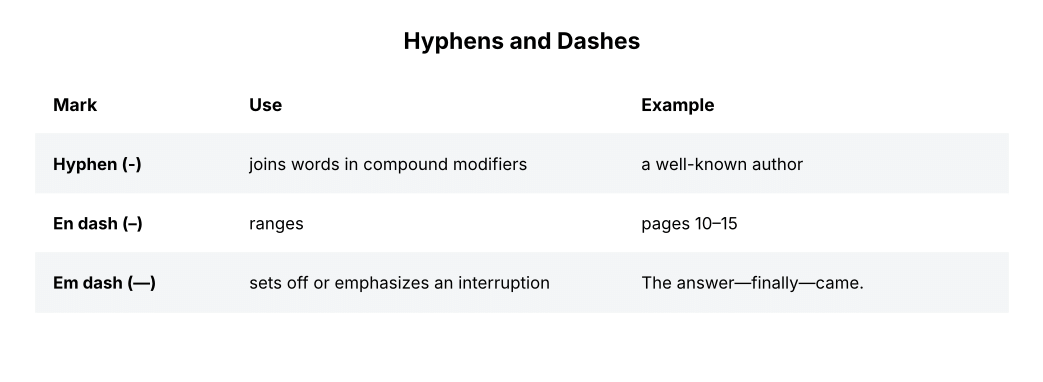
After the noun, the hyphen usually disappears: “The author is well known.” “The child is five years old.”
Do not hyphenate after an adverb ending in -ly: “a quickly moving train,” not “quickly-moving.”
Numbers and fractions. Hyphenate compound numbers from twenty-one to ninety-nine and fractions used as modifiers: “forty-two,” “a two-thirds majority.”
Prefixes. Use a hyphen with self-, ex- (meaning former), and all-, before a capitalized word, and to avoid confusion: self-aware, ex-president, mid-July, re-cover (cover again) versus recover (get better).
Why does this matter? Hyphens can change meaning. “A small-business owner” owns a small business. “A small business owner” might be a short person who owns a business. One tiny mark tells the reader which words belong together.
En Dashes
The en dash means “through” or “to” in ranges: pages 45 to 60, the years 1939 to 1945, or a Monday to Friday schedule, each written with an en dash in place of the word to. In everyday writing and on most tests, the en dash is rarely the focus; the hyphen and em dash matter much more.
Em Dashes
The em dash is the most flexible mark in English. It can:
- Set off an interruption in the middle of a sentence, using a pair of dashes, one before and one after the inserted words.
- Add emphasis to a final idea, using a single dash before it, much like a colon but more dramatic.
- Show a sudden break in thought or speech, especially in dialogue.
For example, a writer might place a pair of em dashes around the words “my oldest friend” in “Lucy, my oldest friend, moved away,” making the phrase stand out more than commas would.
The key rule: dashes that set off an interruption come in pairs, just like commas around a nonessential phrase. Never open with a dash and close with a comma, or the reverse. If you remove the words between the pair, the sentence must still be complete.
Parentheses
Parentheses enclose information that is helpful but less important, such as a definition, an abbreviation, a date, or a quick aside.
- The World Health Organization (WHO) issued new guidance.
- Mark Twain (born Samuel Clemens) grew up in Missouri.
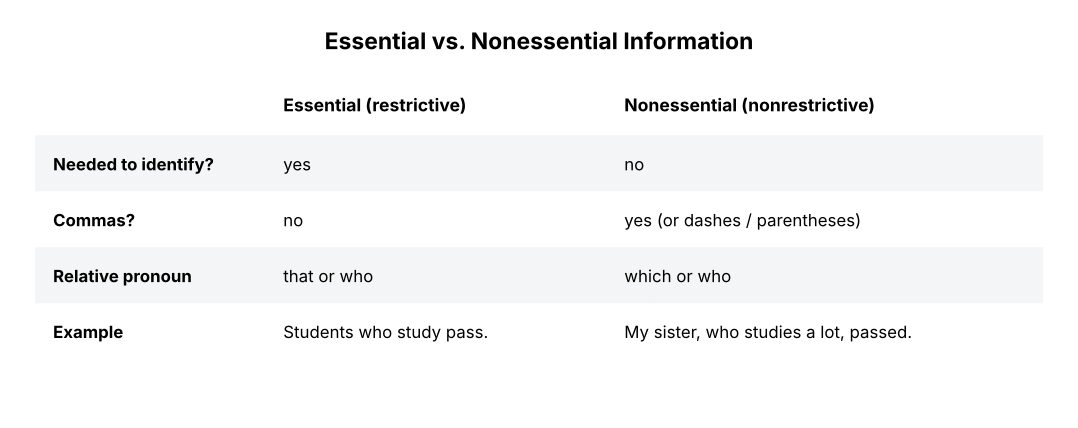
Punctuation that belongs to the main sentence goes outside the closing parenthesis. If a complete sentence stands alone inside parentheses, its period goes inside.
Commas, Dashes, or Parentheses?
All three can set off interrupting information. Think of them as a volume dial:
- Commas: normal volume, a neutral interruption.
- Dashes: loud, drawing attention to the inserted words.
- Parentheses: quiet, like a whispered side note.
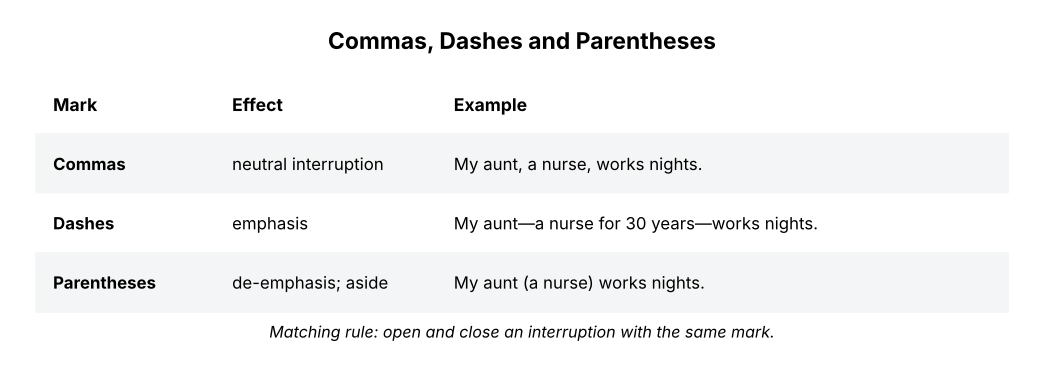
Why does this matter? On tests, answer choices often mix these marks. The correct answer usually matches the mark that opened the interruption, so a sentence that begins an aside with a dash must close it with a dash.
Test-Taking Strategies
Mnemonic Devices and Memory Shortcuts
“Hyphens hug, dashes dramatize, parentheses whisper.” For pairs, remember “open with it, close with it.”
Cross-Topic Connections
- Commas around nonessential information are covered in Topic 7.1: Commas.
- Setting off phrases is explained in Topic 7.2: Punctuating Phrases.
- Dashes that announce a final idea work like colons in Topic 7.3: Semicolons and Colons.
- Compound modifiers are adjectives, reviewed in Topic 3.1: Adjectives and Adverbs.
Common Question Formats
- Decide whether a compound modifier needs a hyphen.
- Choose the mark that closes an interruption.
- Pick commas, dashes, or parentheses for a given effect.
- Place punctuation correctly around parentheses.
Frequent Student Mistakes
- Hyphenating compound modifiers that come after the noun.
- Mixing a dash and a comma around one interruption.
- Hyphenating -ly adverbs.
Test-Day Shortcuts
Find the mark that opens the interruption and choose the answer that closes it with the same mark. Then read the sentence without the interruption to confirm it is complete.
Time Management Tips
Dash and hyphen items on English unit tests and standardized tests such as the SAT and ACT take 20 to 30 seconds. Matching-pair questions are often the fastest points on the test.