
“That’s my last Duchess painted on the wall, / Looking as if she were alive.” With these lines from Robert Browning’s 1842 poem, a duke begins showing a visitor a portrait of his late wife. As he talks, he reveals his jealousy, his pride, and, many readers conclude, his responsibility for her death. He never confesses outright. The poem works because readers hear only his side and must read between the lines. That is the power of the dramatic monologue.
This article covers Topic 2.13: Dramatic Monologue in Unit 2, Structure and Form. The topic asks you to identify the features of a dramatic monologue, infer the situation and silent listener, and analyze what the speaker reveals unintentionally.
By the end, you should be able to:
- Define the dramatic monologue and list its three key features.
- Infer the setting, situation, and listener from clues in the speech.
- Analyze what a speaker reveals about himself or herself without meaning to.
- Distinguish a dramatic monologue from a soliloquy and a lyric poem.
Three Key Features
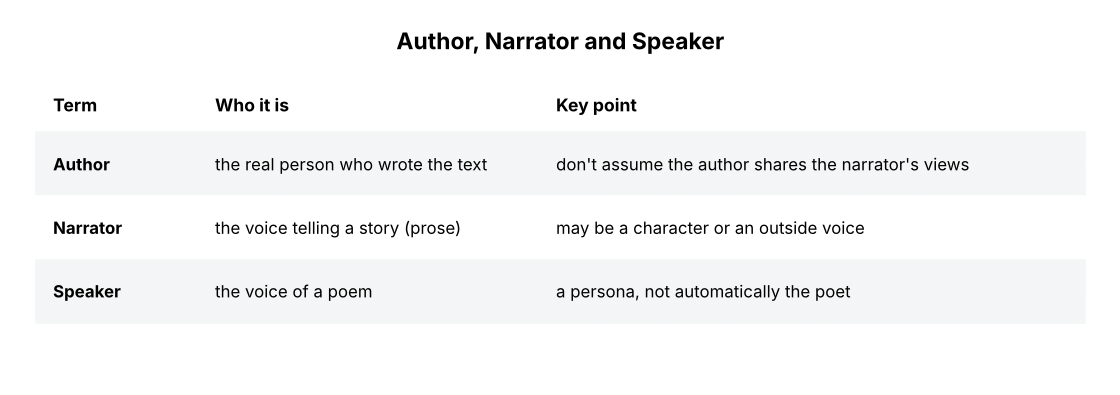
- A single speaker who is clearly a character, not the poet.
- A silent listener whose presence and reactions we infer only from the speaker’s words.
- Self-revelation: the speaker reveals his or her personality, often more than intended.
The form was developed and popularized by Victorian poets, especially Robert Browning and Alfred, Lord Tennyson, in the 1840s.
Comparing Related Forms
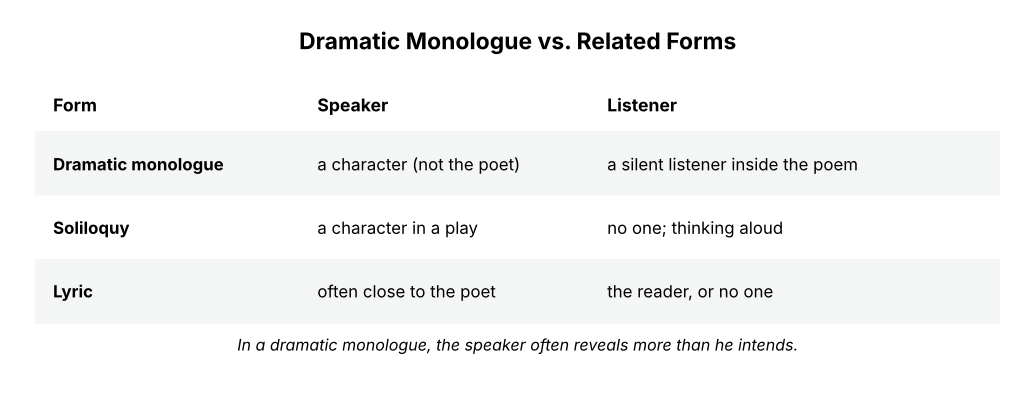
| Form | Speaker | Listener | Context |
|---|---|---|---|
| Dramatic monologue | A character | A silent person in the scene | A stand-alone poem |
| Soliloquy | A character in a play | No one; the character speaks thoughts aloud | Part of a drama |
| Lyric poem | Often close to the poet | Usually the reader or no one specific | A stand-alone poem |
Worked Example: “My Last Duchess”
- Speaker: the Duke of Ferrara, a wealthy Italian nobleman.
- Listener: an envoy, we learn near the end, sent to arrange the Duke’s next marriage.
- Situation: the Duke shows off a portrait of his former wife.
- What he says: she smiled at everyone and was pleased too easily by small kindnesses, and he felt she did not value his “nine-hundred-years-old name” enough.
- What he reveals: he was jealous and controlling. When he says, “I gave commands; / Then all smiles stopped together,” he implies that he had her killed.
- Irony: while trying to impress the envoy, he reveals himself as dangerous, a warning to the next duchess.
Why does this matter? The dramatic monologue trains readers to notice the gap between what a speaker says and what is true. That skill, reading for subtext and unreliable narration, is valuable in every kind of literature.
Inferring the Listener
Since the listener never speaks, look for clues in the speaker’s words:
- Direct address, such as “Will’t please you sit.”
- Responses to unspoken questions or gestures.
- Commands or invitations, such as “Nay, we’ll go / Together down, sir.”
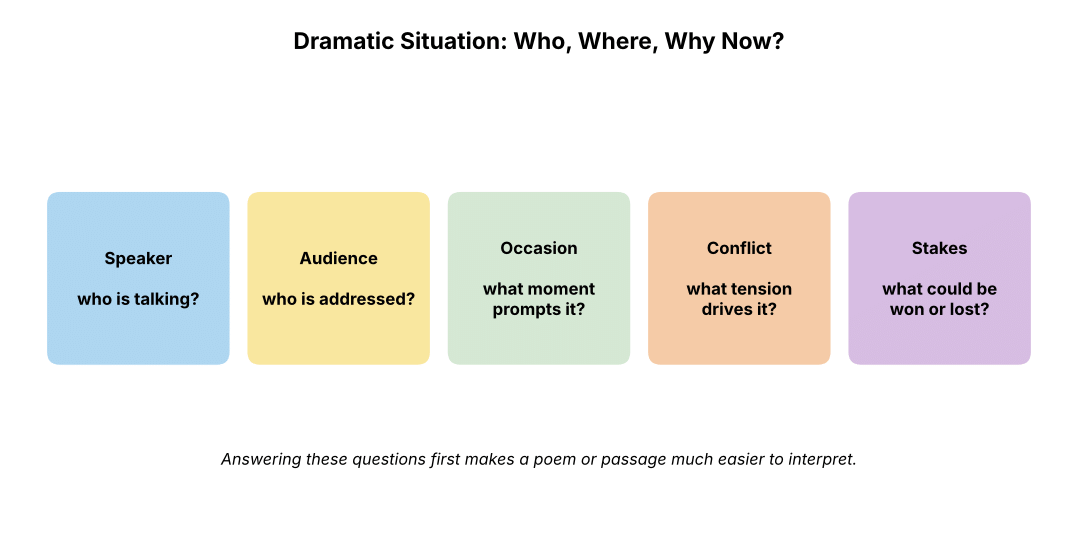
Once you identify the listener, ask why the speaker is talking to this person and what he or she wants.
Other Famous Examples
In Tennyson’s “Ulysses” (1842), the aging Greek hero, back home after years of adventure, tells his listeners that he wants to sail again. The poem ends with the resolve “To strive, to seek, to find, and not to yield.” Readers debate whether Ulysses is admirably brave or selfishly restless, which shows how a dramatic monologue can support more than one interpretation of a character.
T. S. Eliot’s “The Love Song of J. Alfred Prufrock” (1915) adapts the form for the Modernist age. It begins “Let us go then, you and I,” and follows an anxious, self-doubting speaker who cannot bring himself to act.
Why does this matter? Dramatic monologues ask readers to judge a character based on evidence, much like a jury hears testimony. Test questions often ask what a speaker’s words reveal or what a listener’s reaction might be.
How to Analyze a Dramatic Monologue
- Identify who is speaking and to whom.
- Reconstruct the setting and situation.
- List what the speaker claims or wants.
- Find moments where the speaker reveals more than intended.
- Decide what the poet wants readers to think of the speaker.
Test-Taking Strategies
Mnemonic Devices and Memory Shortcuts
“One talks, one listens, all is revealed.” Think of a dramatic monologue as half of a phone call: you hear only one side and must guess the rest.
Cross-Topic Connections
- Persona speakers are introduced in Topic 1.2: Speaker and Voice.
- Compare story-centered poems in Topic 2.12: Narrative and Lyric Poetry.
- Many monologues use the meter in Topic 2.4: Iambic Pentameter.
- Inferring what is unstated draws on Reading Skills Topic 1.1: Close Reading for Key Ideas and Details.
Common Question Formats
- Identify the speaker and the silent listener.
- Infer what the speaker reveals about his or her character.
- Explain the irony in the speaker’s words.
- Distinguish a dramatic monologue from a soliloquy.
Frequent Student Mistakes
- Treating the speaker as the poet.
- Accepting the speaker’s claims without question.
- Ignoring clues about the listener.
Test-Day Shortcuts
Look for lines where the speaker defends or explains himself. Those lines usually reveal the flaw the poet wants readers to notice.
Time Management Tips
Dramatic monologues are long, so on English unit tests and standardized reading tests such as the SAT and ACT, note the speaker, listener, and situation before answering questions.