
“But soft, what light through yonder window breaks?” Romeo’s famous line has ten syllables that alternate weak and strong: but SOFT, what LIGHT through YON-der WIN-dow BREAKS. That pattern, iambic pentameter, is the most important meter in English poetry. Shakespeare, Milton, Wordsworth, and Keats all relied on it, and once you learn to hear it, you will notice it everywhere.
This article covers Topic 2.4: Iambic Pentameter in Unit 2, Structure and Form. The topic asks you to identify iambic pentameter, scan lines that use it, recognize common variations, and explain why poets choose it.
By the end, you should be able to:
- Define iambic pentameter and break the term into its parts.
- Scan a line of iambic pentameter.
- Identify common variations such as trochaic substitution and feminine endings.
- Recognize blank verse and explain why poets use this meter.
Breaking Down the Term
- Iamb: a two-syllable foot with an unstressed syllable followed by a stressed one, da-DUM, as in a-LIVE.
- Penta: five.
- Meter: measure.
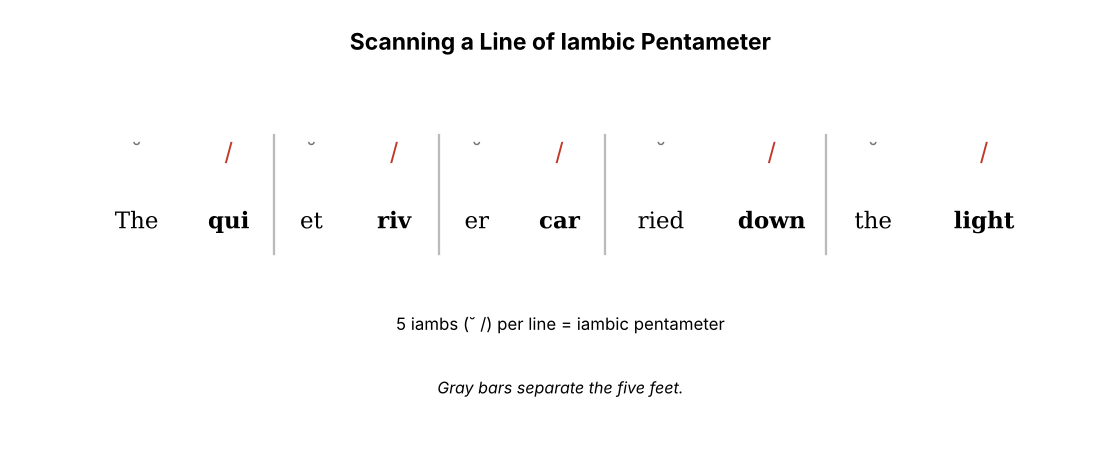
So iambic pentameter is a line of five iambs, usually ten syllables:
da-DUM / da-DUM / da-DUM / da-DUM / da-DUM
Scanning a Line
Take the opening of Shakespeare’s Sonnet 18 (1609):
Shall I compare thee to a summer’s day?
- Count the syllables: Shall-I-com-pare-thee-to-a-sum-mer’s-day = 10.
- Mark the stresses by reading aloud: shall I / com-PARE / thee TO / a SUM / mer’s DAY.
- Most feet follow the da-DUM pattern, so the line is iambic pentameter.
Notice that the first foot, “Shall I,” does not have a strong stress on either syllable in natural speech, and “thee TO” puts a stress on a small word. Real lines rarely fit the pattern perfectly; readers allow some flexibility, as long as the overall pattern stays clear.
Hearing It in Everyday Speech
You probably speak in iambic pentameter without noticing. Try saying “I think I’ll take the bus to school today.” Mark the beats: i THINK / i’ll TAKE / the BUS / to SCHOOL / to-DAY. That is five iambs, a perfect line. Practicing with sentences like this trains your ear, so the pattern becomes easier to hear in Shakespeare.
Why Iambic Pentameter?
English speech naturally tends to alternate unstressed and stressed syllables, so iambic lines sound close to normal talk. A ten-syllable line is also about the length of a natural breath or spoken phrase. The result feels both structured and conversational, which is why Shakespeare used it for most of his dialogue.
Why does this matter? Because iambic pentameter sounds natural, breaks in the pattern stand out. A skilled poet can make readers stress a key word simply by placing it where the rhythm expects, or does not expect, a strong beat.
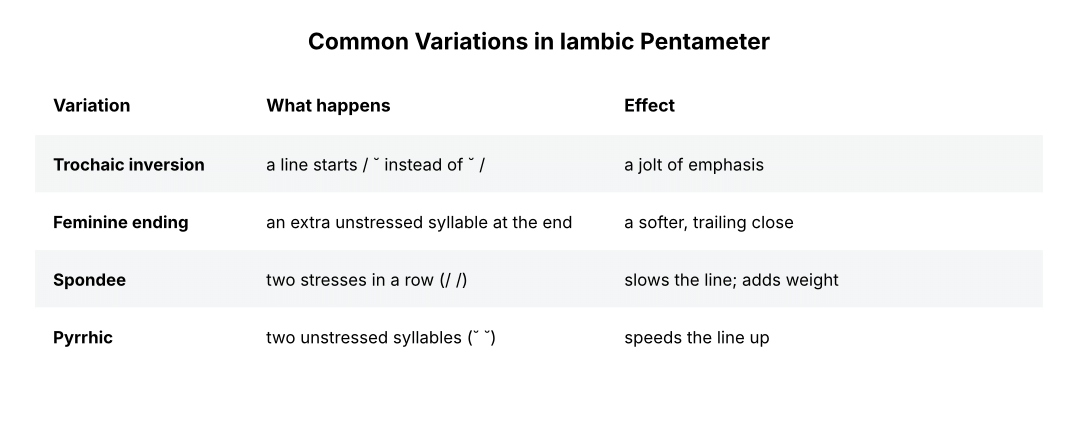
Common Variations
| Variation | What Happens | Effect |
|---|---|---|
| Trochaic substitution | A trochee (DUM-da) replaces the first iamb | Starts the line with force |
| Feminine ending | An extra unstressed syllable at the end, making 11 syllables | Creates a softer, trailing close |
| Spondee | Two stressed syllables side by side | Slows the line and adds weight |
| Caesura | A strong pause within the line | Breaks the rhythm for emphasis |
Worked example: Hamlet’s line “To be, or not to be, that is the question” (around 1600) has eleven syllables. The extra unstressed syllable at the end (“QUES-tion”) is a feminine ending, and the commas create pauses. The line sounds like someone thinking aloud, which suits Hamlet’s uncertainty.
Blank Verse and Heroic Couplets
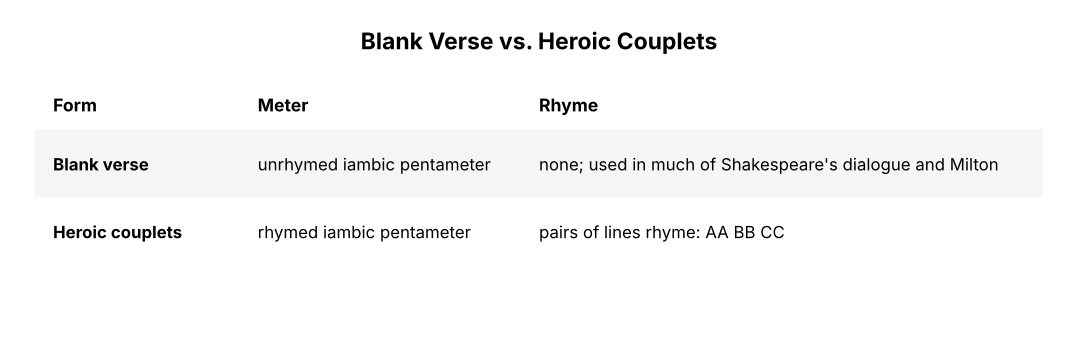
- Blank verse is unrhymed iambic pentameter. Shakespeare’s plays and John Milton’s Paradise Lost (1667) use it extensively.
- Heroic couplets are pairs of rhymed iambic pentameter lines, favored by Alexander Pope and other eighteenth-century poets.
- Sonnets in English are usually written in rhymed iambic pentameter.
Do not confuse blank verse with free verse. Blank verse has meter but no rhyme; free verse has neither a fixed meter nor a set rhyme scheme.
In Shakespeare’s Plays
Shakespeare often gave noble or serious characters lines in iambic pentameter and gave servants, comic characters, or characters losing control lines in prose. A shift from verse to prose, or the reverse, can signal a change in status, mood, or state of mind. Noticing which characters speak in meter adds another layer to reading a play.
Why does this matter? Recognizing the meter helps you read Shakespeare aloud with the right emphasis, and it lets you notice when a character’s speech pattern changes, which often reveals character or emotion.
Test-Taking Strategies
Mnemonic Devices and Memory Shortcuts
“Ten syllables, five beats, da-DUM five times.” Think of a heartbeat: ba-BUM, ba-BUM, ba-BUM, ba-BUM, ba-BUM.
Cross-Topic Connections
- Feet and line lengths are introduced in Topic 2.3: Meter and Rhythm.
- Rhymed patterns are explained in Topic 2.2: Rhyme and Rhyme Scheme.
- Line structure is covered in Topic 2.1: Lines and Stanzas.
- Historical forms are surveyed in Topic 4.1: Poetry Through the Ages.
Common Question Formats
- Identify which line is written in iambic pentameter.
- Scan a line and mark its stresses.
- Explain the effect of a variation in meter.
- Distinguish blank verse from free verse.
Frequent Student Mistakes
- Assuming any ten-syllable line is iambic pentameter.
- Calling blank verse “free verse.”
- Forcing unnatural stresses to make a line fit.
Test-Day Shortcuts
Count syllables first. If a line has 10 or 11 syllables and the even-numbered syllables sound strong, it is almost certainly iambic pentameter.
Time Management Tips
Meter questions on English unit tests and standardized reading tests such as the SAT and ACT take about a minute. Read the line aloud quietly twice.