
Clap along to “Twinkle, twinkle, little star,” and your hands find the beat right away: TWIN-kle, TWIN-kle, LIT-tle STAR. That steady pattern of strong and weak sounds is meter. Long before poems were written down, people used rhythm to remember them, and poets still use it to control how a line sounds, how fast it moves, and what words it emphasizes.
This article covers Topic 2.3: Meter and Rhythm in Unit 2, Structure and Form. The topic asks you to identify stressed and unstressed syllables, name common metrical feet and line lengths, and explain how rhythm supports meaning.
By the end, you should be able to:
- Distinguish rhythm from meter.
- Mark stressed and unstressed syllables in a line (scansion).
- Name the five most common metrical feet and line lengths.
- Explain how variations in meter create emphasis.
Rhythm Versus Meter
Rhythm is the overall flow of sound in language, the rise and fall of stressed and unstressed syllables. All speech has rhythm.
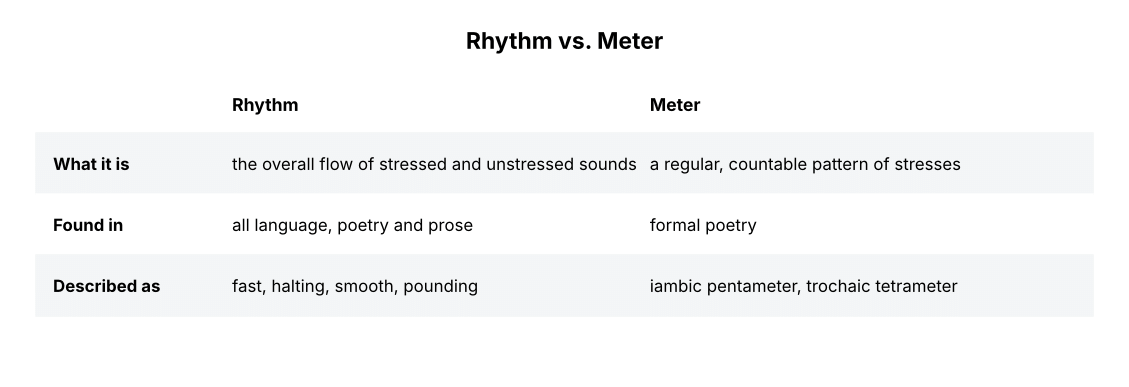
Meter is a regular, repeating pattern of stresses in a line of poetry. Metered poetry follows a set pattern; free verse has rhythm but no fixed meter.
Stressed and Unstressed Syllables
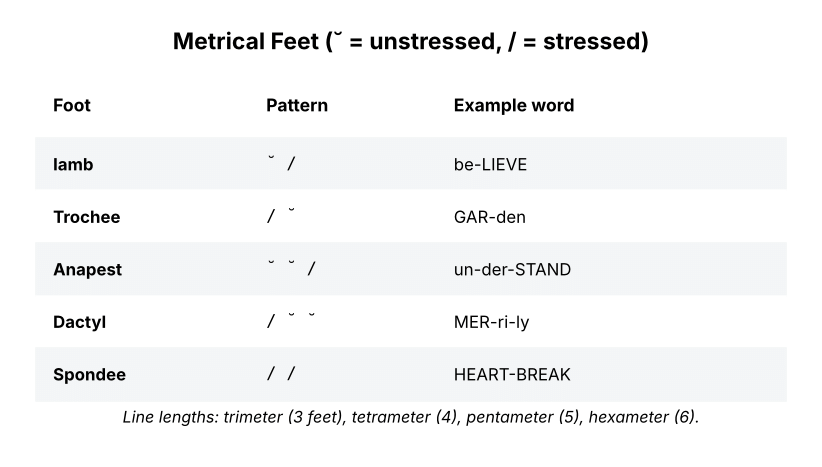
In English, some syllables are spoken with more force than others. In the word happy, the first syllable is stressed: HAP-py. In today, the second is stressed: to-DAY. Marking these stresses is called scansion. Readers often use a slash ( / ) for a stressed syllable and a small u-shaped mark or an x for an unstressed one.
Tip: say the word aloud with different stresses. Only one way sounds natural. “PRE-sent” (a gift) and “pre-SENT” (to show) prove that stress can even change meaning.
Metrical Feet
A foot is one unit of meter, usually two or three syllables.
| Foot | Pattern | Example Word | Sound |
|---|---|---|---|
| Iamb | unstressed, stressed | a-WAY, be-CAUSE | da-DUM |
| Trochee | stressed, unstressed | GAR-den, TI-ger | DUM-da |
| Anapest | unstressed, unstressed, stressed | in-ter-RUPT, un-der-STAND | da-da-DUM |
| Dactyl | stressed, unstressed, unstressed | BEAU-ti-ful, MER-ri-ly | DUM-da-da |
| Spondee | stressed, stressed | HEART-BREAK | DUM-DUM |
Line Length
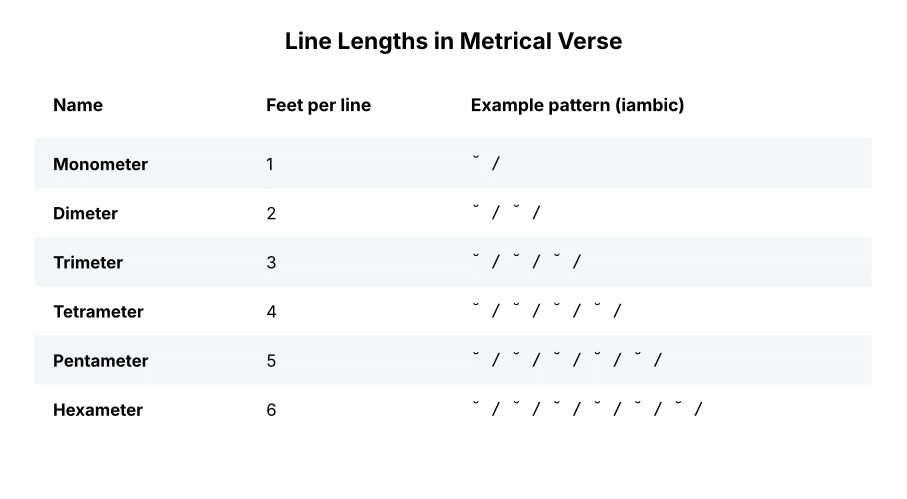
Meter is named by the type of foot plus the number of feet per line.
| Feet per Line | Name |
|---|---|
| 1 | monometer |
| 2 | dimeter |
| 3 | trimeter |
| 4 | tetrameter |
| 5 | pentameter |
| 6 | hexameter |
So iambic pentameter means five iambs per line, and trochaic tetrameter means four trochees per line.
Worked Example
Scan this line from Henry Wadsworth Longfellow’s The Song of Hiawatha (1855):
By the shores of Gitche Gumee,
- Say it aloud: BY the SHORES of GIT-che GU-mee.
- Divide into feet: BY the / SHORES of / GIT-che / GU-mee.
- Each foot is stressed then unstressed, so each is a trochee.
- Four feet per line: trochaic tetrameter.
The falling, chant-like rhythm gives the poem the feeling of a traditional song.
Why does this matter? Meter shapes how a poem feels. Iambs often sound natural and conversational, close to everyday English speech. Anapests gallop and suit fast or comic poems. Trochees can sound chant-like or forceful.
Meter and Meaning
Poets choose meters to fit their subjects. Lord Byron’s “The Destruction of Sennacherib” (1815) describes an army charging into battle, and its anapestic rhythm gallops like horses:
The Assyrian came down like the wolf on the fold,
Read it aloud and you hear da-da-DUM four times: the as-SYR / ian came DOWN / like the WOLF / on the FOLD. The quick, driving beat makes the attack feel fast and unstoppable. A slow, heavy meter would have created a completely different effect for the same event.
Variations and Emphasis
Few poems follow their meter perfectly. Poets break the pattern on purpose, and those breaks draw attention. A substitution replaces an expected foot with a different one, such as a trochee at the start of an iambic line. A missing final syllable or an extra one can create a pause or a lingering ending.
When you find a break in the pattern, ask why it happens there. Often it emphasizes a key word, shows a sudden change, or mirrors the meaning, such as a stumbling rhythm in a line about falling.
Why does this matter? Noticing variations is one of the best ways to find a poem’s most important words. Test questions often ask about the effect of rhythm in a specific line.
Test-Taking Strategies
Mnemonic Devices and Memory Shortcuts
Pair each foot with a model word: iamb is “a-WAKE,” trochee is “GAR-den,” anapest is “un-der-STAND,” and dactyl is “BEAU-ti-ful.” For line lengths, count the prefixes: mono 1, di 2, tri 3, tetra 4, penta 5, hexa 6.
Cross-Topic Connections
- Lines and their breaks are explained in Topic 2.1: Lines and Stanzas.
- Rhyme works with rhythm in Topic 2.2: Rhyme and Rhyme Scheme.
- Reading aloud is part of Topic 1.1: How to Read a Poem.
- Rhythm can shape Topic 1.3: Tone and Mood in Poetry.
Common Question Formats
- Identify the meter of a line.
- Mark the stressed syllables in a line.
- Explain the effect of a change in rhythm.
- Distinguish metered verse from free verse.
Frequent Student Mistakes
- Counting syllables instead of feet.
- Stressing words the way they look rather than how they sound.
- Expecting every line to fit the meter perfectly.
Test-Day Shortcuts
Find a multisyllable word first. Its natural stress is fixed and anchors the pattern for the rest of the line.
Time Management Tips
Meter questions on English unit tests and standardized reading tests such as the SAT and ACT take about a minute. Tap the beat quietly on your desk to check.