
Two poems can describe the same snowy evening and leave you feeling completely different. One might feel peaceful, the other lonely. The difference comes from tone and mood: the attitude the speaker takes and the atmosphere the reader experiences. These two terms are easy to confuse, and they are among the most frequently tested ideas in poetry analysis.
This article covers Topic 1.3: Tone and Mood in Poetry in Unit 1, Reading Poetry. The topic asks you to distinguish tone from mood, identify each with precise vocabulary, and explain how word choice, imagery, and sound create them.
By the end, you should be able to:
- Define tone and mood and explain how they differ.
- Describe tone and mood with precise adjectives.
- Identify the techniques that create tone and mood.
- Recognize shifts in tone within a poem.
Tone Versus Mood
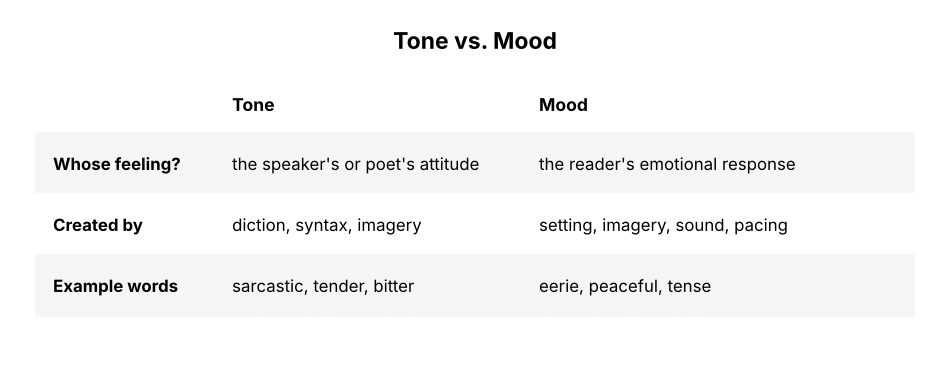
| Term | Definition | Whose Feeling? | Question to Ask |
|---|---|---|---|
| Tone | The speaker’s attitude toward the subject or audience | The speaker’s | How does the speaker feel about this? |
| Mood | The atmosphere or emotional feeling created for the reader | The reader’s | How does this make me feel? |
Tone and mood often match, but not always. A speaker might describe a terrible event in a cheerful, matter-of-fact tone, creating an unsettling mood for the reader.
Building a Tone Vocabulary
Avoid vague words like “good,” “bad,” “happy,” or “sad.” Precise tone words show deeper analysis.
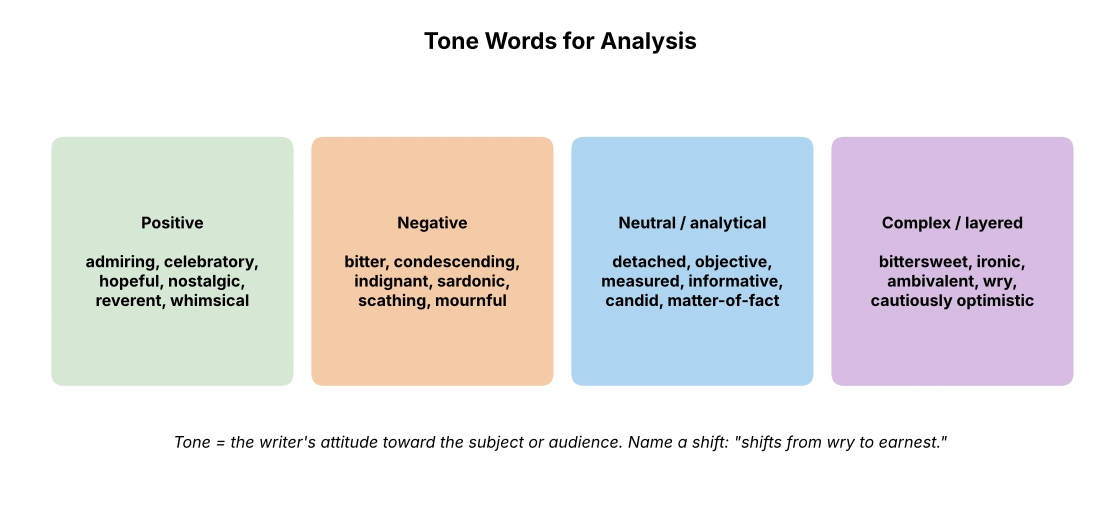
| Positive | Negative | Neutral or Complex |
|---|---|---|
| joyful, reverent, admiring, nostalgic, hopeful, tender, playful | bitter, mournful, sarcastic, contemptuous, anxious, despairing, indignant | reflective, detached, ironic, ambivalent, matter-of-fact, wistful, solemn |
Mood words include eerie, tense, peaceful, gloomy, whimsical, suspenseful, melancholy, and serene.
What Creates Tone and Mood
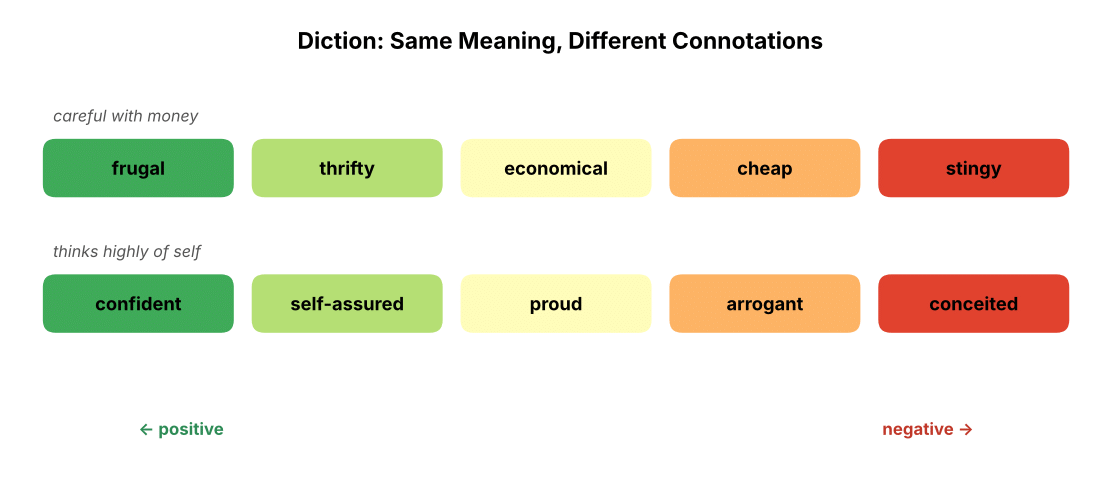
- Diction (word choice): “The child giggled” and “the child cackled” create different effects. Pay attention to connotation.
- Imagery: Dark, cold, or decaying images create a different mood than bright, warm, growing ones.
- Sound and rhythm: Short lines and hard consonants can feel tense; long lines and soft sounds can feel calm.
- Punctuation: Exclamation points, dashes, and questions add urgency or uncertainty.
- Figurative language: Comparisons color how a subject feels.
Worked Example
Edgar Allan Poe’s “The Raven” (1845) opens:
Once upon a midnight dreary, while I pondered, weak and weary,
- Diction: “Midnight,” “dreary,” “weak,” and “weary” all suggest darkness and exhaustion.
- Sound: Internal rhyme (“dreary” and “weary”) and a steady, heavy rhythm create a hypnotic effect.
- Tone: The speaker sounds weary and melancholy.
- Mood: For the reader, the line creates a gloomy, eerie atmosphere that hints at something supernatural.
Why does this matter? Tone guides interpretation. A line like “What a wonderful day” could be sincere or sarcastic; only tone tells you which. Misreading tone can lead you to the opposite of what a poem means.
When Tone and Mood Differ
Some of the most powerful poems create a gap between tone and mood. Imagine a speaker who describes a soldier’s death in a calm, almost cheerful voice. The tone is light, but the mood for the reader is disturbing, because readers sense that the calm voice hides horror. Poets use this gap to create irony and to make readers feel what the speaker refuses to say. When a poem’s tone and mood seem to clash, ask why the poet built that tension.
Shifts in Tone
Many poems change tone partway through. A shift is often signaled by:
- Transition words such as but, yet, still, or now.
- A new stanza or a stanza break.
- A change in punctuation, from statements to questions or exclamations.
- A change in time, from past to present.
In a sonnet, the shift usually comes at the volta, or turn, often around line 9 or in the final couplet. A poem might begin with despair and end with hope, or begin with admiration and end with doubt. Describing a shift requires two tone words: “The tone shifts from anxious to resolved.”
Why does this matter? Shifts often reveal a poem’s central meaning. The change from one attitude to another usually shows what the speaker has learned or realized, which points directly to the theme.
Test-Taking Strategies
Mnemonic Devices and Memory Shortcuts
“Tone is The speaker’s attitude; Mood is Me, the reader.” For evidence, remember DIDLS: Diction, Imagery, Details, Language, Syntax.
Cross-Topic Connections
- Tone depends on Topic 1.2: Speaker and Voice.
- Mood often comes from Topic 3.1: Imagery.
- Word connotation is covered in Reading Skills Topic 2.2: Connotation and Denotation.
- Tone in prose is examined in Reading Skills Topic 2.4: Identifying Author’s Tone.
Common Question Formats
- Choose the word that best describes the speaker’s tone.
- Identify the mood created in a stanza.
- Explain how a word choice contributes to tone.
- Describe how the tone shifts and where.
Frequent Student Mistakes
- Confusing tone with mood.
- Using vague words such as “sad” instead of “mournful” or “wistful.”
- Describing tone without citing specific words as evidence.
Test-Day Shortcuts
Eliminate answer choices that are too extreme. If a poem is gently sad, “despairing” and “furious” are probably wrong. Pick the choice whose intensity matches the language.
Time Management Tips
Tone questions on English unit tests and standardized reading tests such as the SAT and ACT take 30 to 45 seconds. Check two or three words of evidence before choosing.