
Ask what a poem is about, and you might hear “a road in the woods” or “a bird on a branch.” That is the subject. Ask what the poem says about life, and you get something deeper: that every choice closes off other paths, or that hope survives even in hard times. That deeper message is the theme. Finding it is often the final goal of poetry analysis, and it is the question tests ask most.
This article covers Topic 1.4: Theme in Poetry in Unit 1, Reading Poetry. The topic asks you to distinguish subject from theme, state a theme as a complete idea, and support it with evidence from the poem.
By the end, you should be able to:
- Distinguish a poem’s subject from its theme.
- Write a theme statement as a complete sentence.
- Use the title, shifts, images, and ending to identify theme.
- Support a theme with specific textual evidence.
Subject Versus Theme
| Term | Definition | Form | Example |
|---|---|---|---|
| Subject | What the poem is about | A word or phrase | nature, loss, ambition |
| Theme | What the poem says about the subject | A complete sentence | Ambition can destroy the very things it seeks to build. |
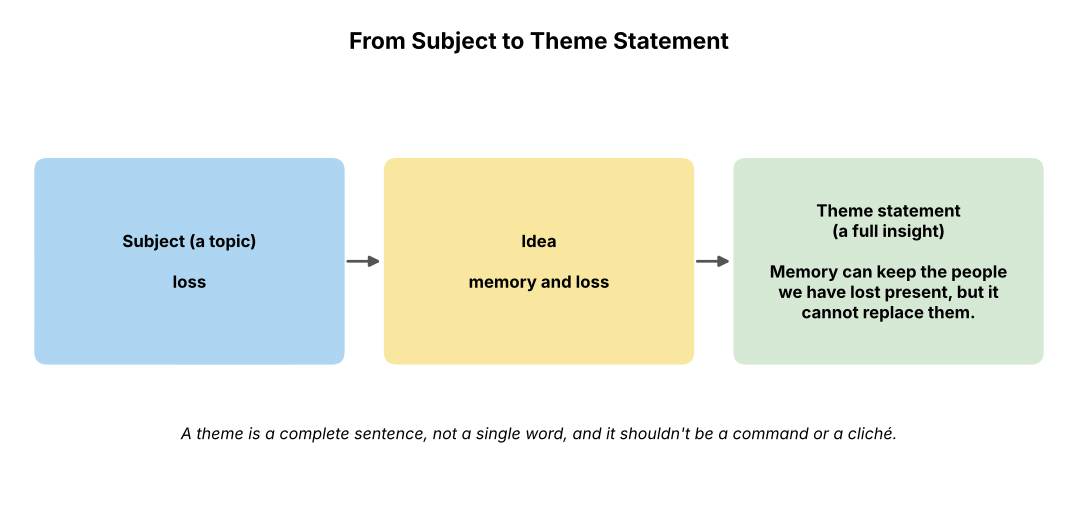
A single word like “love” is a subject, not a theme. A theme makes a claim: “Love can survive distance and time” or “Love that demands control becomes possession.”
Writing a Strong Theme Statement
A good theme statement:
- Is a complete sentence.
- Is universal, applying beyond the poem’s specific characters and events.
- Avoids clichés and absolute words like always and never unless the poem supports them.
- Does not give commands like “You should follow your dreams.”
| Weak | Why | Stronger |
|---|---|---|
| Death. | Only a subject | Death can arrive gently for those who accept it. |
| The speaker misses his wife. | Too specific, a plot summary | Grief can trap a person in the past. |
| Never give up. | A command and a cliché | Persistence matters more than early success. |
Where to Look for Theme
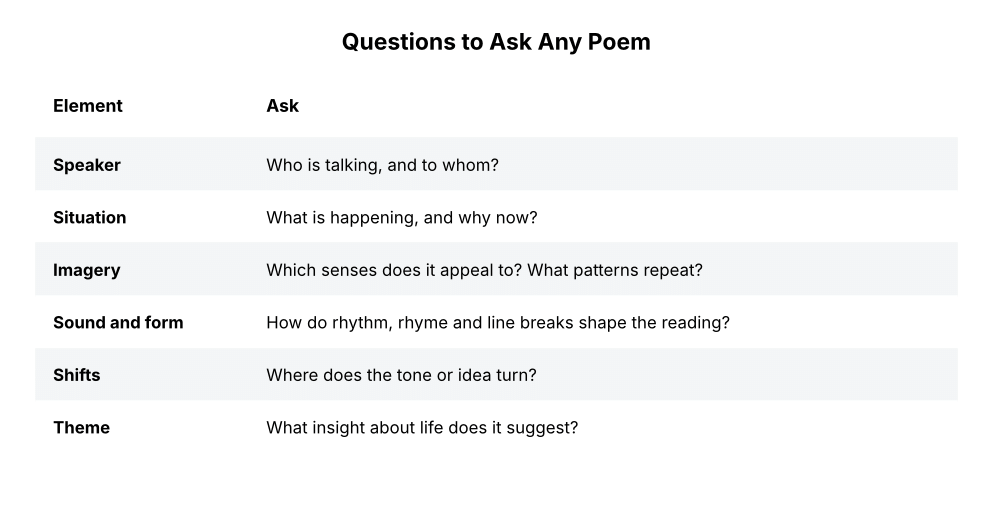
- The title: often names the central idea or gives a key context.
- Repeated words and images: patterns reveal what the poet emphasizes.
- The shift: a change in tone or perspective often shows what the speaker learns.
- The ending: final lines often state or suggest the conclusion.
- Contrasts: light and dark, past and present, or nature and city often point to tensions the theme resolves.
Worked Example
Emily Dickinson’s poem beginning “‘Hope’ is the thing with feathers” (published 1891) opens:
“Hope” is the thing with feathers
That perches in the soul,
- Subject: hope.
- Central image: hope as a small bird living inside a person.
- Development: Later stanzas show the bird singing through storms and cold without ever asking for anything in return.
- Theme statement: Hope endures through hardship and asks nothing of the person who holds it.
- Evidence: The bird sings “in the chillest land” and never asks “a crumb” of the speaker.
Why does this matter? A theme backed by evidence turns a personal reaction into an argument. Teachers and test graders reward interpretations that point to specific words and images, not just general impressions.
Multiple Themes
Poems often support more than one theme. Robert Frost’s “The Road Not Taken” (1916) can be read as being about the weight of choices, but many critics note its irony: the two roads are described as worn “really about the same,” which suggests people may invent meaning for their choices after the fact. Both readings can be supported with evidence, and recognizing that complexity is a sign of strong analysis.
When several themes are possible, choose the one with the strongest support across the whole poem, not just a single line.
Theme and Other Elements
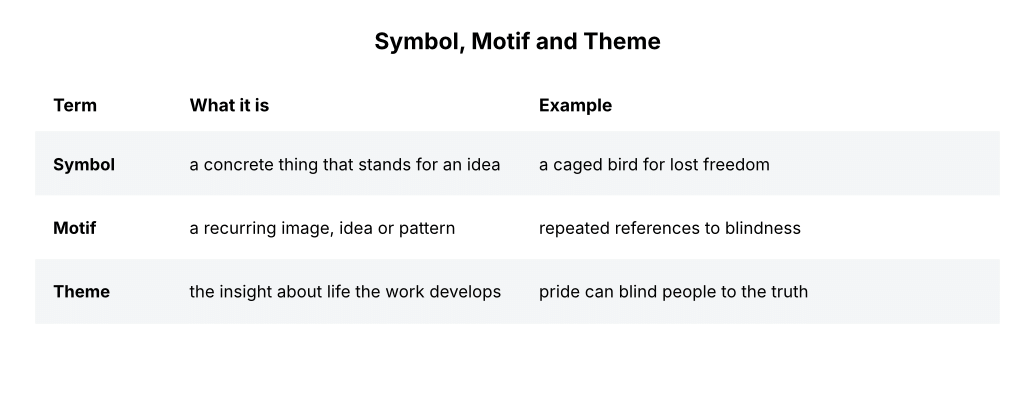
Theme grows out of everything else in the poem. Tone shows how the speaker feels about the subject. Imagery gives the theme concrete form. Structure, such as a sonnet’s turn, often marks where the theme comes into focus. When you explain a theme, connect it to at least one of these elements.
Why does this matter? Essay prompts often ask how a poet develops a theme. Strong answers explain the technique, not just the message, showing how a specific choice creates meaning.
Test-Taking Strategies
Mnemonic Devices and Memory Shortcuts
“Subject is a word; theme is a sentence.” Use the formula Subject + what the poem says about it = Theme.
Cross-Topic Connections
- Themes often emerge from Topic 1.3: Tone and Mood in Poetry.
- Concrete images that carry theme are in Topic 3.1: Imagery.
- Theme in prose is covered in Reading Skills Topic 1.2: Finding the Central Idea.
- Comparing themes is practiced in Reading Skills Topic 3.5: Comparing Themes Across Texts.
Common Question Formats
- Choose the statement that best expresses the poem’s theme.
- Identify the line that best supports a given theme.
- Explain how an image or structure develops the theme.
- Compare the themes of two poems.
Frequent Student Mistakes
- Stating a subject or summary instead of a theme.
- Writing a theme as a command.
- Basing a theme on one line instead of the whole poem.
Test-Day Shortcuts
Eliminate theme choices that are too narrow (about one detail) or too broad (could fit any poem). The right answer covers the whole poem and matches its tone.
Time Management Tips
Theme questions on English unit tests and standardized reading tests such as the SAT and ACT take 45 seconds to a minute. Answer detail questions first, since they build toward theme.