
When Walt Whitman published Leaves of Grass in 1855, many readers were shocked. His lines sprawled across the page, some short, some enormously long, with no regular meter and no rhyme. Some critics said it was not poetry at all. Today, free verse is the most common form of poetry written in English. It is not poetry without rules; it is poetry in which the poet invents the rules for each poem.
This article covers Topic 2.5: Free Verse in Unit 2, Structure and Form. The topic asks you to define free verse, distinguish it from other forms, and analyze how free verse poets create rhythm and structure without fixed meter or rhyme.
By the end, you should be able to:
- Define free verse and distinguish it from blank verse.
- Identify the techniques free verse poets use in place of meter and rhyme.
- Analyze the effect of line breaks and white space.
- Explain why a poet might choose free verse.
What Free Verse Is
Free verse is poetry with no regular meter and no consistent rhyme scheme. The term comes from the French vers libre. The poet decides where lines break, how long they run, and how stanzas are shaped, based on meaning, breath, and sound rather than a set pattern.
| Form | Regular Meter? | Rhyme Scheme? |
|---|---|---|
| Rhymed metrical verse (sonnets, ballads) | Yes | Yes |
| Blank verse | Yes (usually iambic pentameter) | No |
| Free verse | No | No |
Students often confuse blank verse and free verse. Remember: blank verse keeps the beat but drops the rhyme. Free verse drops both.
A Brief History
Walt Whitman and, in France, poets such as Arthur Rimbaud helped pioneer free verse in the nineteenth century. In the early twentieth century, Modernist poets including Ezra Pound, T. S. Eliot, William Carlos Williams, and Carl Sandburg made it central to English poetry. They wanted poems that sounded like real speech and that broke from Victorian conventions.
How Free Verse Creates Structure
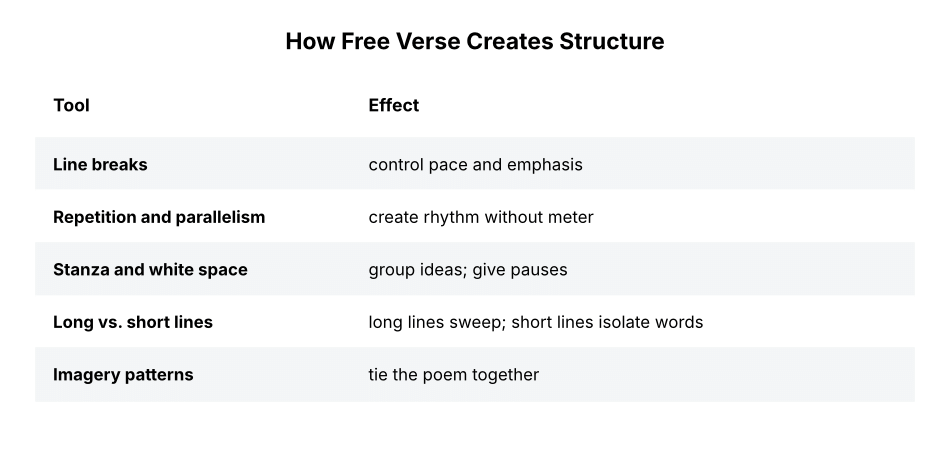
Without meter and rhyme, free verse poets rely on other tools:
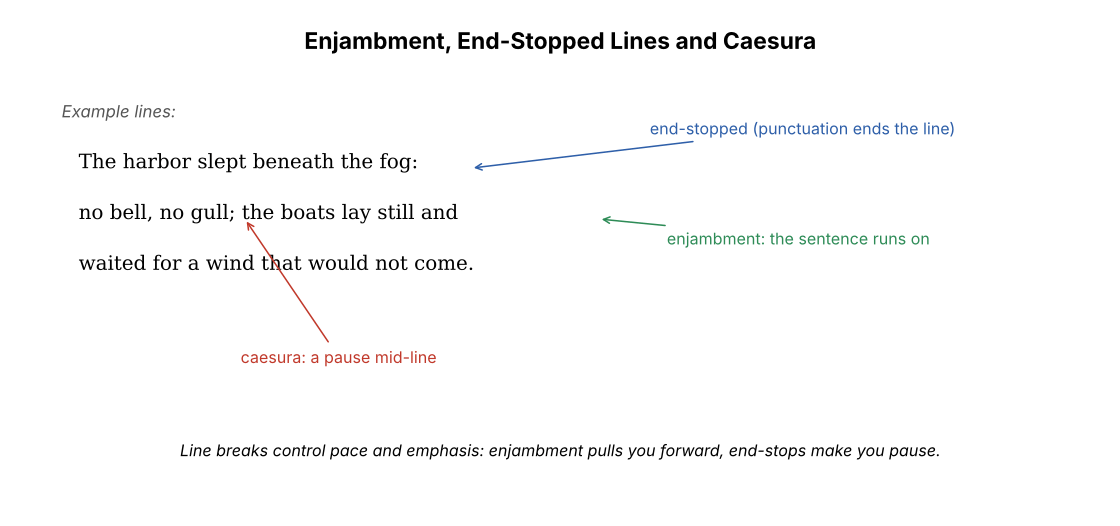
- Line breaks: where a line ends controls pacing and emphasis. The last word of a line receives extra attention.
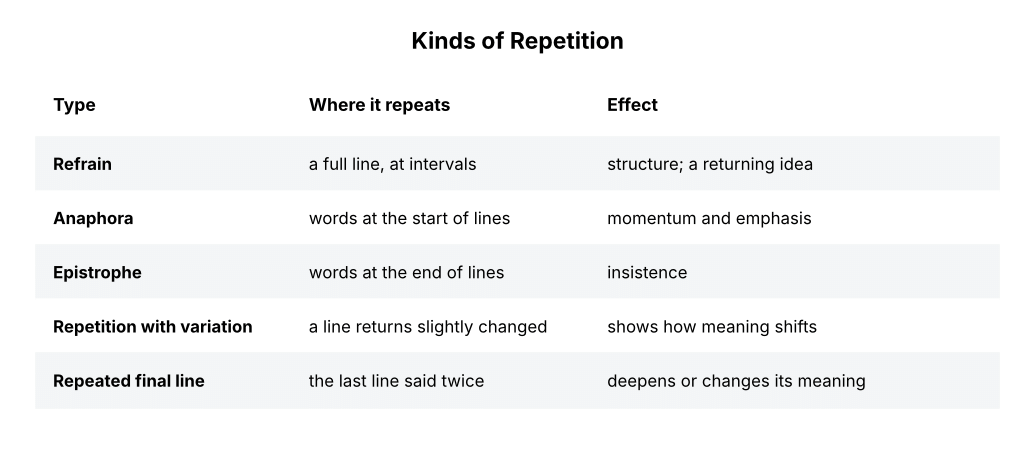
- Repetition: repeated words, phrases, or sentence structures (anaphora) create rhythm.
- Parallelism: lists and balanced structures build momentum.
- Sound devices: alliteration, assonance, and consonance add music.
- White space and stanza shape: the visual layout guides how a reader moves through the poem.
- Imagery: sharp, concrete images often carry the poem.
Worked Example
Carl Sandburg’s “Fog” (1916) begins:
The fog comes
on little cat feet.
- Form: short lines, no rhyme, no regular meter.
- Line break: “The fog comes” stands alone, creating a pause, like fog quietly arriving.
- Metaphor: the fog moves “on little cat feet,” silently and softly.
- Effect: the brief lines mimic the quiet, gentle movement they describe. A long, heavy line would have worked against the image.
Why does this matter? In free verse, form still carries meaning. Asking why a line breaks where it does is one of the best ways to analyze a free verse poem, because the poet made a deliberate choice at every break.
Whitman’s Long Lines
Whitman’s “Song of Myself” opens with “I celebrate myself, and sing myself,” and later lines stretch across the page in long catalogs of people, places, and activities. His long lines and repeated structures create a sweeping, inclusive feeling, as if the poem is trying to hold all of America. Where Sandburg’s short lines feel quiet and precise, Whitman’s long lines feel expansive and celebratory.
Why Poets Choose Free Verse
- To sound like natural speech.
- To let the poem’s shape follow its meaning.
- To avoid forcing word choices just to fit a rhyme.
- To break from tradition and signal something new.
Why does this matter? Free verse is not easier than formal poetry. Without a pattern to follow, every choice must be justified. On tests, questions often ask about the effect of line length, a line break, or repetition, because those are the main structural tools free verse poets use.
Free Verse Is Not Prose
What separates free verse from prose broken into lines? Compression, attention to sound, and purposeful line breaks. A strong free verse poem would lose something important if it were rewritten as a paragraph. A related form, the prose poem, drops line breaks entirely but keeps poetry’s compression and imagery.
Test-Taking Strategies
Mnemonic Devices and Memory Shortcuts
“Free verse is free of meter and rhyme, not free of meaning.” Blank verse is “blank” only of rhyme.
Cross-Topic Connections
- Line breaks are explained in Topic 2.1: Lines and Stanzas.
- Compare with fixed patterns in Topic 2.3: Meter and Rhythm.
- Blank verse is defined in Topic 2.4: Iambic Pentameter.
- Free verse often relies on Topic 3.1: Imagery.
Common Question Formats
- Identify a poem as free verse, blank verse, or rhymed verse.
- Explain the effect of a line break.
- Analyze how repetition creates rhythm.
- Explain how a poem’s shape reflects its subject.
Frequent Student Mistakes
- Confusing free verse with blank verse.
- Assuming free verse has no structure.
- Ignoring line breaks when analyzing a free verse poem.
Test-Day Shortcuts
Look at the last word of each line. In free verse, poets often place the most important or surprising word there.
Time Management Tips
Form questions on English unit tests and standardized reading tests such as the SAT and ACT take about 30 seconds. Effect questions about line breaks may take a minute.