
For more than 700 years, poets have been squeezing big feelings into just 14 lines. Love, death, faith, ambition, and time have all been explored in the sonnet, a form that began in Italy and became one of the most important in English literature. The tight structure is part of its power: a sonnet must set up a problem and turn toward an answer in a very small space.
This article covers Topic 2.6: The Sonnet in Unit 2, Structure and Form. The topic asks you to identify the structure, rhyme schemes, and meter of Petrarchan and Shakespearean sonnets and to analyze the volta, or turn.
By the end, you should be able to:
- Identify the defining features of a sonnet.
- Compare the Petrarchan and Shakespearean sonnet forms.
- Locate and explain the volta in a sonnet.
- Explain how a sonnet’s structure supports its meaning.
What Makes a Sonnet
A traditional sonnet has:
- 14 lines.
- Iambic pentameter in English (ten syllables, five beats per line).
- A set rhyme scheme.
- A volta, or turn, where the poem shifts in thought or tone.
The word sonnet comes from the Italian sonetto, meaning “little song.”
The Petrarchan (Italian) Sonnet
The Italian poet Petrarch made this form famous in the 1300s. It has two parts:
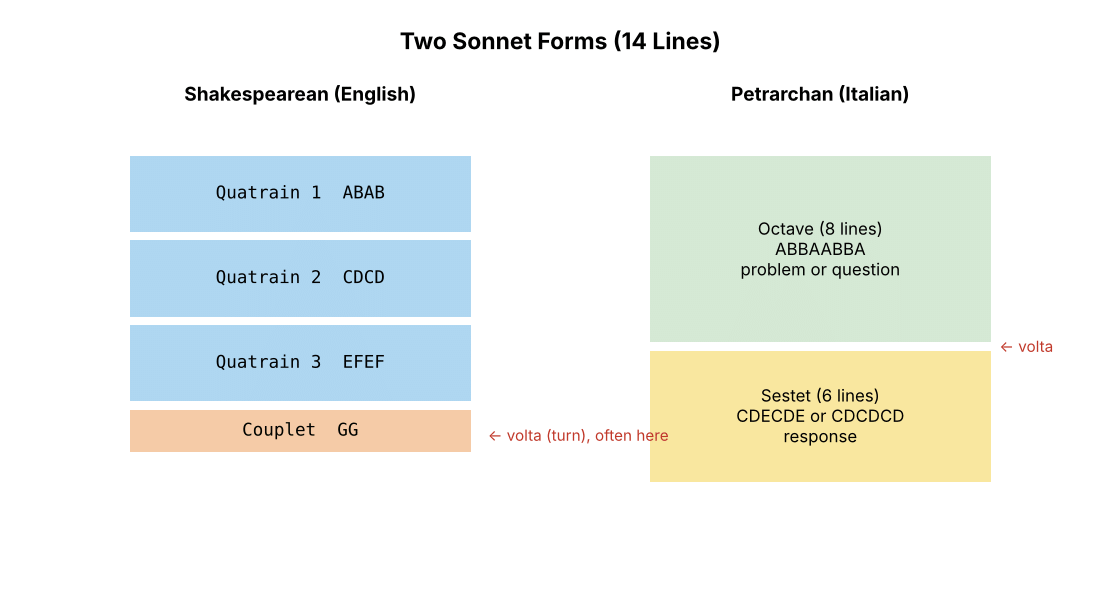
- An octave (8 lines), rhymed ABBAABBA, which presents a problem, question, or situation.
- A sestet (6 lines), often rhymed CDECDE or CDCDCD, which responds, resolves, or reflects.
The volta usually comes at line 9, where the octave ends and the sestet begins.
The Shakespearean (English) Sonnet
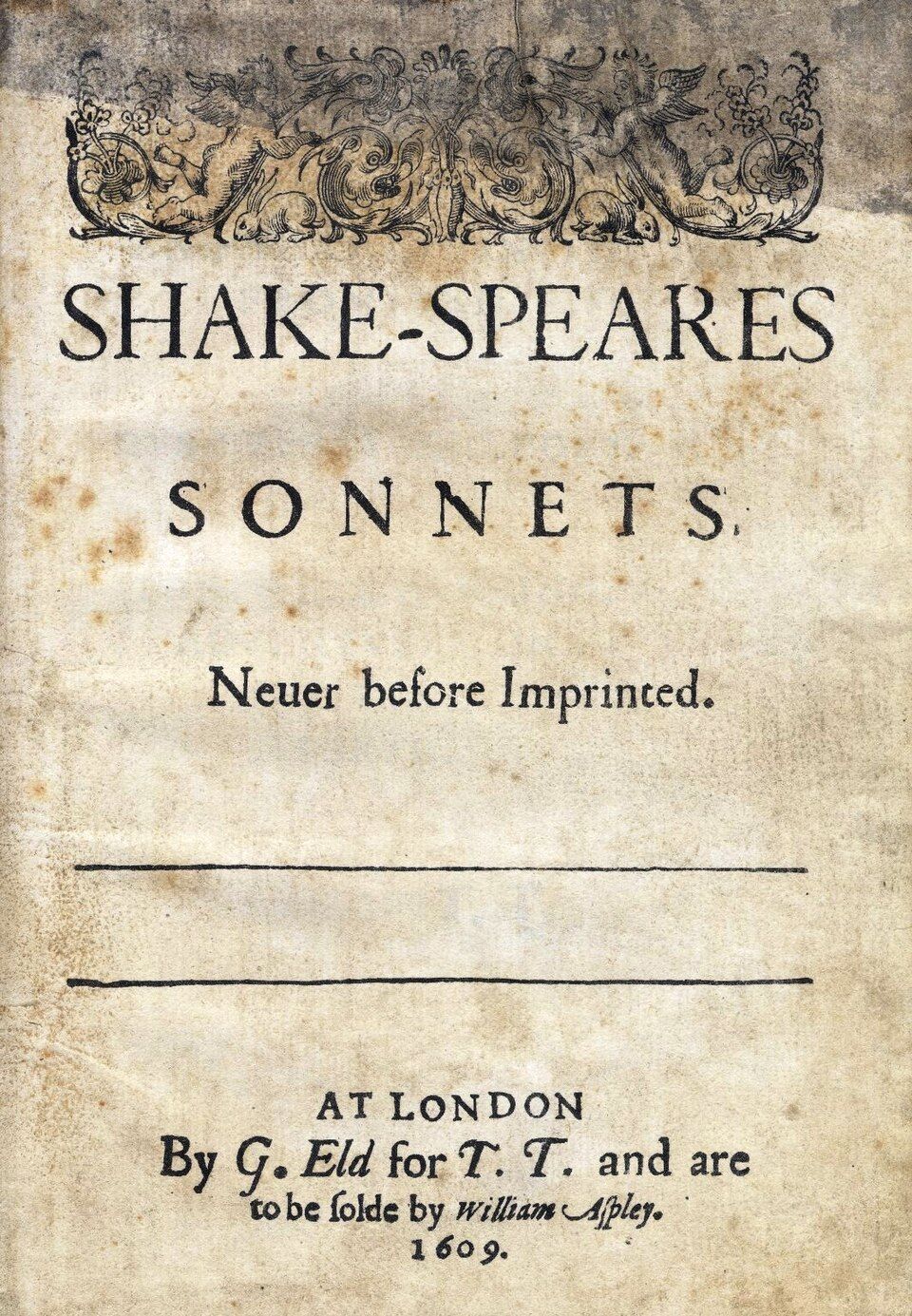
English poets adapted the form, and William Shakespeare wrote 154 sonnets in it. Its structure is:
- Three quatrains (4 lines each), rhymed ABAB CDCD EFEF, which develop an idea in three steps.
- A final couplet (2 lines), rhymed GG, which delivers a conclusion or twist.
The main volta often comes at the couplet (line 13), though some Shakespearean sonnets also shift at line 9.
| Feature | Petrarchan | Shakespearean |
|---|---|---|
| Parts | Octave + sestet | 3 quatrains + couplet |
| Rhyme scheme | ABBAABBA CDECDE (or similar) | ABAB CDCD EFEF GG |
| Usual volta | Line 9 | Line 13 (couplet) |
| Different rhyme sounds | 4 or 5 | 7 |
Why does this matter? The Petrarchan form reuses only a few rhyme sounds, which is easier in Italian, a language rich in rhymes. English has fewer rhyming words, so the Shakespearean form uses more rhyme sounds. The structure itself grew out of the language.
Worked Example: Sonnet 130
Shakespeare’s Sonnet 130 (1609) begins:
My mistress’ eyes are nothing like the sun;
Coral is far more red than her lips’ red;
- Quatrains: for twelve lines, the speaker lists ways his beloved does not match the exaggerated comparisons common in love poetry.
- Volta: the couplet turns, declaring that his love is as rare as any woman praised with false comparisons.
- Meaning: the sonnet mocks clichéd love poetry and argues that honest love is worth more than flattery.
The structure drives the joke. The quatrains build a list of “insults,” and the couplet flips them into a sincere compliment.
Finding the Volta
Look for words that signal a shift: but, yet, then, so, or and yet. Also look for changes in tone, from question to answer, from complaint to acceptance, or from description to judgment. Ask what problem the poem sets up and how the turn responds.
Why does this matter? The volta is usually where the theme comes into focus. Test questions about a sonnet’s structure almost always come back to what changes at the turn and why.
Variations and Sonnet Sequences
Poets have stretched the form in many ways. Edmund Spenser linked his quatrains with shared rhymes (ABAB BCBC CDCD EE). Later poets wrote sonnets with irregular rhyme or even without rhyme. Many poets also wrote sonnet sequences, series of connected sonnets that tell a larger story, such as Shakespeare’s sonnets and Elizabeth Barrett Browning’s Sonnets from the Portuguese (1850).
Test-Taking Strategies
Mnemonic Devices and Memory Shortcuts
“Italian is 8 and 6; English is 4, 4, 4, and 2.” The couplet is Shakespeare’s “mic drop.”
Cross-Topic Connections
- The meter of English sonnets is explained in Topic 2.4: Iambic Pentameter.
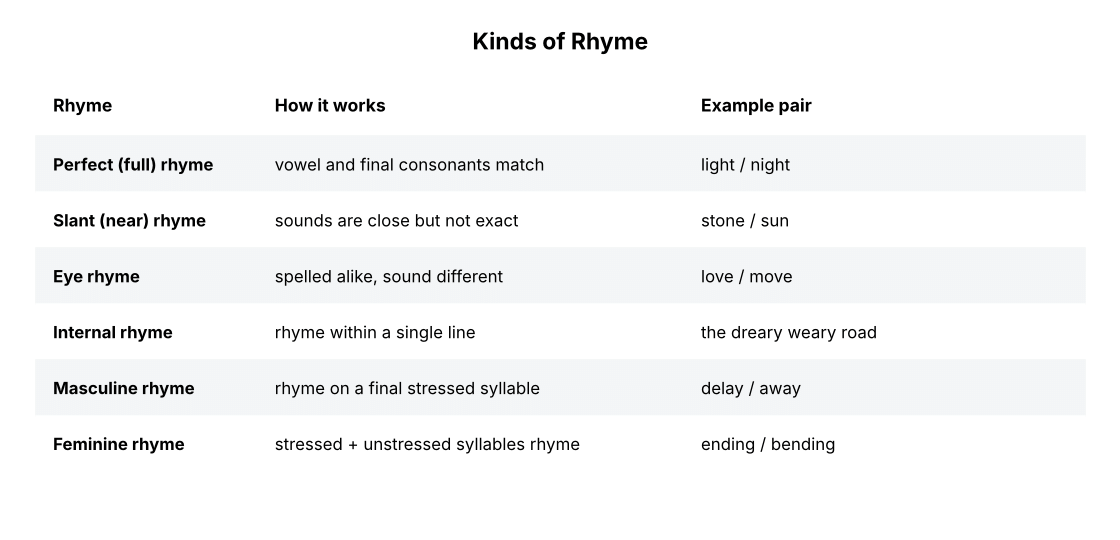
- Labeling rhyme patterns is covered in Topic 2.2: Rhyme and Rhyme Scheme.
- Quatrains, octaves, and couplets are stanza types in Topic 2.1: Lines and Stanzas.
- Shifts in attitude are discussed in Topic 1.3: Tone and Mood in Poetry.
Common Question Formats
- Identify a sonnet as Petrarchan or Shakespearean.
- Label a sonnet’s rhyme scheme.
- Locate the volta and explain the shift.
- Explain how the couplet relates to the quatrains.
Frequent Student Mistakes
- Counting lines incorrectly and missing that a poem is a sonnet.
- Assuming the volta always comes in the couplet.
- Describing structure without explaining its effect on meaning.
Test-Day Shortcuts
Check the last two lines first. If they rhyme with each other and not with earlier lines, it is likely a Shakespearean sonnet.
Time Management Tips
Sonnet questions on English unit tests and standardized reading tests such as the SAT and ACT take 30 seconds to a minute. Label the rhyme scheme quickly in the margin.