
“My love is a red rose.” “My love is like a red rose.” The difference is just one small word, but it marks the line between two of the most important tools in poetry: metaphor and simile. Both compare unlike things to reveal something new. Robert Burns, Shakespeare, Emily Dickinson, and countless other poets built their most memorable lines on these comparisons.
This article covers Topic 3.2: Simile and Metaphor in Unit 3, Figurative Language and Sound. The topic asks you to identify similes and metaphors, distinguish their types, and analyze what a comparison suggests about its subject.
By the end, you should be able to:
- Distinguish a simile from a metaphor.
- Identify the two parts of a comparison: tenor and vehicle.
- Recognize extended and implied metaphors.
- Explain what a comparison reveals about its subject.
Simile Versus Metaphor
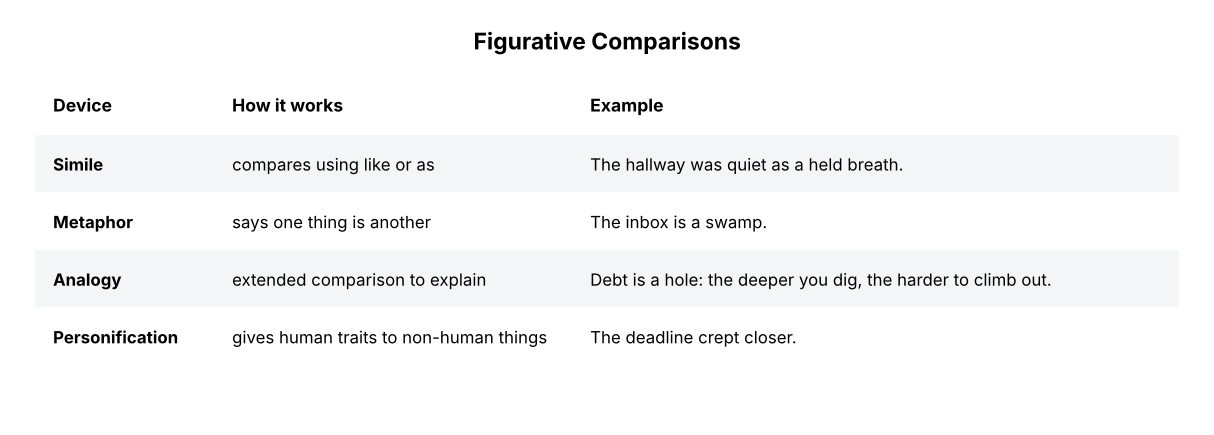
| Device | Definition | Signal Words | Example |
|---|---|---|---|
| Simile | A comparison of unlike things using a connecting word | like, as, than, resembles | Her smile was like sunlight. |
| Metaphor | A comparison that says one thing is another | None; often uses is or was | Her smile was sunlight. |
Not every use of like or as is a simile. “She looks like her sister” compares similar things literally, so it is not figurative. A simile compares things that are fundamentally different.
Tenor and Vehicle
Every comparison has two parts:
- The tenor is the subject being described.
- The vehicle is the image used to describe it.
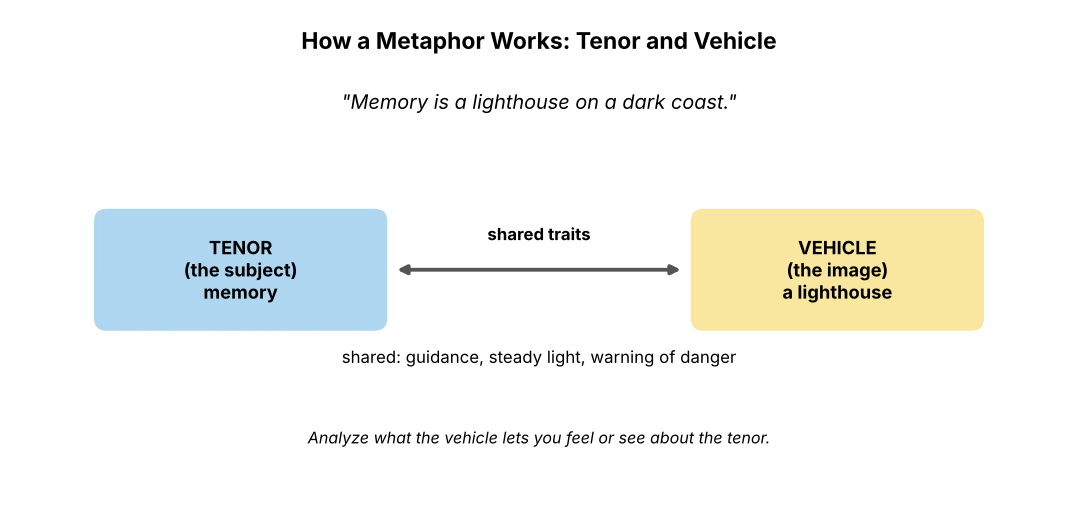
In Robert Burns’s “A Red, Red Rose” (1794), the speaker says:
O my Luve’s like a red, red rose
That’s newly sprung in June;
The tenor is the speaker’s love. The vehicle is a fresh June rose. To analyze the simile, list what roses suggest: beauty, freshness, color, sweetness, and perhaps fragility, since roses fade. Those qualities transfer to the beloved.
Why does this matter? Simply identifying a simile earns few points. Strong analysis explains which qualities of the vehicle carry over to the tenor and what that reveals about the speaker’s feelings.
Metaphors
A metaphor makes a bolder claim than a simile because it states that one thing is another. In Shakespeare’s As You Like It, the character Jaques declares, “All the world’s a stage.” He goes on to describe people as actors with entrances and exits, playing different roles at different ages.
Extended Metaphor
An extended metaphor develops a single comparison over several lines or an entire poem. Jaques’s speech extends the stage metaphor through seven “ages” of life. Emily Dickinson’s “‘Hope’ is the thing with feathers” extends the image of hope as a bird across three stanzas: it perches, sings, survives storms, and never asks for food.
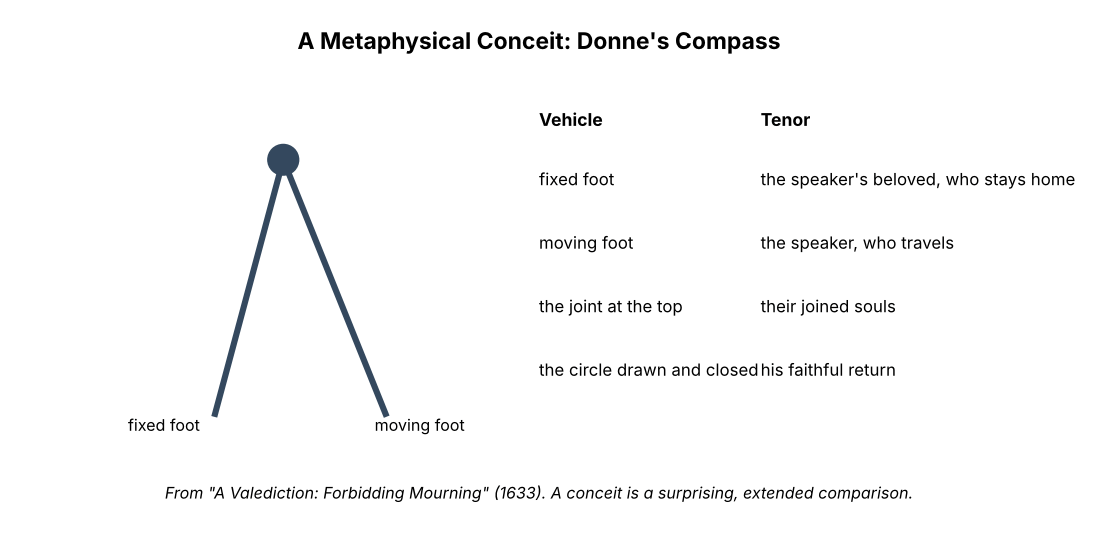
When you find an extended metaphor, track how each new detail adds to the comparison.
Implied Metaphor
An implied metaphor suggests a comparison without stating it directly. “The wind howled” implies that the wind is a wolf or dog without saying so. “She barked orders” implies a comparison to a dog through the verb alone. Implied metaphors often appear in verbs and adjectives, so read word choices carefully.
Worked Example
Analyze: “The classroom was a beehive during the fire drill.”
- Type: metaphor (no like or as).
- Tenor: the classroom.
- Vehicle: a beehive.
- Shared qualities: buzzing noise, crowded movement, busy activity.
- Effect: the reader pictures a loud, crowded, slightly chaotic room in an instant.
Why does this matter? Comparisons compress meaning. One well-chosen metaphor can communicate sound, movement, and mood all at once, which is why poets rely on them so heavily.
Choosing Between Simile and Metaphor
Why would a poet choose one over the other? A simile keeps the two things slightly apart, so it can sound gentler or more tentative. A metaphor fuses them, so it sounds more forceful and certain. “My heart is like a stone” admits a comparison; “My heart is stone” declares a fact about the speaker’s feelings. Noticing which one a poet uses can reveal how strongly the speaker means it.
Dead Metaphors and Clichés
Some metaphors are so common that we no longer notice them, such as “the leg of a table” or “a heart of gold.” These are called dead metaphors or clichés. Poets work to create fresh comparisons that surprise readers and make them see the subject in a new way.
Test-Taking Strategies
Mnemonic Devices and Memory Shortcuts
“Simile is similar, using like or as; metaphor makes it so.” For analysis, remember “tenor is the topic; vehicle is the vision.”
Cross-Topic Connections
- Comparisons create pictures, as explained in Topic 3.1: Imagery.
- Figurative language in prose is covered in Reading Skills Topic 2.3: Interpreting Figurative Language.
- Comparisons often carry Topic 1.4: Theme in Poetry.
- Word associations are explained in Reading Skills Topic 2.2: Connotation and Denotation.
Common Question Formats
- Identify a line as a simile or a metaphor.
- Identify the two things being compared.
- Explain what a comparison suggests about its subject.
- Trace an extended metaphor through a poem.
Frequent Student Mistakes
- Labeling every like as a simile, including literal comparisons.
- Identifying a device without explaining its effect.
- Missing implied metaphors hidden in verbs.
Test-Day Shortcuts
When asked about a comparison’s effect, list two or three qualities of the vehicle. The correct answer usually names one of those qualities.
Time Management Tips
Figurative language questions on English unit tests and standardized reading tests such as the SAT and ACT take 20 to 40 seconds. Spend more time on effect questions than on labeling.