
Quoting a poem is different from quoting a novel or an article. Poems have line breaks, stanza breaks, and line numbers, and each of those details matters. If you quote a poem as if it were prose, you erase the poet’s structure. Learning a few citation rules lets you quote poetry accurately and makes your essays look polished and professional.
This article covers Topic 4.5: Citing Poetry in an Essay in Unit 4, Poetry in Context. The topic asks you to quote poetry using slashes and line numbers, format longer block quotations, integrate quotations smoothly, and list a poem in a Works Cited page, following MLA style.
By the end, you should be able to:
- Show line breaks and stanza breaks in short quotations.
- Cite line numbers correctly in parentheses.
- Format a block quotation of four or more lines.
- Integrate and modify quotations with ellipses and brackets.
Short Quotations (Three Lines or Fewer)
For one to three lines, keep the quotation inside your paragraph and enclose it in quotation marks. Show each line break with a slash that has a space on each side. Show a stanza break with a double slash.
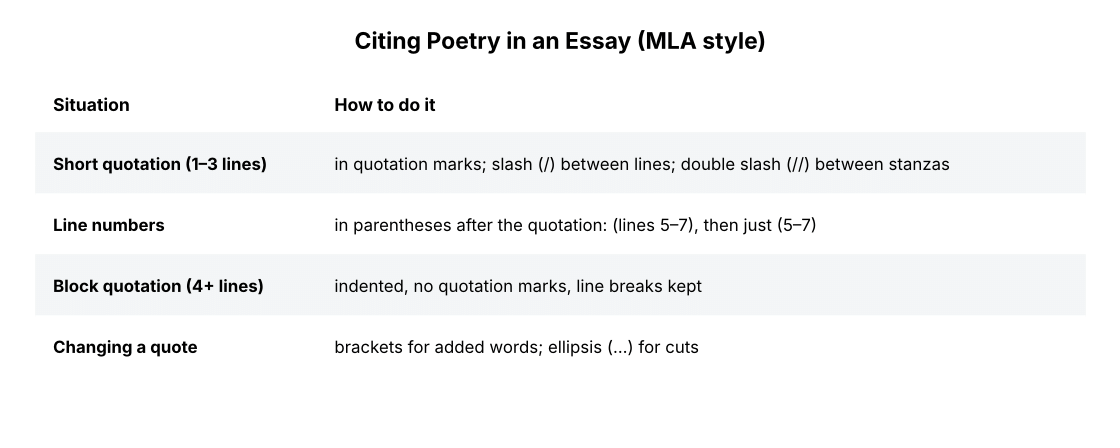
- Coleridge’s mariner laments, “Water, water, every where, / Nor any drop to drink.”
Keep the poet’s capitalization and punctuation exactly as they appear in the original.
Line Numbers
In MLA style, cite poems by line numbers, not page numbers, when the lines are numbered in your source. In your first citation, use the word “line” or “lines.” After that, use the numbers alone.
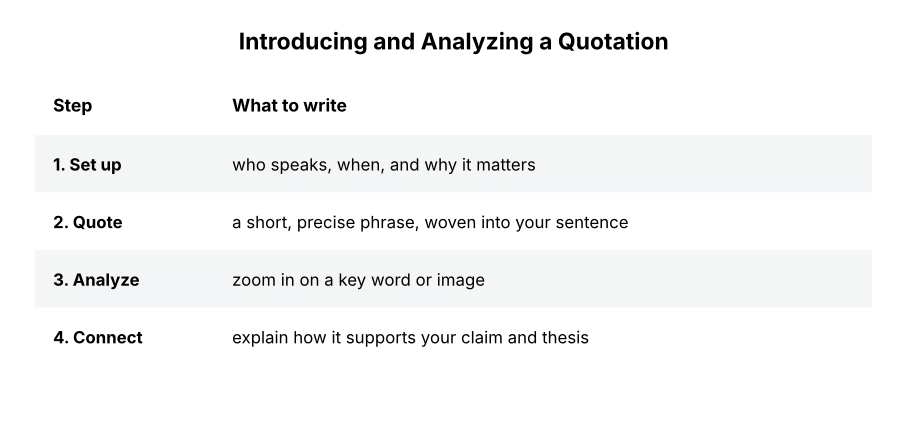
- First citation: Frost’s speaker admits that he “kept the first for another day!” (line 13).
- Later citation: He predicts he will be “telling this with a sigh” (16).
The period goes after the parenthetical citation, not inside the closing quotation mark. Use a hyphen for a range of lines, such as (18-20).
Why does this matter? Line numbers let readers find your evidence instantly. They also show your teacher that you are working closely with the text rather than relying on memory or summaries.
Block Quotations (Four or More Lines)
For four or more lines of poetry, use a block quotation:
- Introduce it with a complete sentence, usually ending in a colon.
- Start the quotation on a new line, indented half an inch from the left margin.
- Do not use quotation marks.
- Keep the original line breaks; no slashes are needed.
- Place the citation after the final punctuation of the last line.
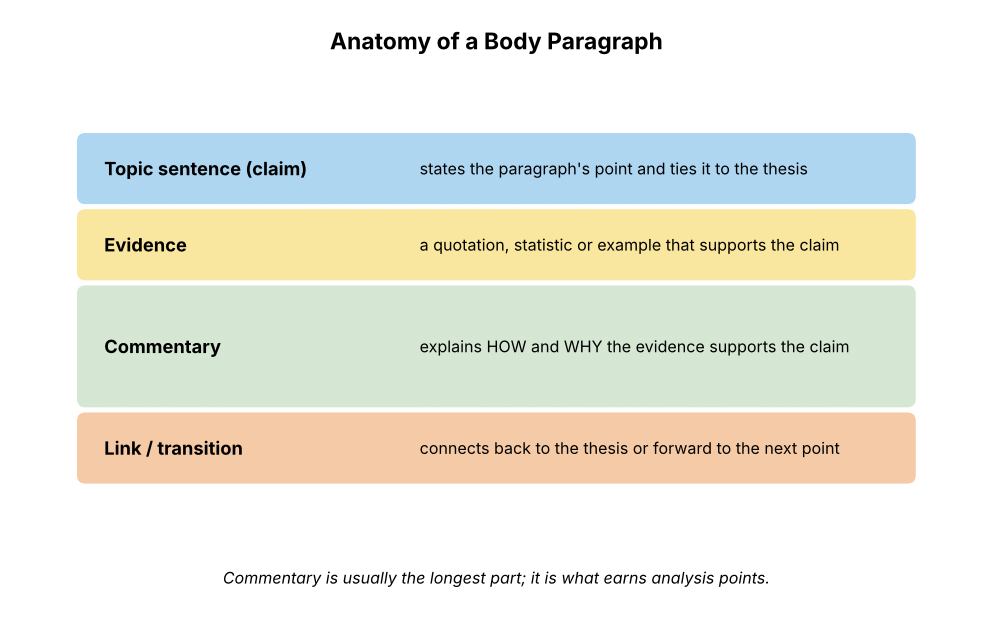
Use block quotations sparingly. Long quotations take up space that your own analysis should fill.
Integrating Quotations Smoothly
Avoid “dropped” quotations that sit alone with no introduction. Use one of these methods:
- Signal phrase: The speaker declares, “…”
- Colon after a complete sentence: The speaker’s despair is clear: “…”
- Blended phrase: The speaker describes the house as “shut and still,” emphasizing its emptiness.
Blended phrases are often the strongest, because they let you quote only the most important words.
Modifying Quotations
- Use an ellipsis (three spaced periods) to show that you have left out words from the middle of a quotation.
- Use square brackets to add or change a word for clarity or grammar, such as replacing a pronoun with the name it refers to: “[Death] kindly stopped for me.”
- Never change a quotation in a way that alters its meaning.
Worked Example
Convert this into a correctly cited sentence: the first two lines of Blake’s “The Tyger.”
- Introduce with a signal phrase: Blake’s speaker addresses the animal directly,
- Quote with a slash for the line break: “Tyger Tyger, burning bright, / In the forests of the night”
- Add the citation and period: (lines 1-2).
- Add commentary: The image of a creature “burning” in darkness suggests both beauty and danger.
The Works Cited Entry
A poem in an anthology is listed by the poet’s name, the poem title in quotation marks, the anthology title in italics, the editor, the publisher, the year, and the page range. A typical pattern looks like this:
Dickinson, Emily. “Because I could not stop for Death.” Title of Anthology, edited by Editor Name, Publisher, Year, pp. page range.
For a poem found online, include the website name and URL. Always check the current MLA handbook or your teacher’s guidelines, since details can vary by edition.
Why does this matter? Accurate citation is a matter of academic honesty and of credibility. It also makes your argument stronger, because readers can verify that your evidence says exactly what you claim.
Test-Taking Strategies
Mnemonic Devices and Memory Shortcuts
“Slash for a line, double slash for a stanza, block at four.” For punctuation, remember “quote, cite, then period.”
Cross-Topic Connections
- Use these citations in the essays described in Topic 4.4: Writing About a Poem.
- Quotation punctuation is reviewed in Grammar Topic 7.5: Quotation Marks.
- Line structure is explained in Topic 2.1: Lines and Stanzas.
- Choosing strong quotations is practiced in Reading Skills Topic 1.6: Using Textual Evidence to Support Claims.
Common Question Formats
- Choose the correctly formatted poetry quotation.
- Insert slashes and line numbers into a quotation.
- Decide whether a quotation needs a block format.
- Correct a Works Cited entry for a poem.
Frequent Student Mistakes
- Leaving out slashes, which erases the poem’s line breaks.
- Using page numbers instead of line numbers.
- Putting the period inside the quotation marks before the citation.
Test-Day Shortcuts
Count the lines you plan to quote. Three or fewer stay in the paragraph with slashes; four or more become a block quotation.
Time Management Tips
In timed essays on English unit tests and standardized tests such as the SAT and ACT, quote short phrases rather than whole stanzas to save time and space for commentary.