
Reading a poem well is one skill. Writing about it well is another. Many students understand a poem but then write an essay that mostly retells it, earning far fewer points than they deserve. A strong poetry essay does not just say what a poem says. It argues how the poem creates meaning, using precise evidence and clear explanation.
This article covers Topic 4.4: Writing About a Poem in Unit 4, Poetry in Context. The topic asks you to write an analytical thesis about a poem, organize body paragraphs around evidence, and explain how poetic techniques create meaning.
By the end, you should be able to:
- Distinguish analysis from summary.
- Write an arguable thesis about a poem.
- Build body paragraphs using claim, evidence, and commentary.
- Use the conventions of literary writing, such as present tense and “the speaker.”
Analysis Versus Summary
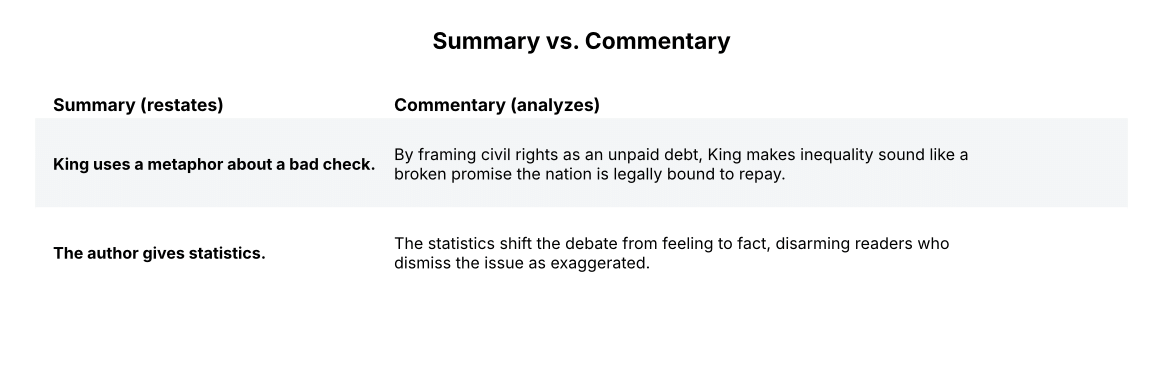
| Summary | Analysis |
|---|---|
| Tells what happens | Explains how and why it matters |
| “The speaker sees daffodils and feels happy.” | “Wordsworth’s personification of the daffodils as a dancing crowd transforms the speaker’s loneliness into a sense of joyful companionship.” |
| Follows the poem line by line | Is organized around an argument |
A little summary is fine for context, but every paragraph should move quickly into analysis.
Step 1: Read and Annotate
Before writing, read the poem several times. Mark the speaker, tone, shifts, key images, figurative language, sound devices, and structure. Look for patterns. Ask what the poem seems to say about its subject and which techniques make that message powerful.
Step 2: Write a Strong Thesis
A thesis for a poetry essay should connect technique to meaning. A useful formula:
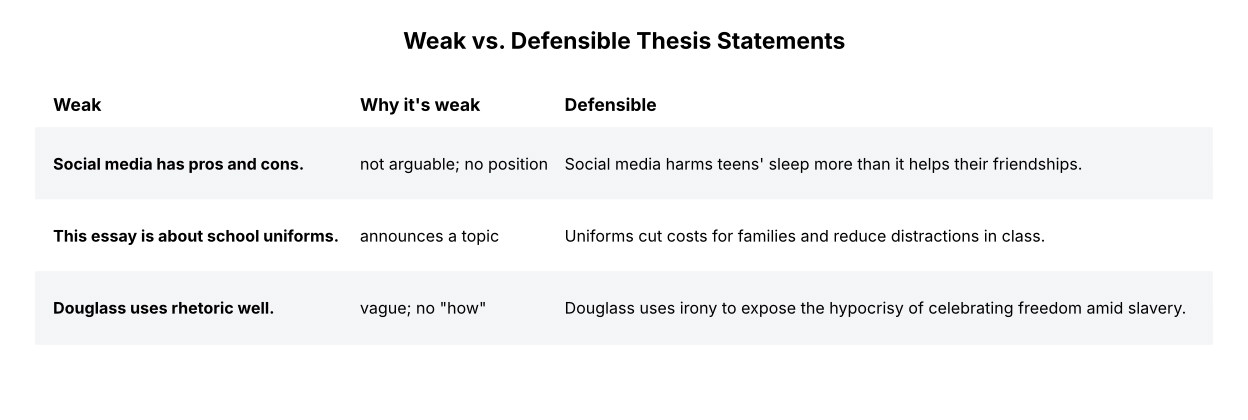
In [title], [poet] uses [technique 1], [technique 2], and [technique 3] to [show, reveal, or argue] [insight about the theme].
- Weak: “The Raven” is a poem about a man and a bird.
- Weak: Poe uses many literary devices in “The Raven.”
- Strong: In “The Raven,” Poe uses a haunting refrain, dark imagery, and a hypnotic rhythm to show how grief can grow into obsession and despair.
The strong thesis makes a claim that someone could disagree with and that the essay must prove.
Why does this matter? The thesis controls the whole essay. A clear, arguable thesis tells readers what to expect and keeps your paragraphs focused. Graders often decide early whether an essay is analytical based on its thesis.
Step 3: Build Body Paragraphs
Organize each body paragraph around one technique or one idea, using a claim, evidence, commentary structure.
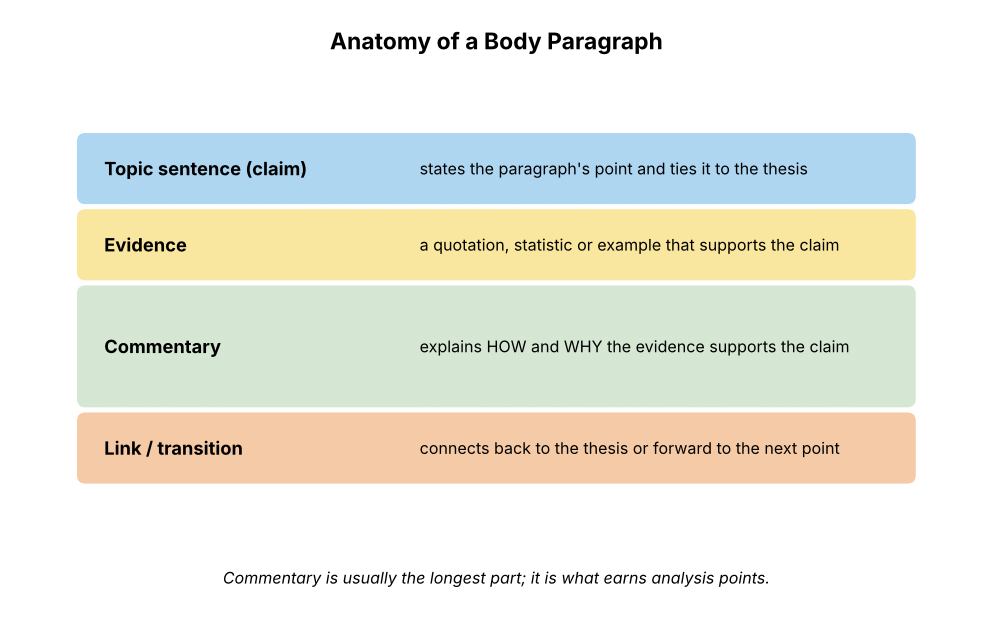
- Claim (topic sentence): state the point the paragraph will prove.
- Evidence: quote a short, specific passage from the poem.
- Commentary: explain how the evidence supports the claim. Discuss word choice, sound, imagery, or structure.
- Link: connect the point back to the thesis.
Commentary should be at least as long as the evidence, and often longer. A common guideline is two sentences of commentary for every piece of evidence.
Worked Example: A Body Paragraph
Claim: Poe’s refrain shows the speaker’s hope gradually collapsing into despair. Evidence: Each time the speaker asks the raven a question, the bird answers “Nevermore.” Commentary: At first, the word seems merely odd, a bird’s one learned word. As the speaker’s questions turn to whether he will ever see Lenore again, the same word becomes a cruel verdict. The repetition mirrors how grief returns again and again, and the speaker’s growing agitation shows that he is asking questions he knows will hurt. Link: In this way, the refrain becomes the engine of the speaker’s obsession.
Step 4: Organize the Essay
- Introduction: title, poet, brief context, and thesis.
- Body paragraphs: usually two to four, each focused on one technique or idea, often in the order the thesis lists them.
- Conclusion: restate the thesis in new words and explain the broader significance. Avoid simply repeating the introduction.
Conventions of Literary Writing
- Write about literature in the present tense: “The speaker mourns,” not “The speaker mourned.”
- Refer to the speaker, not the poet, when discussing the voice in the poem.
- Use the poet’s last name after the first full mention.
- Put poem titles in quotation marks and book titles in italics.
- Embed quotations smoothly into your own sentences.
Why does this matter? These conventions signal that you are writing as a careful literary analyst. They also prevent common errors, such as confusing the speaker with the poet, that weaken an argument.
Test-Taking Strategies
Mnemonic Devices and Memory Shortcuts
“Claim it, cite it, explain it, link it.” For the thesis, remember “technique plus meaning.”
Cross-Topic Connections
- The analysis process is modeled in Topic 1.5: Poetry Analysis Step by Step.
- A thesis usually states Topic 1.4: Theme in Poetry.
- Choosing evidence is practiced in Reading Skills Topic 1.6: Using Textual Evidence to Support Claims.
- Deeper analysis is developed in Reading Skills Topic 4.6: Developing Critical Analysis Skills.
Common Question Formats
- Write a thesis statement for a given poem.
- Choose the best evidence to support a claim.
- Revise a summary into analysis.
- Write a timed analytical essay on a poem.
Frequent Student Mistakes
- Summarizing the poem instead of analyzing it.
- Listing devices without explaining their effects.
- Dropping in quotations with no commentary.
Test-Day Shortcuts
Spend five minutes planning before you write. Jot your thesis and two or three pieces of evidence, each with a word or two about its effect.
Time Management Tips
For timed essays on English unit tests and standardized tests such as the SAT and ACT, use about 10 percent of your time to plan, 80 percent to write, and 10 percent to proofread.