
After World War I, many writers felt the old ways of writing could no longer describe the world. Millions had died, cities were changing fast, and new ideas in science, psychology, and art were shaking old certainties. Poets responded by breaking the rules: dropping regular rhyme and meter, cutting poems into fragments, and packing them with sharp images and unexpected references. This movement is called Modernism, and its influence still shapes the poetry written today.
This article covers Topic 4.3: Modernist Poetry in Unit 4, Poetry in Context. The topic asks you to describe the historical context and key features of Modernist poetry, identify major Modernist poets, and analyze Modernist techniques.
By the end, you should be able to:
- Place Modernist poetry in its historical context.
- List the major characteristics of Modernist poetry.
- Explain the goals of Imagism.
- Identify major Modernist poets and analyze Modernist techniques in a poem.
Historical Context
Modernism in English-language poetry flourished from roughly the 1910s through the 1940s. Key influences included:
- World War I (1914 to 1918): its massive destruction shook faith in progress, tradition, and authority.
- Rapid modernization: cities, cars, telephones, film, and mass media changed daily life.
- New ideas: Sigmund Freud’s theories of the unconscious and Albert Einstein’s physics challenged older views of the mind and the universe.
- Artistic experiment: painters such as Pablo Picasso broke images into fragments in Cubism, and poets attempted similar experiments with language.
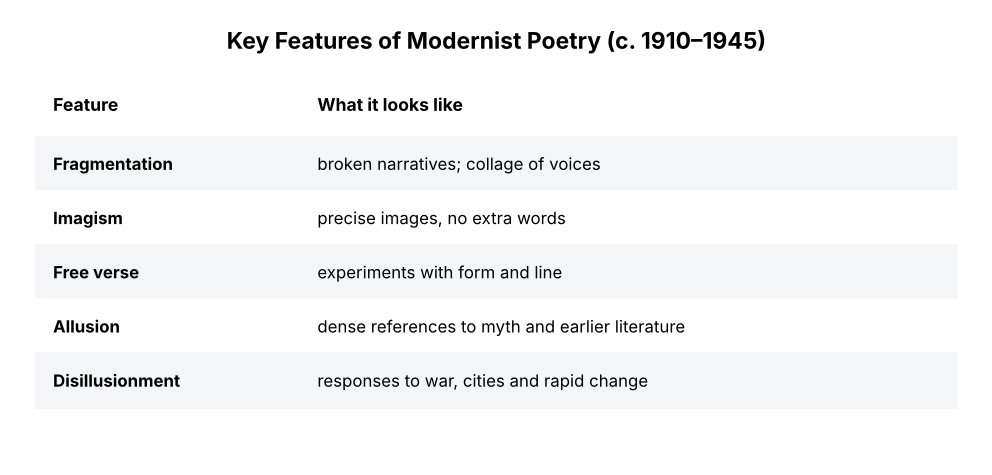
Key Characteristics
| Feature | Description |
|---|---|
| Free verse | Rejection of regular meter and rhyme in favor of natural speech rhythms |
| Fragmentation | Broken structure, sudden shifts, and collage-like arrangement of images and voices |
| Precise imagery | Sharp, concrete images instead of abstract statements |
| Allusion | Dense references to myth, history, literature, and other languages |
| Ambiguity | Meaning left open, requiring active interpretation |
| Alienation | Themes of isolation, uncertainty, and loss of meaning in modern life |
| Ordinary subjects | Everyday objects and urban scenes treated as worthy of art |
Ezra Pound summed up the spirit of the movement in a famous slogan: “Make it new.”
Imagism
Imagism was an early Modernist movement led by Ezra Pound, H.D. (Hilda Doolittle), and Amy Lowell, among others, around 1912 to 1917. Imagists called for:
- Direct treatment of the subject.
- No unnecessary words.
- Rhythm based on musical phrasing rather than strict meter.
Pound’s “In a Station of the Metro” (1913) is the classic Imagist poem. Its two lines place the faces of people in a Paris subway crowd beside “Petals on a wet, black bough.” There is no explanation, only two images side by side, leaving the reader to sense the connection between fleeting human faces and delicate petals.
Why does this matter? Imagism shows how Modernists wanted readers to do more work. Instead of being told what to feel, readers must build meaning from images, which is why careful close reading matters so much for Modernist poems.
Major Poets
- T. S. Eliot: “The Love Song of J. Alfred Prufrock” (1915) and The Waste Land (1922), which presents a fragmented portrait of postwar civilization.
- Ezra Pound: Imagist poems and the long, allusive Cantos.
- William Carlos Williams: “The Red Wheelbarrow” (1923), which focuses on a single everyday scene.
- Wallace Stevens: philosophical poems about imagination and reality, collected in Harmonium (1923).
- Marianne Moore and H.D.: precise, inventive poems with unusual forms.
- Langston Hughes and other Harlem Renaissance poets: blended modern techniques with blues and jazz rhythms to portray Black American life.
Worked Example: “The Red Wheelbarrow”
Williams’s poem begins “so much depends / upon” and then presents a red wheelbarrow, glazed with rain water, beside white chickens.
- Free verse: short lines with no rhyme or meter.
- Ordinary subject: a farm tool and chickens.
- Precise imagery: the colors red and white, the shine of rain.
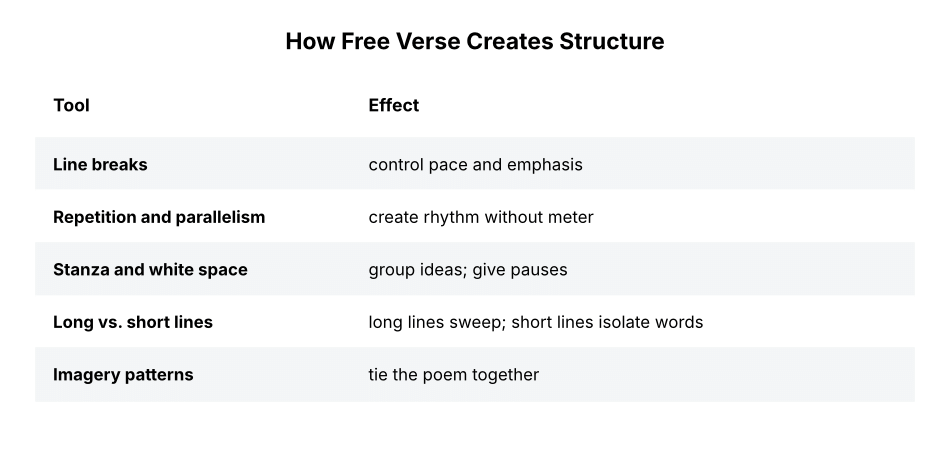
- Line breaks: words like “wheel / barrow” split across lines, slowing the reader so each detail gets attention.
- Ambiguity: the poem never says what depends on the wheelbarrow, inviting reflection on how much of life rests on simple things.
Why does this matter? Modernist poems can seem puzzling because they leave out the explanations readers expect. Recognizing the movement’s goals helps you see that the gaps are deliberate and part of the meaning.
Test-Taking Strategies
Mnemonic Devices and Memory Shortcuts
“Make it new: free, fragmented, focused.” Remember Modernism as “after the war, the rules broke.”
Cross-Topic Connections
- Compare with the earlier movement in Topic 4.2: Romantic Poetry.
- Modernists favored Topic 2.5: Free Verse.
- Dense references are explained in Topic 3.5: Allusion.
- Imagists learned from Topic 2.7: Haiku.
Common Question Formats
- Identify features that make a poem Modernist.
- Explain the effect of fragmentation or juxtaposition.
- Match a poet with a work or movement.
- Compare a Modernist poem with a Romantic one.
Frequent Student Mistakes
- Assuming Modernist poems have no structure at all.
- Expecting the poem to state its meaning directly.
- Confusing “Modernist” with simply “modern” or “recent.”
Test-Day Shortcuts
If a poem uses free verse, sharp images, and sudden shifts without explanation, and it dates from the early twentieth century, Modernism is the likely answer.
Time Management Tips
Modernist poems can be dense, so on English unit tests and standardized reading tests such as the SAT and ACT, focus on images first and save interpretation for after a second read.