
In 1798, two young English poets, William Wordsworth and Samuel Taylor Coleridge, published a small book called Lyrical Ballads. It featured poems about shepherds, beggars, and country people, written in plain language instead of the polished style that was fashionable at the time. The book helped launch the Romantic movement, which changed poetry by placing emotion, imagination, and nature at its center.
This article covers Topic 4.2: Romantic Poetry in Unit 4, Poetry in Context. The topic asks you to describe the historical context and key features of Romantic poetry and identify major Romantic poets and works.
By the end, you should be able to:
- Place the Romantic period in its historical context.
- List the major characteristics of Romantic poetry.
- Identify the major British Romantic poets and their key works.
- Recognize Romantic features in a poem you have not seen before.
Historical Context
The British Romantic period is usually dated from about 1798 to the 1830s. It grew out of several major changes:
- The Industrial Revolution: factories and crowded cities led many writers to celebrate the countryside and the natural world.
- The French Revolution (1789): ideals of liberty and equality inspired many poets, at least at first.
- A reaction to the Enlightenment: where earlier writers prized reason, order, and rules, the Romantics valued feeling, imagination, and individual experience.
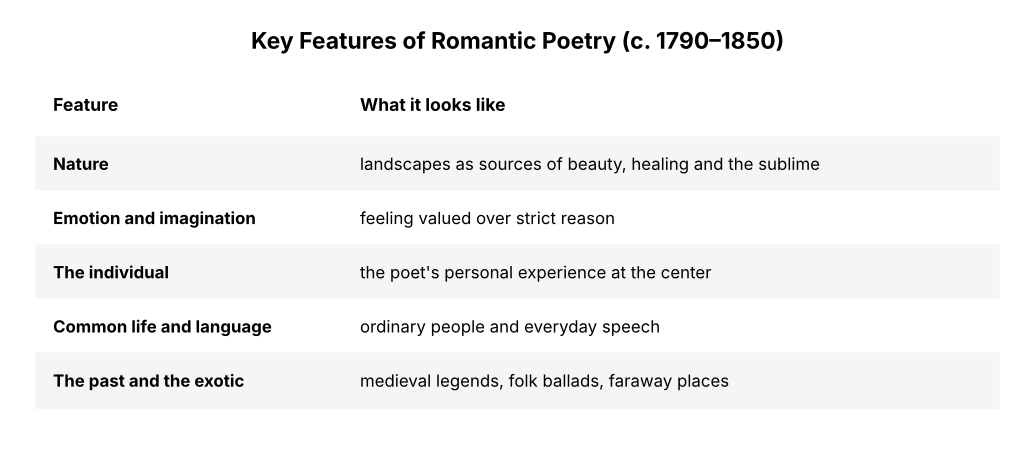
Key Characteristics
| Feature | Description |
|---|---|
| Emotion | Personal feeling is the heart of poetry. Wordsworth called poetry “the spontaneous overflow of powerful feelings.” |
| Nature | Nature is a source of beauty, healing, moral truth, and spiritual insight. |
| Imagination | The creative mind can reveal truths that reason cannot. |
| The individual | The poet’s own experience and inner life are worthy subjects. |
| Common people and language | Ordinary people and everyday speech are suitable for serious poetry. |
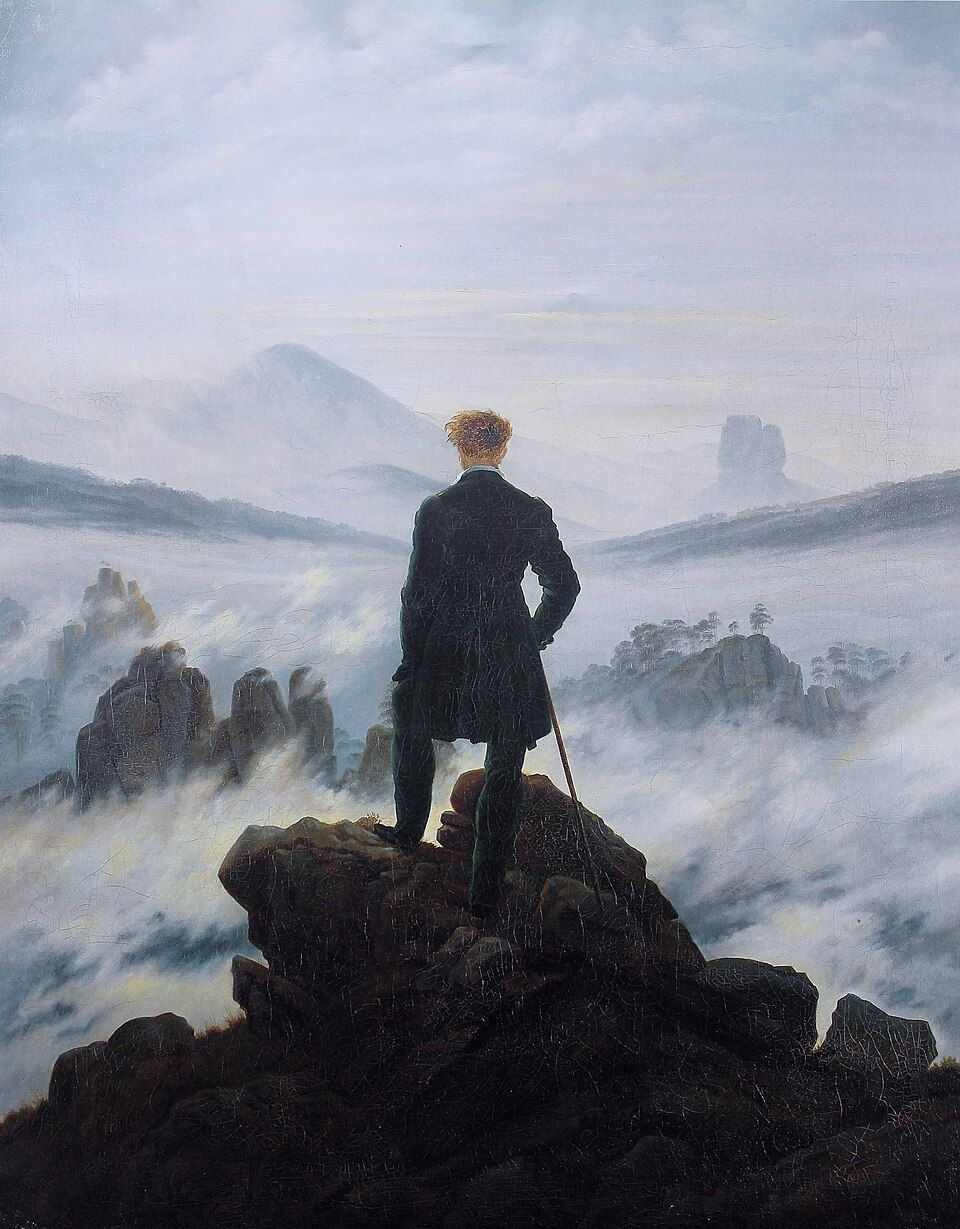
| The sublime | Awe, even fear, in the face of nature’s vast power, such as mountains and storms. |
| The supernatural and exotic | Mystery, dreams, legends, and faraway places. |
The Major Poets
Literary historians often describe two generations of British Romantic poets, with William Blake as an important independent figure.
- William Blake (1757 to 1827): Songs of Innocence and of Experience (1794), including “The Tyger” and “The Lamb.”
- William Wordsworth (1770 to 1850): “Lines Composed a Few Miles above Tintern Abbey” (1798) and “I Wandered Lonely as a Cloud” (1807).
- Samuel Taylor Coleridge (1772 to 1834): “The Rime of the Ancient Mariner” (1798) and “Kubla Khan” (1816).
- Lord Byron (1788 to 1824): Don Juan and “She Walks in Beauty.”
- Percy Bysshe Shelley (1792 to 1822): “Ozymandias” (1818) and “Ode to the West Wind” (1820).
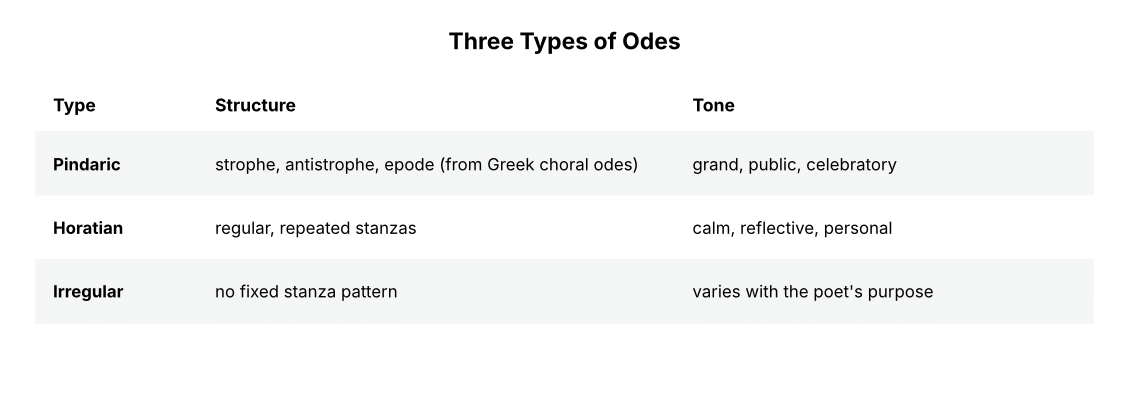
- John Keats (1795 to 1821): the great odes of 1819, including “Ode on a Grecian Urn” and “To Autumn.”
Wordsworth and Coleridge form the first generation. Byron, Shelley, and Keats form the second; all three died young.
Why does this matter? Knowing the period helps you interpret poems. A Romantic poem about a mountain is rarely just about a mountain. It is usually about how nature affects the human mind and spirit.
Worked Example: Wordsworth’s Daffodils
In “I Wandered Lonely as a Cloud,” the speaker sees “a host, of golden daffodils” beside a lake. Years later, lying on his couch, he recalls them, and his heart “with pleasure fills.”
- Nature: the daffodils are the central image.
- Emotion: the speaker moves from loneliness to joy.
- Imagination and memory: the experience lives on in the “inward eye,” the mind’s ability to relive it.
- Plain language: simple words and a regular rhyme scheme make the poem accessible.
Romanticism Beyond Britain
Romanticism was an international movement. In Germany, Johann Wolfgang von Goethe was a leading figure. In the United States, Romantic ideas shaped the work of Edgar Allan Poe, Henry Wadsworth Longfellow, and the Transcendentalists, including Ralph Waldo Emerson and Henry David Thoreau, who emphasized nature and individual intuition.
Why does this matter? Many later movements defined themselves in relation to Romanticism. Victorian poets continued some of its ideas, and Modernist poets often rebelled against its emotional style. Understanding the Romantics helps you understand what came after.
Test-Taking Strategies
Mnemonic Devices and Memory Shortcuts
Remember the poets as “Blake, then Wordsworth and Coleridge, then Byron, Shelley, and Keats.” For features, think NEIS: Nature, Emotion, Imagination, Sublime.
Cross-Topic Connections
- The broader timeline appears in Topic 4.1: Poetry Through the Ages.
- Keats and Shelley perfected Topic 2.8: The Ode.
- Coleridge’s best-known work is discussed in Topic 2.10: Ballads.
- Nature imagery is explained in Topic 3.1: Imagery.
Common Question Formats
- Identify which features make a poem Romantic.
- Match a poet with a work or period.
- Explain how a poem reflects Romantic ideas about nature.
- Compare a Romantic poem with a poem from another period.
Frequent Student Mistakes
- Thinking “Romantic” means only love poetry.
- Mixing up the first and second generations of poets.
- Describing nature imagery without connecting it to emotion or insight.
Test-Day Shortcuts
If a poem features a solitary speaker reflecting on nature with strong emotion, Romanticism is the safest period to choose.
Time Management Tips
Literary period questions on English unit tests and standardized reading tests such as the SAT and ACT take about 30 seconds. Spend more time on analysis questions about specific lines.