
Long before most people could read, stories of love, betrayal, battles, and ghosts traveled from village to village in song. Singers passed them down by memory, changing a word here and a verse there. These songs were ballads, and their simple rhythms, repeated refrains, and dramatic stories still echo in folk music, country songs, and modern pop.
This article covers Topic 2.10: Ballads in Unit 2, Structure and Form. The topic asks you to identify the features of the ballad, distinguish folk ballads from literary ballads, and analyze how the ballad stanza shapes storytelling.
By the end, you should be able to:
- Define the ballad and list its typical features.
- Identify the ballad stanza by its meter and rhyme scheme.
- Distinguish folk ballads from literary ballads.
- Analyze how dialogue, repetition, and gaps create drama.
What Is a Ballad?
A ballad is a narrative poem, often meant to be sung, that tells a dramatic story in short stanzas. Typical features include:
- A story, often tragic, involving love, death, betrayal, adventure, or the supernatural.
- Simple language that is easy to remember.
- Dialogue that lets characters speak directly.
- Repetition and refrains that aid memory and build emotion.
- Abrupt beginnings that jump into the action.
- Gaps that skip explanations and leave the reader to fill them in.
The Ballad Stanza
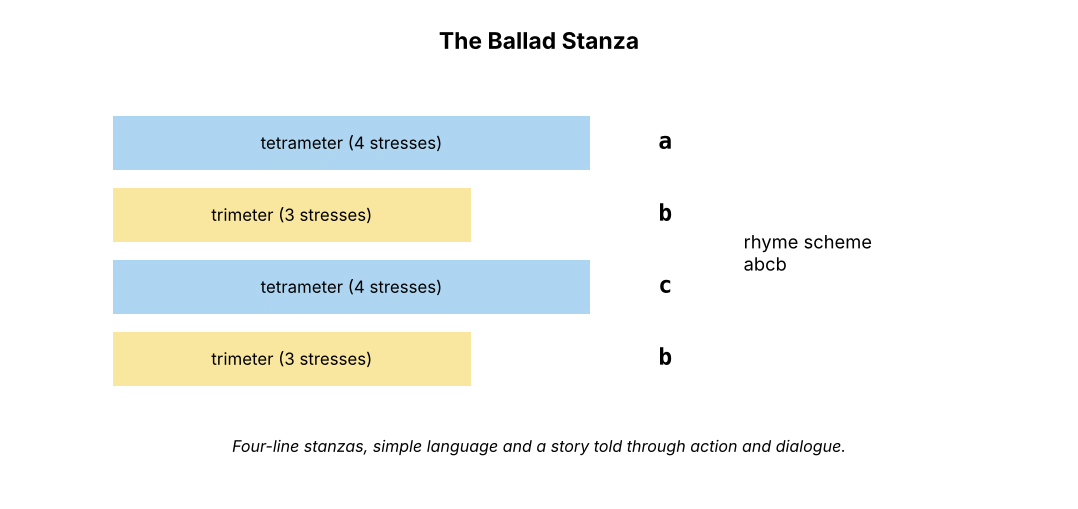
The traditional ballad stanza is a quatrain (four lines) with:
- Alternating line lengths: lines 1 and 3 have four stressed beats (tetrameter); lines 2 and 4 have three (trimeter).
- Rhyme scheme ABCB, where only lines 2 and 4 rhyme. Some ballads use ABAB.
A closely related pattern, called common meter, uses iambic tetrameter and trimeter. It appears in many hymns and in much of Emily Dickinson’s poetry.
Why does this matter? The short, regular stanza works like a musical phrase, easy to sing and remember. That is why ballads survived for centuries in oral tradition, long before they were written down.
Folk Ballads Versus Literary Ballads
| Feature | Folk Ballad | Literary Ballad |
|---|---|---|
| Author | Usually unknown; shaped by many singers | A known poet |
| Transmission | Passed down orally, with many versions | Written and published |
| Style | Simple, direct, often stark | Imitates folk style but may be more polished or symbolic |
| Examples | “Sir Patrick Spens,” “Barbara Allen” | “The Rime of the Ancient Mariner,” “La Belle Dame sans Merci” |
Many folk ballads from England and Scotland were collected in the 1800s, most famously by the American scholar Francis James Child, whose collection includes 305 ballads.
Worked Example: “The Rime of the Ancient Mariner”
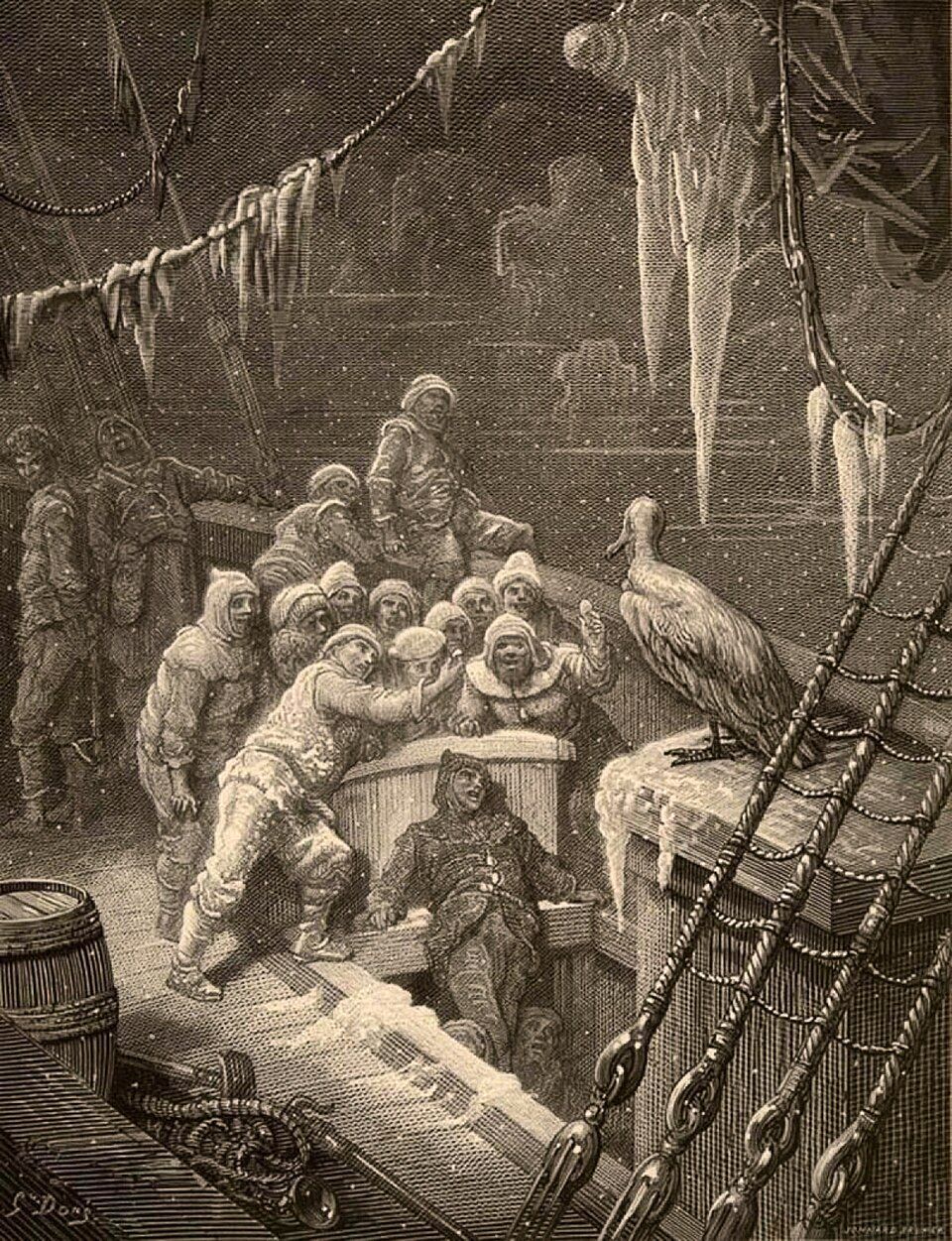
Samuel Taylor Coleridge published this literary ballad in 1798. A sailor shoots an albatross, a bird that seemed to bring good luck, and the crew suffers terribly. Stranded on a motionless sea, the mariner describes their thirst:
Water, water, every where,
Nor any drop to drink.
- Form: four stressed beats in the first line, three in the second, part of a ballad stanza.
- Repetition: “Water, water” emphasizes the cruel irony of being surrounded by undrinkable seawater.
- Story: a supernatural tale of guilt and punishment, typical of ballad subject matter.
- Theme: the poem suggests that all living creatures are connected and that harming nature brings consequences.
Drama Through Dialogue and Gaps
Ballads often tell stories through quick exchanges of dialogue with little narration. Folk ballads also skip important events. A ballad may jump from a ship setting sail to the drowned sailors lying at the bottom of the sea without describing the storm. These gaps, sometimes called “leaping and lingering,” force the reader to imagine what happened and make the story feel more intense.
Why does this matter? Recognizing gaps helps you answer inference questions. When a ballad leaves something out, ask what the reader is meant to assume and why the omission makes the moment more powerful.
Ballads Today
The ballad tradition lives on in folk songs, country music, and story-driven popular songs. When a song tells a dramatic story with a repeating chorus, it is drawing on the same techniques that ballad singers used centuries ago.
Test-Taking Strategies
Mnemonic Devices and Memory Shortcuts
“Four, three, four, three; A, B, C, B.” Ballads “leap and linger”: they skip the boring parts and dwell on the dramatic ones.
Cross-Topic Connections
- Labeling ABCB patterns uses Topic 2.2: Rhyme and Rhyme Scheme.
- Counting stressed beats is explained in Topic 2.3: Meter and Rhythm.
- Quatrains are a stanza type in Topic 2.1: Lines and Stanzas.
- Following a ballad’s plot uses Reading Skills Topic 1.7: Tracking Character and Plot Development.
Common Question Formats
- Identify the rhyme scheme and meter of a ballad stanza.
- Explain the effect of a refrain.
- Infer events that the ballad skips.
- Distinguish a folk ballad from a literary ballad.
Frequent Student Mistakes
- Assuming every ballad must rhyme ABAB.
- Confusing ballads with any slow love song.
- Ignoring what the gaps in the story suggest.
Test-Day Shortcuts
Read one stanza aloud quietly and count the beats. A four-three-four-three pattern with lines 2 and 4 rhyming almost always signals a ballad.
Time Management Tips
Ballads are often long, so on English unit tests and standardized reading tests such as the SAT and ACT, summarize the plot in a few words after each section.