
Imagine writing a poem in which two lines must come back again and again, four times each, and still feel fresh every time. That is the challenge of the villanelle, one of the strictest forms in English poetry. Its repeated lines circle back like a thought you cannot shake, which is why poets often use it for obsession, grief, and loss.
This article covers Topic 2.11: Villanelles in Unit 2, Structure and Form. The topic asks you to identify the villanelle’s structure, track its two refrains, and analyze how repetition shapes meaning.
By the end, you should be able to:
- Describe the structure of a villanelle: lines, stanzas, and rhyme.
- Identify and label the two refrains.
- Explain how the refrains gain new meaning as the poem progresses.
- Explain why poets choose this form for certain subjects.
The Rules of the Form
A villanelle has:
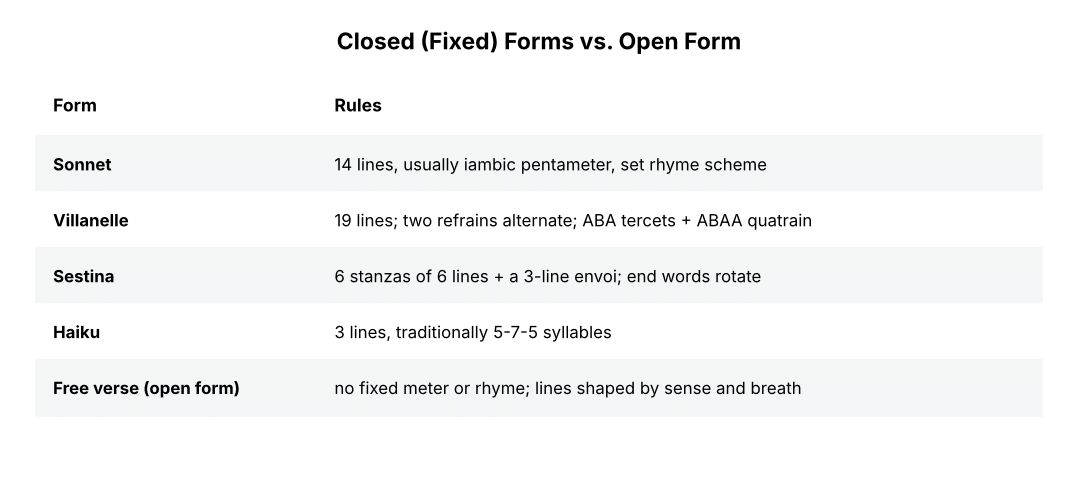
- 19 lines.
- Five tercets (three-line stanzas) followed by one quatrain (a four-line stanza).
- Only two rhyme sounds throughout, in the pattern ABA for each tercet and ABAA for the quatrain.
- Two refrains: line 1 and line 3 of the first stanza repeat in a fixed pattern and come together as a pair at the end.
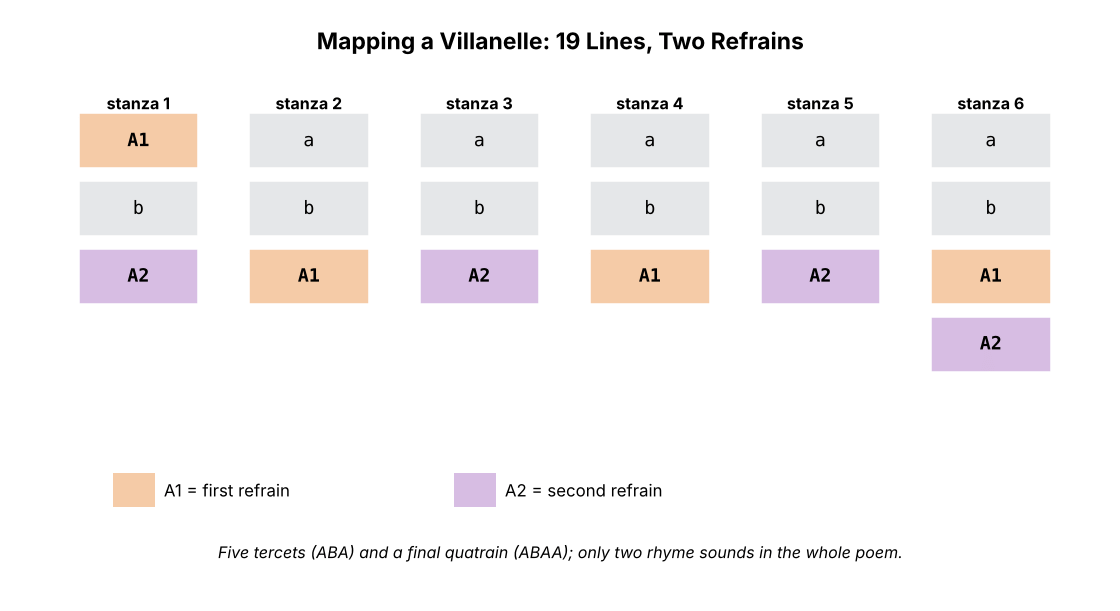
Mapping the Refrains
Poets often label the first line A1 and the third line A2. Here is where they appear:
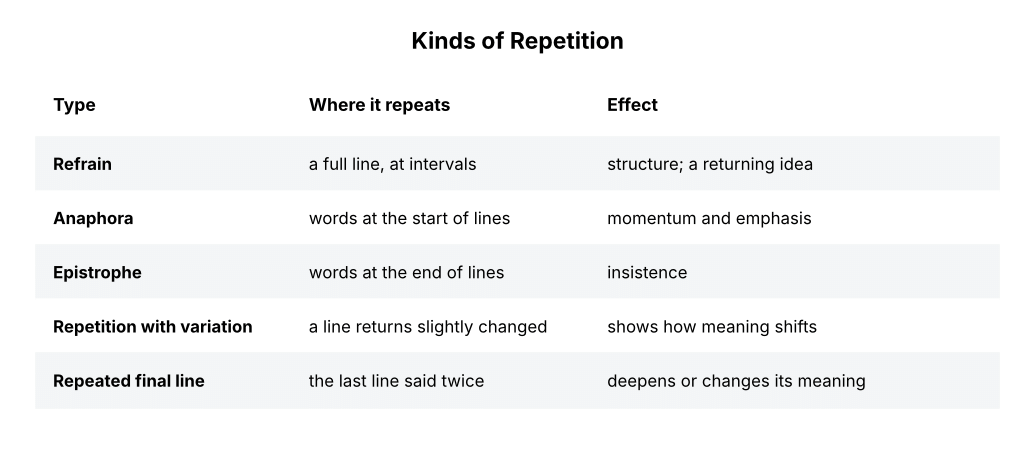
| Stanza | Line Pattern |
|---|---|
| 1 (tercet) | A1, b, A2 |
| 2 (tercet) | a, b, A1 |
| 3 (tercet) | a, b, A2 |
| 4 (tercet) | a, b, A1 |
| 5 (tercet) | a, b, A2 |
| 6 (quatrain) | a, b, A1, A2 |
Each refrain appears four times. Lowercase letters mark lines that rhyme with the refrains but are new each time. Poets sometimes vary the refrains slightly, changing a word or punctuation to shift meaning.
Why does this matter? The fixed pattern means the poem keeps returning to the same two ideas. That structure mirrors experiences that repeat in the mind: grief that returns, a fear that will not leave, or a lesson someone keeps relearning.
Origins
The word villanelle comes from the Italian villanella, a rustic song. The fixed nineteen-line form is usually traced to a French poem by Jean Passerat published in 1606. English poets took up the form in the late 1800s, and it became especially popular in the twentieth century.
Worked Example
Edwin Arlington Robinson’s “The House on the Hill” (1894) begins:
They are all gone away,
The House is shut and still,
There is nothing more to say.
- A1: “They are all gone away” (the people are gone).
- A2: “There is nothing more to say” (silence and finality).
- Rhyme: “away” and “say” share the A sound; “still” sets the B sound that every middle line repeats.
- Effect: as the refrains return, the emptiness of the house deepens. By the final quatrain, when both lines appear together, the poem feels like it has nowhere else to go, which matches its theme of loss and abandonment.
How Refrains Change Meaning
Even when the words stay the same, a refrain can mean something different each time because of the lines around it. Early in a villanelle, a refrain might sound like a simple statement. By the end, after everything the middle lines have added, it can sound like a plea, a confession, or a hard-won truth.
When you analyze a villanelle, read each appearance of a refrain in context and ask: what has changed since the last time I saw this line?
Famous Twentieth-Century Villanelles
Two of the most famous villanelles in English are Dylan Thomas’s “Do not go gentle into that good night,” in which a speaker urges his dying father to fight against death, and Elizabeth Bishop’s “One Art,” in which a speaker claims that losing things is easy while the poem gradually reveals a much deeper loss. Both show how the form’s repetition can express emotions the speaker is struggling to control.
Why does this matter? The strict form creates tension. When a speaker repeats a line like a rule or a mantra, readers sense the effort it takes to hold onto that idea, and the cracks in the repetition reveal real feeling.
Test-Taking Strategies
Mnemonic Devices and Memory Shortcuts
“Nineteen lines, two rhymes, two refrains, four times each.” Think of the two refrains as a pair of friends who take turns visiting and finally arrive together at the end.
Cross-Topic Connections
- Labeling rhyme uses Topic 2.2: Rhyme and Rhyme Scheme.
- Tercets and quatrains are stanza types in Topic 2.1: Lines and Stanzas.
- Another strict form is Topic 2.6: The Sonnet.
- Many villanelles mourn, like Topic 2.9: The Elegy.
Common Question Formats
- Identify a poem as a villanelle.
- Locate each appearance of a refrain.
- Explain how the meaning of a refrain changes.
- Explain why the form suits the poem’s subject.
Frequent Student Mistakes
- Miscounting the stanzas or lines.
- Treating the refrains as filler instead of analyzing them.
- Missing small changes in wording between repetitions.
Test-Day Shortcuts
Underline the first and third lines of the poem, then find where they return. The final two lines, where both refrains appear together, usually express the poem’s central idea.
Time Management Tips
Villanelle questions on English unit tests and standardized reading tests such as the SAT and ACT take 30 to 60 seconds. Mapping the refrains first speeds up every later question.