
Words like analyze, significant, evidence, and hypothesis rarely show up in casual conversation, but they appear constantly in textbooks, test questions, and essays. These are academic vocabulary words, and they unlock understanding across every subject. A student who knows what “evaluate” or “infer” really means can answer questions more accurately, read harder texts, and write with more precision.
This article covers Topic 4.5: Building Academic Vocabulary in Unit 4, Reading Strategies. The topic asks you to recognize the tiers of vocabulary, use word parts and context to determine meaning, and apply strategies to learn and remember academic words.
By the end, you should be able to:
- Distinguish everyday, academic, and subject-specific vocabulary.
- Use prefixes, suffixes, and roots to determine meaning.
- Use context clues and reference tools effectively.
- Apply strategies to learn and retain new words.
Three Tiers of Vocabulary
Educators often describe vocabulary in three tiers, a model developed by Isabel Beck and her colleagues:
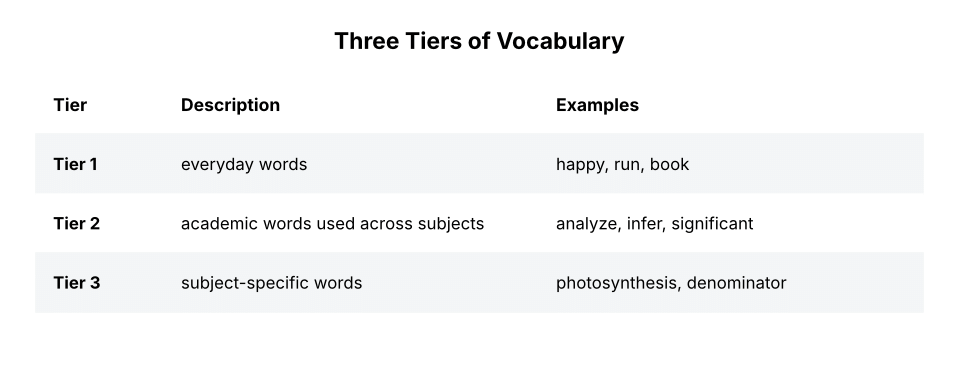
| Tier | Description | Examples |
|---|---|---|
| Tier 1 | Everyday words most speakers know | happy, walk, house |
| Tier 2 | General academic words used across subjects | analyze, contrast, significant, infer, evaluate |
| Tier 3 | Subject-specific technical terms | photosynthesis, denominator, metaphor, amendment |
Tier 2 words are especially valuable because they appear in every class and on every test. Learning them pays off everywhere.
Word Parts
Many academic words come from Latin and Greek. Knowing common parts lets you figure out unfamiliar words.
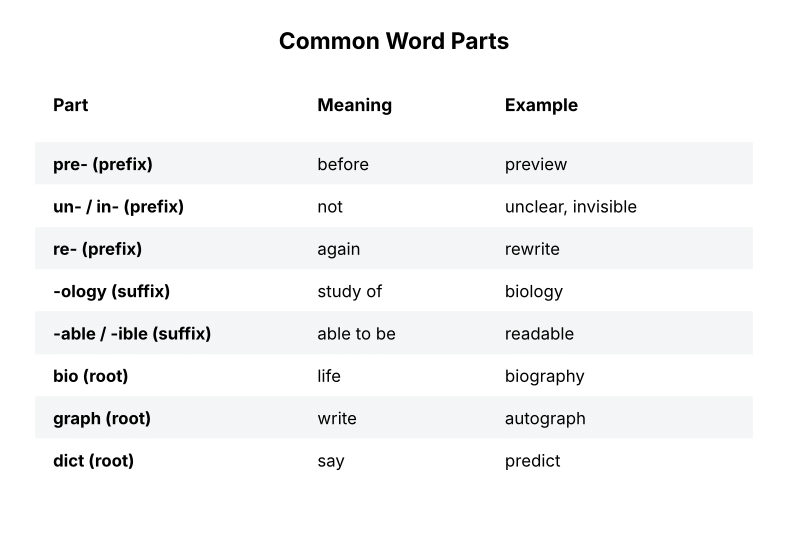
| Part | Meaning | Examples |
|---|---|---|
| pre- (prefix) | before | preview, predict |
| re- (prefix) | again, back | revise, reconsider |
| un-, in-, dis- (prefixes) | not | unlikely, inaccurate, disagree |
| bio (root) | life | biology, biography |
| dict (root) | say, speak | predict, contradict |
| port (root) | carry | transport, portable |
| -ology (suffix) | study of | geology, psychology |
| -tion (suffix) | act or state (makes a noun) | evaluation, conclusion |
Worked example: What does contradict mean? Contra means “against,” and dict means “speak.” To contradict is to speak against, or to say the opposite of something.
Why does this matter? Learning one root can unlock dozens of words. Knowing dict helps with dictionary, dictate, verdict, and predict, multiplying the value of every word part you learn.
Context Clues
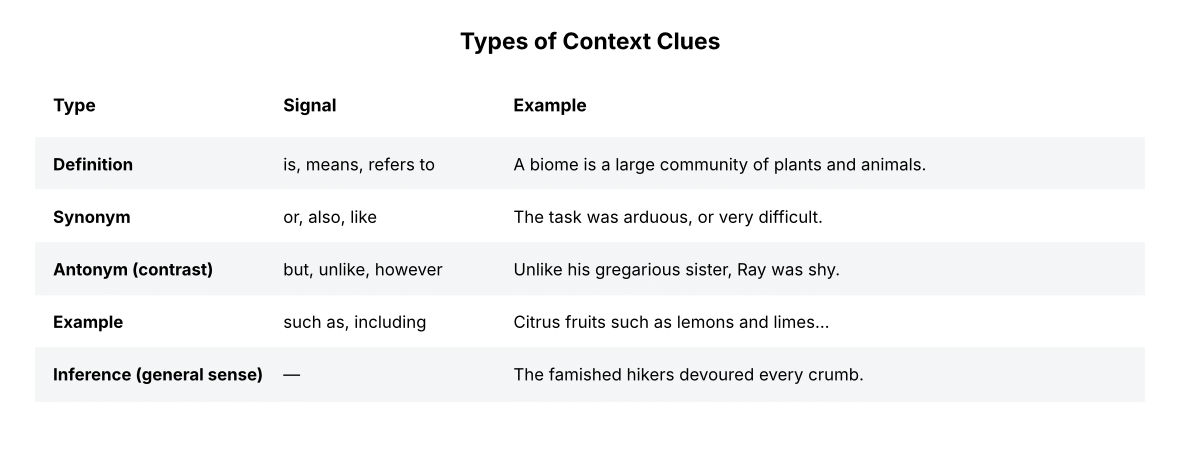
Surrounding words often reveal meaning:
- Definition: “The arid, or extremely dry, climate made farming difficult.”
- Example: “Precipitation, such as rain, snow, and hail, fell all week.”
- Contrast: “Unlike his gregarious sister, Ben preferred to be alone.”
- Inference: “After the long hike, the famished campers ate everything in sight.”
Using Reference Tools
When context and word parts are not enough, use a dictionary or glossary. Read all the definitions listed, then choose the one that fits the sentence. A thesaurus can suggest synonyms, but be careful: synonyms rarely mean exactly the same thing, and their connotations may differ. Many digital dictionaries also show example sentences and word origins, which can help you remember a word. Look up a word after first trying to figure it out yourself, so the dictionary confirms or corrects your thinking.
Academic Words in Test Questions
Test directions use specific academic verbs. Misreading them can lead to the wrong kind of answer.
- Analyze: break into parts and explain how they work.
- Evaluate: judge the quality or effectiveness, with reasons.
- Infer: draw a conclusion from evidence.
- Summarize: state the main points briefly.
- Compare / contrast: show similarities / differences.
- Cite: quote or refer to evidence directly.
Strategies to Learn and Remember Words
- Read widely: most vocabulary is learned through reading.
- Keep a word journal: record the word, its meaning, a sentence from your reading, and your own sentence.
- Use a Frayer model: a four-box chart with definition, characteristics, examples, and non-examples.
- Practice active use: use new words in writing and discussion within a few days.
- Review with spacing: revisit words over days and weeks rather than cramming.
- Learn word families: analyze, analysis, analytical.
Why does this matter? Vocabulary knowledge is closely linked to reading comprehension. The more words you know, the more of a difficult text you can understand, and the easier it becomes to learn even more words from context.
Test-Taking Strategies
Mnemonic Devices and Memory Shortcuts
“Roots grow word trees.” For context clues, remember DECI: Definition, Example, Contrast, Inference.
Cross-Topic Connections
- Clues from surrounding words are explained in Topic 2.1: Using Context Clues.
- Shades of meaning are covered in Topic 2.2: Connotation and Denotation.
- Vocabulary grows through Topic 4.2: Active Reading Strategies.
- Look-alike words are compared in Grammar Topic 6.3: Commonly Confused Words.
Common Question Formats
- Determine the meaning of a word as used in a passage.
- Choose the word that best fits a sentence.
- Use a root or affix to define an unfamiliar word.
- Identify the meaning of an academic direction word.
Frequent Student Mistakes
- Choosing the most common meaning instead of the meaning in context.
- Ignoring prefixes that reverse meaning, such as un- and dis-.
- Learning definitions without practicing the word in sentences.
Test-Day Shortcuts
For words-in-context questions, cover the answer choices, reread the sentence, and predict a simple synonym. Then pick the choice closest to your prediction.
Time Management Tips
Vocabulary-in-context questions on English unit tests and standardized reading tests such as the SAT and ACT take 20 to 40 seconds. They are often the quickest points in a passage set.