
Think about your favorite movie. Early scenes introduce the characters and their world. Then something goes wrong, the tension builds, and everything comes to a head in a big moment. Finally, the loose ends get tied up. That shape is no accident. Most stories, from ancient myths to modern novels, follow a recognizable structure, and knowing that structure helps you understand, predict, and analyze what you read.
This article covers Topic 2.7: Story Structure and Plot Elements in Unit 2, Craft and Structure. The topic asks you to identify the five stages of plot, recognize types of conflict, and analyze how authors use structural choices such as flashback and foreshadowing.
By the end, you should be able to:
- Identify the five stages of a plot structure.
- Distinguish internal and external conflict and their main types.
- Recognize structural techniques such as flashback, foreshadowing, and in medias res.
- Explain how structure creates suspense and supports meaning.
The Five Stages of Plot
The German writer Gustav Freytag described a five-part structure in 1863, often drawn as a pyramid or arc and called Freytag’s Pyramid.
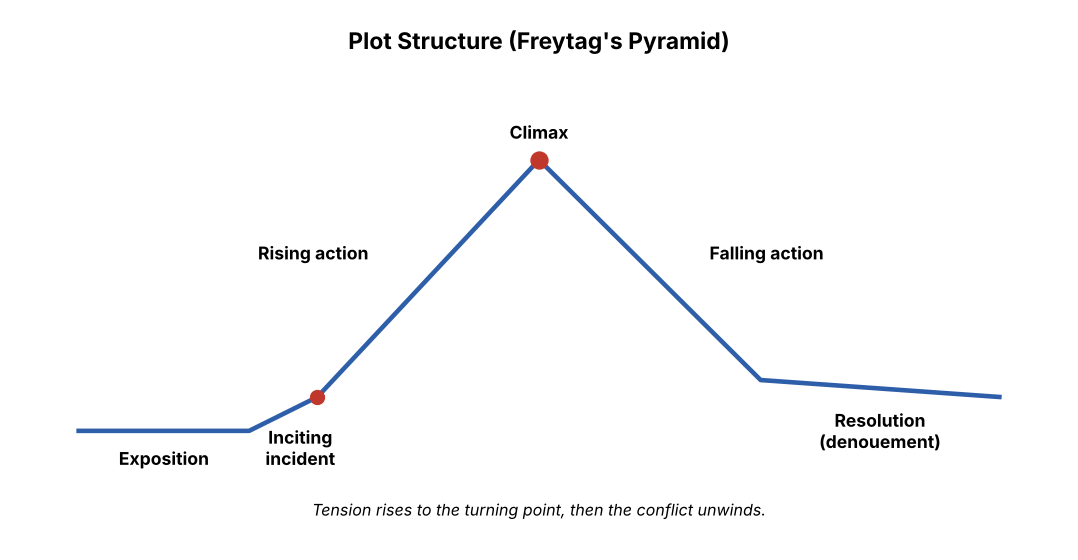
| Stage | What Happens |
|---|---|
| Exposition | Introduces characters, setting, and background information |
| Rising action | An inciting incident starts the conflict, and complications build tension |
| Climax | The turning point, the moment of greatest tension when the conflict comes to a head |
| Falling action | Events after the climax that show the results of the turning point |
| Resolution (denouement) | The conflict is settled and loose ends are tied up |
The inciting incident is the event that sets the main conflict in motion. It usually comes at the end of the exposition or the start of the rising action.
Worked Example: “Cinderella”
- Exposition: Cinderella lives with a cruel stepmother and stepsisters who treat her like a servant.
- Inciting incident: the prince announces a royal ball.
- Rising action: Cinderella is forbidden to go; her fairy godmother helps her attend; she dances with the prince but must leave by midnight, losing a glass slipper.
- Climax: the slipper fits Cinderella’s foot, revealing her identity.
- Falling action: the stepfamily reacts, and the prince prepares to marry her.
- Resolution: Cinderella and the prince marry.
Why does this matter? Recognizing structure helps you find the most important moments quickly. Questions often ask about the climax or turning point, and identifying it correctly is key to understanding what a story is really about.
Types of Conflict
Conflict is the struggle between opposing forces that drives a plot.
- Internal conflict: a struggle within a character’s mind, such as a hard decision, guilt, or fear (character versus self).
- External conflict: a struggle against an outside force:
- Character versus character.
- Character versus nature.
- Character versus society.
- Character versus technology or the supernatural.
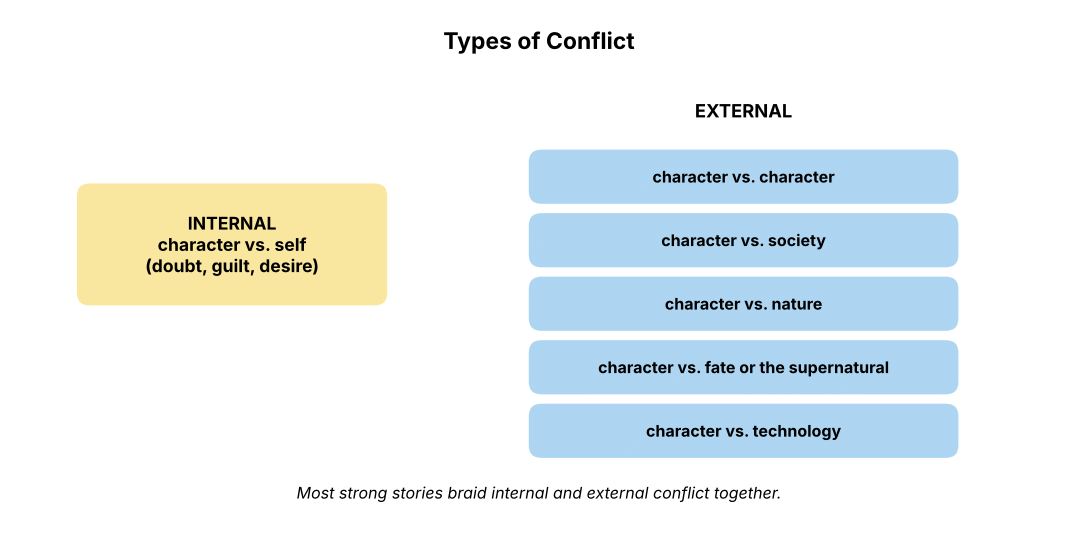
Many stories have both. A character might fight a storm (external) while overcoming fear (internal).
Structural Techniques
Authors do not always tell events in order. They make structural choices to create effects:
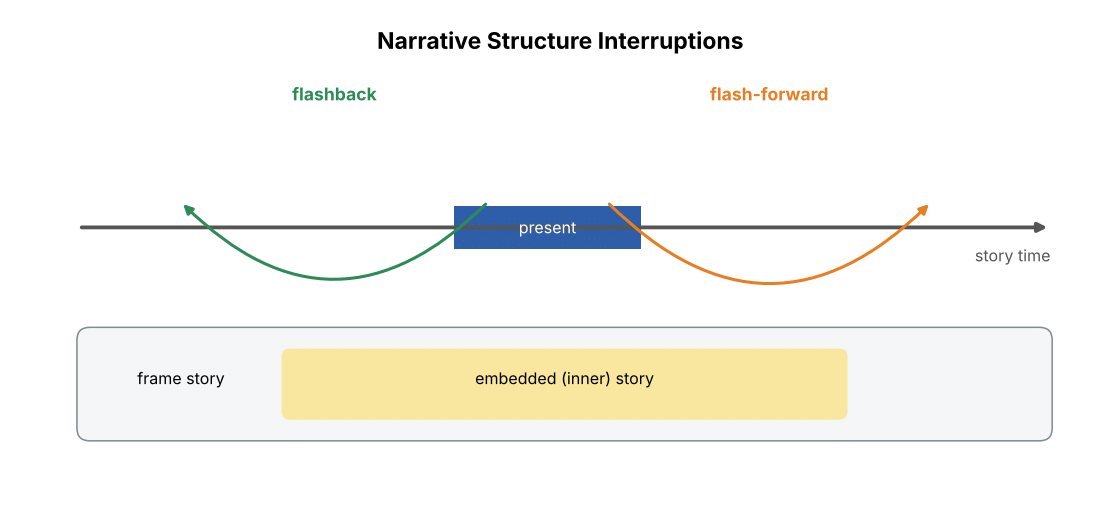
- Flashback: a scene that interrupts the present to show earlier events. It reveals background or motivation.
- Foreshadowing: hints about what will happen later. It builds suspense and makes endings feel earned.
- In medias res: Latin for “in the middle of things”; the story begins mid-action, with background filled in later. Homer’s Odyssey begins this way.
- Frame story: a story told within another story.
- Cliffhanger: a chapter or section that ends at a moment of high suspense.
- Parallel plots: two storylines that develop side by side.
Why does this matter? Structural choices shape how readers feel. Foreshadowing creates dread or anticipation; a flashback can change how we judge a character. Tests often ask how a scene “contributes to the structure” of a passage.
Plot Versus Story
The story is all the events in chronological order. The plot is how the author arranges and presents those events. Two authors could tell the same story with very different plots, one starting at the beginning and another starting with the ending and working backward.
Beyond the Pyramid
Not every story fits Freytag’s Pyramid neatly. Some stories have open endings with no clear resolution. Others use multiple climaxes or circular structures that end where they began. When a text breaks the usual pattern, ask why the author made that choice.
Test-Taking Strategies
Mnemonic Devices and Memory Shortcuts
“Every Rising Climber Falls Rarely”: Exposition, Rising action, Climax, Falling action, Resolution.
Cross-Topic Connections
- Character arcs are traced in Topic 1.7: Tracking Character and Plot Development.
- Nonfiction structures are covered in Topic 2.6: Analyzing Text Structure in Nonfiction.
- Story summaries use the same elements as Topic 1.4: Summarizing a Text.
- Stories in verse are discussed in Poetry Topic 2.12: Narrative and Lyric Poetry.
Common Question Formats
- Identify the climax or inciting incident of a story.
- Label a type of conflict.
- Explain the effect of a flashback or foreshadowing.
- Explain how a scene contributes to the overall structure.
Frequent Student Mistakes
- Confusing the climax with the most exciting action scene rather than the turning point.
- Calling the inciting incident the climax.
- Ignoring internal conflict.
Test-Day Shortcuts
To find the climax, look for the point after which the main conflict can only go one way. Everything after it is falling action.
Time Management Tips
Structure questions on English unit tests and standardized reading tests such as the SAT and ACT take 30 to 45 seconds. Sketch a quick plot arc in the margin for longer passages.