
A friend asks what a movie was about, and you have about thirty seconds before they lose interest. You cannot describe every scene. You have to pick the most important events and explain them clearly and quickly. That is summarizing, and it is one of the most useful skills in school and beyond. A good summary proves you understood a text; a poor one either leaves out the key points or drowns in details.
This article covers Topic 1.4: Summarizing a Text in Unit 1, Key Ideas and Details. The topic asks you to write objective summaries of literary and informational texts that capture the central idea and key supporting details.
By the end, you should be able to:
- Explain what makes a summary effective.
- Distinguish important ideas from minor details.
- Write objective summaries of fiction and nonfiction.
- Avoid opinions and copied wording in a summary.
What a Summary Is
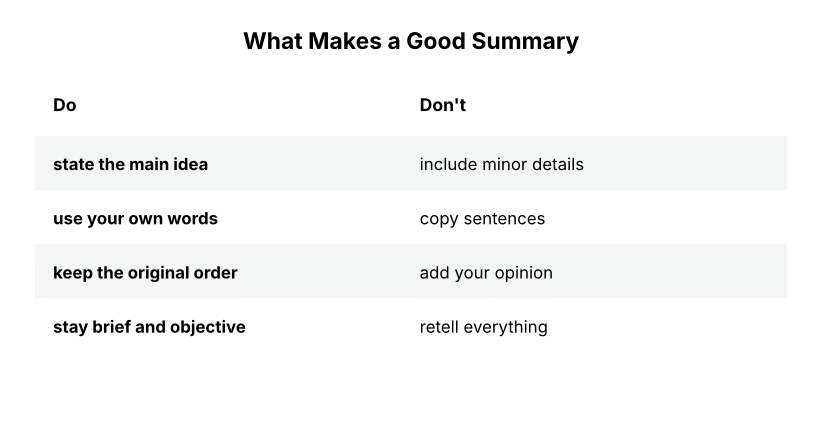
A summary is a brief restatement, in your own words, of a text’s central idea and most important points. A summary is:
- Short: much shorter than the original, often about a quarter of the length or less.
- Objective: it presents the text’s ideas without your opinions.
- In your own words: it does not copy sentences from the text.
- Complete: it covers the whole text, not just the beginning.
Summary Versus Related Skills
| Skill | Length | Purpose |
|---|---|---|
| Summary | Much shorter than the original | Captures main ideas only |
| Paraphrase | About the same length as the passage | Restates a specific passage in your own words, including details |
| Analysis | Varies | Explains how and why a text works |
| Review | Varies | Gives an opinion about quality |
Summarizing Fiction: Somebody Wanted But So Then
For stories, use this framework:
- Somebody: the main character.
- Wanted: the character’s goal.
- But: the conflict or obstacle.
- So: how the character responds.
- Then: how the story ends.
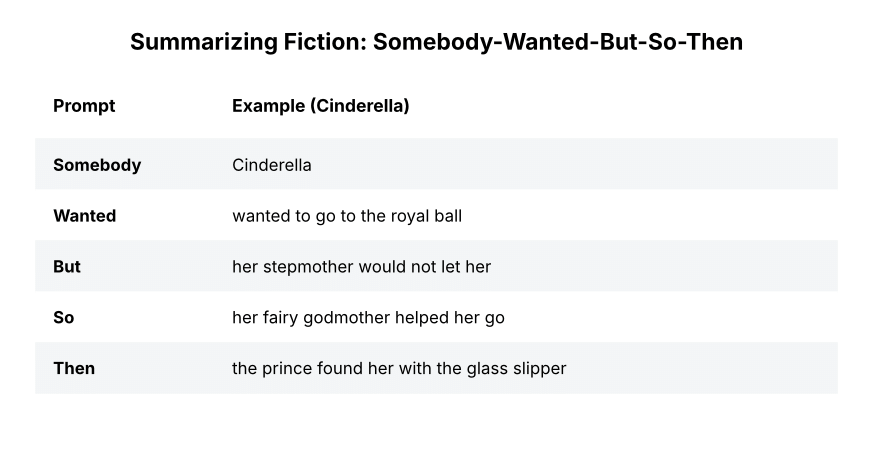
Example: In “The Boy Who Cried Wolf,” a shepherd boy (Somebody) wanted excitement (Wanted), but the villagers grew tired of his false alarms (But), so they ignored him when a real wolf appeared (So), and then the wolf scattered his flock (Then).
Summarizing Nonfiction
For informational texts, follow these steps:
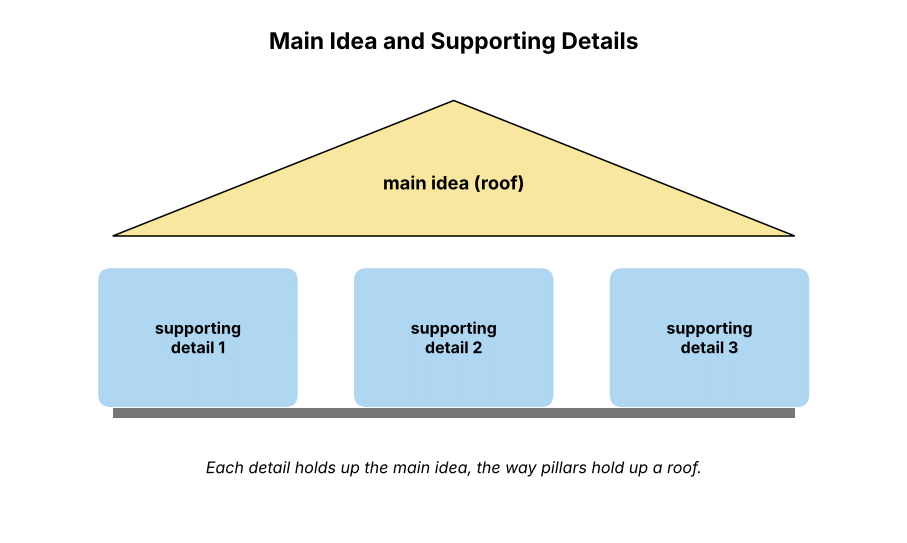
- Identify the central idea of the whole text.
- Find the main point of each section or paragraph, often in topic sentences.
- Cut examples, statistics, and descriptions unless they are essential.
- Combine the central idea and main points into a few sentences in logical order.
Worked example: Summarize this paragraph.
Honeybees are essential to agriculture. They pollinate many fruits, nuts, and vegetables, including almonds, apples, and blueberries. Without bees, farmers would have to pollinate crops by hand or with machines, which is slow and expensive. In recent decades, however, beekeepers in many regions have reported heavy colony losses linked to parasites, pesticides, disease, and habitat loss. Scientists and farmers are working on solutions, such as planting wildflowers and reducing certain chemicals.
Summary: Honeybees play a vital role in pollinating crops, but colony losses caused by parasites, pesticides, disease, and habitat loss threaten them, so scientists and farmers are seeking ways to protect them.
Notice what was left out: the specific crop examples and the details of hand pollination. They support the ideas but are not the main points.
Why does this matter? Summarizing forces you to decide what matters most. That same decision is at the heart of central idea questions, note-taking, and research writing.
Keeping It Objective
An objective summary contains no opinions, judgments, or personal reactions.
- Not objective: The author makes a brilliant argument that bees are important.
- Objective: The author argues that bees are essential to agriculture.
Use neutral verbs such as argues, explains, describes, claims, and shows. Avoid words like amazing, boring, or wrong.
Common Problems
- Too long: includes minor details or retells every event.
- Too short: leaves out the ending or a key point.
- Copied: uses the author’s exact sentences instead of your own words.
- Distorted: changes the author’s meaning or adds ideas the author did not express.
Why does this matter? Standardized tests often ask you to choose the best summary of a passage. Wrong answers usually include a minor detail, an opinion, or an idea that is not in the text at all.
Test-Taking Strategies
Mnemonic Devices and Memory Shortcuts
For fiction, use Somebody Wanted But So Then. For nonfiction, think “central idea plus main points, minus examples.”
Cross-Topic Connections
- A summary starts with Topic 1.2: Finding the Central Idea.
- Story summaries track events from Topic 1.7: Tracking Character and Plot Development.
- Careful reading comes first, as in Topic 1.1: Close Reading for Key Ideas and Details.
- Summaries differ from themes, explained in Topic 1.3: Determining Theme.
Common Question Formats
- Choose the best summary of a passage.
- Identify which detail should be left out of a summary.
- Write a one- to three-sentence summary.
- Find the error in a flawed summary.
Frequent Student Mistakes
- Including opinions or personal reactions.
- Focusing only on the beginning of the text.
- Copying the author’s wording.
Test-Day Shortcuts
Eliminate summary choices that contain an opinion, a detail from only one paragraph, or anything the passage did not say.
Time Management Tips
Summary questions on English unit tests and standardized reading tests such as the SAT and ACT take 45 seconds to a minute. Jot a one-line summary after reading to compare against choices.