
You walk into the kitchen and see flour on the counter, a mixing bowl in the sink, and a timer ticking on the oven. Nobody tells you what is happening, but you know someone is baking. You used clues plus what you already know to reach a logical conclusion. That is an inference, and readers make them constantly. Authors rarely spell everything out, so the ability to read between the lines is essential for understanding any text.
This article covers Topic 1.5: Making Inferences in Unit 1, Key Ideas and Details. The topic asks you to draw logical conclusions from textual evidence and background knowledge and to support those inferences with specific details.
By the end, you should be able to:
- Define an inference and distinguish it from a stated fact or a guess.
- Combine textual evidence with background knowledge to make inferences.
- Make inferences about characters, settings, and authors’ ideas.
- Support inferences with specific evidence.
What an Inference Is
An inference is a logical conclusion based on evidence and reasoning rather than on direct statement. The basic formula is:
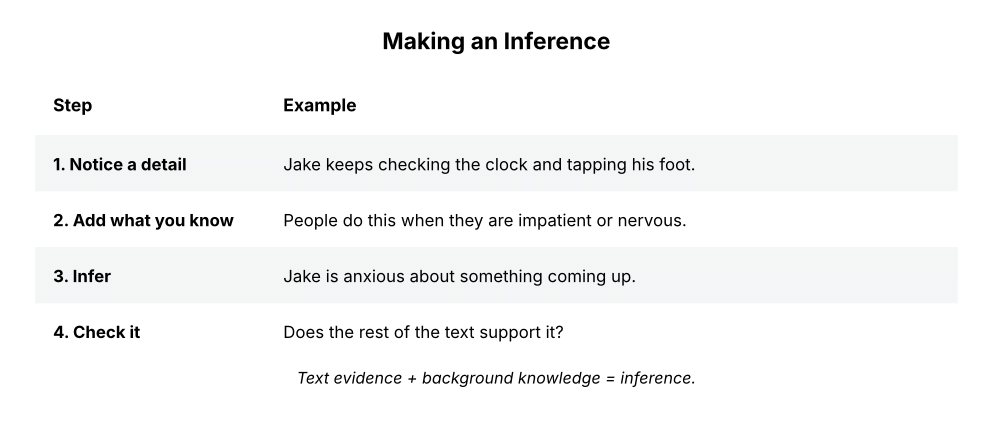
Text clues + background knowledge = inference
| Type | Description | Example |
|---|---|---|
| Explicit information | Stated directly in the text | “Jordan was furious.” |
| Inference | A conclusion supported by clues | “Jordan slammed the door and threw his backpack across the room.” (He is angry.) |
| Unsupported guess | A conclusion the clues do not support | “Jordan hates his brother.” (No evidence given.) |
Making Inferences About Characters
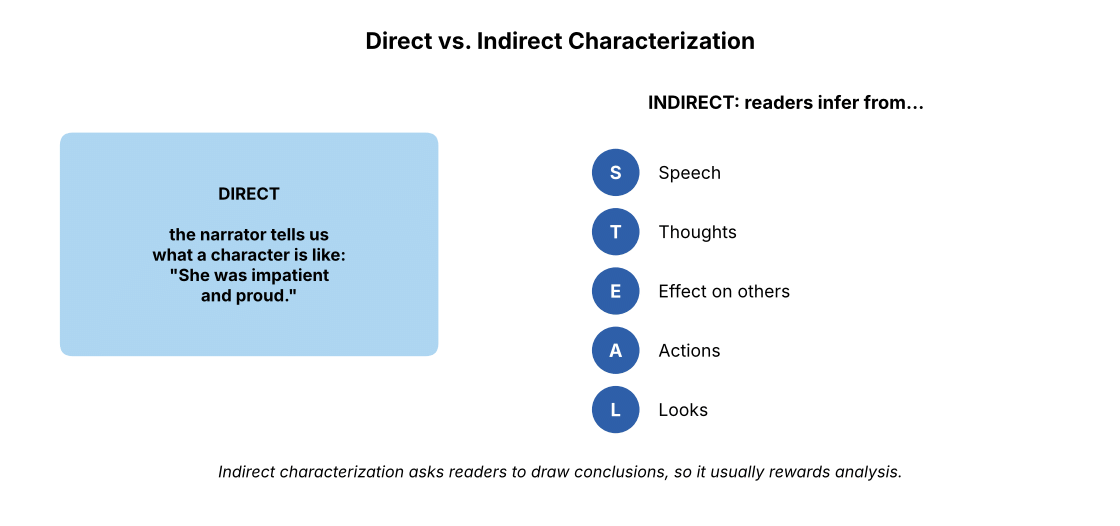
Authors reveal characters indirectly through:
- Actions: what a character does.
- Speech: what a character says and how.
- Thoughts: what a character thinks or feels.
- Effects on others: how other characters react.
- Appearance: details of dress, posture, or expression.
Worked example:
Lena checked the mailbox for the third time that afternoon. When the mail truck finally rounded the corner, she ran down the driveway, then stopped and walked the last few steps slowly, smoothing her hair. She flipped through the envelopes twice before handing them to her mother without a word.
- Clue: she checks the mailbox repeatedly. Knowledge: people check often when expecting something important. Inference: Lena is waiting for a specific letter.
- Clue: she runs, then slows and smooths her hair. Inference: she is eager but wants to appear calm.
- Clue: she checks twice, then hands over the mail silently. Inference: the letter did not come, and she is disappointed.
The passage never states that Lena is waiting, eager, or disappointed. Every conclusion comes from evidence.
Why does this matter? Much of the meaning in literature is implied. Readers who only notice stated facts miss characters’ motives, emotions, and relationships, which are often the heart of a story.
Inferences in Nonfiction
In informational texts, readers infer an author’s purpose, attitude, and unstated assumptions. If an article about city parks describes “crumbling benches” and “overgrown paths” and then notes that the city cut the parks budget, you can infer that the author connects the budget cuts to the parks’ poor condition, even if the author never says so directly.
Testing an Inference
Ask these questions to check whether an inference is valid:
- Is it supported by specific evidence in the text?
- Does it fit all the evidence, not just one detail?
- Is it the most reasonable conclusion, or am I going too far?
- Could someone else find the same evidence and agree?
Why does this matter? On tests, wrong answers to inference questions are often too extreme. They go beyond what the evidence supports. The correct answer is usually the most cautious conclusion the text clearly backs up.
Supporting Inferences in Writing
When you state an inference in an essay, use this pattern: state the inference, cite the evidence, and explain the connection. For example: “Lena is disappointed, as shown when she hands the mail to her mother ‘without a word.’ Her silence suggests the letter she hoped for did not arrive.”
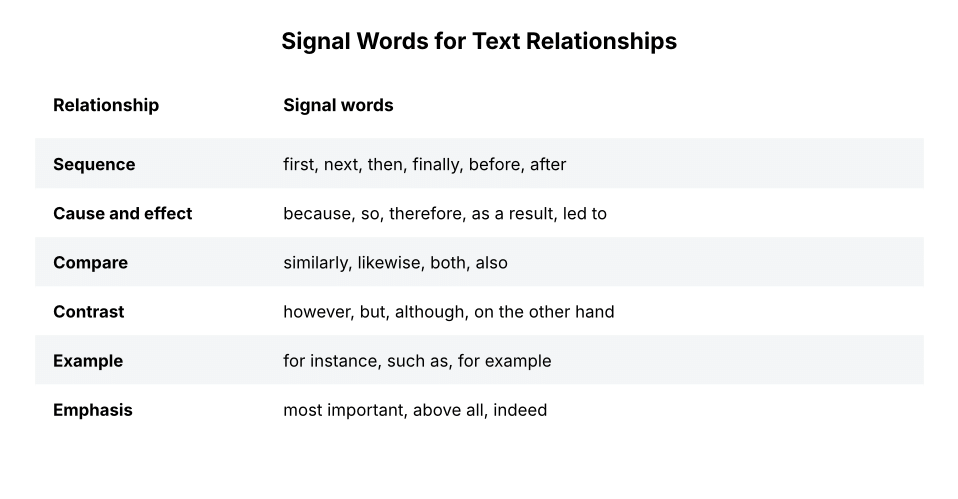
Inference Signal Words
Test questions about inferences often use these words: suggests, implies, most likely, can be inferred, probably, and indicates. When you see them, the answer will not be stated directly; look for clues.
Test-Taking Strategies
Mnemonic Devices and Memory Shortcuts
“It says, I say, and so”: what the text says, what I know, and so what I conclude. Remember “clues plus knowledge equals inference.”
Cross-Topic Connections
- Inferences start with Topic 1.1: Close Reading for Key Ideas and Details.
- Every inference needs support, as in Topic 1.6: Using Textual Evidence to Support Claims.
- Inferring word meanings uses Topic 2.1: Using Context Clues.
- Characters revealed indirectly are tracked in Topic 1.7: Tracking Character and Plot Development.
Common Question Formats
- Choose what the passage most strongly suggests.
- Infer a character’s feelings or motives.
- Select the evidence that best supports an inference.
- Infer an author’s attitude or assumption.
Frequent Student Mistakes
- Choosing answers that go beyond the evidence.
- Relying on personal opinion instead of text clues.
- Basing an inference on a single detail.
Test-Day Shortcuts
Before choosing an answer, point to the exact line that supports it. If you cannot find one, eliminate that choice.
Time Management Tips
Inference questions on English unit tests and standardized reading tests such as the SAT and ACT take 45 seconds to a minute. Paired evidence questions take a little longer.