
Maximize your score with these resources:
- Albert.io AP® Chemistry question banks
- Free AP® Chemistry cheat sheets
- Free AP® Chemistry score calculator
A sealed flask of nitrogen dioxide gas sits at equilibrium, a steady reddish brown. Plunge it into ice water and the color fades; warm it and the color deepens. Squeeze the flask into a smaller volume and the color shifts again. Le Châtelier’s principle predicts each of these responses, and the reaction quotient, Q, explains exactly why they happen. Connecting the two is one of the most tested skills in AP® Chemistry Unit 7.
This article covers Topic 7.10: Reaction Quotient and Le Châtelier’s Principle in Unit 7, Equilibrium. The topic asks you to explain shifts in equilibrium by comparing the reaction quotient with the equilibrium constant after a system is disturbed.
By the end, you should be able to:
- Write a reaction quotient expression and compare Q with K to predict the direction of a reaction.
- Explain how changes in concentration and volume change Q but not K.
- Explain why a temperature change is the only stress that changes K.
- Connect Le Châtelier’s principle to a quantitative Q versus K argument.
Q Versus K: The Core Comparison
For a general reaction \(a\text{A}+b\text{B}\rightleftharpoons c\text{C}+d\text{D}\), the reaction quotient has the same form as the equilibrium constant but uses the current concentrations, whatever they are:
\(Q=\dfrac{[\text{C}]^{c}[\text{D}]^{d}}{[\text{A}]^{a}[\text{B}]^{b}}\)
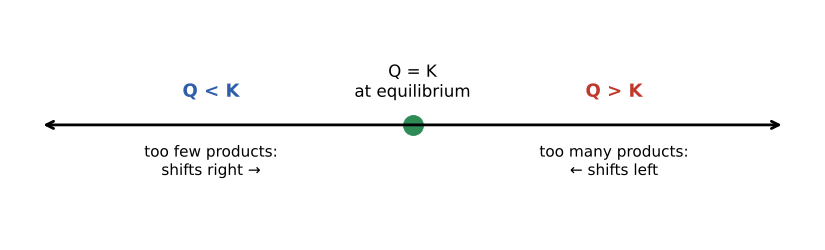
Pure solids and pure liquids are left out, just as they are in K. Comparing Q with K tells you which way the reaction must run to reach equilibrium.
| Comparison | What It Means | Net Reaction |
|---|---|---|
| \(Q\lt K\) | Too few products relative to reactants | Proceeds forward, toward products |
| \(Q=K\) | System is at equilibrium | No net change |
| \(Q\gt K\) | Too many products relative to reactants | Proceeds in reverse, toward reactants |
Worked example 1: For \(\text{H}_{2}(g)+\text{I}_{2}(g)\rightleftharpoons 2\text{HI}(g)\), K is about 54 at 430°C. A mixture contains 0.10 M H2, 0.10 M I2, and 0.50 M HI. Which way will it shift?
- \(Q=\dfrac{(0.50)^{2}}{(0.10)(0.10)}=25\)
- Since \(25\lt 54\), \(Q\lt K\).
- The reaction proceeds forward, forming more HI until Q rises to K.
Le Châtelier’s Principle Through Q
Le Châtelier’s principle states that when a system at equilibrium is disturbed, it shifts in the direction that partially counteracts the disturbance. The AP exam expects you to go further and justify the shift with Q and K. Right after a disturbance, Q no longer equals K, and the system reacts until they match again.
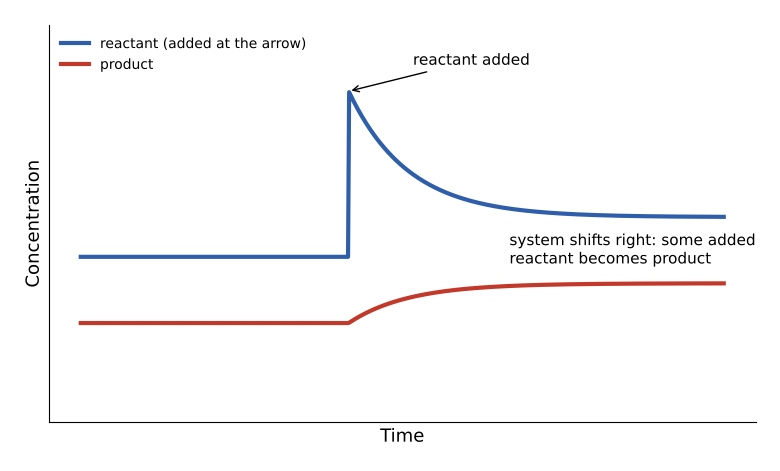
Adding or removing a substance. Adding a reactant increases the denominator of Q, so \(Q\lt K\) and the reaction shifts forward. Removing a product decreases the numerator, which has the same effect. Adding a product or removing a reactant makes \(Q\gt K\), and the reaction shifts in reverse. K itself does not change.
Why does this matter? Industrial chemists use this idea constantly. In the Haber process, ammonia is condensed and removed as it forms. Removing product keeps Q below K, so the forward reaction keeps running and the yield improves.
Changing Volume or Pressure
For gas-phase reactions, compressing the container raises every gas concentration by the same factor. Whether Q changes depends on the moles of gas on each side.
Worked example 2: For \(\text{N}_{2}(g)+3\text{H}_{2}(g)\rightleftharpoons 2\text{NH}_{3}(g)\), the volume is suddenly halved. Predict the shift.
- Halving the volume doubles every concentration.
- The new quotient is \(Q=\dfrac{(2[\text{NH}_{3}])^{2}}{(2[\text{N}_{2}])(2[\text{H}_{2}])^{3}}=\dfrac{4}{16}K=\dfrac{1}{4}K\).
- Since \(Q\lt K\), the reaction shifts forward, toward the side with fewer moles of gas (2 moles versus 4).
If both sides have the same number of moles of gas, as in the HI reaction, a volume change leaves Q unchanged and causes no shift.
Adding an inert gas such as argon at constant volume does not change any partial pressure or concentration, so Q stays equal to K and nothing shifts.
Changing Temperature
Temperature is different: it is the only common stress that changes the value of K itself. Treat heat as a reactant or product:
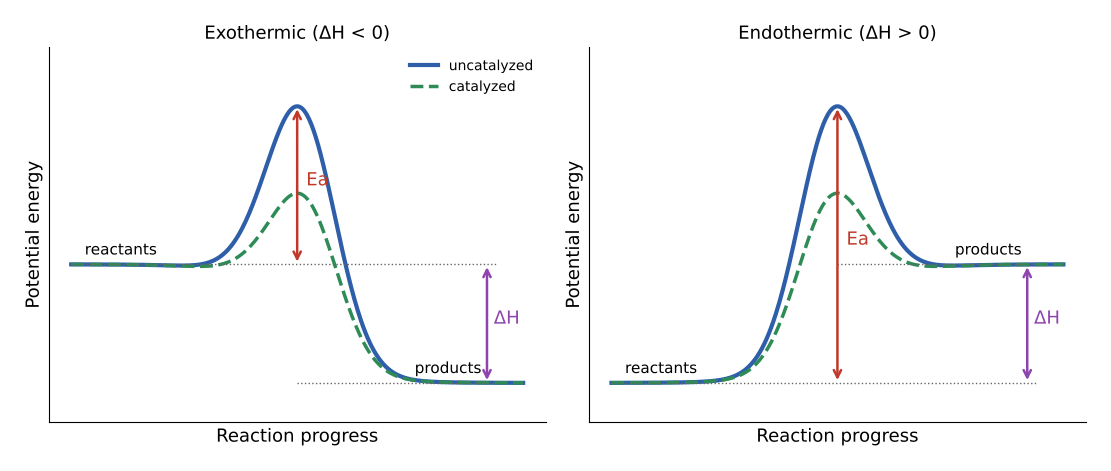
- For an exothermic reaction (\(\Delta H\lt 0\)), heat acts like a product. Raising the temperature decreases K, so now \(Q\gt K\) and the reaction shifts toward reactants.
- For an endothermic reaction (\(\Delta H\gt 0\)), heat acts like a reactant. Raising the temperature increases K, so \(Q\lt K\) and the reaction shifts toward products.
In the opening example, \(2\text{NO}_{2}(g)\rightleftharpoons\text{N}_{2}\text{O}_{4}(g)\) is exothermic in the forward direction. Cooling increases K, the system shifts toward colorless N2O4, and the brown color fades.
Catalysts
A catalyst speeds up the forward and reverse reactions equally. It changes neither Q nor K, so it does not shift the position of equilibrium. It only helps the system reach equilibrium faster.
Why does this matter? Free-response questions often ask you to “justify your answer in terms of Q and K.” A response that only says “Le Châtelier’s principle” usually earns partial credit at best. Stating how the disturbance changed Q, comparing it with K, and naming the resulting direction earns full credit.
Test-Taking Strategies
Mnemonic Devices and Memory Shortcuts
“Q small, go tall”: when Q is less than K, the reaction grows toward products. “Only temperature touches K.” For volume, “squeeze toward fewer gas moles.”
Cross-Topic Connections
- The qualitative version of this topic is Topic 7.9: Introduction to Le Châtelier’s Principle.
- Writing Q and K expressions is covered in Topic 7.3: Reaction Quotient and Equilibrium Constant.
- Finding new concentrations after a shift uses Topic 7.7: Calculating Equilibrium Concentrations.
- The same reasoning applies to Topic 7.12: Common-Ion Effect.
Common Question Formats
- Calculate Q from given concentrations and predict the direction of the reaction.
- Predict and justify a shift after adding or removing a species.
- Explain the effect of a volume change on a gas-phase equilibrium.
- Explain how a temperature change affects K for an exothermic or endothermic reaction.
Frequent Student Mistakes
- Claiming that adding a reactant changes K.
- Including pure solids or liquids in Q.
- Saying a catalyst shifts equilibrium toward products.
Test-Day Shortcuts
For any disturbance, ask one question first: did the temperature change? If not, K is fixed, and you only need to decide whether the disturbance raised or lowered Q.
Time Management Tips
Multiple-choice questions on the AP® Chemistry exam average about 90 seconds each. Q versus K calculations fit easily in that time; save extra minutes for free-response justifications.
Check for Understanding
Think you’ve got it? Complete the quiz below to make sure. Download your results at the end.