
Maximize your score with these resources:
- Albert.io AP® US Government question banks
- Free AP® US Government study guides
- Free AP® US Government score calculator
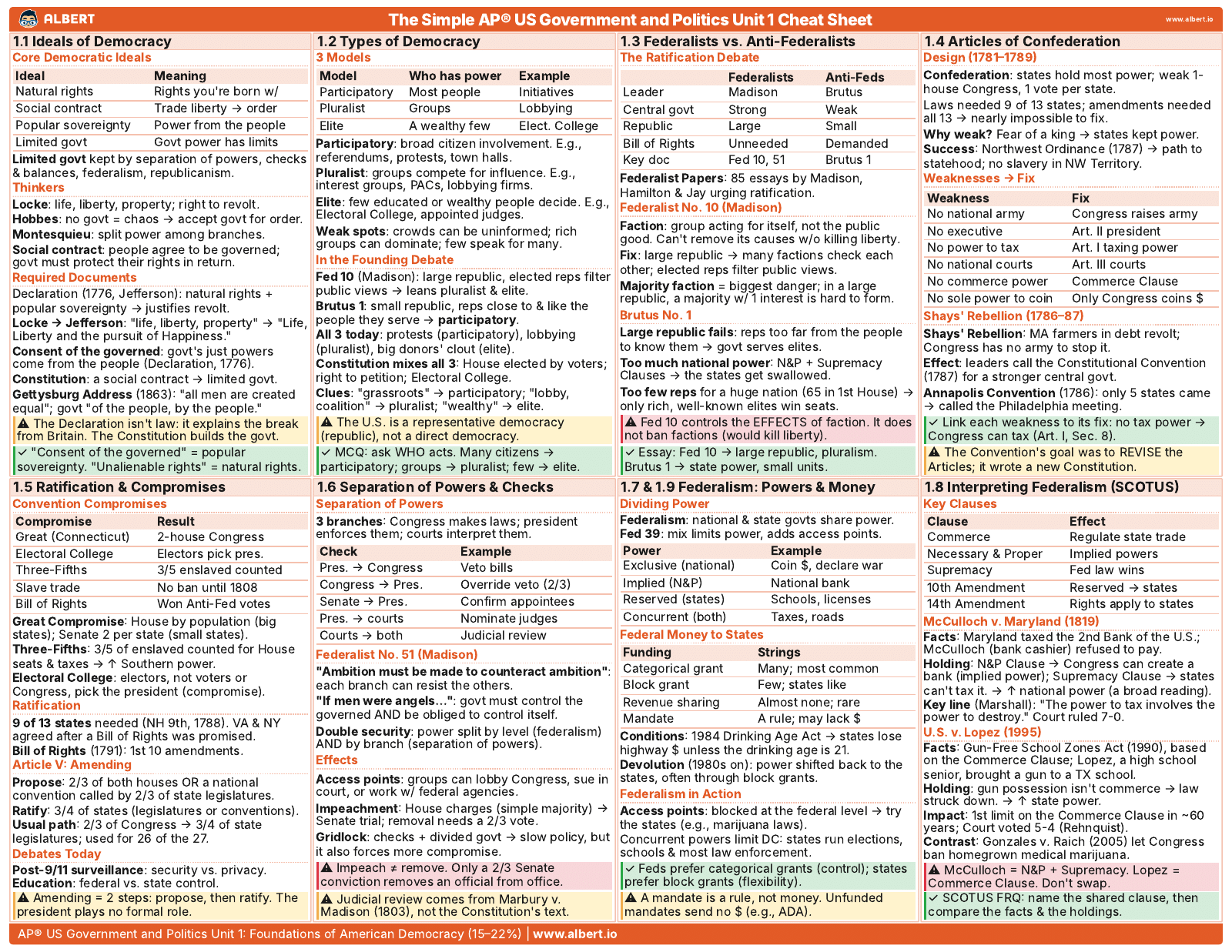
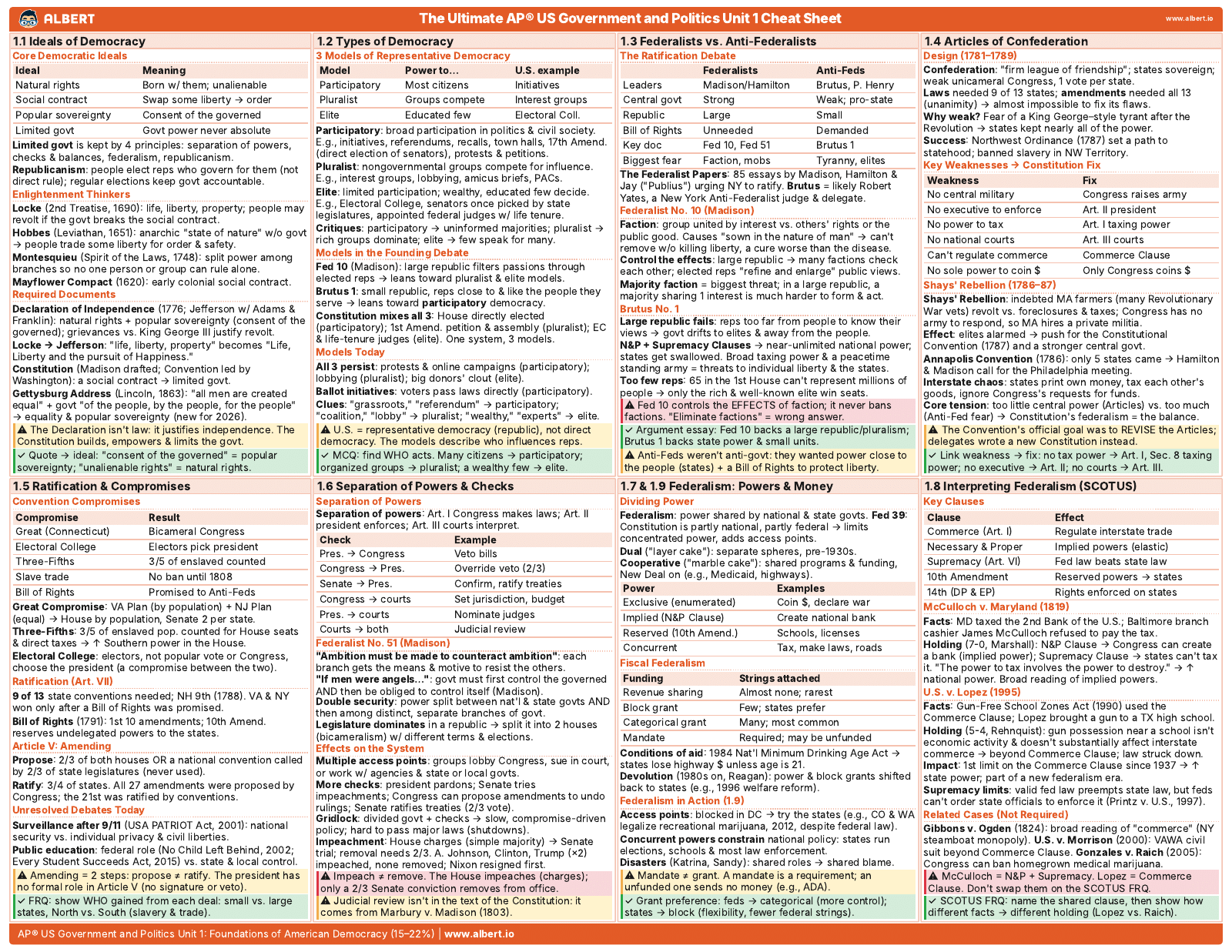
This AP Gov Unit 1 cheat sheet covers Foundations of American Democracy, the unit that sets up everything else in AP® U.S. Government and Politics: democratic ideals, the founding debates, checks and balances and federalism. Unit 1 is 15–22% of the multiple-choice section. Download it in Simple for a first pass or Ultimate for full exam review.
Practice AP® US Government and Politics Unit 1 questions on Albert
What’s on the AP Gov Unit 1 Cheat Sheet?
Both versions follow the nine topics College Board lists for Unit 1, from the ideals behind the Declaration to the Supreme Court cases that set the limits of federal power. They use the same eight cards, so you can switch between them without losing your place.
The Simple version is for your first pass through the unit or for a student who wants the core ideas without the extras. It keeps the essentials: the four democratic ideals, the three models of democracy, Federalist No. 10 vs. Brutus No. 1, the weaknesses of the Articles, the major compromises, checks and balances, the types of federal grants, and the two required cases.
The Ultimate version is for the week before a unit test or the exam. It adds the details that separate a 4 from a 5: the Federalist No. 51 quotations, the Article V math, devolution and cooperative federalism, the Annapolis Convention, the 2026 additions to the required documents (the Gettysburg Address and Federalist No. 39), and related cases like Gibbons v. Ogden and Gonzales v. Raich that help you reason about new scenarios.
AP Gov Unit 1 at a Glance
Unit 1 makes up 15–22% of the multiple-choice section. It is the base for everything that follows: Unit 2’s fights between branches, Unit 3’s rights cases and Unit 5’s interest groups all assume you already understand the principles here.
| Topic | Name | Focus |
|---|---|---|
| 1.1 | Ideals of Democracy | Natural rights, social contract, popular sovereignty, limited government |
| 1.2 | Types of Democracy | Participatory, pluralist and elite models |
| 1.3 | Government Power and Individual Rights | Federalist No. 10 vs. Brutus No. 1 |
| 1.4 | Challenges of the Articles of Confederation | Weaknesses and Shays’ Rebellion |
| 1.5 | Ratification of the U.S. Constitution | Convention compromises and Article V |
| 1.6 | Principles of American Government | Separation of powers, checks and balances, Federalist No. 51 |
| 1.7 | Relationship Between the States and National Government | Exclusive, reserved and concurrent powers; grants and mandates |
| 1.8 | Constitutional Interpretations of Federalism | Key clauses, McCulloch and Lopez |
| 1.9 | Federalism in Action | How divided power shapes policymaking |
Key Concepts in Unit 1: Foundations of American Democracy
Democratic Ideals and the Founding Documents (1.1)
Four ideals sit under the whole system. Natural rights are rights people have from birth that no government grants or can take away. A social contract is the unwritten deal in which people give up some freedom so the government can keep order. Popular sovereignty means government power comes from the consent of the people. Limited government means that power is never absolute, and the Constitution protects it through separation of powers, checks and balances, federalism and republicanism.
The trick is linking a phrase from a document to the right ideal. Take the Declaration’s claim that governments derive “their just powers from the consent of the governed.” That is popular sovereignty, not natural rights. The line about “unalienable Rights” to “Life, Liberty and the pursuit of Happiness” is natural rights, adapted from John Locke’s life, liberty and property. Starting in fall 2026, the Gettysburg Address is also required here: Lincoln’s “government of the people, by the people, for the people” restates popular sovereignty, and his return to “all men are created equal” restates equality.
Exam tip: the Declaration explains why the colonies broke away; it creates no government. If a question asks which document set up a system of limited government, the answer is the Constitution.
Three Models of Democracy (1.2)
The U.S. is a representative democracy, and political scientists describe three ways citizens influence representatives. Participatory democracy stresses broad involvement: ballot initiatives, referendums, protests, town halls. Pluralist democracy stresses groups competing for influence: interest groups, lobbying, PACs, amicus briefs. Elite democracy stresses a small, wealthy or educated group making decisions: the Electoral College, appointed federal judges and, before the Seventeenth Amendment, senators chosen by state legislatures.
Worked example: a scenario describes a national association of farmers meeting with members of the House Agriculture Committee to shape a farm bill. Ask who is acting. An organized group is pressing its interest, so this is pluralist democracy. If the scenario instead described voters in a state passing a minimum-wage increase by ballot initiative, it would be participatory.
Exam tip: all three models exist in the Constitution at once. The directly elected House is participatory, the First Amendment’s right to petition supports pluralism, and the Electoral College is elite. Questions often ask you to match one feature to one model.
Federalists, Anti-Federalists and the Articles (1.3–1.4)
The Articles of Confederation (1781–1789) left power with the states. Congress could not tax, had no army to put down Shays’ Rebellion, had no executive to enforce laws, no national courts, no power over interstate commerce and no exclusive power to coin money. Amending the Articles took all 13 states, so the flaws could not be fixed. Shays’ Rebellion convinced many leaders that a stronger central government was needed.
The fight over the new Constitution produced two required documents. In Federalist No. 10, Madison argues that factions are “sown in the nature of man,” so the goal is to control their effects, not remove their causes. A large republic with many competing factions, filtered through elected representatives, keeps any one faction (especially a majority faction) from taking over. In Brutus No. 1, the Anti-Federalist author argues that a republic as large as the United States cannot work: representatives will be too far from the people, the Necessary and Proper and Supremacy Clauses will let the national government swallow the states, and liberty will suffer.
Worked example: a passage says that “the greater number of citizens and extent of territory” makes it harder for a majority to act together against others. Which document, and which model? That is Federalist No. 10, and its filtering of public views points toward pluralist and elite democracy.
Exam tip: Federalist No. 10 never proposes banning factions. Any answer that says Madison wanted to eliminate factions is a trap.
Compromise, Ratification and Checks and Balances (1.5–1.6)
The Convention ran on compromise. The Great (Connecticut) Compromise blended the Virginia Plan and the New Jersey Plan: the House is based on population and the Senate gives each state two seats. The Three-Fifths Compromise counted three-fifths of the enslaved population for House seats and taxes, which increased Southern power. The Electoral College had electors, not the popular vote or Congress, choose the president. The delegates also delayed any ban on the slave trade until 1808 and, to win ratification, promised a Bill of Rights.
Article V sets a two-step amendment process. An amendment is proposed by two-thirds of both houses of Congress or by a national convention that Congress calls when two-thirds of the state legislatures ask for one, then ratified by three-fourths of the states. The president has no formal role.
Federalist No. 51 explains why power is split. “Ambition must be made to counteract ambition”: each branch gets the tools and the motive to resist the others. Those tools are the checks: the veto, the veto override, Senate confirmation and treaty approval, judicial review and impeachment. In impeachment, the House charges an official by majority vote and the Senate removes only with a two-thirds conviction.
Exam tip: impeachment is not removal. Andrew Johnson, Bill Clinton and Donald Trump were impeached, and none was removed.
Federalism: Powers, Grants and the Courts (1.7–1.9)
Federalism splits power between the national and state governments. Exclusive powers belong only to the national government, including enumerated powers like coining money and implied powers drawn from the Necessary and Proper Clause. Reserved powers belong to the states under the Tenth Amendment. Concurrent powers, like taxing and building roads, are shared. Federalist No. 39, now required, describes the Constitution as partly national and partly federal, a mix that limits concentrated power and creates more access points.
Money is how the national government shapes state policy. Categorical grants come with many strings, are the most common and are preferred by the national government. Block grants have few strings and are preferred by states. Revenue sharing has almost none and is rarely used. Mandates are requirements, and unfunded mandates come with no money at all. The 1984 National Minimum Drinking Age Act is the classic example of conditions on aid: states that did not raise the drinking age to 21 lost part of their highway funds.
Two required cases show the courts moving the line. In McCulloch v. Maryland (1819), the Court held that the Necessary and Proper Clause lets Congress create a national bank and the Supremacy Clause stops Maryland from taxing it, which expanded national power. In United States v. Lopez (1995), the Court held that carrying a gun near a school is not economic activity, so the Gun-Free School Zones Act went beyond the Commerce Clause, which limited national power.
Exam tip: keep the clauses straight. McCulloch is about Necessary and Proper plus Supremacy; Lopez is about Commerce.
How Unit 1 Shows Up on the Exam
The exam has 55 multiple-choice questions in 80 minutes (50% of the score) and four free-response questions in 100 minutes (the other 50%). Unit 1 appears throughout. Expect multiple-choice sets built on passages from Federalist No. 10, Federalist No. 51 and Brutus No. 1, where you identify the author’s argument or the model of democracy it supports. Expect scenario questions that ask which type of power, grant or check is at work.
On the free-response section, Unit 1 fits each question type. In Concept Application, you might explain how a federal grant condition affects a state. In Quantitative Analysis, a chart of federal grant spending or state policy adoption can lead to questions about federalism. The SCOTUS Comparison often pairs a required case like Lopez or McCulloch with an unfamiliar case and asks you to identify the shared clause and explain why the facts led to the same or a different holding. The Argument Essay asks for a defensible claim backed by at least one required foundational document, and Federalist No. 10, Brutus No. 1, Federalist No. 51 and the Constitution are common choices. Scorers reward a clear thesis, specific evidence tied to the claim, reasoning that explains why the evidence supports it, and a response to an opposing view.
Common Mistakes in Unit 1
- Mistake: saying Madison wanted to eliminate factions. Fix: Federalist No. 10 controls the effects of faction through a large republic; removing the causes would destroy liberty.
- Mistake: treating impeachment as removal. Fix: the House impeaches (charges); only a two-thirds Senate vote removes.
- Mistake: mixing up block and categorical grants. Fix: categorical grants have more strings and the national government prefers them; block grants have fewer strings and states prefer them.
- Mistake: citing the Commerce Clause for McCulloch. Fix: McCulloch rests on the Necessary and Proper and Supremacy Clauses; Lopez is the Commerce Clause case.
- Mistake: calling the Declaration of Independence the source of U.S. law. Fix: it justifies independence; the Constitution creates and limits the government.
Frequently Asked Questions
Can I use this cheat sheet on the exam?
No. College Board doesn’t allow notes in the AP exam room, and AP® U.S. Government and Politics provides no reference sheet. The AP Gov Unit 1 cheat sheet is a study tool: use it to review, quiz yourself and find gaps before test day.
Should I start with the Simple or the Ultimate version?
Start with Simple if you are learning the unit for the first time or feel shaky on the basics. Move to Ultimate once you can explain every line of Simple without looking, usually a week or two before a unit test or the May exam.
Which required documents and cases are in Unit 1?
The documents are the Declaration of Independence, the Articles of Confederation, Federalist No. 10, Brutus No. 1, the Constitution and Federalist No. 51, plus the Gettysburg Address and Federalist No. 39, added for fall 2026. The required cases are McCulloch v. Maryland and United States v. Lopez.
How should I use the cheat sheet alongside practice questions?
Cover one card, answer a set of AP Gov Unit 1 practice questions on that topic, then check the card against every question you missed. The pattern of misses tells you which card to reread.
For the official topic list and learning objectives, see College Board’s AP® U.S. Government and Politics course page.