
Maximize your score with these resources:
- Albert.io AP® Human Geography question banks
- Free AP® Human Geography study guides
- Free AP® Human Geography score calculator
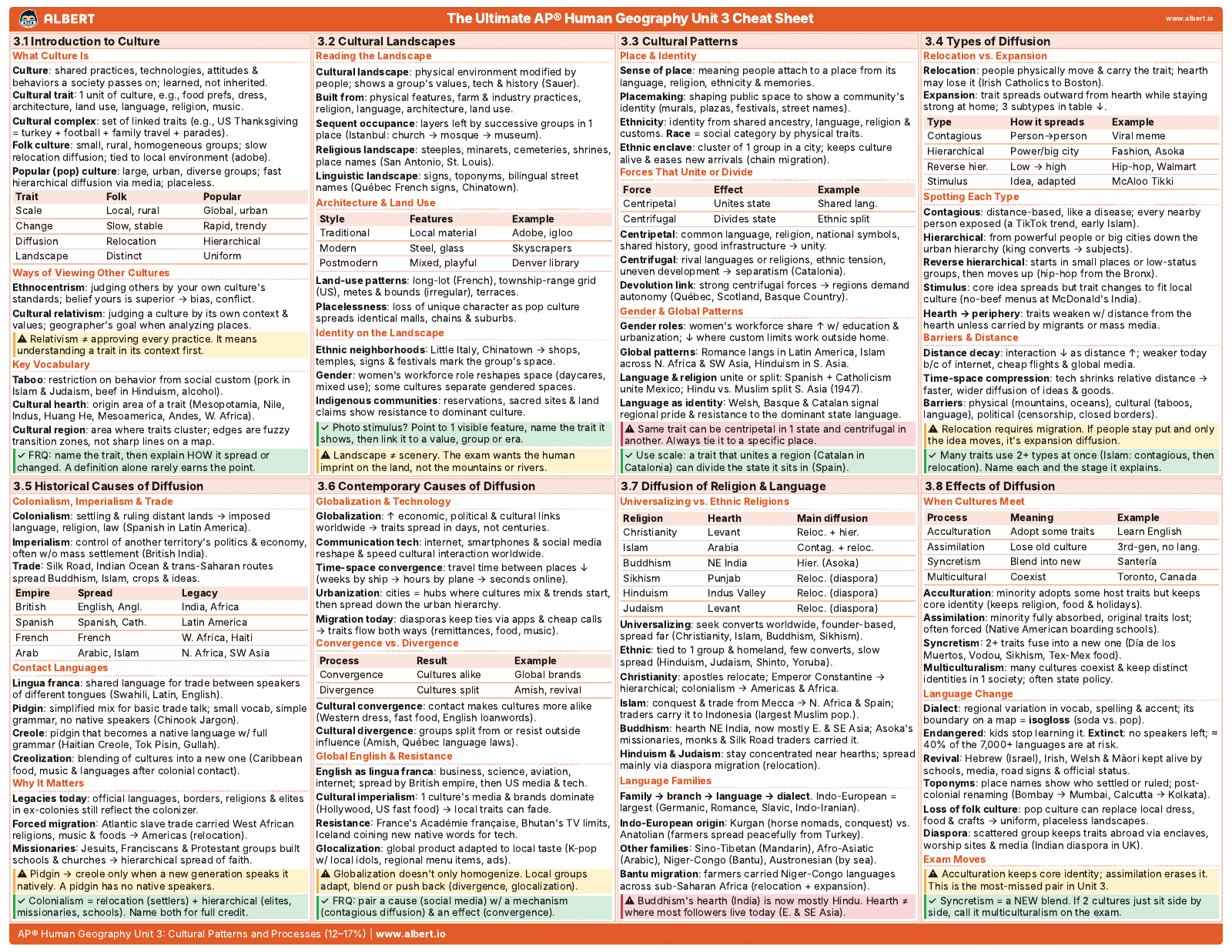
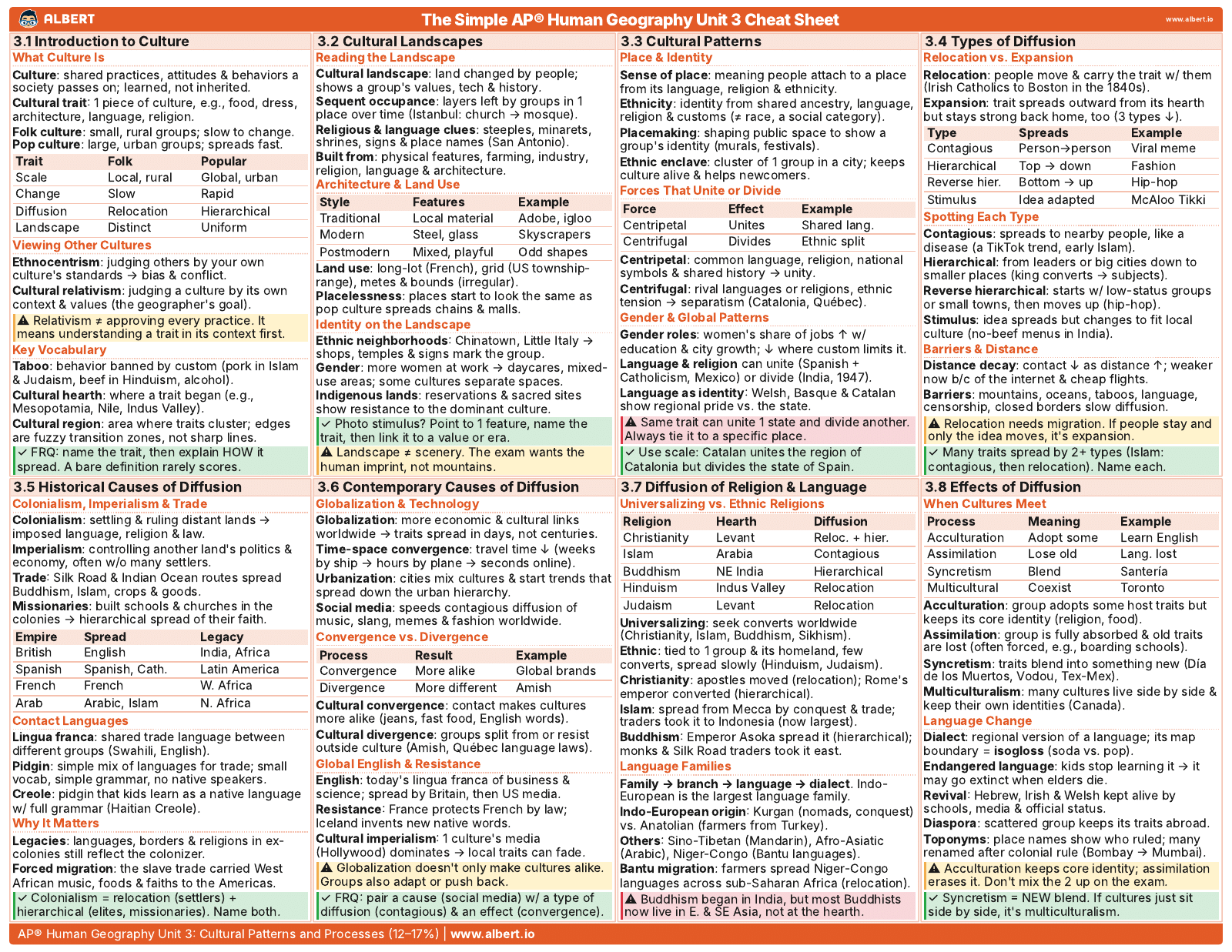
The AP® Human Geography Unit 3 cheat sheet condenses Cultural Patterns and Processes, the unit on how culture forms, shows up on the landscape, and spreads around the world. Unit 3 makes up 12–17% of the AP® Human Geography exam. Download the Simple version for a clean first pass or the Ultimate version for every term, example, and exam trap in one page.
Practice AP® Human Geography Unit 3 questions on Albert
What’s on the AP® Human Geography Unit 3 Cheat Sheet?
Both versions follow the eight topics in the College Board’s AP® Human Geography Course and Exam Description, one card per topic, from 3.1 Introduction to Culture through 3.8 Effects of Diffusion.
The Simple version is for your first pass through the unit or a quick check the night before a quiz. It keeps the core definitions (folk vs. popular culture, the four types of expansion diffusion, universalizing vs. ethnic religions, acculturation vs. assimilation) and one strong example for each, with a few words of context the first time a term appears.
The Ultimate version is for students who already know the vocabulary and want every detail that shows up in multiple-choice distractors and FRQ scoring: sequent occupance examples, contact languages (lingua franca, pidgin, creole), the Kurgan and Anatolian hypotheses, religion hearths and diffusion paths, glocalization, and toponym changes after colonial rule. Every card ends with a tip or a warning about a common mistake.
AP® Human Geography Unit 3 at a Glance
Unit 3 accounts for 12–17% of the exam score, which usually means roughly 7 to 10 of the 60 multiple-choice questions, plus a good chance that at least one free-response question leans on culture or diffusion. Here are the eight topics and what each one asks you to do.
| Topic | Name | Focus |
|---|---|---|
| 3.1 | Introduction to Culture | Define culture and cultural traits; compare ethnocentrism and cultural relativism. |
| 3.2 | Cultural Landscapes | Read the human imprint on the land, including sequent occupance and architecture. |
| 3.3 | Cultural Patterns | Explain sense of place, ethnic neighborhoods, gender roles, and centripetal and centrifugal forces. |
| 3.4 | Types of Diffusion | Tell relocation diffusion apart from contagious, hierarchical, and stimulus expansion diffusion. |
| 3.5 | Historical Causes of Diffusion | Connect colonialism, imperialism, and trade to the spread of language and religion. |
| 3.6 | Contemporary Causes of Diffusion | Explain globalization, communication technology, and time-space convergence. |
| 3.7 | Diffusion of Religion and Language | Trace hearths and diffusion paths of major religions and language families. |
| 3.8 | Effects of Diffusion | Distinguish acculturation, assimilation, syncretism, and multiculturalism. |
Key Concepts in Unit 3: Cultural Patterns and Processes
Culture, Folk vs. Popular, and How We Judge Other Cultures
Culture is the set of shared practices, technologies, attitudes, and behaviors that a society passes from one generation to the next. A cultural trait is a single piece of that culture: a food, a style of house, a language, a religious practice. Geographers sort culture into two broad types. Folk culture belongs to small, rural, fairly uniform groups, changes slowly, and is closely tied to the local environment. Popular culture belongs to large, diverse, mostly urban populations, changes quickly, and spreads through media and trade.
The unit also asks how people look at cultures other than their own. Ethnocentrism means judging another culture by the standards of your own, usually assuming your own is better. Cultural relativism means trying to understand a practice within its own context before judging it.
Worked example: Adobe houses in the American Southwest are a folk trait. Thick earthen walls hold heat during cold desert nights and stay cool during hot days, and the building material comes from local soil. A suburban house with vinyl siding built the same way in Arizona, Ohio, and Georgia is a popular culture trait: its design ignores the local environment and spread through national builders and mortgage standards.
Exam tip: When a question asks you to “explain” a folk or popular trait, connect it to the environment (folk) or to the diffusion process (popular). A definition alone rarely earns the point.
Reading the Cultural Landscape
The cultural landscape is the physical environment as people have changed it: buildings, fields, roads, signs, places of worship, and land-use patterns. It records a group’s values, technology, and history. Sequent occupance describes the layers that successive groups leave in the same place over time.
Land-use patterns are part of the landscape too. French settlers in Québec and Louisiana divided land into long lots, narrow strips running back from a river so every farm had water access. The U.S. township-and-range system produced the square grid you can see from an airplane over the Midwest. Architecture tells a similar story, from traditional buildings made of local materials to modern steel-and-glass towers to postmodern designs that mix styles.
Worked example: Istanbul’s Hagia Sophia was built as a Byzantine Christian cathedral, became a mosque under Ottoman rule (minarets were added), was turned into a museum by the secular Turkish republic, and was reconverted to a mosque in 2020. Each layer reflects the group in power at the time, which makes it a textbook case of sequent occupance.
Exam tip: With a photo stimulus, point to one visible feature, name the cultural trait it shows, then tie it to a value, group, or time period. Graders reward specific evidence from the image.
Cultural Patterns, Identity, and Centripetal vs. Centrifugal Forces
Regional patterns of language, religion, and ethnicity give places their character. A sense of place is the meaning people attach to a location, and placemaking is the deliberate shaping of public space (murals, plazas, festivals, street names) to reflect a community’s identity. Ethnic neighborhoods such as Chinatowns and Little Italys keep cultural traits alive and help new migrants settle. Attitudes toward gender also leave a mark: as more women join the paid workforce, cities add daycare centers and mixed-use spaces, while some cultures keep public spaces separated by gender.
Culture can hold a state together or pull it apart. Centripetal forces (a shared language, common religion, national symbols) unify. Centrifugal forces (competing languages or religions, ethnic tension) divide.
Worked example: In Spain, the Catalan language is a centripetal force inside Catalonia, where it strengthens regional identity. At the scale of the Spanish state, the same language becomes a centrifugal force, feeding support for Catalan independence. One trait, two effects, depending on scale.
Exam tip: Always name the place and the scale when you call a trait centripetal or centrifugal. The same trait can do both.
Types of Diffusion
Relocation diffusion happens when people move and carry a trait with them. Expansion diffusion happens when a trait spreads outward from its hearth while staying strong at home. Expansion diffusion has three main forms. Contagious diffusion spreads from person to person, like a disease. Hierarchical diffusion moves from people or places with power (leaders, large cities) down to smaller places; reverse hierarchical diffusion moves the other way, from small places or low-status groups up. Stimulus diffusion spreads the underlying idea, but the trait changes to fit the local culture.
Worked example: McDonald’s in India sells the McAloo Tikki, a potato-based burger, and offers no beef because many Hindus avoid it. The idea of the fast-food burger diffused, but the product was adapted to local food taboos. That adaptation makes it stimulus diffusion, not simple hierarchical diffusion.
Exam tip: Relocation always requires people to migrate. If the people stay put and only the idea moves, it is some form of expansion diffusion.
Historical and Contemporary Causes of Diffusion
Historically, colonialism, imperialism, and trade spread language and religion across continents. Spanish and Catholicism dominate Latin America because of Spanish colonization; English is an official language in India, Nigeria, and Kenya because of the British Empire. Trade routes such as the Silk Road and the Indian Ocean network carried Buddhism and Islam. Contact between groups produced a lingua franca (a shared trade language like Swahili), pidgins (simplified mixtures with no native speakers), and creoles (pidgins that became native languages, like Haitian Creole).
Today, globalization, the internet, and social media drive diffusion. Time-space convergence means the time it takes to move people, goods, or ideas between places keeps shrinking. The result can be cultural convergence (cultures becoming more alike) or cultural divergence (groups resisting outside influence, as France does by protecting the French language).
Worked example: A K-pop song can reach millions of listeners in Brazil within hours of release through streaming and social media. That is contagious diffusion sped up by time-space convergence, leading to cultural convergence among young fans worldwide.
Exam tip: For full credit, link a cause (social media), a mechanism (contagious diffusion), and an effect (convergence).
Religion, Language, and the Effects of Diffusion
Universalizing religions (Christianity, Islam, Buddhism, Sikhism) actively seek converts and have spread far from their hearths. Ethnic religions (Hinduism, Judaism) are tied to one group and homeland and spread mainly when followers migrate. Languages are grouped into families, with Indo-European the largest. Its spread is explained by two competing ideas: the Kurgan hypothesis (horse-riding nomads from the steppe) and the Anatolian hypothesis (farmers expanding from present-day Turkey).
When cultures meet, four outcomes are possible. Acculturation: a group adopts some traits of the host culture but keeps its core identity. Assimilation: the group is fully absorbed and loses its original traits. Syncretism: traits blend into something new, like Día de los Muertos, which mixes Indigenous Mexican and Catholic traditions. Multiculturalism: groups live side by side and keep distinct identities.
Worked example: Indonesia has the largest Muslim population in the world, yet it is thousands of miles from Islam’s hearth in Arabia. Muslim merchants carried Islam there along Indian Ocean trade routes, a case of relocation diffusion followed by contagious diffusion among local populations.
Exam tip: Acculturation keeps the core identity; assimilation erases it. This pair is one of the most commonly confused in the unit.
How Unit 3 Shows Up on the Exam
The AP® Human Geography exam has two sections, each worth 50% of your score: 60 multiple-choice questions in 60 minutes, then 3 free-response questions in 75 minutes. One FRQ has no stimulus, one uses one stimulus, and one uses two stimuli such as a map, photo, or data table.
Unit 3 multiple-choice questions often show a photo of a landscape and ask which process it reflects, or describe a spread pattern and ask you to name the type of diffusion. Expect distractors that swap closely related terms: acculturation and assimilation, hierarchical and contagious, pidgin and creole, universalizing and ethnic.
On FRQs, culture questions usually use the task verbs “identify,” “describe,” and “explain.” Scorers reward answers that name a specific process and give a real place as evidence. A response that says “the religion spread through relocation diffusion when Irish immigrants moved to Boston” earns more than “people brought their religion with them.” When a prompt includes a map or photo, use what the stimulus shows rather than writing a general answer that could fit any image.
Common Mistakes in Unit 3
- Calling any spread “relocation.” Relocation needs migration. If the idea travels while people stay home, it is expansion diffusion.
- Mixing up acculturation and assimilation. Acculturation keeps the core identity; assimilation erases it.
- Labeling a blend as multiculturalism. If two traits combine into something new, that is syncretism. Multiculturalism means the cultures stay separate side by side.
- Assuming a religion’s hearth is where most followers live. Buddhism began in India, but most Buddhists today live in East and Southeast Asia.
- Treating the cultural landscape as scenery. The exam wants human changes to the land, not mountains and rivers.
Frequently Asked Questions
Can I use this cheat sheet on the AP® Human Geography exam?
No. No notes or reference sheets are allowed on the AP® Human Geography exam. The cheat sheet is a study tool for review sessions, homework, and the days before your unit test or the exam.
Should I start with the Simple or the Ultimate version?
Start with Simple if you are learning Unit 3 for the first time or need a fast refresher. Move to Ultimate once the core terms feel easy, since it adds the extra examples and traps that separate a 4 from a 5.
How much of the AP® Human Geography exam is Unit 3?
Unit 3 is weighted at 12–17% of the exam, about the same as most other units. Culture and diffusion also appear inside questions about population, political geography, and urban areas, so the vocabulary pays off beyond this unit.
What is the best way to study diffusion types?
Build a list of real examples for each type and practice naming the type from a short description. Then test yourself with exam-style practice questions, since the multiple-choice section often describes a pattern and asks you to classify it.