
Maximize your score with these resources:
- Albert.io AP® Macroeconomics question banks
- Free AP® Macroeconomics study guides
- Free AP® Macroeconomics score calculator
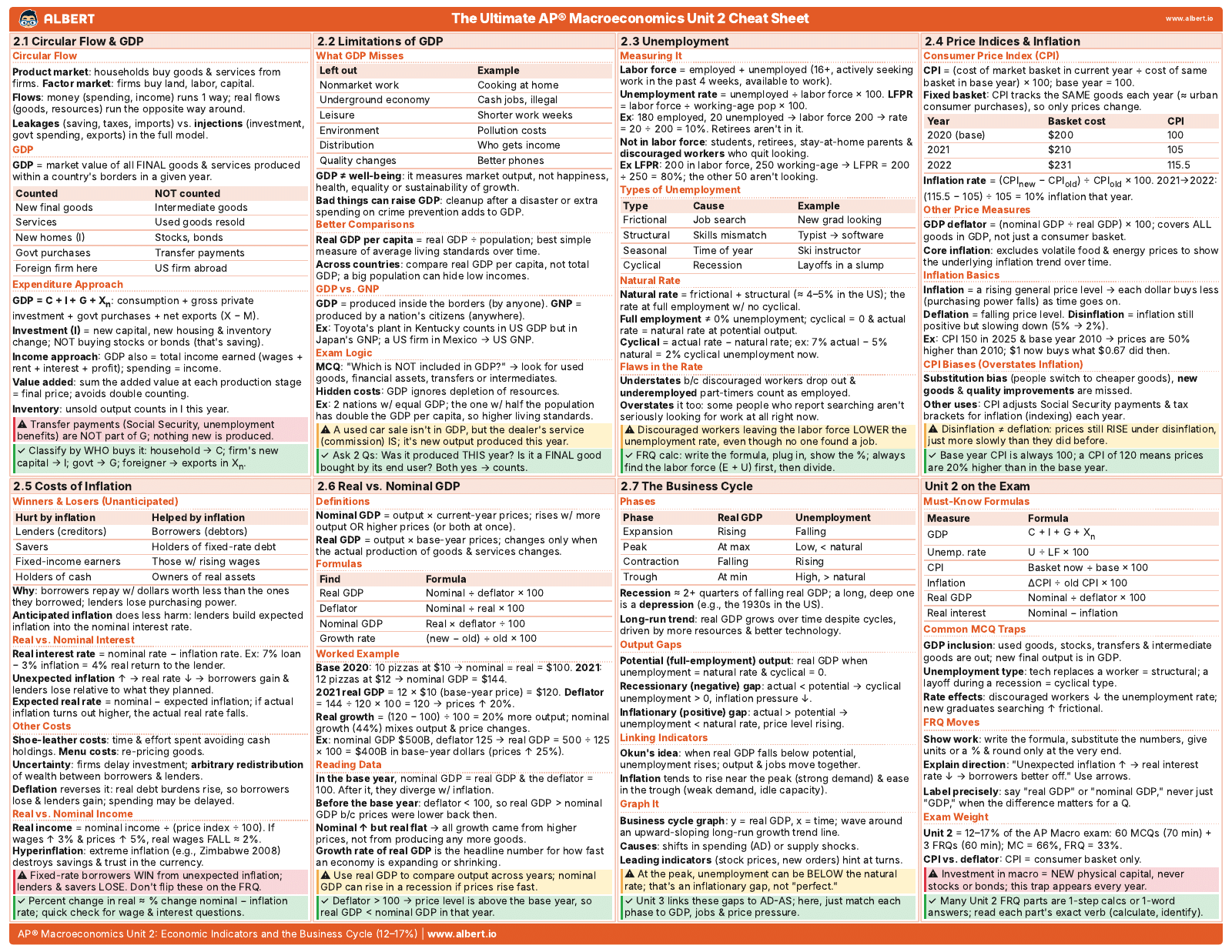
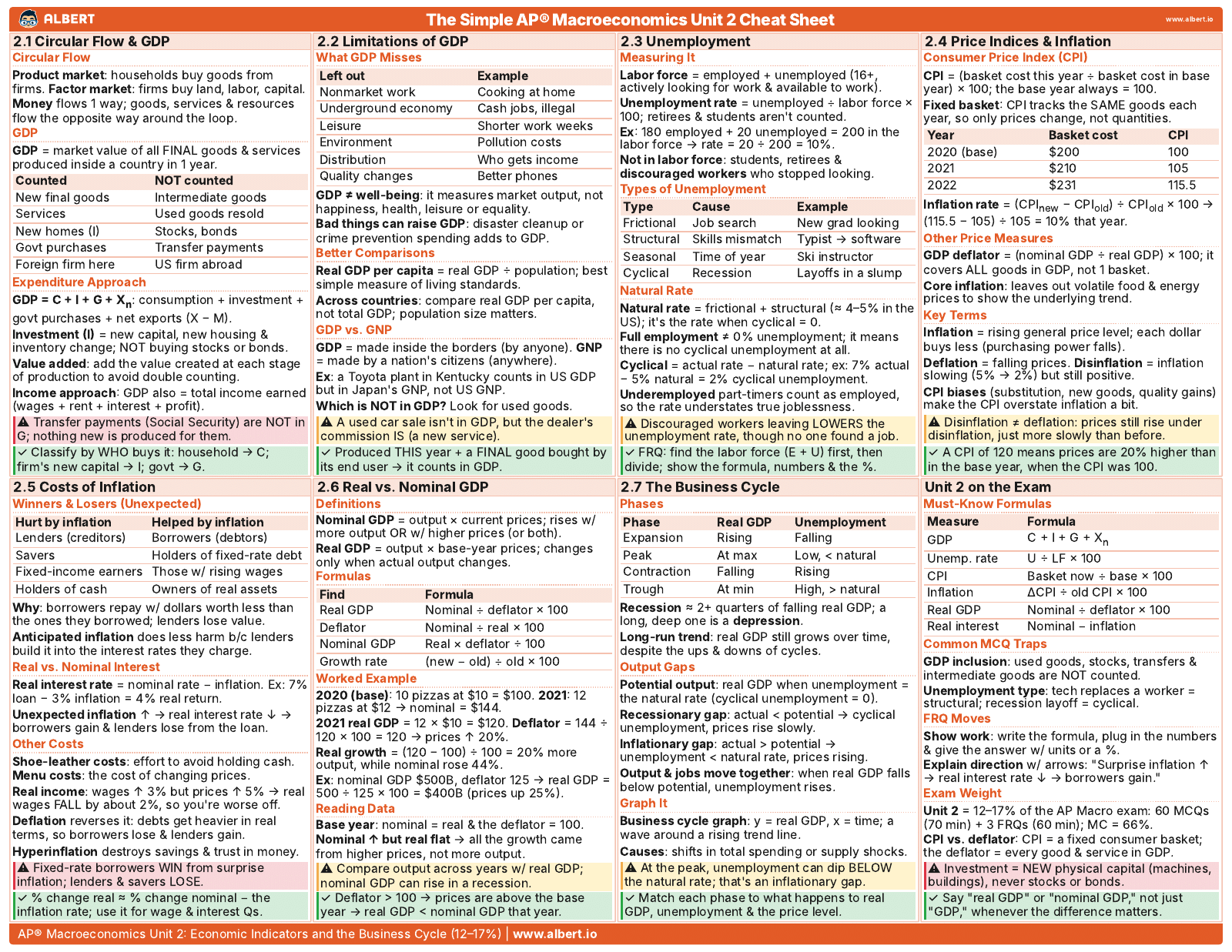
This AP Macro Unit 2 cheat sheet covers how economists measure the economy: GDP and its limits, unemployment, the consumer price index, inflation and who it hurts, real versus nominal GDP, and the business cycle. Unit 2 makes up 12% to 17% of the AP® Macroeconomics exam and supplies the formulas you will use in every later unit. Choose the Simple version for the essentials or the Ultimate version for every formula, example, and trap.
Practice AP® Macroeconomics Unit 2 questions on Albert
What’s on the AP Macro Unit 2 Cheat Sheet?
Both versions follow Unit 2 of the College Board’s AP® Macroeconomics course. Seven cards cover topics 2.1 through 2.7 in order, and an eighth card collects the formulas, common traps, and free-response moves you need on exam day.
The Simple version gives you what counts in GDP, the four components of spending, the unemployment rate formula and the four types of unemployment, how to build a CPI and calculate inflation, a winners-and-losers table for inflation, a worked real GDP example, and the phases of the business cycle.
The Ultimate version adds the circular flow’s leakages and injections, value added and the income approach, GDP versus GNP, the labor force participation rate, CPI biases and core inflation, expected versus actual real interest rates, deflation and hyperinflation, extra deflator calculations, and output gaps tied to unemployment and inflation. Start with Simple, then move to Ultimate when you are practicing free-response questions.
AP Macro Unit 2 at a Glance
| Topic | Name | Focus |
|---|---|---|
| 2.1 | The Circular Flow and GDP | What GDP measures and the expenditure approach |
| 2.2 | Limitations of GDP | What GDP leaves out and better comparisons |
| 2.3 | Unemployment | The labor force, the unemployment rate, and its types |
| 2.4 | Price Indices and Inflation | Building a CPI and calculating inflation |
| 2.5 | Costs of Inflation | Winners, losers, and real interest rates |
| 2.6 | Real v. Nominal GDP | Adjusting output for price changes |
| 2.7 | Business Cycles | Phases, output gaps, and full employment |
Unit 2 accounts for 12% to 17% of the exam, which has 60 multiple-choice questions in 70 minutes and three free-response questions in 60 minutes.
Key Concepts in Economic Indicators and the Business Cycle
GDP and What It Leaves Out
Gross domestic product is the market value of all final goods and services produced within a country’s borders in a year. Using the expenditure approach, GDP = C + I + G + Xn: consumption, gross private investment, government purchases, and net exports. Investment means new physical capital, new housing, and changes in inventories. Buying stocks or bonds is not investment in GDP; it is saving.
GDP excludes intermediate goods, used goods, purely financial transactions, and transfer payments such as Social Security. It also misses nonmarket work, the underground economy, leisure, pollution, and how income is distributed. That is why real GDP per capita is a better measure of living standards than total GDP.
Worked example: A used car sells for $8,000 and the dealer earns a $500 commission. Only the $500 counts in GDP, because the car was produced in an earlier year but the dealer’s service is new.
Exam tip: Ask two questions. Was it produced this year? Is it a final good bought by its end user? If both answers are yes, it counts.
Unemployment
The labor force is everyone 16 and older who is employed or unemployed and actively looking for work. The unemployment rate is the number unemployed divided by the labor force, times 100. Students, retirees, and discouraged workers who have stopped looking are not in the labor force.
There are four types of unemployment: frictional (between jobs), structural (skills no longer match available jobs), seasonal, and cyclical (caused by a recession). The natural rate of unemployment is frictional plus structural, and full employment means cyclical unemployment is zero, not that unemployment is zero.
Worked example: 180 people are employed and 20 are unemployed. The labor force is 200, so the unemployment rate is 20 ÷ 200 = 10%. If 5 of the unemployed give up looking, the labor force falls to 195 and the rate falls to 15 ÷ 195, about 7.7%, even though no one found a job.
Price Indices and Inflation
The consumer price index compares the cost of a fixed market basket in a given year to its cost in the base year: CPI = (current-year cost ÷ base-year cost) × 100. The inflation rate is the percent change in the CPI from one year to the next. The GDP deflator measures prices for all goods in GDP, not just a consumer basket.
Worked example: A basket costs $200 in the base year, $210 the next year, and $231 the year after. The CPIs are 100, 105, and 115.5, and inflation in the third year is (115.5 − 105) ÷ 105 = 10%.
Exam tip: Disinflation is not deflation. Under disinflation, prices still rise, only more slowly.
Costs of Inflation
Unexpected inflation redistributes wealth. Borrowers with fixed-rate loans gain because they repay with dollars worth less than the ones they borrowed. Lenders, savers, and people on fixed incomes lose. The real interest rate equals the nominal interest rate minus inflation, so a 7% loan during 3% inflation earns a 4% real return. If inflation unexpectedly rises to 5%, the lender’s real return falls to 2%.
Inflation also brings shoe-leather costs (effort spent avoiding cash), menu costs (changing prices), and uncertainty that can discourage investment. Deflation reverses the redistribution: real debt burdens rise, so borrowers lose.
Real Versus Nominal GDP
Nominal GDP values output at current prices, so it rises with either more output or higher prices. Real GDP values output at base-year prices, so it changes only when production changes. Real GDP = nominal GDP ÷ deflator × 100.
Worked example: In the base year, 10 pizzas sell at $10, so nominal and real GDP are both $100. The next year, 12 pizzas sell at $12: nominal GDP is $144, real GDP is 12 × $10 = $120, and the deflator is 144 ÷ 120 × 100 = 120. Output grew 20%, and prices rose 20%.
The Business Cycle
The business cycle moves through expansion, peak, contraction, and trough around a long-run upward trend in real GDP. When actual output is below potential output, the economy has a recessionary gap and cyclical unemployment. When actual output is above potential, it has an inflationary gap, unemployment falls below the natural rate, and prices rise faster.
Exam tip: Match each phase to three things: real GDP, unemployment, and pressure on the price level.
How Unit 2 Shows Up on the AP Macro Exam
Multiple-choice questions often ask which transaction is included in GDP, which type of unemployment a scenario describes, how a change affects the unemployment rate, or who gains from unexpected inflation. Calculation questions ask you to find the unemployment rate, a CPI, an inflation rate, real GDP, or a real interest rate from a small table.
On the free-response section, Unit 2 parts are usually short: calculate a value and show your work, identify a type of unemployment, or explain the effect of unexpected inflation on a borrower or lender. Scorers reward the correct number with the setup shown and a clear direction of change. These ideas return in Unit 3, where output gaps and the price level appear on the AD-AS graph.
Common Mistakes in AP Macro Unit 2
- Counting stocks or bonds as investment. Fix: investment means new physical capital, housing, and inventories.
- Counting transfer payments in G. Fix: only government purchases of goods and services count.
- Dividing by the population instead of the labor force. Fix: unemployment rate = unemployed ÷ labor force.
- Flipping winners and losers of inflation. Fix: fixed-rate borrowers gain; lenders and savers lose.
- Comparing years with nominal GDP. Fix: use real GDP to compare output over time.
Frequently Asked Questions
Can I use this cheat sheet on the exam?
No. The AP® Macroeconomics exam doesn’t allow notes or formula sheets. Use the cheat sheet as a study tool so the formulas and definitions are memorized before test day.
Should I start with the Simple or the Ultimate version?
Start with the Simple version of the AP Macro Unit 2 cheat sheet to learn the core definitions and formulas. Move to Ultimate once you are practicing calculations and free-response questions.
Is a calculator allowed on the AP® Macroeconomics exam?
Four-function calculators are permitted on the AP® Macroeconomics exam, but most Unit 2 calculations are simple enough to do by hand. Check the College Board’s current calculator policy before test day.
Why isn’t the natural rate of unemployment zero?
Some unemployment always exists in a healthy economy. People move between jobs (frictional) and industries change, leaving some workers with skills that no longer match open jobs (structural). The natural rate counts both, so full employment still includes them. Only cyclical unemployment disappears at full employment.
How do I tell whether a purchase counts as investment?
In macroeconomics, investment means spending on new physical capital: a firm buying new machines or building a factory, households buying newly built homes, and changes in business inventories. A family buying shares of stock, a used office building, or a government bond is not investment in GDP, because nothing new is produced. If the purchase creates new productive capacity this year, it belongs in I.
What is the difference between the CPI and the GDP deflator?
The CPI tracks a fixed basket of goods bought by consumers. The GDP deflator covers every good and service included in GDP, including investment goods and government purchases.