
Maximize your score with these resources:
- Albert.io AP® US History question banks
- Free AP® US History cheat sheets
- Free AP® US History score calculator
In his 1796 Farewell Address, George Washington warned Americans of the “baneful effects of the Spirit of Party” — the danger of political factions that would divide the nation. His warning went unheeded. Within months of his departure from office, the nation’s first two political parties were in open, bitter conflict. The Federalists and Democratic-Republicans represented fundamentally different visions of what America should be, and their clash shaped the Constitution, the early presidency, and the party system that persists today.

What Was America Like Early On?
The original thirteen colonies had one thing in common: they all hated British taxation and control. But as soon as the Revolution ended, the cracks appeared. How strong should the new federal government be? What should it be allowed to do? Who should control it?
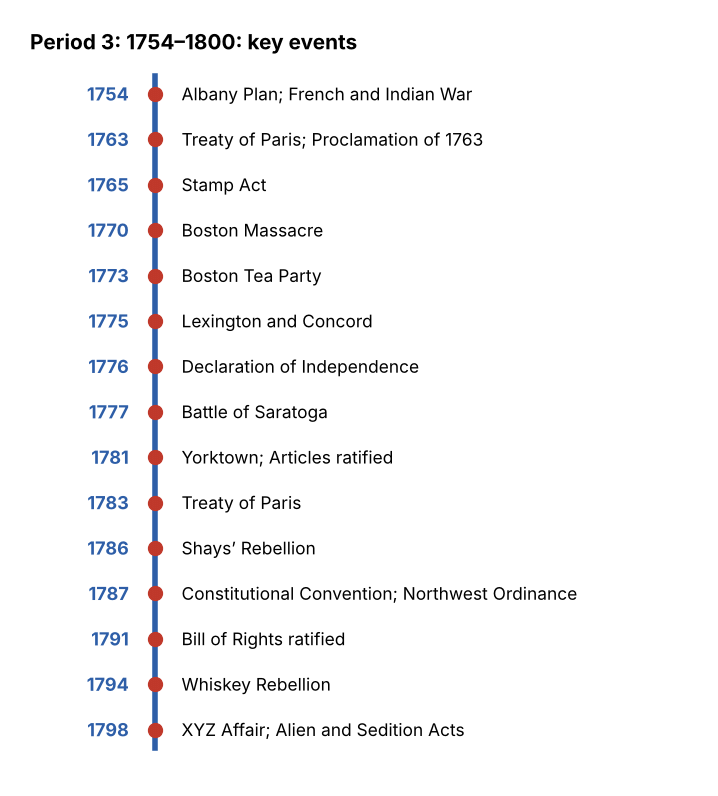
These debates weren’t abstract. Under the Articles of Confederation (the first government, 1781–1789), the federal government was so weak it couldn’t tax, raise an army, or regulate commerce between states. Shays’ Rebellion (1786–87) — an armed uprising of debt-ridden Massachusetts farmers — demonstrated the Articles’ failure to maintain order. The result was the Constitutional Convention of 1787, which created a stronger central government. But the debate about how much stronger continued for decades.
The Two Teams: Federalists vs. Democratic-Republicans
| Federalists | Democratic-Republicans | |
|---|---|---|
| Leader | Alexander Hamilton | Thomas Jefferson |
| Base | Merchants, bankers, wealthy landowners, industrialists; concentrated in New England | Farmers, frontier settlers, craftsmen, laborers; concentrated in the South and West |
| Government philosophy | Strong central government; loose interpretation of the Constitution | Limited central government; strict interpretation of the Constitution |
| Economic vision | Manufacturing, commerce, national bank, protective tariffs | Agriculture, small farming, free trade |
| Foreign policy | Pro-British; valued trade and stability | Pro-French; admired French Revolution ideals |
| Who should govern | Educated elite; distrusted common people’s judgment | Common people; democracy from the bottom up |
The core philosophical divide: Federalists believed in loose construction of the Constitution — if the Constitution didn’t explicitly prohibit something, the federal government could do it (“implied powers”). Democratic-Republicans believed in strict construction — the government could only do what the Constitution explicitly permitted.
Hamilton vs. Jefferson

The conflict wasn’t just theoretical — it was personal. Both Hamilton and Jefferson served in Washington’s cabinet simultaneously, and the tension was constant.
Hamilton’s major accomplishments as Secretary of the Treasury:
- Assumed all state war debts under the federal government (the “Assumption Plan”)
- Created the First Bank of the United States (1791) — Jefferson’s biggest objection, because the Constitution never explicitly authorized a national bank
- Established the U.S. Mint
- Authored the “Report on Manufactures,” advocating for tariffs and industrial policy
Jefferson’s counterarguments:
- The Constitution didn’t authorize a national bank — creating one violated strict construction
- Hamilton’s policies favored the wealthy commercial class over ordinary farmers
- A powerful central government was a slippery slope toward monarchy
Both men eventually resigned from Washington’s cabinet — Hamilton in 1795, Jefferson in 1793 — and the partisan conflict intensified after Washington left office.
The 12th Amendment
The original Constitution’s electoral system didn’t account for political parties. Each elector cast two votes for president; the winner became president, the runner-up became vice president. This worked fine when there were no organized parties, but it created crises once parties formed.
In 1796: Adams (Federalist) won with 71 electoral votes; Jefferson (Democratic-Republican) came in second with 68. The result was a Federalist president and a Democratic-Republican vice president — political opponents forced to govern together.
In 1800: Jefferson and Aaron Burr (both Democratic-Republicans) each received 73 electoral votes, throwing the election to the House of Representatives, which took 36 ballots to resolve in Jefferson’s favor.
The 12th Amendment (ratified 1804) fixed this by requiring separate electoral votes for president and vice president — ensuring a running mate would always share the ticket with their president.
Why the 12th Amendment Was Created
The framers of the 1787 Constitution had assumed the “best men” would govern as a natural elite above party politics. The Federalist Papers, written anonymously by Hamilton, Madison, and Jay, argued at length that the Constitution’s design would prevent factional dominance. That assumption proved wrong within a decade. The 12th Amendment was the constitutional acknowledgment that parties were here to stay — and the original electoral design needed to account for them.
The Election of 1804
Jefferson’s 1804 reelection — defeating Federalist Charles Cotesworth Pinckney by 45 percentage points — effectively ended the Federalist Party as a national force. The Federalists never won another presidential election. By the 1810s, they had collapsed entirely, leaving a brief period of one-party rule called the Era of Good Feelings (1816–1824) under James Monroe.
The collapse of the Federalists didn’t end the debate they represented, however. The strict vs. loose construction argument lived on in debates over internal improvements, tariffs, nullification, and ultimately slavery.
The Importance Today
The Federalist vs. Democratic-Republican debate established the template for American political conflict. The core question — how much power should the federal government have, and what constraints does the Constitution impose? — has never been fully resolved. The McCulloch v. Maryland (1819) Supreme Court decision gave federal power a major boost, ruling that the “necessary and proper” clause implied broad federal authority. But the fundamental tension between federal power and states’ rights, between implied and enumerated powers, continues to define American political debate more than two centuries later.
Test-Taking Strategies
Federalists vs. Democratic-Republicans is one of APUSH’s most consistently tested early republic topics. Here’s how to nail it.
Mnemonic: “FEDS love BANKS” — Federalists favored a national Bank, strong central government, and were based in the Northeast (New England). For Democratic-Republicans, think “DR. Jefferson” — Democratic-Republicans, Thomas Jefferson, agrarian vision. The contrast between Hamilton (banker/industrialist worldview) and Jefferson (farmer/democracy worldview) captures the entire divide.
Cross-topic connections:
- Federalists/DR → Era of Good Feelings: Federalist collapse → one-party politics under Monroe → but factional splits reappeared within the Democratic-Republicans, creating the Whigs and Democrats by the 1830s
- Strict vs. loose construction → nullification crisis: Jefferson’s Kentucky Resolutions (1798–99) used strict construction to argue states could nullify federal laws — a direct line to South Carolina’s nullification of tariffs in 1832
- Hamilton’s bank → McCulloch v. Maryland (1819): Marshall Court’s ruling that Congress could create a national bank settled Hamilton’s position legally — loose construction won in court
Common question formats: Expect comparison questions contrasting Federalist and Democratic-Republican positions on specific issues — bank, tariffs, foreign policy. Also expect questions about how the Election of 1800 represented a “peaceful transfer of power” between rival parties, which APUSH frames as a landmark moment in democratic history.
Frequent student mistakes:
- Confusing Federalists (1790s party) with Federalists (supporters of the Constitution in 1787–1788). The word means different things in different contexts — the 1780s “Federalists” became both Federalists AND Democratic-Republicans by the 1790s
- Forgetting that Hamilton and Jefferson both served in Washington’s cabinet — a frequently tested fact about early American governance
- Assuming the 1800 election was clean — it was a constitutional crisis that required 36 House votes to resolve, directly prompting the 12th Amendment
Test-day shortcut: If an APUSH question asks about “strict vs. loose construction,” “implied powers,” or the “necessary and proper clause,” you’re in Federalist/Democratic-Republican territory. The answers map directly: Hamilton = loose construction = federal power = national bank; Jefferson = strict construction = states’ rights = no bank unless the Constitution says so.