

Maximize your score with these resources:
- Albert.io AP® US History question banks
- Free AP® US History cheat sheets
- Free AP® US History score calculator
“Speak softly and carry a big stick.” Almost every red-blooded American has heard that phrase before. But do you really know what it means? More than that, could you explain why it is important in the form of a Free Response Question on the AP® US History exam? You need to be very familiar with this idea for the APUSH test, so we made a quick breakdown for your learning pleasure. So, here you have it: a crash course on Big Stick Diplomacy, as coined by good ole Teddy Roosevelt.
The Quick Details
Definition: A method of negotiating where it is approached peacefully, but recognizing the possible need for force. Specifically used in reference to American foreign affairs during the presidency of Theodore Roosevelt.
Dates: 1899-1908
Where: American foreign affairs with Latin America, Cuba, and Japan
Who: Theodore Roosevelt and American Congress
Why: To exert American influence and power, and to efficiently expand American markets.
Background

Theodore Roosevelt apparently coined the phrase “Speak softly and carry a big stick,” which pretty accurately summarizes the foreign affair policy of Big Stick Diplomacy, in 1901. It would go on to pretty accurately summarize his actions while in office. During the presidency of William McKinley, there was some early tension between American economic markets and foreign markets. Tension was building under McKinley’s presidency. When he was assassinated in 1901, Theodore Roosevelt was ready to step in and fill the void. He came prepared with his Big Stick Diplomacy.
Then What?
It did not take very much time into Roosevelt’s term for him to put his policy into action. As an example of his “speak softly” philosophy, Roosevelt refrained from using military force to break up strikes, even though that was a common practice by previous governments. Instead, when a bunch of mine workers went on strike, he decided to have a meeting with some of the mining company’s leaders to negotiate a deal. Their negotiations ended up not being able to resolve the issue, and Roosevelt threatened to use the military. However, instead of forcefully breaking the strike, he threatened to have the army seize and run the mines. The mining companies proceeded to give in, agreeing to arbitration, and the strike came to a close. This was one of the first examples of Theodore Roosevelt’s Big Stick Diplomacy, just on a domestic scale.
There are numerous examples of Roosevelt’s Big Stick Diplomacy at work in foreign affairs, and you probably covered many of them in your AP® US History course. We will run through a couple different ones. For the APUSH exam, you will not need to know all the ins and outs of each foreign affair issue. You do, however, need to know about the actions America took in each circumstance and how that represented Big Stick Diplomacy.
Latin America
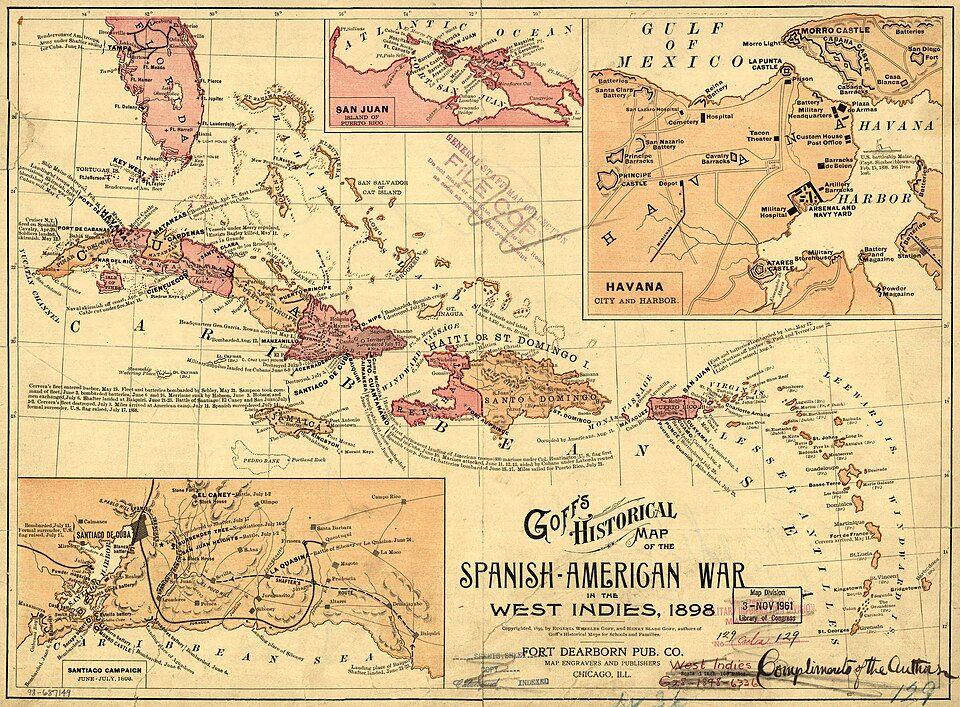
In Venezuela, as a result of previous tensions with Britain and Germany, a blockade by these two forces was put into action. Although this conflict did not directly affect the U.S., Roosevelt went ahead and got involved. He denounced the blockade and asked for it to be ended. He felt that it was important to protect the interests of smaller countries and allowing them to function on their own, as they needed to. To back up his request for the end of the blockade, he created a naval presence near Cuba. Just for enforcement purposes.
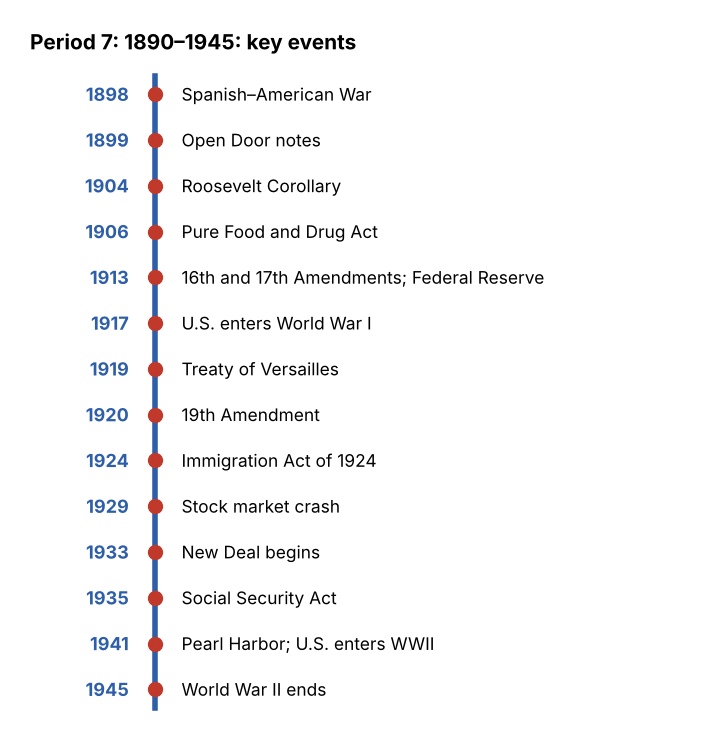
This is a key example of Big Stick Diplomacy because the first action was rooted in peaceful negotiation. He simply requested an end to the blockade. However, he was not hesitant to use the military to further enforce the issue. He spoke softly, but carried a big stick. In 1904, Roosevelt formalized this approach with the Roosevelt Corollary to the Monroe Doctrine, which claimed that the United States could act as an international police power in Latin America.
The Panama Canal
If ever there was a time where the US stuck its nose where it didn’t belong to further their own interests, it was during the construction of the Panama Canal. America wanted to build the canal as a way of expanding their market, as having a way for ships to navigate through Central America would be very beneficial economically. Colombia and France had companies that were to oversee construction of the canal, and knowing the importance of it to the U.S., they raised their prices. Instead of going to war with Colombia, America instead engineered a revolution in Panama, encouraging them to break away from Colombia. America also funded much of that endeavor, which scored them permanent access to the canal and cheaper rates of construction. This was once again a key example of exerting Big Stick Diplomacy. This time, Roosevelt used America’s economic firepower to manipulate Panama into breaking from Colombia, and U.S. warships kept Colombian troops from putting down the revolt.
Cuba
Just before Roosevelt’s presidency, relations with Cuba went through a couple of different amendments. In 1898, the Teller Amendment was a U.S. self-restriction: it disclaimed any intention to annex Cuba and pledged that the United States would leave governance of the island to the Cuban people. The later Platt Amendment (1901) is what actually restricted Cuban sovereignty — it limited Cuba’s rights to self rule and gave America established rights to intervene. It also established American rights to intervention in Cuba when necessary, while also calling for a withdrawal of troops. This serves as an example of Roosevelt’s Big Stick Diplomacy because the Platt Amendment, passed under McKinley, gave Roosevelt a legal basis to intervene, which he used when he sent troops to Cuba in 1906. Also, it continues the theme of America getting involved in areas that they didn’t necessarily have a reason to be involved in.
Wrapping Up Big Stick Diplomacy and AP® US History
Okay, so you should have a good idea of what Big Stick Diplomacy is and a few examples of it. You need to know that it was a practice of negotiation in which Theodore Roosevelt approached negotiations peacefully, while also not being afraid to use military force to enforce his negotiations. You should also know that it was relatively controversial because it often involved America taking part in aspects of foreign affairs where they didn’t really belong. Lastly, it led the way for William Howard Taft’s less successful Dollar Diplomacy.
Looking for AP® US History practice?
Kickstart your AP® US History prep with Albert. Start your AP exam prep today.
Check for Understanding
Think you’ve got it? Complete the quiz below to make sure. Download your results at the end.