

Maximize your score with these resources:
- Albert.io AP® Psychology question banks
- Free AP® Psychology cheat sheets
- Free AP® Psychology score calculator
The psychoanalytical/psychodynamic perspective is one of psychology’s oldest and most influential frameworks. Rooted in Sigmund Freud’s work, it holds that behavior, emotion, and mental life are shaped by unconscious forces — often originating in early childhood experiences. For AP® Psychology, this perspective informs Unit 4 (Social Psychology and Personality) and Unit 5 (Mental and Physical Health) and is the foundation for understanding defense mechanisms, the unconscious mind, and the origins of modern psychotherapy.
Defining the Psychoanalytical/Psychodynamic Perspective
The psychoanalytic perspective rests on a few core claims about human psychology:
| Principle | What It Means |
|---|---|
| Unconscious influence | Most of what drives behavior operates below conscious awareness — desires, fears, and memories the person isn’t aware of |
| Past shapes present | Early childhood experiences (especially trauma or unresolved conflicts) leave lasting imprints on personality and behavior |
| Conflict drives behavior | Psychological tension between unconscious drives and conscious restraints produces anxiety, defense mechanisms, and symptoms |
| Insight leads to healing | Making unconscious material conscious — through therapy — is how people resolve long-standing psychological problems |
The key insight: behavior isn’t random or freely chosen — it’s determined by forces the person can’t readily see. The goal of psychoanalytic therapy is to surface those forces so they lose their grip on behavior.
Founders of The Psychoanalytical/Psychodynamic Perspective


Sigmund Freud (1856–1939) founded psychoanalysis and introduced the most influential structural model of the mind in psychology’s history. His key contributions:
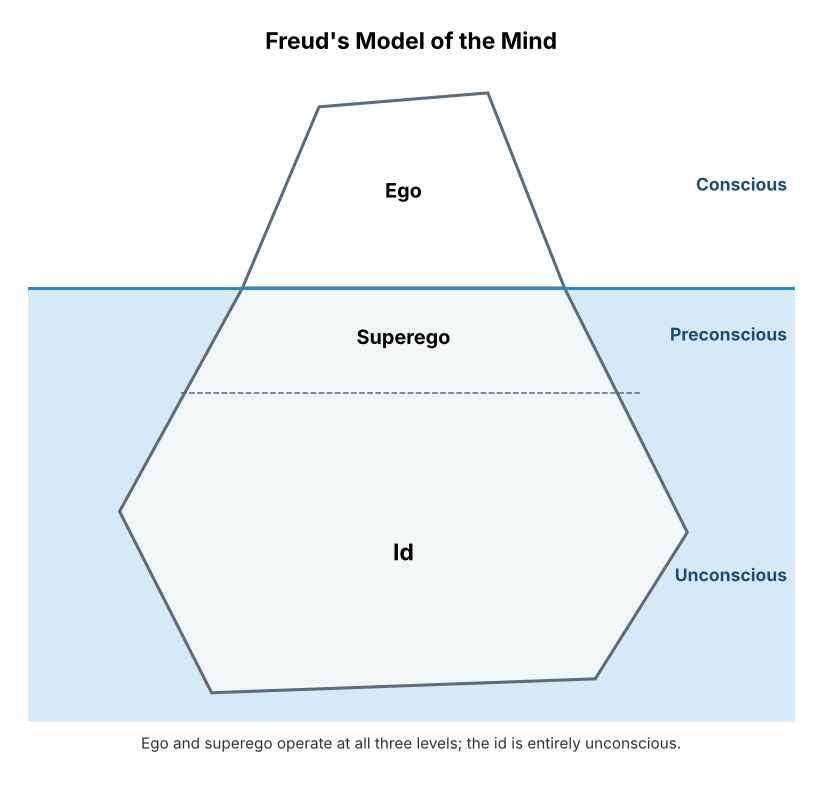
- Three-level model of mind: Conscious (what you’re aware of), preconscious (retrievable memories), and unconscious (vast reservoir of repressed material driving behavior)
- Id, ego, and superego: The id operates on the pleasure principle (immediate gratification); the ego mediates on the reality principle; the superego enforces internalized moral standards
- Psychosexual stages: Oral → Anal → Phallic → Latency → Genital. Fixation (unresolved conflict) at any stage produces characteristic adult personality problems
- Defense mechanisms: Unconscious strategies the ego uses to manage anxiety when id impulses threaten to break through
- Psychoanalytic therapy: Free association (saying whatever comes to mind) and dream analysis (interpreting manifest vs. latent content) as techniques to access the unconscious
Later theorists extended and revised Freud’s framework. Carl Jung introduced the collective unconscious and archetypes. Alfred Adler emphasized inferiority complexes and social motivation over sexual drives. Karen Horney challenged Freud’s male-centered framework and emphasized anxiety from social relationships. Erik Erikson expanded to psychosocial development across the entire lifespan. These neo-Freudians all appear on the AP exam.
Examples of The Psychoanalytical/Psychodynamic Perspective
The most commonly tested application of this perspective involves identifying defense mechanisms — the unconscious strategies the ego deploys to manage anxiety. Know these cold:
| Defense Mechanism | Definition | Example |
|---|---|---|
| Repression | Motivated forgetting — pushing threatening thoughts or memories into the unconscious | A trauma survivor has no conscious memory of the event but experiences unexplained anxiety in similar contexts |
| Projection | Attributing your own unacceptable feelings to someone else | A person who is unconsciously hostile accuses others of being aggressive toward them |
| Displacement | Redirecting an emotional response from the true target to a safer one | After being reprimanded by a boss, a person comes home and snaps at their family |
| Rationalization | Creating logical-sounding justifications for actions driven by unconscious motives | “The test was unfair” after failing an exam one didn’t study for |
| Reaction formation | Expressing the opposite of an unacceptable feeling | A person with unconscious hostility toward a sibling acts excessively caring and doting |
| Regression | Reverting to behavior from an earlier developmental stage under stress | A stressed adult begins thumb-sucking or throwing tantrums |
| Sublimation | Channeling unacceptable impulses into socially acceptable activities | Channeling aggressive impulses into contact sports or competitive work |
Test-Taking Strategies
Mnemonic for defense mechanisms:
“Really Pretty Dresses Rarely Require Real Style” → Repression, Projection, Displacement, Rationalization, Reaction formation, Regression, Sublimation
Common question formats:
- Defense mechanism identification MCQ: A scenario describes someone’s behavior — you identify which defense mechanism it exemplifies. This is the single most common application of Freud on the AP exam. The scenario will give you the behavioral clue; your job is pattern-matching
- Perspective comparison MCQ: “Which perspective would most likely explain anxiety as stemming from early childhood trauma?” → psychoanalytic/psychodynamic
- Free-response application: Apply the psychodynamic perspective to a character in a scenario — identify the defense mechanism, name the underlying unconscious conflict, and explain why that behavior persists
Cross-topic connections:
- Neo-Freudians: Erikson’s psychosocial stages (8 stages from birth to death) are tested separately from Freud’s psychosexual stages (5 stages ending in adolescence) — know both, and know the key difference: Erikson emphasized social relationships over biological drives
- Consciousness and dreams: Freud’s unconscious connects to discussions of consciousness and dreaming — dream analysis (manifest vs. latent content) is frequently tested
- Psychological disorders: Psychoanalytic explanations for anxiety and personality disorders appear in Unit 5 (Mental and Physical Health) — connecting unresolved conflicts to symptom formation
Frequent student mistakes:
- Confusing repression (unconscious, motivated forgetting of threatening material) with suppression (conscious effort to push a thought aside) — repression is involuntary and unconscious
- Mixing up Freud’s structural model (id/ego/superego) with his topographic model (unconscious/preconscious/conscious) — these are two different frameworks, both testable
- Mislabeling displacement as projection — displacement redirects to a different target; projection attributes your feeling to the other person
Pattern-matching tip for defense mechanisms: Train yourself on these four signals: repression = “can’t remember”; projection = “accuses others of their own feeling”; displacement = “redirects toward a safer target”; reaction formation = “acts opposite to true feeling.” Once these patterns are automatic, you can answer defense mechanism questions in 20–30 seconds.