

Maximize your score with these resources:
- Albert.io AP® Biology question banks
- Free AP® Biology cheat sheets
- Free AP® Biology score calculator
Introduction
When you hear “lipids,” you might think only of dietary fat — but lipids are one of the four major classes of biological macromolecules, and they do far more than store energy. They form every cell membrane in your body, serve as hormones that regulate development and reproduction, and provide insulation and organ protection. For AP® Biology, you need to understand three families of lipids — fats (triglycerides), phospholipids, and steroids — along with their structures, functions, and the chemical properties that unite them.
The defining characteristic of all lipids is that they are hydrophobic (insoluble in water). This single property explains why oil separates from vinegar in salad dressing, why cell membranes can act as selective barriers, and why steroid hormones can pass directly through the phospholipid bilayer without a transport protein.
What are Lipids?
Lipids are hydrocarbon-based organic compounds grouped by their hydrophobicity rather than by a single shared monomer (unlike proteins, carbohydrates, and nucleic acids, which are all true polymers). The three main families differ significantly in structure and function:
| Lipid Family | Structure | Primary Function | Key Example |
|---|---|---|---|
| Fats (triglycerides) | Glycerol + 3 fatty acids | Long-term energy storage, insulation, organ protection | Butter, olive oil, body fat |
| Phospholipids | Glycerol + 2 fatty acids + phosphate group | Cell membrane structure (phospholipid bilayer) | Lecithin |
| Steroids | 4 fused hydrocarbon rings + variable side groups | Cell membrane fluidity, signaling hormones | Cholesterol, testosterone, estradiol |
Fats (Triglycerides)
Fats are assembled from one molecule of glycerol bonded to three fatty acids via dehydration synthesis (also called condensation) — the same bond-forming reaction you’ll see with carbohydrates and proteins. Each bond forms an ester linkage and releases one water molecule. The reverse reaction, hydrolysis, breaks fats apart by adding water.
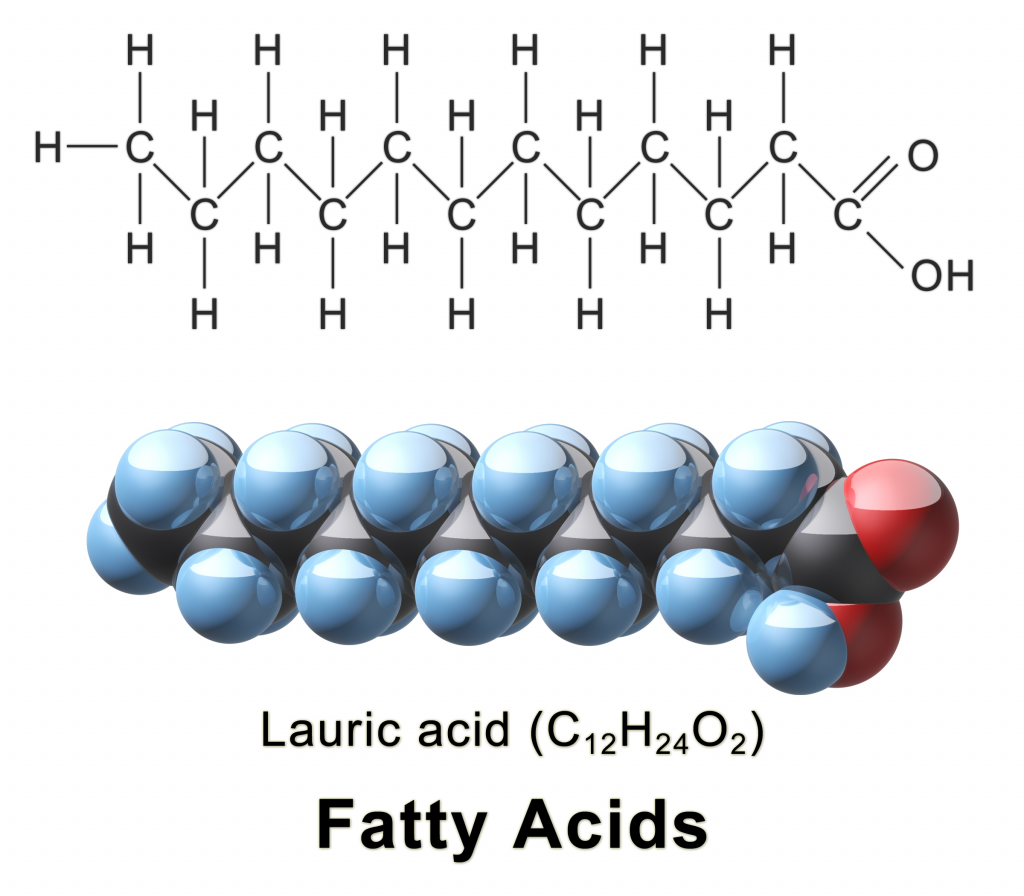 Image Source: Wikimedia Commons
As shown in the diagram above, a fatty acid consists of a long hydrocarbon tail (which is hydrophobic) and a carboxyl group (-COOH) head. The key distinction between fat types comes down to the bonds in these tails:
- Saturated fats: Only single bonds between carbons — the chain is fully “saturated” with hydrogen atoms. Saturated fats pack tightly together, making them solid at room temperature. Sources: animal fats (butter, lard), coconut oil, palm oil. Excess consumption is linked to cardiovascular disease due to plaque buildup in arteries.
- Unsaturated fats: At least one C=C double bond, which introduces a kink in the chain. This kink prevents tight packing, so unsaturated fats are liquid at room temperature (oils). Sources: olive oil, canola oil, fish oil. Monounsaturated fats have one double bond; polyunsaturated fats have two or more.
- Trans fats: Industrially produced by partial hydrogenation — adding hydrogen to vegetable oils to eliminate some double bonds and make the product more solid (e.g., margarine). The remaining double bonds adopt a trans configuration instead of the natural cis configuration, which allows tighter packing. Trans fats increase the risk of heart disease and type 2 diabetes.
Why fats matter biologically: Fat is the most energy-dense macromolecule — 1 gram of fat stores about 9 kcal, compared to ~4 kcal per gram for carbohydrates or proteins. This makes fat ideal for long-term energy storage in animals. Adipose tissue also insulates against heat loss (think whale blubber) and cushions vital organs.
Phospholipids
Phospholipids are structurally similar to fats but with one critical difference: one of the three fatty acids is replaced by a phosphate group (PO4). This gives the molecule a dual nature:
- The phosphate head is hydrophilic (polar, attracted to water)
- The two fatty acid tails are hydrophobic (nonpolar, repelled by water)
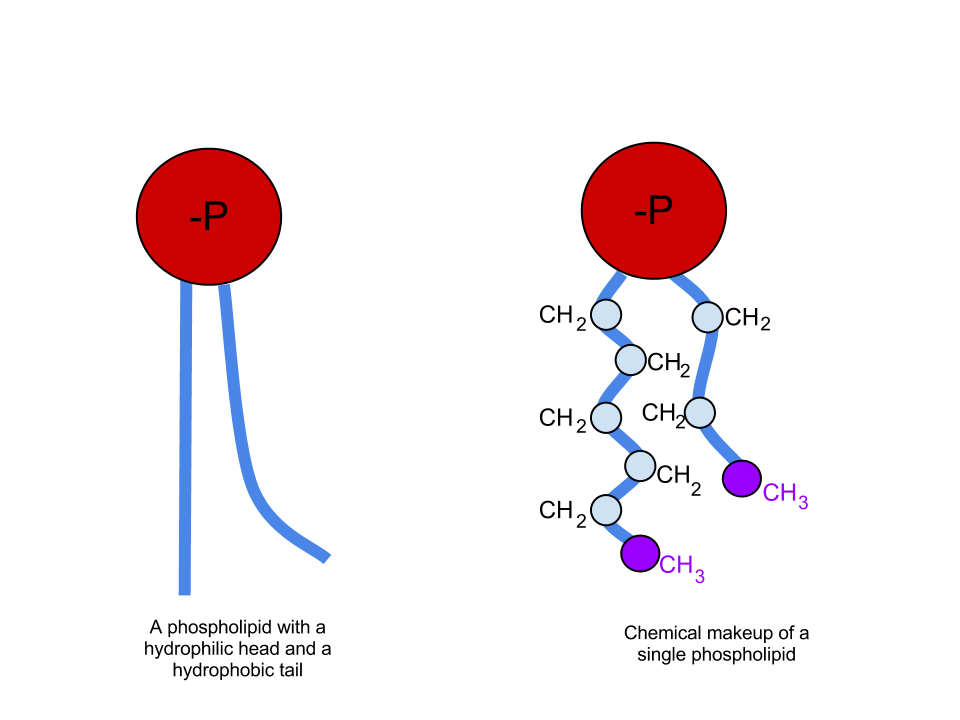 Image Source: Wikimedia Commons
This amphipathic nature (both hydrophilic and hydrophobic regions in one molecule) is what drives phospholipids to spontaneously form a phospholipid bilayer in aqueous environments. The hydrophilic heads face outward toward the water on both sides of the membrane, while the hydrophobic tails face inward, creating a nonpolar interior that acts as a selective barrier. This is the fundamental structure of all cell membranes — and one of the most frequently tested concepts on the AP® Biology exam.
Steroids
Steroids look nothing like fats or phospholipids. Instead of fatty acid chains, steroids are built from four fused hydrocarbon rings. Different functional groups attached to these rings determine which specific steroid the molecule is.
 Image Source: Wikimedia Commons
The steroid you most need to know for AP® Biology is cholesterol:
- Membrane component: Cholesterol is embedded in animal cell plasma membranes, where it acts as a fluidity buffer — at high temperatures it restrains phospholipid movement (reducing fluidity), and at low temperatures it prevents the membrane from becoming too rigid.
- Hormone precursor: Cholesterol is the starting material for synthesizing sex hormones like testosterone, estradiol, and progesterone, as well as stress hormones like cortisol.
- Signaling mechanism: Because steroid hormones are lipid-soluble, they can cross the plasma membrane directly and bind to intracellular receptors (often in the nucleus), activating gene transcription. This contrasts with water-soluble hormones like insulin, which must bind to surface receptors.
Other Lipids Worth Knowing
A few additional lipid types appear on the AP exam:
- Waxes: Long-chain fatty acids bonded to long-chain alcohols. Found as protective coatings on plant leaves (cuticle), bird feathers, and animal fur — all exploiting the hydrophobic property to repel water.
- Omega fatty acids (omega-3 and omega-6): Essential polyunsaturated fatty acids that the human body cannot synthesize. Important for brain development, inflammation regulation, and cardiovascular health.
Test-Taking Strategies
Lipids appear throughout the AP® Biology curriculum — from cell structure (Unit 2) to cell communication (Unit 4) to ecology (energy flow). Here’s how to handle them on exam day:
- Structure-function questions are the most common format. The AP exam loves asking you to connect a lipid’s molecular structure to its biological role. For every lipid type, be able to explain why its structure enables its function: triglycerides store energy because their C-H bonds contain lots of potential energy; phospholipids form bilayers because they’re amphipathic; cholesterol buffers fluidity because its rigid ring structure interacts with fatty acid tails.
- Know the membrane model. The fluid mosaic model is a major testable concept. Be prepared to explain how phospholipid composition (saturated vs. unsaturated tails), cholesterol content, and temperature all affect membrane fluidity. A common FRQ format gives you two membranes with different compositions and asks you to predict which is more fluid and why.
- Don’t confuse the three families. A frequent multiple-choice trap presents a molecule’s structure and asks you to classify it. Remember: 3 fatty acids = triglyceride; 2 fatty acids + phosphate = phospholipid; 4 fused rings = steroid. If the question describes an amphipathic molecule, it’s a phospholipid.
- Connect lipids to signal transduction. Steroid hormones (lipid-soluble → cross membrane → bind intracellular receptor → activate transcription) vs. peptide hormones (water-soluble → bind surface receptor → signal cascade) is a high-yield comparison for Unit 4.
- Energy storage comparisons. If asked to compare macromolecules for energy storage, remember: fats store ~9 kcal/g vs. ~4 kcal/g for carbohydrates. Fats are better for long-term storage; carbohydrates (glycogen, starch) are better for quick access.
- Dehydration synthesis and hydrolysis. These reactions appear across all macromolecule topics. For lipids specifically, ester bonds form between glycerol and fatty acids via dehydration synthesis (removing H2O) and break via hydrolysis (adding H2O). The AP exam may ask you to identify which macromolecule is being assembled or broken down based on the reactants and products shown.
Check for Understanding
Think you’ve got it? Complete the quiz below to make sure. Download your results at the end.