
Maximize your score with these resources:
- Albert.io AP® Biology question banks
- Free AP® Biology cheat sheets
- Free AP® Biology score calculator
What We Review
Introduction
The endosymbiotic theory explains how eukaryotic cells acquired their most important organelles — mitochondria and chloroplasts. If you’ve ever wondered why these organelles carry their own DNA, have their own ribosomes, and look suspiciously like bacteria, endosymbiosis is the answer. This topic spans CED Unit 1 (Chemistry of Life) and Unit 2 (Cell Structure and Function), and it appears regularly on the AP® exam in both multiple-choice and free-response formats.
What is Endosymbiotic Theory?
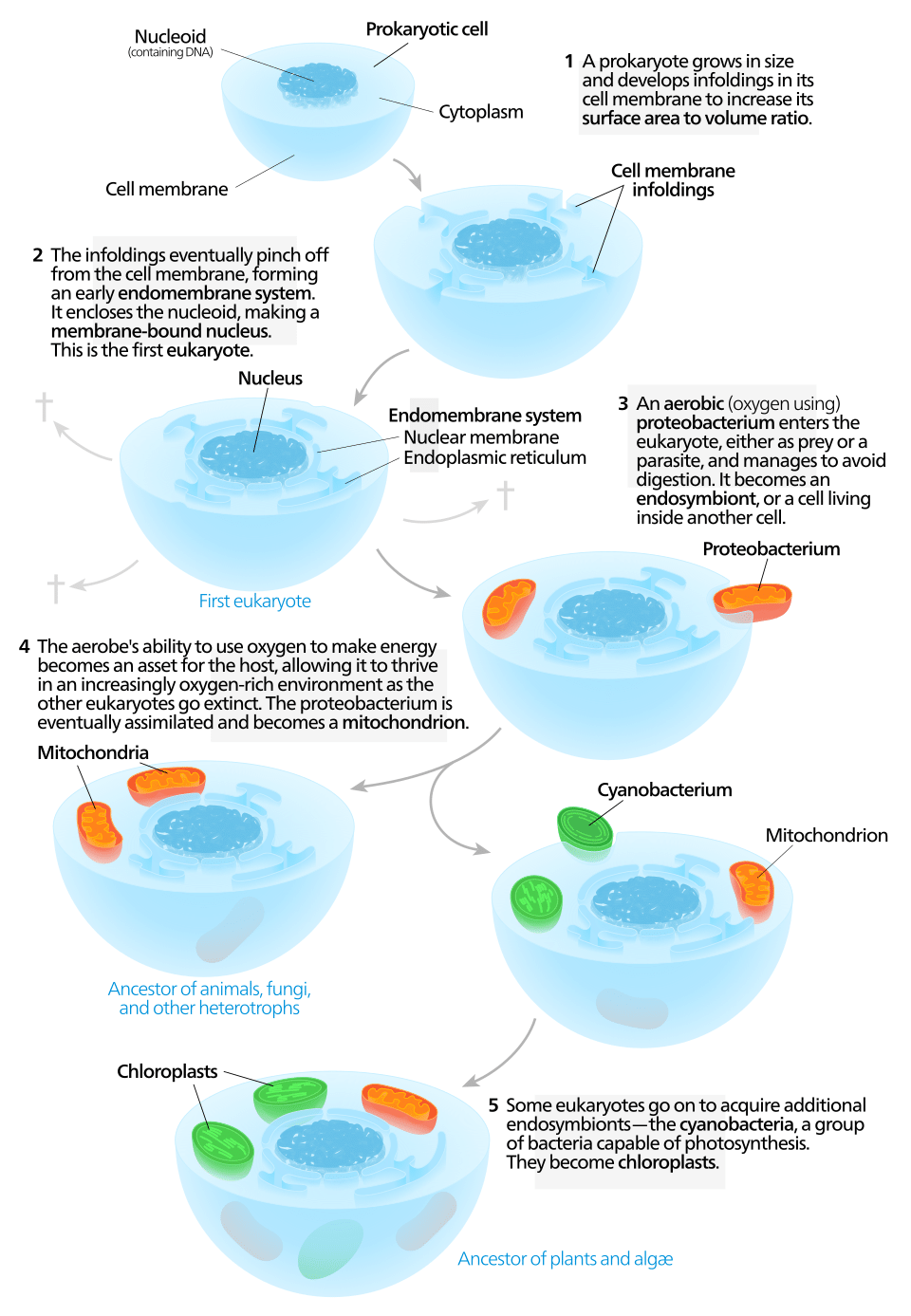
Endosymbiosis describes a relationship in which one organism lives inside another. The endosymbiotic theory proposes that mitochondria and chloroplasts originated as independent prokaryotic cells that were engulfed by a larger host cell billions of years ago. Rather than being digested, the engulfed cells survived and provided critical metabolic advantages.
The theory involves two sequential events:
- An ancestral anaerobic host cell engulfed a smaller aerobic bacterium. The bacterium survived inside the host and provided efficient ATP production through aerobic respiration. Over evolutionary time, this endosymbiont became the mitochondrion.
- In a later, separate event, some cells that already contained mitochondria engulfed photosynthetic cyanobacteria. These cyanobacteria became chloroplasts, giving the host cell the ability to convert light energy into chemical energy.
Dr. Lynn Margulis championed this theory in the late 1960s, publishing her landmark paper in 1967. Initially met with intense skepticism, the theory is now supported by overwhelming molecular, structural, and genetic evidence and stands as one of the most well-supported theories in evolutionary biology.


The diagram shows the two-stage endosymbiotic process: first the engulfment of an aerobic prokaryote (leading to mitochondria in all eukaryotes), then a subsequent engulfment of a photosynthetic prokaryote (leading to chloroplasts in the plant and algae lineage only).
Differences Between Prokaryotic and Eukaryotic Cells
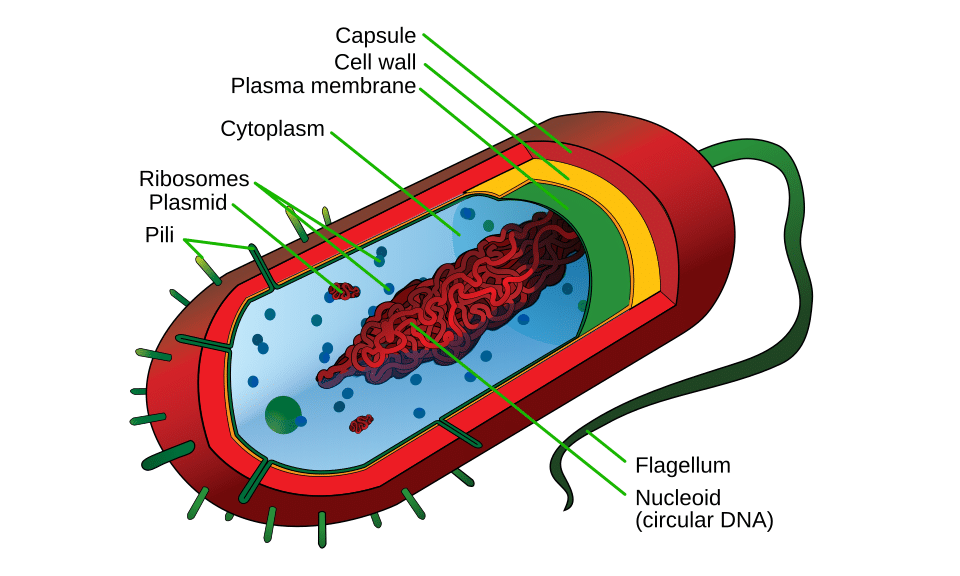
Understanding endosymbiosis requires a clear grasp of what separates prokaryotic and eukaryotic cells. Pay particular attention to the features in the rightmost column that “break the eukaryotic rules” — those exceptions are exactly what the endosymbiotic theory predicts.
| Feature | Prokaryotic Cells | Eukaryotic Cells |
|---|---|---|
| Size | Typically 1–10 µm | Typically 10–100 µm |
| Nucleus | No membrane-bound nucleus; DNA in nucleoid region | Membrane-bound nucleus with linear chromosomes |
| DNA shape | Circular chromosome(s) | Linear chromosomes (but mitochondria/chloroplasts have circular DNA) |
| Membrane-bound organelles | Absent | Present (mitochondria, ER, Golgi, chloroplasts in plants/algae) |
| Ribosomes | 70S (smaller) | 80S in cytoplasm; 70S inside mitochondria and chloroplasts |
| Compartmentalization | Limited; reactions occur in cytoplasm or on plasma membrane | Extensive; organelles separate biochemical pathways |
| Reproduction | Binary fission | Mitosis/meiosis (but mitochondria and chloroplasts divide by binary fission) |
The Evolution of Membrane-Bound Organelles
The endosymbiotic theory provides six independent lines of evidence that you need to know cold for the AP® exam. Use the mnemonic “DRaB SCP” (think: the drab, simple cells that started it all) to lock them in:
- D — Double membrane: Both organelles are surrounded by two membranes. The inner membrane likely came from the original prokaryote’s plasma membrane, while the outer membrane came from the host cell’s engulfing vesicle (endocytic membrane).
- R — Ribosomes (70S): The ribosomes inside mitochondria and chloroplasts are 70S — the same size as bacterial ribosomes — not the 80S ribosomes found in the eukaryotic cytoplasm. This is why antibiotics targeting 70S ribosomes (like chloramphenicol) can inhibit mitochondrial protein synthesis.
- B — Binary fission: Mitochondria and chloroplasts reproduce by splitting in two, just like bacteria. They never arise de novo — new mitochondria come only from pre-existing mitochondria.
- S — Size similarity: Mitochondria and chloroplasts are approximately the same size as typical bacteria (1–10 µm).
- C — Circular DNA: Both organelles contain their own small, circular DNA molecules, separate from the linear chromosomes in the nucleus — just like bacterial chromosomes.
- P — Phylogenetics: DNA sequence comparisons show that mitochondrial genes are most closely related to alphaproteobacteria, and chloroplast genes are most closely related to cyanobacteria. This molecular evidence is the single strongest support for the theory.
Functions of Endosymbiotic Organelles
Understanding what these organelles do helps you see why endosymbiosis was such a game-changer for the evolution of complex life.
Mitochondria
- Perform aerobic cellular respiration, converting glucose and oxygen into ATP through glycolysis (cytoplasm), the Krebs cycle (matrix), and oxidative phosphorylation (inner membrane).
- The highly folded cristae of the inner membrane increase surface area for the electron transport chain, maximizing ATP yield.
- Found in nearly all eukaryotic cells (both plant and animal). The ancestral endosymbiotic event gave eukaryotes a massive energy advantage over anaerobic competitors.
Chloroplasts
- Perform photosynthesis, capturing light energy and converting CO₂ and H₂O into glucose and O₂.
- Contain thylakoid membranes (organized into grana) where the light reactions occur, and a fluid stroma where the Calvin cycle fixes carbon.
- Found only in plants and algae. The endosymbiotic engulfment of a cyanobacterium gave these lineages the ability to produce their own food — the foundation of nearly every terrestrial and aquatic food web.
| Feature | Mitochondria | Chloroplasts |
|---|---|---|
| Primary function | Aerobic respiration → ATP | Photosynthesis → glucose |
| Energy input | Organic molecules + O₂ | Light energy + CO₂ + H₂O |
| Energy output | ATP + CO₂ + H₂O | Glucose + O₂ |
| Prokaryotic ancestor | Aerobic alphaproteobacterium | Photosynthetic cyanobacterium |
| Key internal structure | Cristae (inner membrane folds) | Thylakoids / grana |
| Found in | Nearly all eukaryotes | Plants and algae only |
Test-Taking Strategies
Key Mnemonic
Use “DRaB SCP” to recall the six lines of evidence for endosymbiosis: Double membrane, Ribosomes (70S), Binary fission, Size, Circular DNA, Phylogenetics. If an FRQ asks you to “describe the evidence,” list all six and briefly explain each — a clear sentence per point is sufficient.
Cross-Topic Connections
- Endosymbiosis → Cellular respiration (Unit 3): Mitochondria origin questions often lead into questions about the electron transport chain and ATP synthesis. Know that the inner membrane of the mitochondrion (from the original bacterium) is where oxidative phosphorylation occurs.
- Endosymbiosis → Photosynthesis (Unit 3): Chloroplast questions connect to the light reactions (thylakoid membranes) and the Calvin cycle (stroma). The inner membrane system traces back to the cyanobacterial ancestor.
- Endosymbiosis → Evolution (Unit 7): The AP® exam may ask how endosymbiosis represents evolutionary change through mechanisms other than natural selection. Endosymbiosis demonstrates that cooperation (mutualism) can drive major evolutionary transitions — not just competition.
Common Question Formats and Pitfalls
- Scenario-based MCQs: “A scientist discovers an organelle with circular DNA, 70S ribosomes, and a double membrane. What is the most likely evolutionary origin?” The answer is always endosymbiosis — those are the signature fingerprints.
- FRQ structure: When comparing prokaryotic features with those of mitochondria/chloroplasts, use a structured list or table to organize your answer for maximum points.
- Pitfall — Wrong ancestor: Mitochondria descended from aerobic alphaproteobacteria; chloroplasts descended from cyanobacteria. Don’t mix these up.
- Pitfall — Sequence of events: Mitochondria came first. All eukaryotes have (or ancestrally had) mitochondria; only plants and algae gained chloroplasts in a second, later event.
- Pitfall — “Just a theory”: On the AP® exam, treat endosymbiosis as strongly supported by evidence. In science, “theory” means a well-tested, well-supported explanation — not a guess.
Time Management on Test Day
- If a question mentions “own DNA,” “70S ribosomes,” or “double membrane” in the context of an organelle, the answer almost certainly involves endosymbiosis.
- For “describe the evidence” FRQs, budget 2–3 minutes. List your six evidence points with one clear sentence each, then move on.
This quiz requires JavaScript to be enabled.