

Maximize your score with these resources:
- Albert.io AP® Biology question banks
- Free AP® Biology cheat sheets
- Free AP® Biology score calculator
What We Review
Introduction
When you flip a coin, the outcome is random — and so is which allele ends up in a gamete. That randomness is meiosis at work. Meiosis is one of the most heavily tested topics on the AP® Biology exam and one of the most commonly confused with mitosis. This specialized cell division halves the chromosome number, produces genetically unique gametes, and underpins all sexual reproduction. Master meiosis and you’ll be ready for both MCQ and FRQ questions on chromosome inheritance, genetic variation, and the molecular basis of evolution.
What is Meiosis?
Meiosis is a type of cell division that produces four haploid (n) daughter cells from one diploid (2n) parent cell. It occurs only in specialized cells of the reproductive organs (ovaries and testes in animals; ovules and anthers in plants). The result is gametes — eggs and sperm in animals, and the sperm and eggs produced within pollen and ovules in plants — that carry half the genetic information of the parent cell. When two gametes fuse at fertilization, the diploid chromosome number is restored.
The Purpose of Meiosis
Meiosis serves two critical functions:
- Reduction of chromosome number: Without meiosis, chromosome number would double every generation. By halving the count (2n → n), meiosis ensures the zygote returns to 2n after fertilization.
- Generation of genetic variation: Three mechanisms introduce diversity: crossing over (recombination during prophase I), independent assortment (random orientation of homologs at metaphase I), and random fertilization (which gametes fuse). This variation is the raw material for natural selection — a direct link to Unit 7 on the AP exam.
Meiosis vs. Mitosis
| Feature | Mitosis | Meiosis |
|---|---|---|
| Number of divisions | 1 | 2 (meiosis I + meiosis II) |
| Daughter cells produced | 2 diploid (2n) | 4 haploid (n) |
| Genetic outcome | Genetically identical to parent | Genetically unique |
| Crossing over | Does not occur | Occurs during prophase I |
| Homolog pairing | No synapsis | Homologs pair (synapsis) in prophase I |
| Purpose | Growth, repair, asexual reproduction | Gamete production for sexual reproduction |
| Where it occurs | Somatic cells | Germ cells (gonads) |
If a question mentions “genetically identical,” think mitosis. If it mentions “haploid,” “gametes,” or “genetic variation,” think meiosis.
Meiosis Stages
Meiosis consists of two consecutive rounds of division. Meiosis I is the “reduction division” that separates homologous chromosomes. Meiosis II resembles mitosis and separates sister chromatids.
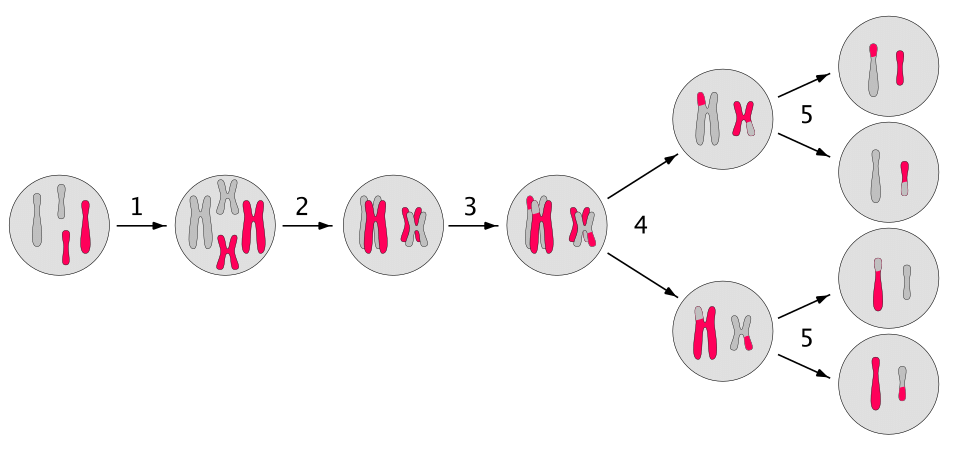
Key events unique to meiosis I:
- Synapsis: Homologous chromosomes pair up to form tetrads (bivalents)
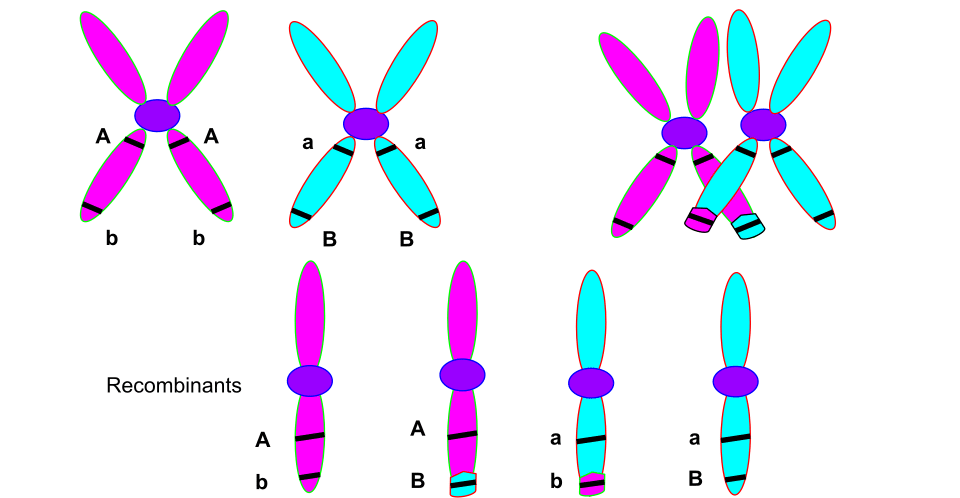
- Crossing over: Non-sister chromatids exchange segments, creating recombinant chromosomes
- Independent assortment: Each homologous pair orients randomly at the metaphase plate
Meiosis II mechanics: Mechanically similar to mitosis — sister chromatids separate — but starts with haploid cells and produces haploid daughters. No DNA replication occurs between meiosis I and II.


Detailed Breakdown of Each Stage
Meiosis I:
| Stage | Key events |
|---|---|
| Prophase I | Homologs pair (synapsis) forming tetrads; crossing over exchanges DNA between non-sister chromatids; nuclear envelope breaks down; spindle forms |
| Metaphase I | Homologous pairs align at the metaphase plate; orientation is random (independent assortment) |
| Anaphase I | Homologous chromosomes separate and move to opposite poles; sister chromatids remain joined |
| Telophase I | Nuclear envelopes may reform; cytokinesis produces two haploid cells |
Meiosis II:
| Stage | Key events |
|---|---|
| Prophase II | Chromosomes condense; spindle reforms in each haploid cell |
| Metaphase II | Individual chromosomes (not homologous pairs) align at the metaphase plate |
| Anaphase II | Sister chromatids separate and move to opposite poles |
| Telophase II | Nuclear envelopes reform; cytokinesis produces four haploid daughter cells total |
Outcomes of Meiosis
A single diploid cell that completes meiosis yields four genetically unique haploid cells. The genetic uniqueness comes from three sources:
- Crossing over during prophase I creates recombinant chromosomes with new allele combinations
- Independent assortment at metaphase I produces 2n possible chromosome arrangements — for humans (n = 23), that’s over 8 million combinations per parent
- Random fertilization multiplies the variation further — any gamete from one parent can fuse with any gamete from the other
This genetic diversity is the foundation of evolution by natural selection. Populations with greater variation are more likely to include individuals adapted to changing environments.
Test-Taking Strategies
Mnemonics:
- “PMAT × 2” — Meiosis goes through Prophase, Metaphase, Anaphase, Telophase twice
- “SCI” for what makes meiosis I unique: Synapsis, Crossing over, Independent assortment
- “4 unique halves” — 4 haploid cells, all genetically unique
- “CIA” for all three variation sources — Crossing over, Independent assortment, rAndom fertilization
Cross-topic connections:
- Genetics — Link meiosis to Mendel’s Law of Segregation (homologs separate in anaphase I) and Law of Independent Assortment (random orientation at metaphase I).
- Evolution — Crossing over and independent assortment generate the variation that natural selection acts on. More variation = better adaptation potential.
- Chromosome disorders — Nondisjunction in anaphase I or II leads to trisomy/monosomy → Down syndrome (trisomy 21), Turner syndrome (monosomy X).
Common question formats:
- “Identify the stage” MCQs showing chromosome arrangements — look for chromosome condensation, spindle presence, chromosome position
- FRQ: “Explain how meiosis contributes to genetic variation. Name all three mechanisms for full credit.”
- Data-based: “A karyotype shows an extra chromosome 21. Where did nondisjunction likely occur — anaphase I or anaphase II?”
Frequent student mistakes:
- Saying meiosis produces “identical” cells — that’s mitosis. Meiosis produces genetically unique cells
- Confusing what separates when: homologs separate in meiosis I; sister chromatids separate in meiosis II
- Forgetting crossing over happens between non-sister chromatids — sister chromatids are identical, so crossing over between them creates no new combinations
- Stating that DNA replication occurs between meiosis I and II — it does not
Test-day shortcuts:
- “Genetically identical” = mitosis. “Haploid,” “gametes,” “genetic variation” = meiosis.
- What separates: homologs apart after anaphase I, sister chromatids apart after anaphase II.
- For nondisjunction: if all four final cells are abnormal (two with an extra chromosome, two lacking it), nondisjunction was in meiosis I. If two of four final cells are normal (one has an extra chromosome and one lacks it), it was in meiosis II.
Time management: Meiosis FRQs often require naming all three variation sources. Spend 1 minute defining each, 1 minute on where it occurs, 1 minute on why it matters. Don’t rush — this section is an easy place to earn full credit with a clear, organized answer.