

Maximize your score with these resources:
- Albert.io AP® Biology question banks
- Free AP® Biology cheat sheets
- Free AP® Biology score calculator
Genetic diversity is one of the most foundational concepts in AP® Biology, cutting across evolution (Unit 7), genetics (Units 5–6), and ecology (Unit 8). Understanding why populations need genetic variation, how diversity is lost through bottlenecks and genetic drift, and how it’s maintained through sexual reproduction and gene flow are all high-yield exam topics. This guide connects the molecular mechanisms to population-level consequences, giving you exactly the framework AP® examiners test.
What We Review
Key Takeaways
- Genetic diversity is the total variety of alleles and genotypes in a population; it is the raw material that allows populations to adapt when environments change.
- Sources of new variation: mutations (ultimate source), crossing over and independent assortment during meiosis, and random fertilization.
- Hardy-Weinberg equilibrium (\(p^2 + 2pq + q^2 = 1\)) is the null model; violations reveal forces acting on a population (selection, drift, gene flow, mutation, non-random mating).
- Genetic drift (random allele frequency change) has the greatest effect in small populations; driven by bottleneck events and founder effects.
- The bottleneck effect reduces diversity by chance; the founder effect reduces diversity when a small group colonizes a new area.
- Inbreeding increases homozygosity and can expose harmful recessive alleles, reducing fitness (inbreeding depression).
- Gene flow between populations increases diversity within the receiving population and homogenizes allele frequencies across populations.
Introduction
Genetic diversity refers to the total number of genetic characteristics in the genetic makeup of a species. It provides the variation that natural selection requires to adapt populations to changing environments. Without it, a single novel pathogen or climate shift can eliminate an entire population.
Understanding Genetic Diversity
| Level | Definition | Example |
|---|---|---|
| Allelic diversity | Number of different alleles for a given gene in a population | ABO blood type locus: three alleles (I^A, I^B, i) in the human population |
| Genotypic diversity | Number of distinct genotype combinations in a population | A population with both homozygous and heterozygous individuals at multiple loci |
| Phenotypic diversity | Observable variation in traits produced by genotype × environment interaction | Coat color variation in a population of wild mice |
Sources of Genetic Variation
| Source | Mechanism | When It Occurs | AP® Exam Connection |
|---|---|---|---|
| Mutation | Changes in DNA sequence — point mutations, insertions, deletions | During DNA replication or from mutagens | Ultimate source of all new alleles; most mutations are neutral or harmful, few are beneficial |
| Crossing over (recombination) | Exchange of segments between homologous chromosomes during meiosis I | Prophase I of meiosis | Produces new allele combinations on chromosomes; increases variation beyond independent assortment alone |
| Independent assortment | Random orientation of homologous chromosome pairs at the metaphase I plate | Metaphase I of meiosis | \(2^n\) possible combinations where n = number of chromosome pairs (humans: \(2^{23}\) = ~8 million) |
| Random fertilization | Any sperm can fertilize any egg | Fertilization | Multiplies variation produced by meiosis: ~8 million × ~8 million = ~64 trillion genetically unique zygotes possible in humans |
| Gene flow | Migration of individuals (and their alleles) between populations | Ongoing, generation to generation | Introduces new alleles to receiving population; reduces divergence between populations |
Hardy-Weinberg Equilibrium
The Hardy-Weinberg principle states that allele and genotype frequencies in a population remain constant from generation to generation in the absence of evolutionary influences. It requires five conditions:
- No mutations
- No gene flow (no immigration or emigration)
- Random mating
- No natural selection (all genotypes equally fit)
- Infinitely large population size (no genetic drift)
The equations: \(p + q = 1\) (allele frequencies) and \(p^2 + 2pq + q^2 = 1\) (genotype frequencies)
Where p = frequency of dominant allele, q = frequency of recessive allele, \(p^2\) = homozygous dominant, \(2pq\) = heterozygous, \(q^2\) = homozygous recessive.
AP® Exam calculation tip: If you know the frequency of homozygous recessive individuals (\(q^2\)), take the square root to get q, then calculate p = 1 − q, then solve for all genotype frequencies.
Population Bottleneck and Founder Effects
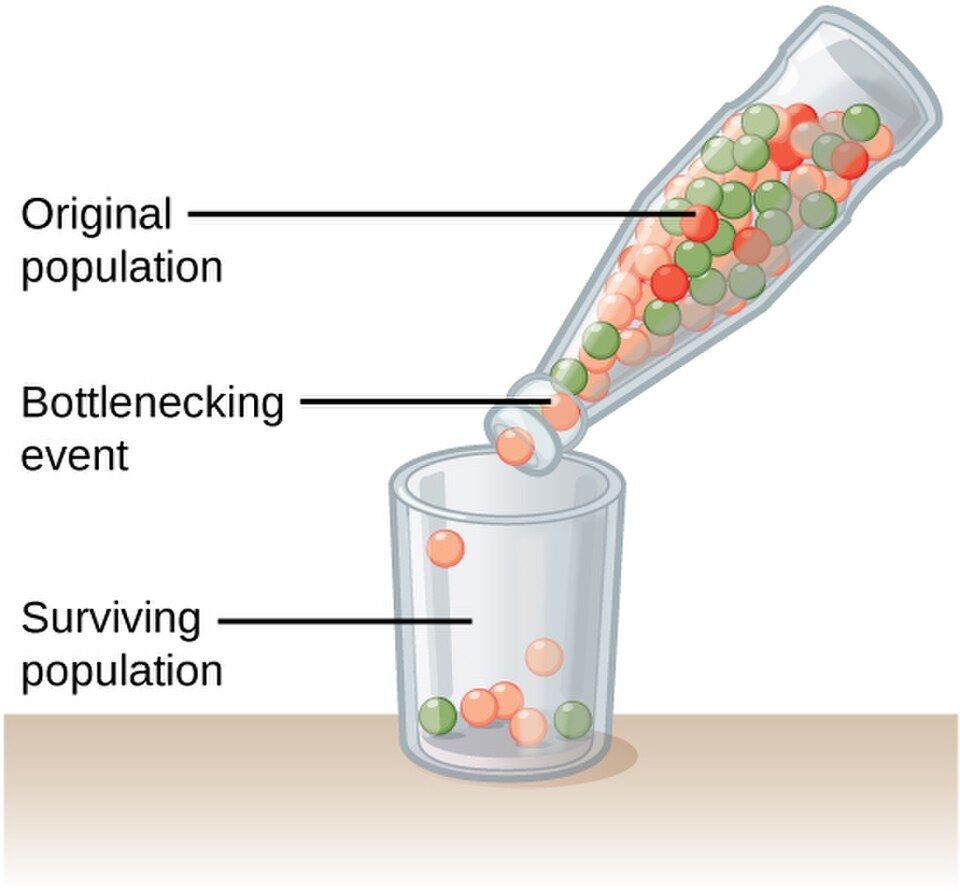
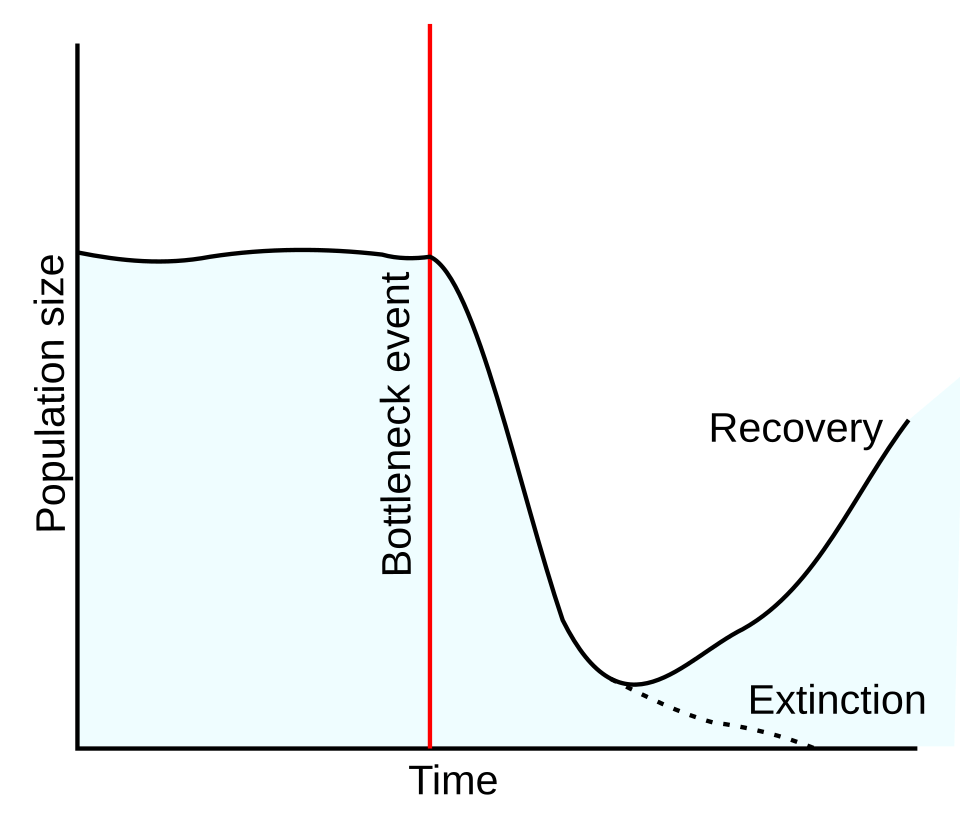

| Effect | Definition | Genetic Consequence | Example |
|---|---|---|---|
| Bottleneck effect | A drastic reduction in population size due to a catastrophic event; the surviving small population is an unrepresentative sample of the original | Loss of alleles; reduced diversity; surviving allele frequencies don’t reflect the original population | Northern elephant seal — reduced to ~20 individuals in the late 1800s; very low heterozygosity today despite population recovery |
| Founder effect | A small group of individuals colonizes a new, isolated area; founding group carries only a subset of original alleles | Reduced genetic diversity; random allele frequencies that don’t reflect the source population; increased frequency of rare alleles | Amish community in Pennsylvania — high frequency of Ellis-van Creveld syndrome (polydactyly + heart defects) due to founder carrying the allele |
Both effects are forms of genetic drift — random changes in allele frequency. Drift has the greatest effect in small populations because random sampling error is greater when sample size is small.
Inbreeding and Its Effects on Genetic Diversity
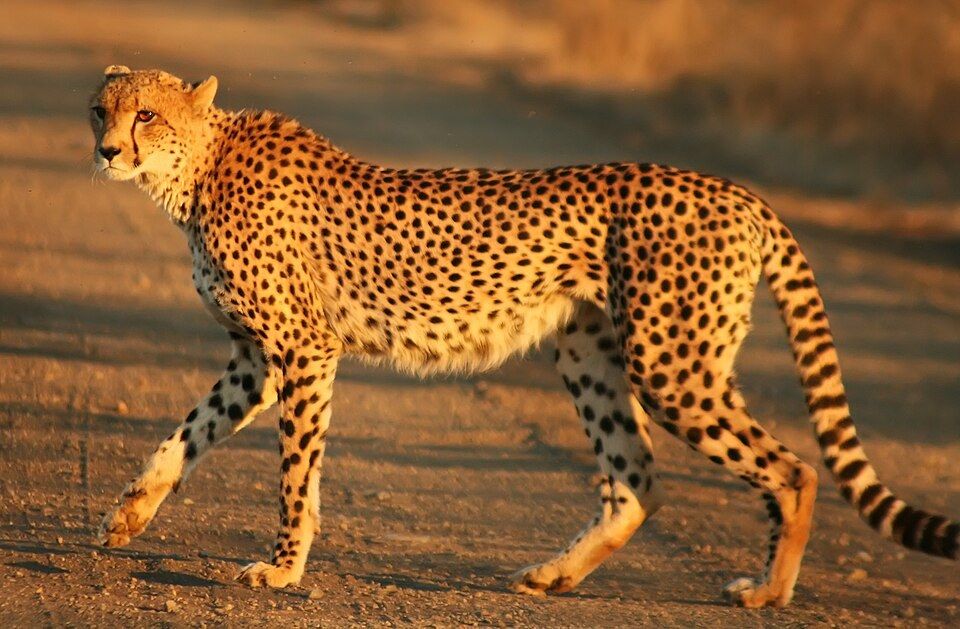
| Concept | Definition | Population-Level Effect |
|---|---|---|
| Inbreeding | Mating between closely related individuals; increases the probability of inheriting identical alleles from a common ancestor | Increases homozygosity across the genome; does not change allele frequencies, but shifts genotype frequencies toward homozygotes |
| Inbreeding depression | Reduced fitness in inbred offspring due to increased expression of harmful recessive alleles | Lower reproductive rates, higher juvenile mortality, increased susceptibility to disease |
| Heterozygote advantage | Heterozygous individuals have higher fitness than either homozygote | Maintains both alleles in the population; classic example is sickle-cell anemia / malaria resistance in heterozygous carriers |
Mechanisms That Maintain Genetic Diversity
| Mechanism | How It Maintains Diversity | Example |
|---|---|---|
| Sexual reproduction | Crossing over, independent assortment, and random fertilization generate unique genotype combinations every generation | Every human individual (except identical twins) is genetically unique |
| Gene flow | Migration introduces alleles from other populations, preventing populations from losing diversity through drift or selection | Pollinator-mediated gene flow between isolated plant populations |
| Balancing selection | Natural selection maintains two or more alleles at high frequencies (e.g., heterozygote advantage, frequency-dependent selection) | Sickle-cell allele maintained at high frequency in malaria-endemic regions because heterozygotes (Hb^A Hb^S) are most fit |
| Disruptive selection | Selects against intermediate phenotypes, favoring extreme variants; can maintain multiple alleles | Beak size in African seedcracker finches — small and large beaks both favored over intermediate sizes |
Genetic Diversity and Conservation
| Population State | Genetic Diversity | Conservation Implication |
|---|---|---|
| Large, connected population | High; gene flow prevents divergence | Resilient to environmental change; lower extinction risk |
| Fragmented population | Decreasing; isolation increases drift and inbreeding | Extinction vortex risk; habitat corridors needed |
| Post-bottleneck population | Very low; may lack alleles needed for future adaptation | Captive breeding programs may need to carefully manage pairings to maximize heterozygosity |
Quick Reference Chart: Key Vocabulary
| Term | Definition | AP® Exam Tip |
|---|---|---|
| Genetic diversity | Total variety of alleles and genotypes within a population | Contrast with species diversity and ecosystem diversity |
| Hardy-Weinberg equilibrium | Null model: allele frequencies constant when no evolutionary forces act | Know both equations and all 5 conditions; violations indicate evolution |
| Genetic drift | Random change in allele frequency due to chance sampling in finite populations | Greater effect in small populations; not directional like selection |
| Bottleneck effect | Diversity loss due to catastrophic population reduction | Survivors are a non-representative sample; allele frequencies shift randomly |
| Founder effect | Reduced diversity when a small group colonizes a new area | Explain Amish/Ellis-van Creveld; rare alleles can become common by chance |
| Gene flow | Movement of alleles between populations via migration | Increases diversity in receiving population; reduces divergence between populations |
| Inbreeding depression | Reduced fitness from increased homozygosity of harmful recessives | Explains why conservation programs avoid related pairings |
| Heterozygote advantage | Heterozygous genotype has higher fitness than either homozygote | Classic example: sickle-cell / malaria resistance |
| Balancing selection | Natural selection maintains multiple alleles at high frequency | Maintains variation — contrast with directional and stabilizing selection |
| Mutation | Ultimate source of all new genetic variation | Most are neutral or harmful; rare beneficial mutations fuel adaptation |
Test-Taking Strategies
Mnemonics to lock in key concepts:
- “Bottleneck = Bottle shake, Founder = First ones in” — Bottleneck: catastrophe dramatically reduces a large population (like shaking a bottle and only a few marbles fall through). Founder: a small group leaves and starts somewhere new. Both reduce diversity, but by different mechanisms. On the AP® exam, if you see “volcanic eruption wiped out most of the population,” that’s bottleneck. If you see “a few individuals migrated to an island,” that’s founder.
- “H-W violations = Evolution in action” — Every Hardy-Weinberg condition that is violated represents a mechanism of evolution: mutation (new alleles), gene flow (allele exchange), non-random mating (changes genotype frequencies), selection (changes allele frequencies), drift (random changes). If an FRQ says allele frequencies changed, you must identify which conditions were violated.
- “\(q^2\) first, then solve” — For Hardy-Weinberg calculations, always identify the recessive homozygote frequency (\(q^2\)) first from the data. Take the square root for q, calculate p = 1 − q, and then compute \(p^2\) and \(2pq\). Never skip this order.
- “Drift = Random, Selection = Directional” — Genetic drift causes random allele frequency changes not related to fitness. Natural selection causes directional changes in allele frequency based on fitness differences. Distinguishing them is a frequent FRQ task.
Cross-topic connections the AP® exam tests:
- Genetic diversity → Evolution (Unit 7): Drift, gene flow, selection, and mutation are all mechanisms of evolution that operate on the diversity present in a population. Low diversity = fewer options for selection to act on.
- Genetic diversity → Meiosis (Unit 5): Crossing over and independent assortment during meiosis are the immediate sources of variation produced each generation. Connect these molecular mechanisms to population-level diversity.
- Genetic diversity → Conservation biology (Unit 8): Low genetic diversity in small, fragmented, or post-bottleneck populations accelerates the extinction vortex. Habitat corridors maintain gene flow and diversity.
Common mistakes to avoid:
- Confusing bottleneck and founder effects — both reduce diversity but by different mechanisms (catastrophe vs. colonization).
- Thinking inbreeding changes allele frequencies — it doesn’t. Inbreeding shifts genotype frequencies toward homozygotes but leaves allele frequencies unchanged. Inbreeding depression reduces fitness by exposing harmful recessives.
- Forgetting that Hardy-Weinberg equilibrium means no evolution is occurring. If the AP® exam gives you data showing allele frequency change, that is evidence of evolution, and you must identify which H-W condition was violated.
- Mixing up genetic drift (random) with natural selection (fitness-based). Drift is strongest in small populations; selection is most effective in large populations with heritable variation.
Time management: Hardy-Weinberg calculation problems on FRQs are structured — show the formula, substitute values, solve for q, then p, then genotype frequencies. Budget ~3 minutes for calculation FRQs and show all work for full credit even if your final answer is wrong.
Check for Understanding
Think you’ve got it? Complete the quiz below to make sure. Download your results at the end.