

Maximize your score with these resources:
- Albert.io AP® Biology question banks
- Free AP® Biology cheat sheets
- Free AP® Biology score calculator
The origin of life is one of the most conceptually rich topics on the AP® Biology exam. It bridges chemistry, geology, and biology into a single narrative: how did non-living molecules on a hostile early Earth become self-replicating, evolving systems? You need to understand the conditions of early Earth, the key experiments that demonstrated abiotic synthesis of organic molecules, the RNA World hypothesis, and the major milestones in life’s history — from the first prokaryotes to the endosymbiotic origin of eukaryotes.
What We Review
Key Takeaways
- Life originated through abiogenesis: monomers formed abiotically → polymerized → RNA self-replicated → membrane-enclosed protocells formed.
- The Miller-Urey experiment demonstrated that amino acids can form from inorganic compounds under early Earth-like conditions — the most tested origin-of-life experiment on the AP® exam.
- Early Earth’s reducing atmosphere lacked free O₂, allowing organic molecules to accumulate without being oxidized.
- The RNA World hypothesis proposes RNA was the first molecule capable of both storing information and catalyzing reactions, solving the DNA-protein chicken-and-egg problem.
- Ribozymes (catalytic RNA) are the key evidence for the RNA World; the ribosome’s catalytic core is rRNA — a molecular fossil.
- The Great Oxygenation Event (~2.4 bya) oxygenated the atmosphere through cyanobacterial photosynthesis, enabling aerobic respiration but causing a mass extinction of anaerobes.
- Endosymbiotic theory: mitochondria and chloroplasts originated as engulfed prokaryotes; evidence includes double membranes, own circular DNA, 70S ribosomes, and binary fission.
Introduction
Life on Earth emerged from non-living matter through abiogenesis. Current scientific understanding describes a sequence of chemical milestones: small organic molecules formed first, then polymerized into macromolecules, then self-replicating systems emerged, and eventually membrane-bound cells appeared.
Understanding the Concept of the Origin of Life
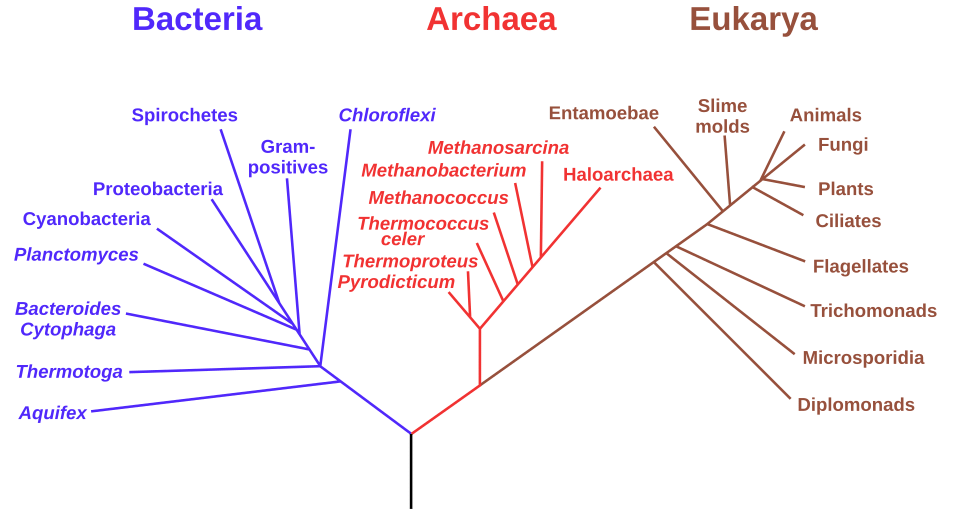
| Step | What Happened | Key Evidence / Experiment |
|---|---|---|
| 1. Abiotic synthesis of monomers | Simple organic molecules formed from inorganic precursors | Miller-Urey experiment (1953); amino acids in Murchison meteorite |
| 2. Polymerization | Monomers joined into polymers via dehydration synthesis | Sidney Fox’s proteinoid microspheres; clay mineral catalysis experiments |
| 3. Self-replication | RNA molecules capable of copying themselves and catalyzing reactions emerged | RNA World hypothesis; discovery of ribozymes |
| 4. Membrane formation | Lipid bilayers spontaneously formed vesicles, enclosing self-replicating molecules into protocells | Liposome experiments; amphipathic lipid self-assembly in water |
Conditions on Early Earth (~4.6–3.5 bya):
- Reducing atmosphere: Rich in \(H_2O\), \(CH_4\) (methane), \(NH_3\) (ammonia), \(H_2\), and \(CO_2\) — but virtually no free \(O_2\)
- Energy sources abundant: Lightning, UV radiation (no ozone layer), volcanic heat, hydrothermal vents
- Water present: Liquid oceans formed by ~4.2 bya, providing a solvent for chemical reactions
Geological Evidence Supporting the Origin of Life
| Event | Approximate Date | Significance |
|---|---|---|
| Earth forms | ~4.6 bya | Reducing atmosphere, no free \(O_2\) |
| Liquid oceans form | ~4.2 bya | Provides solvent for prebiotic chemistry |
| Earliest fossil evidence (stromatolites) | ~3.5 bya | Layered structures built by prokaryotic communities |
| Great Oxygenation Event (GOE) | ~2.4 bya | Cyanobacterial photosynthesis floods atmosphere with \(O_2\) |
| First eukaryotes | ~2.1 bya | Endosymbiosis: ancestral prokaryote engulfs aerobic bacterium → mitochondria |
| Cambrian Explosion | ~541 mya | Rapid diversification of multicellular animal body plans |
The Miller-Urey Experiment and Other Theories
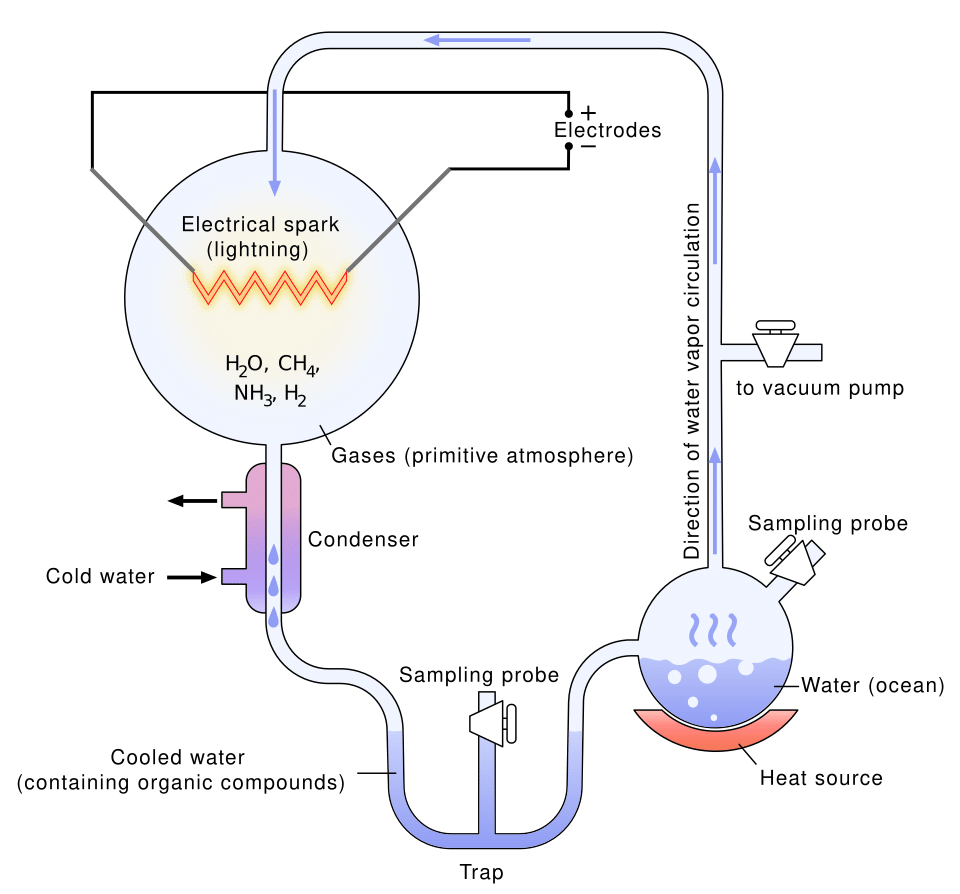
- Miller-Urey (1953): Sealed apparatus with \(H_2O\), \(CH_4\), \(NH_3\), and \(H_2\); electrical sparks simulated lightning. Result: amino acids formed abiotically. Key limitation: only demonstrated monomer formation — not proteins, not RNA, not cells.
- Deep-sea hydrothermal vent hypothesis: Metal sulfide minerals catalyze organic reactions; continuous energy available; shielded from UV radiation. These conditions may have supported the first metabolic reactions.
- Panspermia: Organic molecules arrived via meteorites (Murchison meteorite contained 90+ amino acids). Does not explain how life originated — it only shifts the question to a different location.
The RNA World Hypothesis
The RNA World hypothesis proposes that RNA was the first molecule capable of both storing genetic information and catalyzing chemical reactions, solving the “chicken-and-egg” problem: DNA can’t replicate without protein enzymes, and proteins can’t be made without DNA. RNA solves this because it can do both.


| Evidence | What It Shows |
|---|---|
| Ribozymes exist | RNA can catalyze reactions, not just store information |
| Ribosome is a ribozyme | The catalytic core of the ribosome is rRNA — a molecular fossil of the RNA World |
| RNA nucleotides in coenzymes | ATP, NAD⁺, FAD, and coenzyme A all contain adenine ribonucleotide — molecular fossils |
| RNA primers in DNA replication | DNA replication still requires an RNA primer — a vestige of RNA’s earlier role |
Key Vocabulary and Definitions
| Term | Definition / Key Feature | AP® Exam Connection |
|---|---|---|
| Abiogenesis | Origin of life from non-living matter through natural processes | Distinguish from biogenesis (life from life, Pasteur’s experiment) |
| Reducing atmosphere | Early Earth atmosphere with \(CH_4\), \(NH_3\), \(H_2O\), \(H_2\); no free \(O_2\) | Explains why organic molecules could accumulate without oxidation |
| Miller-Urey experiment | Demonstrated abiotic amino acid synthesis from simulated early Earth conditions | Most-tested origin-of-life experiment; know setup, results, and limitations |
| Stromatolites | Layered rock structures built by prokaryotic communities | Earliest fossil evidence of life (~3.5 bya) |
| Great Oxygenation Event | Cyanobacterial photosynthesis oxygenated the atmosphere (~2.4 bya) | Enabled aerobic respiration; caused mass extinction of anaerobes |
| RNA World hypothesis | RNA was the first molecule with both informational and catalytic functions | Solves the DNA-protein chicken-and-egg problem |
| Ribozymes | RNA molecules that catalyze chemical reactions | Key evidence for RNA World; ribosome’s catalytic core is rRNA |
| Panspermia | Hypothesis that organic molecules or life arrived from space | Supported by meteorite amino acids; doesn’t explain ultimate origin of life |
| Endosymbiotic theory | Mitochondria and chloroplasts originated as engulfed prokaryotes | Evidence: double membrane, circular DNA, 70S ribosomes, binary fission |
| Protocell | Lipid-enclosed vesicle containing self-replicating molecules; precursor to first cells | The membrane formation step in abiogenesis |
Test-Taking Strategies
Mnemonics to lock in key concepts:
- “MARS” for the 4 steps to life — Monomers form abiotically → Assembly into polymers → RNA self-replication → Self-enclosed in membranes (protocells). This sequence is the core narrative of abiogenesis.
- “4.6, 3.5, 2.4” — the three anchor dates — Earth forms (4.6 bya) → earliest fossils/stromatolites (3.5 bya) → GOE/oxygen fills atmosphere (2.4 bya). These dates appear on almost every origin-of-life question.
- “RNA does both” for the RNA World — RNA both stores information (like DNA) and catalyzes reactions (like proteins). This is why it’s the solution to the chicken-and-egg problem. If a question asks what problem the RNA World solves, say exactly this.
- “Miller-Urey = Monomers Only” — The experiment produced amino acids (monomers), not proteins, not RNA, not cells. Many students overstate what it demonstrated.
- “D-C-D-B” for endosymbiosis evidence — Double membrane, Circular DNA, Divide by binary fission, Bacterial-sized (70S) ribosomes. List all four when FRQs ask for evidence.
Cross-topic connections the AP® exam tests:
- Origin of life → Molecular biology (Unit 6): RNA World connects to the central dogma — RNA’s dual informational and catalytic role predates the DNA → RNA → protein flow. Ribosomes as ribozymes are a testable molecular fossil.
- Great Oxygenation Event → Cellular respiration (Unit 3): O₂ released by cyanobacteria enabled aerobic respiration, dramatically increasing energy yield per glucose molecule. This connects the GOE to the evolution of mitochondria.
- Endosymbiotic theory → Cell structure (Unit 1): Mitochondria and chloroplasts have double membranes because the outer membrane came from the host cell’s phagocytic vesicle, while the inner membrane is the original prokaryote’s plasma membrane.
Common mistakes to avoid:
- Saying Miller-Urey “created life” — it only produced amino acids (monomers). Never claim the experiment demonstrated the origin of cells or self-replication.
- Confusing the reducing early atmosphere with today’s oxidizing atmosphere. Early Earth: no O₂, methane and ammonia present. Today: 21% O₂, trace methane and ammonia.
- Forgetting what specific problem the RNA World solves: how can you have replication without proteins, and proteins without replication? RNA solves this by doing both functions.
- Confusing panspermia with abiogenesis — panspermia doesn’t explain the origin of life, only where organic molecules may have come from. The origin question still applies to wherever those molecules came from.
- Listing only 1–2 pieces of endosymbiotic evidence on FRQs — list all four (DCDB) for full credit.
Time management: Origin of life questions on FRQs often ask you to (1) describe evidence for a hypothesis and (2) explain what problem it solves or what it demonstrates. For endosymbiosis, name all four evidence types. For RNA World, name the problem it solves (chicken-and-egg) and the key evidence (ribozymes, especially the ribosome’s rRNA core).
Check for Understanding
Think you’ve got it? Complete the quiz below to make sure. Download your results at the end.