

Maximize your score with these resources:
- Albert.io AP® Environmental Science question banks
- Free AP® Environmental Science cheat sheets
- Free AP® Environmental Science score calculator
What We Review
Introduction
Earth’s atmosphere is the foundation of all life on our planet. It shields you from harmful solar radiation, regulates temperature, and circulates the gases you breathe and plants depend on. In AP® Environmental Science, understanding atmospheric composition connects directly to weather patterns, climate change, and elemental cycles—especially the carbon cycle. This guide breaks down the major gases in the atmosphere, the layers that form it, and how temperature changes with altitude, showing you how the atmosphere links with other Earth systems.
What Is the Earth’s Atmosphere?
The atmosphere is the layer of gases surrounding our planet, extending from ground level to outer space. It acts as a protective shell, blocking much of the Sun’s harmful ultraviolet radiation while retaining enough heat to keep Earth habitable. Without it, life as you know it would not exist. The atmosphere also interacts with the hydrosphere (water bodies) and biosphere (living organisms) to regulate climate. Even small changes in atmospheric composition can shift global temperature, alter weather patterns, and disrupt the carbon cycle.
Think of the atmosphere like a cozy blanket around Earth. Just as a blanket traps your body heat, the atmosphere holds in Earth’s heat through greenhouse gases like \(\text{CO}_2\). Without this blanket, temperatures would be too cold to sustain life.
Composition of Earth’s Atmosphere
The atmosphere is made of several gases, each playing a distinct role in maintaining environmental balance. Understanding these percentages is crucial for the AP® exam:
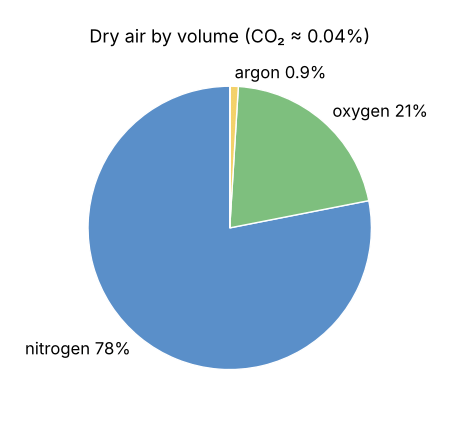
- Nitrogen (\(\text{N}_2\)): ~78%—the most abundant gas, used by nitrogen-fixing bacteria in the nitrogen cycle
- Oxygen (\(\text{O}_2\)): ~21%—essential for aerobic respiration in plants and animals
- Argon (\(\text{Ar}\)): ~0.9%—an inert noble gas with minimal biological impact
- Carbon Dioxide (\(\text{CO}_2\)): ~0.04%—rising due to fossil fuel combustion; powers photosynthesis and drives the carbon cycle
- Trace Gases: Includes neon, helium, methane, and others; tiny percentages but sometimes crucial for climate (methane is a potent greenhouse gas)
Remember that while \(\text{CO}_2\) makes up only 0.04% of the atmosphere, even this small amount has enormous effects on global temperature. The AP® exam frequently tests your understanding of how trace gases influence climate.
Layers of the Earth’s Atmosphere
Scientists divide the atmosphere into layers based on how temperature changes with altitude. Each layer has distinct characteristics that you need to know for the exam:
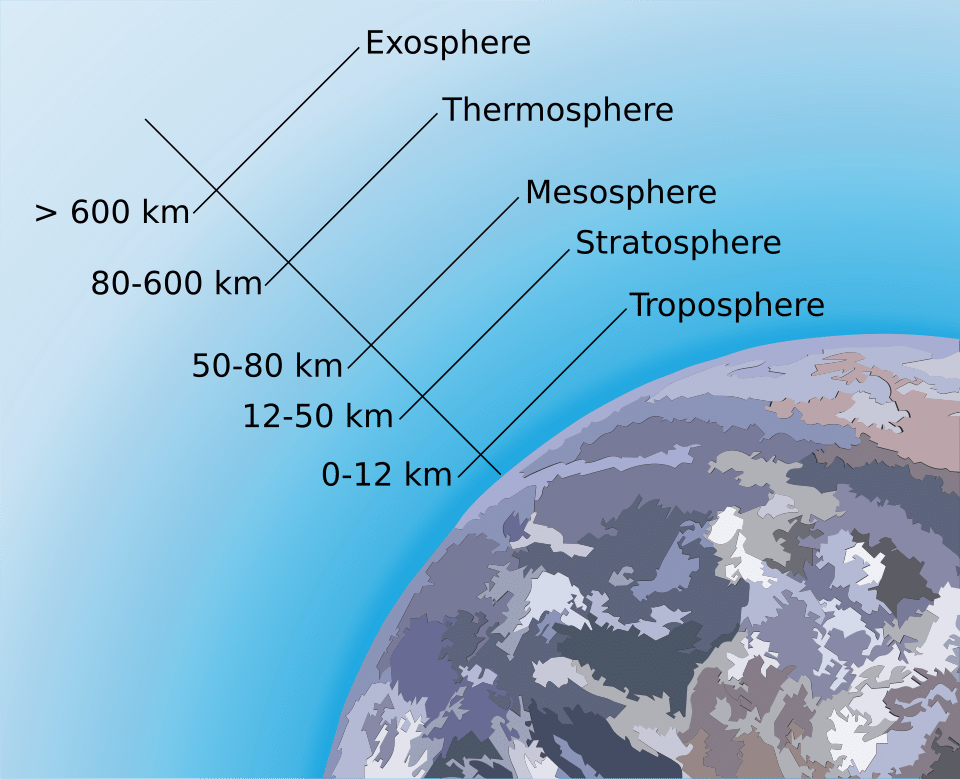
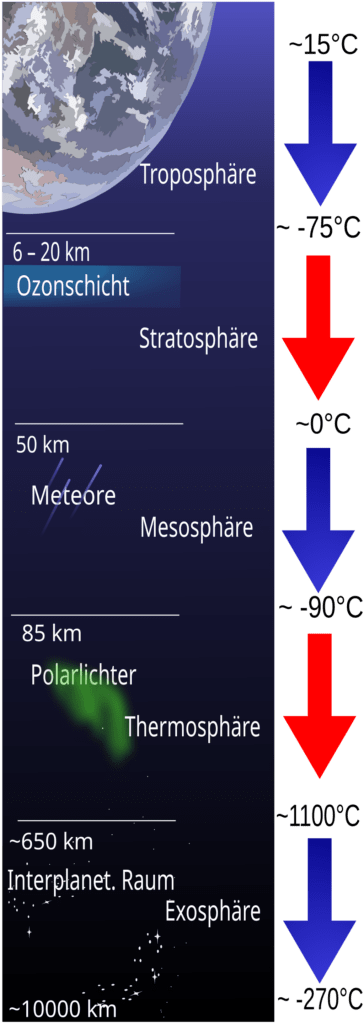

- Troposphere: The lowest layer, extending from ground level to about 8–16 km. All weather happens here—rain, snow, clouds, and storms occur in the troposphere. Temperature decreases with altitude (about 6.5°C per km). You live in the troposphere.
- Stratosphere: Located above the troposphere, extending to about 50 km. Contains the ozone layer, which absorbs harmful ultraviolet radiation from the Sun—protecting all life below. Unlike the troposphere, temperature increases with altitude here because ozone absorbs UV energy.
- Mesosphere: Extends to about 85 km. Temperatures drop significantly with altitude, making it one of the coldest regions of the atmosphere. Meteors burn up here as they enter from space.
- Thermosphere: Ranges from roughly 85 to 600 km. Temperatures reach extremely high levels (over 1,000°C) due to direct absorption of intense solar radiation. The auroras (northern and southern lights) occur here when charged particles from the Sun interact with atmospheric gases.
- Exosphere: The outermost layer, transitioning gradually into outer space. Gas molecules are extremely sparse, and boundaries become undefined as the atmosphere blends into the vacuum of space.
Temperature Gradients in the Atmosphere
Temperature patterns vary dramatically between layers because of how solar energy is absorbed. The troposphere cools with altitude because it’s heated from below (by Earth’s surface radiating heat upward). The stratosphere warms with altitude because ozone absorbs UV radiation. Other layers, like the thermosphere, experience intense heating from high-energy solar radiation.
A critical concept for the AP® exam is temperature inversion—when a layer of warm air becomes trapped above cooler air. This creates serious air quality problems because pollutants cannot escape upward; they accumulate near ground level where people breathe them. Temperature inversions commonly occur in mountain valleys and coastal cities, and the exam frequently asks about their effects on air pollution.
As you climb a mountain, air pressure decreases and air expands, cooling significantly. This is why mountain climates are much colder than lowland areas at the same latitude. Remember: pressure and temperature are closely linked in the atmosphere.
The Role of the Atmosphere in Earth’s Systems
The atmosphere is deeply interconnected with Earth’s other spheres. These interactions are tested extensively on the AP® exam:
- Carbon Cycle: Plants absorb atmospheric \(\text{CO}_2\) during photosynthesis. When plants and animals decompose or are burned, \(\text{CO}_2\) returns to the atmosphere. Increasing atmospheric \(\text{CO}_2\) drives climate change.
- Hydrological Cycle: Atmospheric circulation patterns determine rainfall distribution. This shapes soil formation, nutrient distribution, and freshwater availability. Ocean currents, driven by atmospheric wind patterns, redistribute heat around the globe and moderate coastal climates.
- Energy and Resources: Renewable energy depends on atmospheric movements—wind turbines harness atmospheric wind patterns to generate electricity.
- Ocean Currents and Climate: Wind-driven ocean currents transport warm and cold water. Disruptions in atmospheric patterns like El Niño can alter ocean currents, triggering global climate impacts and fishing industry changes.
Key Vocabulary
- Atmosphere: The layer of gases surrounding a planet, serving as a protective shield and heat regulator.
- Troposphere: The lowest atmospheric layer where weather occurs and temperature decreases with altitude.
- Stratosphere: The second layer, home to the ozone layer; temperature increases with altitude.
- Mesosphere: The middle layer cooling with altitude; where meteors burn up.
- Thermosphere: Layer with extreme temperatures where auroras occur.
- Exosphere: The outermost layer transitioning into space.
- Ozone Layer: Concentrated \(\text{O}_3\) in the stratosphere that absorbs harmful UV radiation.
- Temperature Inversion: When warm air traps cooler air below, preventing pollutants from dispersing.
Test-Taking Strategies
Mnemonic Device: Remember the five atmospheric layers with “Try Striving, Making Tremendous Efforts”: Troposphere, Stratosphere, Mesosphere, Thermosphere, Exosphere. When questions ask about which layer exhibits a particular phenomenon (weather, auroras, meteor burn-up), this mnemonic will help you identify the correct answer quickly.
Cross-Topic Connections: The AP® exam links atmospheric composition to three major topics:
- Climate Change: Rising \(\text{CO}_2\) concentrations trap more heat, warming the troposphere. You’ll see questions connecting atmospheric composition to global temperature increases.
- Air Quality: Temperature inversions trap pollutants near ground level, causing smog and respiratory problems. Questions often ask about conditions that create inversions (calm, cool nights in valleys).
- Ozone Depletion: CFCs released from refrigerants destroy the ozone layer. Though less common on recent exams, understand that ozone loss in the stratosphere increases UV radiation reaching Earth’s surface.
Common Question Formats: The AP® exam tests atmospheric knowledge through:
- “In which layer does…?” Questions identify where weather, auroras, or meteor burn-up occurs. Answer: troposphere (weather), thermosphere (auroras), mesosphere (meteors).
- Percentage-based questions: You might see a pie chart asking which gas represents ~78% of the atmosphere. Answer: nitrogen.
- Temperature gradient graphs: Graphs show temperature on the x-axis and altitude on the y-axis. Identify which layer has increasing temperature (stratosphere due to ozone) versus decreasing temperature (troposphere, mesosphere).
- Scenario-based pollution questions: A question describes a city in a mountain valley on a cool, clear night. Identify the atmospheric condition (temperature inversion) and predict the consequence (pollutant accumulation).
Frequent Student Mistakes: Avoid these common errors:
- Confusing temperature trends: Many students forget that the stratosphere warms with altitude (ozone absorbs UV). The troposphere and mesosphere both cool with altitude.
- Underestimating \(\text{CO}_2\) importance: Don’t dismiss \(\text{CO}_2\) as “only 0.04%.” On the AP® exam, trace gases drive climate change and the carbon cycle. Its small percentage is exactly why questions test your understanding.
- Missing the ozone-UV connection: Remember: ozone layer = stratosphere = UV protection. Loss of ozone = increased UV reaching Earth = skin cancer risk and ecosystem damage.
- Forgetting layer altitudes: Memorize rough altitudes: troposphere (0–16 km), stratosphere (16–50 km), mesosphere (50–85 km). Free-response questions sometimes ask you to identify layers given altitude data.
Test-Day Shortcuts: When you encounter an atmospheric question:
- Identify what’s being described: Weather/clouds? Troposphere. Auroras? Thermosphere. Meteor burn-up? Mesosphere. This three-part categorization handles most questions instantly.
- Look for “trap” answer choices: Questions about the atmosphere’s role in climate often include an answer claiming that “atmosphere prevents all solar radiation.” It doesn’t—it lets most through. The correct answer is that atmosphere traps outgoing heat radiation.
- Use process of elimination on composition questions: If a question asks about the most abundant gas, eliminate oxygen (only ~21%) immediately. It’s nitrogen.
Time Management Tip: Atmospheric composition and structure typically appears in 2–3 multiple-choice questions and may feature in free-response questions about climate change or air quality. Aim for about 1 minute per multiple-choice question (80 questions in 90 minutes); if you’re unsure, use your mnemonic for layers or the percentage rule for gases to narrow options, then move on. Don’t get stuck overthinking atmospheric questions—the concepts are usually straightforward once you understand the layer roles and composition percentages.
Check for Understanding
Think you’ve got it? Complete the quiz below to make sure. Download your results at the end.