

What We Review
Maximize your score with these resources:
- Albert.io AP® Psychology question banks
- Free AP® Psychology cheat sheets
- Free AP® Psychology score calculator
Developmental psychology is the scientific study of how and why human beings change over the course of their lives. On the AP® Psychology exam, developmental psychology is primarily covered in Unit 3, though connections span Units 1 (biological bases), 4 (personality), and 5 (clinical psychology). This review covers the major theories, research methods, and key concepts you need — with the exam-relevant distinctions that matter most.
Key Debates in Developmental Psychology
Three foundational debates shape how developmentalists think about human change. The AP exam tests whether you can identify which debate a given research question reflects:
| Debate | The Question | Current Consensus |
|---|---|---|
| Nature vs. Nurture | How much do genetics vs. environment shape development? | Both interact continuously; neither dominates |
| Stability vs. Change | Do traits established early in life persist or transform? | Personality shows moderate stability but remains open to change throughout adulthood |
| Continuous vs. Discontinuous | Is development gradual or stage-like with qualitative leaps? | Both exist — some aspects gradual (height), others stage-like (Piaget’s cognitive stages) |
Major Theories of Development
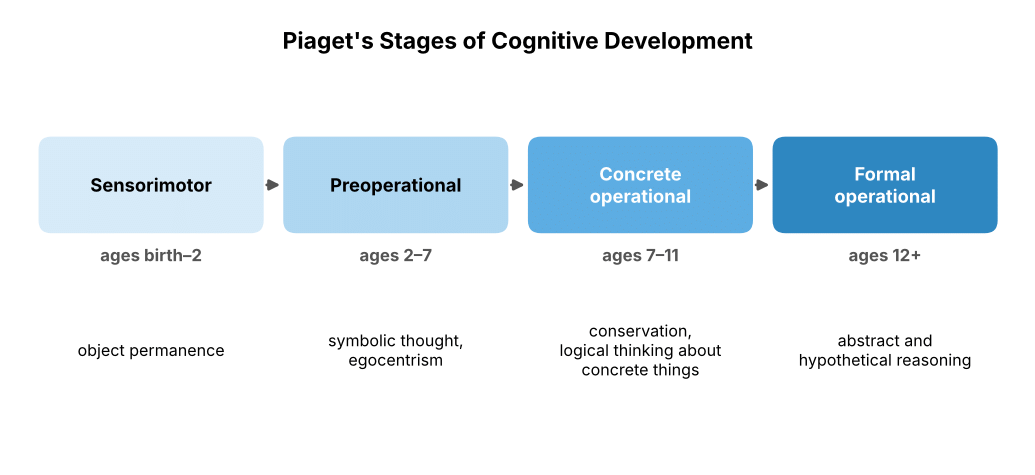
Piaget’s cognitive development theory proposes four invariant stages that all children pass through in the same sequence. The sensorimotor stage (birth–2 years) is defined by object permanence development. The preoperational stage (2–7 years) features symbolic thinking but egocentrism and lack of conservation. The concrete operational stage (7–11 years) brings logical thinking about concrete objects and conservation. The formal operational stage (12+) introduces abstract, hypothetical-deductive reasoning.
Vygotsky’s sociocultural theory emphasizes that cognitive development is socially mediated — children learn by interacting with more knowledgeable others within their Zone of Proximal Development (ZPD), the gap between what they can do alone vs. with guidance. Vygotsky gives culture and language a far more central role than Piaget does.
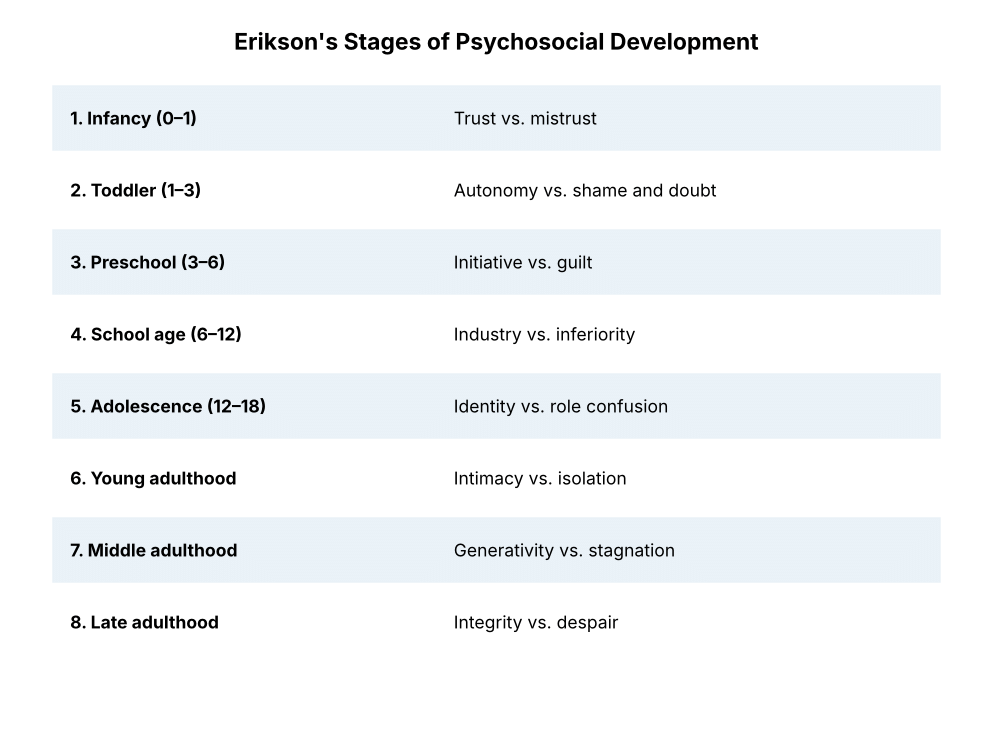
Erikson’s psychosocial theory spans eight stages across the entire lifespan, each presenting a developmental crisis whose resolution shapes personality. Key stages for the AP exam: trust vs. mistrust (infancy), autonomy vs. shame/doubt (toddlerhood), initiative vs. guilt (preschool), industry vs. inferiority (school age), identity vs. role confusion (adolescence), intimacy vs. isolation (young adulthood), generativity vs. stagnation (middle adulthood), and ego integrity vs. despair (late adulthood). Mnemonic: TAIIIIGE — Trust, Autonomy, Initiative, Industry, Identity, Intimacy, Generativity, Ego integrity.
Bowlby’s attachment theory and Harlow’s rhesus monkey studies established that infants need contact comfort and secure emotional bonds beyond just feeding. Ainsworth’s Strange Situation identified four attachment patterns: secure, anxious-ambivalent, avoidant, and disorganized. Secure attachment predicts healthier social and emotional development across the lifespan.
Physical and Cognitive Development
Physical development follows cephalocaudal (head to tail) and proximodistal (center outward) patterns. The prefrontal cortex — governing judgment, impulse control, and planning — is the last brain region to mature, completing development in the mid-20s. This timing explains adolescent risk-taking despite increasing cognitive sophistication.
Language acquisition illustrates the interaction of nature and nurture: Chomsky’s Language Acquisition Device (LAD) proposes an innate language-learning mechanism, while Vygotsky emphasizes that language is a social tool that shapes thought. The critical period hypothesis suggests that language acquisition is most effective before puberty; cases like Genie (discovered at age 13 after severe isolation) support this.
Crystallized intelligence (accumulated knowledge) remains stable or grows with age. Fluid intelligence (novel problem-solving speed) peaks in early adulthood and gradually declines.
Social and Moral Development
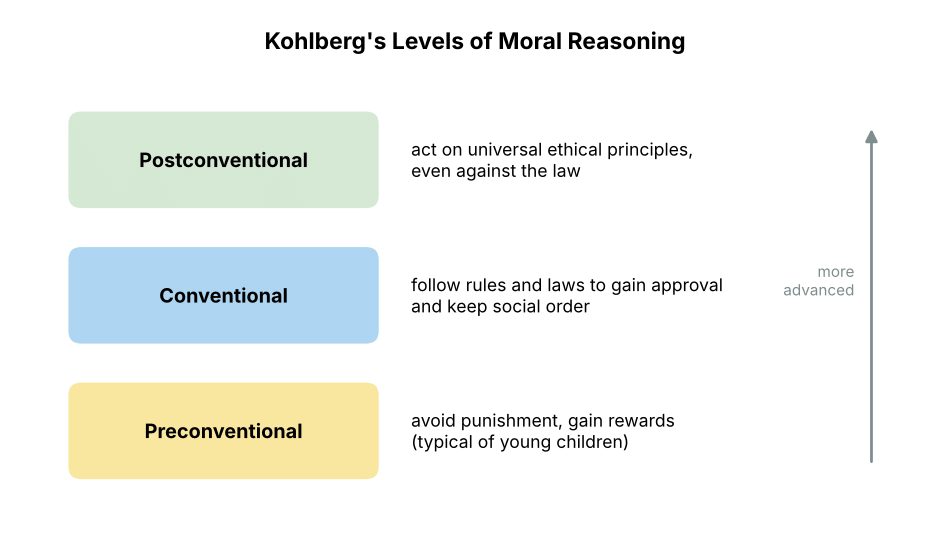
Kohlberg’s theory of moral development describes three levels. At the preconventional level, children follow rules to avoid punishment or gain rewards. At the conventional level, individuals follow rules to maintain social approval and uphold law and order. At the postconventional level, principled reasoning based on abstract concepts of justice and rights guides behavior. Carol Gilligan’s critique highlighted that Kohlberg’s theory was based primarily on male subjects and undervalued an ethic of care emphasizing relationships alongside justice.
Temperament — the inborn predisposition toward certain emotional and behavioral patterns — is relatively stable from infancy. Thomas and Chess identified three temperament types: easy, difficult, and slow-to-warm-up. Temperament interacts with parenting style (goodness of fit) to shape development.
Research Methods in Developmental Psychology
| Method | Design | Strength | Limitation |
|---|---|---|---|
| Cross-sectional | Compare different age groups at one point in time | Fast, inexpensive; no participant attrition | Cohort effects: age differences may reflect generation, not development |
| Longitudinal | Follow same individuals over months/years | Reveals actual developmental change within individuals | Time-consuming; attrition bias; practice effects |
Cohort effects are a critical AP concept: when cross-sectional studies find that older adults perform worse on memory tests than younger adults, this could reflect normal aging OR the fact that today’s older adults had less formal education and less cognitive stimulation than younger cohorts. Longitudinal studies control for cohort because the same people are followed over time.
Adolescent Development and Identity
James Marcia expanded Erikson’s identity stage into four identity statuses:
- Identity achievement: Explored and committed — the most mature status
- Moratorium: Actively exploring, not yet committed — healthy and normal
- Foreclosure: Committed without exploration, often adopting parental identity
- Identity diffusion: Neither exploring nor committed — most concerning developmentally
The adolescent brain shows a mismatch between the fully developed limbic system (emotion and reward) and the still-maturing prefrontal cortex (regulation and judgment). Imaginary audience (feeling constantly observed) and personal fable (believing one is uniquely special and immune to consequences) are Elkind’s descriptions of adolescent egocentrism.
Test-Taking Strategies
Use the mnemonic PAVE to organize the major theorists: Piaget (cognitive stages), Ainsworth/Bowlby (attachment), Vygotsky (sociocultural/ZPD), Erikson (psychosocial lifespan stages). For Kohlberg: pre-conventional = self-interest, conventional = social approval and law, post-conventional = abstract principles.
Cross-topic connections:
- Biological Psychology: Prefrontal cortex maturation timeline explains adolescent behavior; attachment has neurobiological underpinnings (cortisol regulation)
- Research Methods: Cross-sectional vs. longitudinal is a methodology question as much as a developmental one — cohort effects are the key threat to cross-sectional validity
- Personality: Erikson’s stages connect to personality development across the lifespan; attachment patterns predict adult relationship styles
Common mistakes:
- Confusing Piaget’s stages by age or name — use “Some People Can Fly” (Sensorimotor, Preoperational, Concrete, Formal)
- Confusing Erikson’s stages — use the TAIIIIGE mnemonic
- Applying adult cognition assumptions to children in scenarios — concrete operational children cannot handle abstract problems
- Mixing up moratorium (healthy, exploring) and diffusion (neither exploring nor committed)