

Maximize your score with these resources:
- Albert.io AP® Computer Science Principles question banks
- Free AP® Computer Science Principles cheat sheets
- Free AP® Computer Science Principles score calculator
Computing innovations are everywhere — from smartphones to self-driving cars to social media platforms. AP® CSP focuses on how these innovations are created, the role of collaboration in building them, and what makes teams effective. This topic is straightforward on the exam but rewards students who can apply the concepts to novel scenarios.
What We Review
What Is a Computing Innovation?
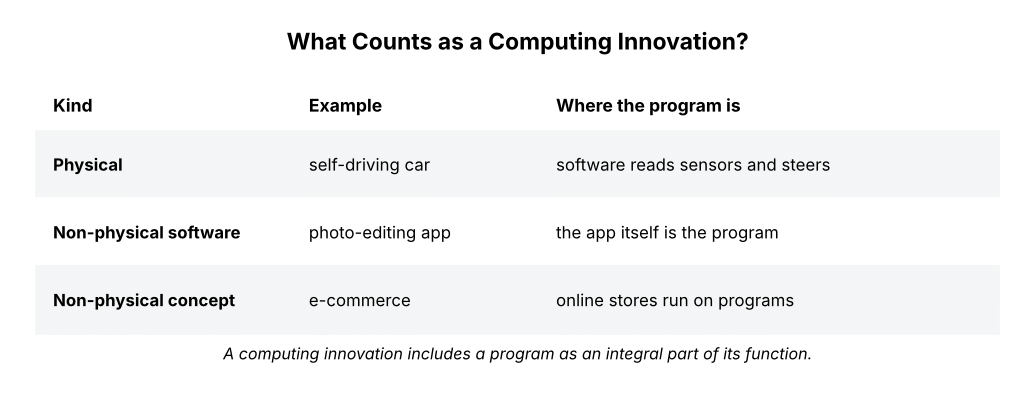
A computing innovation is any creation or concept where a computer program plays an essential role in its functionality. There are three types: physical innovations — real-world devices that depend on software (self-driving cars, drones, smartwatches); nonphysical software innovations — digital tools that exist only as programs (image editors, word processors, music streaming apps); and nonphysical conceptual innovations — broader ideas enabled by computing (e-commerce, social networking, online banking). Every computing innovation depends on a program for its core function.
The Role of Collaboration in Developing Computing Innovations
Computing innovations are rarely built by one person. Collaboration brings together multiple perspectives, skill sets, and areas of expertise. A student building a school app: one teammate codes, one designs the interface, one researches what users actually need. The combination produces something better than any individual could build alone. AP CSP explicitly values collaboration because it leads to more creative, more complete, and more equitable solutions.

The Interplay Between Collaboration and Diversity
Diverse teams produce better computing innovations. People from different backgrounds bring varied problem-solving approaches and catch assumptions that homogeneous teams miss. A video game built by developers from multiple cultures is more likely to appeal to a global audience. A medical app designed with input from patients, doctors, and engineers is more likely to actually solve the right problem. AP CSP connects diversity to both the quality of innovations and their ethical implications — diverse teams are less likely to build systems that unintentionally harm underrepresented groups.
Essential Skills for Effective Collaboration
Four interpersonal skills are explicitly listed in the AP CSP curriculum: communication — expressing ideas so all team members understand the goals; consensus building — finding solutions all members can support; conflict resolution — addressing disagreements respectfully without derailing the project; and negotiation — adjusting plans so each person’s perspective is heard. These aren’t soft extras — they’re tested on the AP exam as essential components of effective team development.
Tools for Collaboration
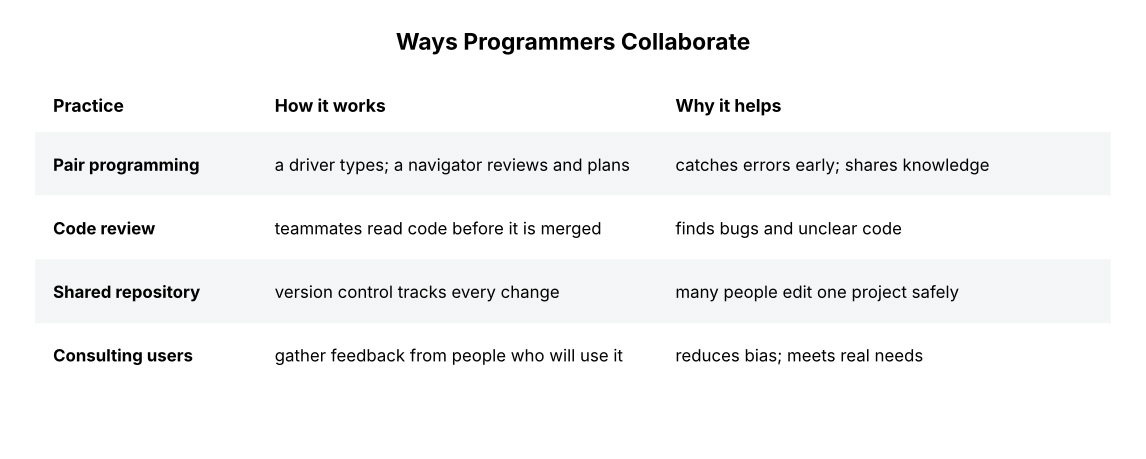
Key collaboration tools for AP CSP: GitHub provides version control — multiple people can work on the same codebase, track changes, and revert mistakes; Slack provides real-time communication channels for quick questions and updates; Google Docs enables simultaneous document editing from any location. These tools remove the barriers of distance and time, making distributed teamwork possible.
Models of Collaboration
Pair programming is the primary collaboration model tested on AP CSP. Two programmers share one computer: one is the driver (types the code) and one is the navigator (reviews each line, spots errors, suggests improvements). Roles alternate regularly. Benefits: errors are caught immediately, both members stay engaged, and both understand the full codebase. Example pseudocode demonstrating a simple collaborative procedure:
PROCEDURE CollaborationDemo
{
  DISPLAY("Hello, collaboration!")
}
Key Terms to Know
| Term | Definition |
| Computing Innovation | Any technology or concept that relies on a computer program for key functions |
| Physical Innovation | A real-world device powered by software (drone, smartwatch, self-driving car) |
| Nonphysical Software Innovation | A digital tool that exists only as a program (app, platform, service) |
| Collaboration | Working with others toward shared goals by combining skills and perspectives |
| Pair Programming | Two programmers sharing one computer: driver types, navigator reviews |
| Diversity | Including people from varied backgrounds to improve creativity and fairness |
| Interpersonal Skills | Communication, consensus building, conflict resolution, and negotiation |
Test-Taking Strategies
For innovation classification questions, ask: Does a program power it? If yes, it’s a computing innovation. Does it have a physical form? Yes = physical innovation. No = nonphysical (software or conceptual). For collaboration questions, remember the four interpersonal skills with CCNC: Communication, Consensus building, Negotiation, Conflict resolution.
Cross-Topic Connections: Big Idea 1 (Creativity) — computing innovations ARE the creative output of Big Idea 1; collaboration is how they’re built. Big Idea 5 (Impact) — every computing innovation has social impacts — who benefits, who’s excluded, what data is collected; diversity in development teams reduces harmful unintended consequences. Algorithm Bias (Big Idea 5) — when development teams lack diversity, their biases can be encoded into algorithms, causing discriminatory outcomes.
Common Question Formats: “Classify this innovation as physical, nonphysical software, or nonphysical conceptual” — apply the three-category framework. “How does pair programming benefit a development team?” — errors caught early, knowledge shared, both team members understand the full system. “Why is diversity important in software development?” — diverse perspectives catch bias, improve usability for broader audiences, and lead to more creative solutions.
Frequent Mistakes: Forgetting that nonphysical concepts (like e-commerce) count as computing innovations — not just apps and devices. Describing pair programming as “two people working separately” — it requires sharing one computer, one typing while the other reviews. Treating diversity as only demographic — AP CSP frames diversity as perspectives and skill sets, not just demographics; a team of coders all with the same background is low-diversity even if they look different.
Time-Saving Tips: Computing innovations questions are conceptual and require no computation — budget 1–2 minutes each. Free-response about collaboration always rewards naming specific skills (communication, pair programming, version control tools) rather than vague statements like “they worked together.” For impact questions about innovations, structure your answer: what does it do, who benefits, what risks does it create.