

Maximize your score with these resources:
- Albert.io AP® Computer Science Principles question banks
- Free AP® Computer Science Principles cheat sheets
- Free AP® Computer Science Principles score calculator
Technology shapes modern life in countless ways, helping people communicate faster, discover new ideas, and solve everyday problems. However, it can also create challenges such as privacy risks or unhealthy online habits. Understanding both the benefits of technology and its negative effects is central to AP® CSP’s Big Idea 5 (Impact of Computing). The way people complete tasks often changes once a new computing innovation enters the scene, and not all those changes are predictable — even by the developers who created the innovation.
What We Review
What Are Computing Innovations?
Computing innovations are new or improved technologies that use computing power to address a need or a desire. Smartphones gave users the ability to communicate instantly; the Internet opened doors to global information sharing; GPS navigation changed how people move through cities. People create computing innovations to solve problems, entertain, or provide services. However, not every effect of a computing innovation is anticipated in advance — and understanding both the positive and negative possibilities is crucial for the AP exam.
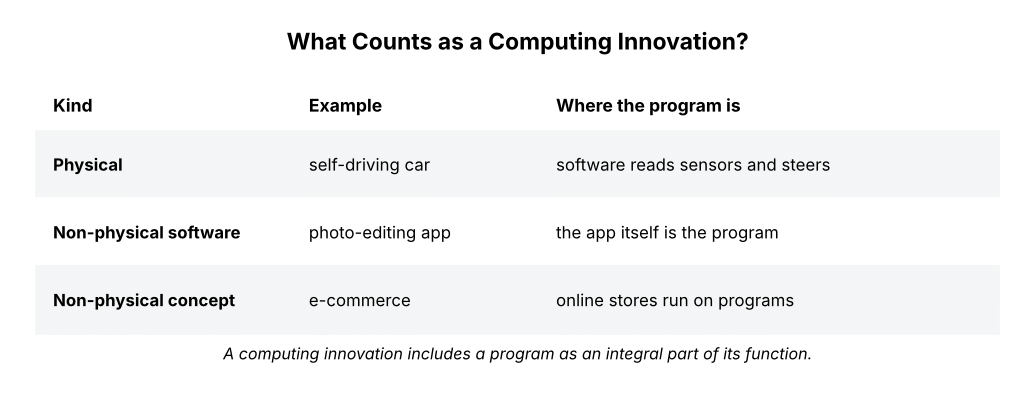
Think of a new ride at an amusement park. It promises thrills and excitement, but might also lead to longer lines and safety concerns. In the same way, a computing innovation often brings practical aids and new capabilities, but it can also introduce new risks that creators never intended.
Benefits of Technology
Many wonder, “How does technology help us?” The answer lies in how it boosts efficiency and opens creative avenues. The Internet allows rapid sharing of ideas across art, science, and business. Advances in computing have led to breakthroughs in medicine, engineering, and communications, enabling humanity to accomplish tasks faster and explore novel solutions.
Consider telemedicine as a concrete example. A patient schedules an online consultation using a video conferencing app. A doctor reviews medical history through a secure digital portal. The patient receives immediate advice and can electronically transfer test results. The doctor monitors progress remotely. This entire process saves time, reduces travel costs, gives patients quick access to specialists, and allows medical professionals to collaborate across regions — all enabled by computing innovations working together.
Negative Effects of Technology
Despite these advantages, technology can have a darker side. Privacy concerns, misinformation, and addiction can arise from the same platforms that bring people together. Social networks collect personal data, leading to targeted advertising or potential misuse. Intensive screen time affects mental health.

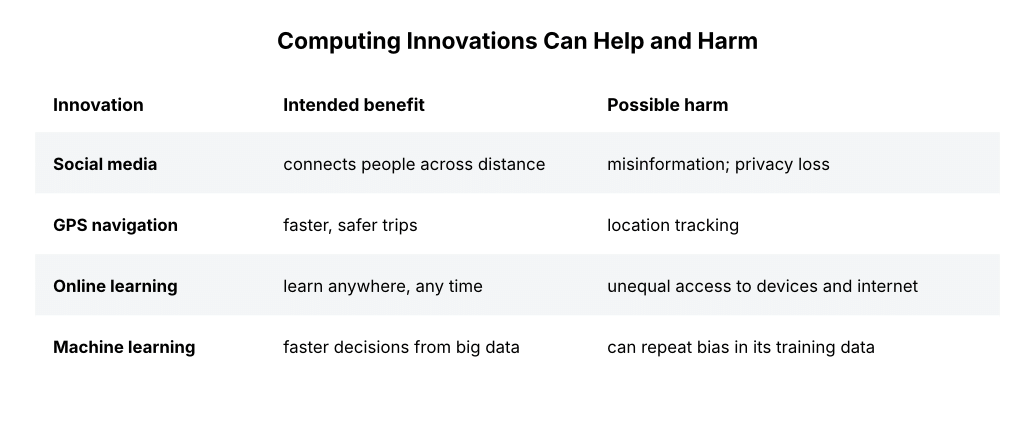
Social media illustrates this tension clearly. A user spends hours scrolling through feeds. They compare their everyday life to the highlight reels others post. Self-esteem drops due to unrealistic standards. Stress and anxiety increase, reducing overall well-being. The platform that enables connection also enables harm — and the same user who benefits from staying in touch with distant family may suffer from the constant pressure to perform for an audience.
The Duality of Effects
The same computing innovation can offer life-changing services and cause unexpected problems. Online learning platforms illustrate this tension: they open doors to students globally, allowing them to learn from top experts, while also potentially contributing to social isolation or creating gaps in hands-on experiences. A single effect can be viewed as both beneficial and harmful by different people — or even by the same person at different times. Evaluating a computing innovation’s overall impact before fully adopting it is essential.
The College Board specifically tests whether you recognize this duality. An answer that labels a technology as purely good or purely bad will rarely be correct. Always look for the nuance.
Unintended Consequences
Technology often evolves far beyond its original purpose — sometimes in positive ways, sometimes with disturbing consequences. Creators cannot always predict how users will adopt their inventions, and some unintended effects surface years after a technology is deployed.
The World Wide Web is the classic example. Initially intended for scientists to share research quickly, it rapidly expanded for public use, fostering social networks, businesses, and global collaboration. It also led to online fraud, cyberbullying, and misinformation campaigns. E-commerce flourished, boosting economies, while simultaneously raising privacy and security questions. None of these outcomes — positive or negative — were fully anticipated by its creators.
Responsible Innovation
Because it is not possible for a programmer to consider all the ways a computing innovation can be used, responsible programming is vital. Developers should think about privacy, security, and ethical design. Programs often reach more users than initially expected, creating ripple effects across industries and communities.
Responsible design practices include encryption tools that keep personal information safe, time-limit features in apps that reduce the temptation of overuse, strong data protection guidelines, and transparent user controls. Responsible programmers try to plan for unintended uses and weigh both the benefits of technology and its possible harmful effects — so society can appreciate technological progress without losing sight of potential dangers.
Key Terms to Know
| Term | Definition |
| Computing Innovation | A new or improved technology that uses computer power to address a need or desire |
| Benefits of Technology | Positive outcomes such as efficiency gains, creative problem-solving, and rapid communication |
| Negative Effects of Technology | Harmful impacts like privacy invasion, mental health strain, and misinformation spread |
| Unintended Consequences | Outcomes that were not planned or predicted by the creators of a technology |
| Responsible Programming | Designing and building software with consideration for ethical use, safety, and privacy |
| Filter Bubble | A situation where algorithms show users only confirming information, limiting exposure to diverse perspectives |
Test-Taking Strategies
Use the mnemonic BICNE to remember the core framework for AP® CSP impact questions: Benefits (identify positive impacts first), Innovations (these are the subject — know what the technology is and does), Consequences (look for unintended outcomes), Negative effects (harmful effects often accompany benefits), Ethical design (responsible programming mitigates risks). Work through each letter whenever you analyze a computing innovation scenario.
Cross-Topic Connections: This topic connects to every AP CSP Big Idea. Big Idea 1 (Creativity) — innovation fosters creative problem-solving but also enables misinformation. Big Idea 2 (Data) — data collection improves services but raises privacy concerns. Big Idea 3 (Algorithms) — automation benefits efficiency but can encode bias. Big Idea 4 (Networks) — connectivity enables collaboration but creates new attack surfaces. Big Idea 5 (Impact) — responsible programming anticipates unintended uses and builds in safeguards. When you see a scenario, ask which Big Idea(s) are implicated.
Common Question Formats: “Which statement best describes an unintended consequence of [technology]?” — always choose the answer showing the technology was used differently than planned. “Which is both a benefit AND a negative effect of [innovation]?” — look for dual-nature outcomes (e.g., connectivity enables both collaboration and misinformation). “How could a programmer reduce negative effects?” — focus on encryption, user controls, time limits, and transparency.
Frequent Mistakes: The most common error is viewing technology as purely good or purely bad. The AP exam expects you to recognize duality — innovations have both benefits and risks simultaneously. Students also frequently forget that designers cannot predict all uses, so focus on how technology gets repurposed rather than original intent. Remember that different people experience the same technology’s effects differently — what benefits one group may harm another.
Time-Saving Tips: Scan for “hidden words” in question scenarios: “unintended,” “concern,” “risks,” or “responsible” signal what the question is really asking. Use a T-chart mental model — Benefits on the left, Negative Effects on the right — to think in duality automatically. When stuck between two multiple-choice answers, choose the one mentioning “impact on society” or “unintended uses” — these signal AP CSP thinking. When analyzing a computing innovation, always consider at least one way the innovation could harm users or society.
Check for Understanding
Think you’ve got it? Complete the quiz below to make sure. Download your results at the end.