
Maximize your score with these resources:
- Albert.io Digital SAT® Math question banks
- Free Digital SAT® Math cheat sheets
- Free Digital SAT® Math score calculator
Surface area and volume of 3D figures show up on nearly every SAT. Whenever a question talks about “wrapping” a gift box or “filling” a tank, the topic is in play. Therefore, a solid grasp of these ideas can quickly boost any SAT Math geometry score. This guide walks through key formulas, handy scale-factor shortcuts, and test-ready examples.
What We Review
Meet the 3D Figures You Must Know
The SAT sticks to a short cast of solids. Recognizing them on sight saves time.
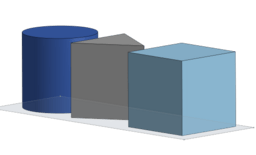
- Prisms & Cylinders – think cereal boxes and soup cans.
- Pyramids & Cones – picture a gift-shop pyramid or an ice-cream cone.
- Spheres – any basketball or marble.
- Composite or “from-life” objects – a candle (cylinder + cone) or a water tower (cylinder + hemisphere).
Because these shapes appear everywhere in daily life, visualizing them feels natural once the basic forms are clear.

Surface Area Made Simple
A. Concept Check: “Wrapping Paper” Model
Surface area is the amount of paper needed to wrap the entire outside of a solid. Therefore, every face counts, including the top and bottom.
B. Net Diagrams—Why They Help
Unfolding a solid into a flat “net” shows all faces at once. Consequently, counting areas becomes addition instead of spatial reasoning.
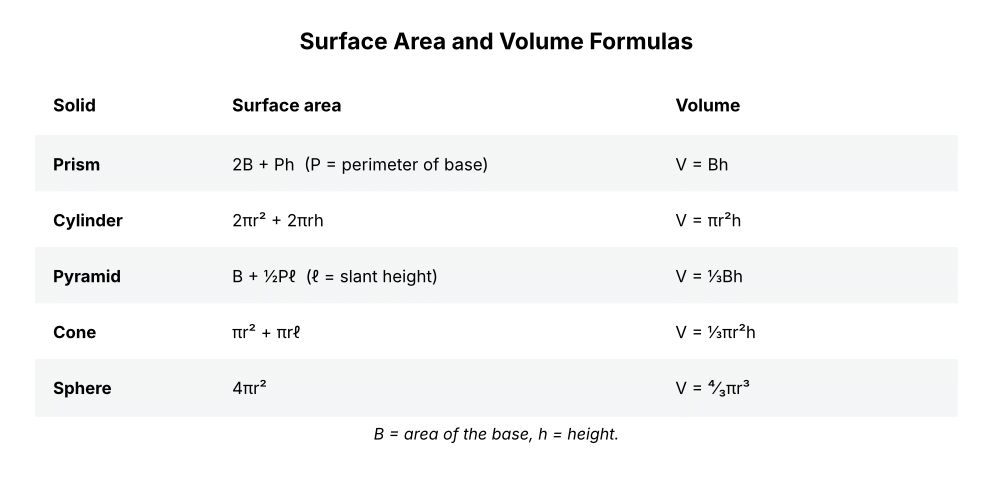
C. Must-Memorize Formulas
Rectangular Prism:
\(SA = 2lw + 2lh + 2wh\)
Cylinder:
\(SA = 2\pi r h + 2\pi r^2\)
Right Square Pyramid:
\(SA = B + \frac12 P l\) (\(B\) = area of base, \(P\) = perimeter of base, \(l\) = slant height)
Right Circular Cone:
\(SA = \pi r l + \pi r^2\)
Sphere:
\(SA = 4\pi r^2\)
D. Example 1
Question (SAT-style)
A right circular cone has a radius of \(3\) cm and a slant height of \(5\) cm. What is its surface area?
Solution
- Write the formula:
- \(SA = \pi r l + \pi r^2\)
- Substitute \(r = 3\) and \(l = 5\):
- \(SA = \pi(3)(5) + \pi(3)^2\)
- Simplify each term:
- \(= 15\pi + 9\pi\)
- Combine:
- \(= 24\pi\)
Therefore, the surface area equals \(24π\) square centimeters (approximately \(75.4\) square centimeters when needed).
Volume: How Much Fits Inside?
A. Concept Check: “Filling with Water” Model
Volume answers, “How much water could this shape hold?” Because capacity depends on all three dimensions at once, units become cubic (\(\text{cm}^3\), \(\text{in}^3\)).
B. Must-Memorize Formulas
Rectangular Prism:
\(V = lwh\)
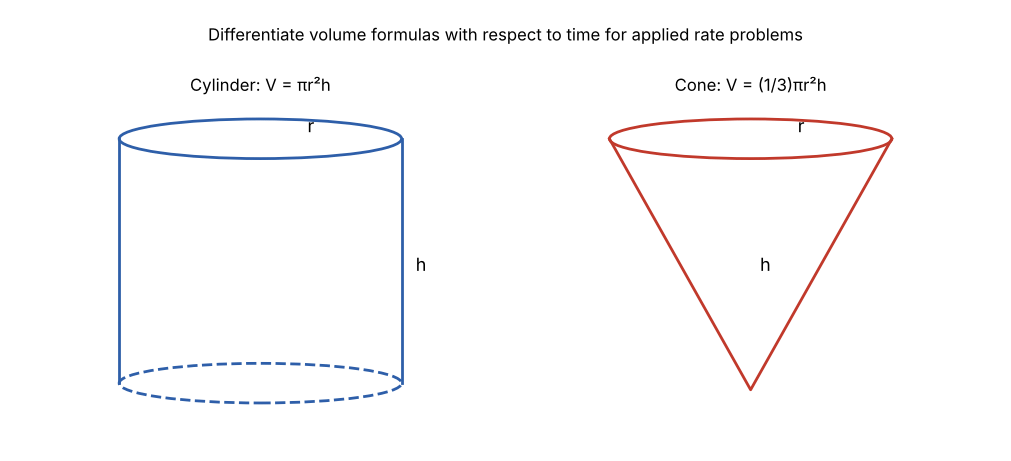
Cylinder:
\(V = \pi r^2 h\)
Pyramid:
\(V = \frac13 B h\)
Cone:
\(V = \frac13 \pi r^2 h\)
Sphere:
\(V = \frac43 \pi r^3\)
C. Example 2
Question (Composite Solid)
A cylindrical water tank has radius of \(4\) m and height of \(10\) m. A hemispherical dome (half a sphere) with the same radius sits on top. What is the total volume?
Solution
Cylinder volume:
\(V_{\text{cyl}} = \pi r^2 h = \pi (4)^2 (10) = 160\pi\)
Hemisphere volume:
Sphere volume would be \(\frac43 \pi (4)^3 = \frac43 \pi \cdot 64 = \frac{256}{3}\pi\)
Half of that:
\(V_{\text{hemi}} = \frac12 \times \frac{256}{3}\pi = \frac{128}{3}\pi\)
Add the two volumes:
\(V_{\text{total}} = 160\pi + \frac{128}{3}\pi = \frac{480}{3}\pi + \frac{128}{3}\pi = \frac{608}{3}\pi\)
Therefore, the tank holds \(\frac{608}{3}\pi \approx 636.7\text{ m}^3\).
Scaling & Similar Solids Shortcuts
A. Scale-Factor Rules
If every length is multiplied by \(k\):
- Surface area multiplies by \(k^2\).
- Volume multiplies by \(k^3\).
B. Visual Analogy: Enlarging a 3-D Printer Model
Imagine instructing a 3-D printer to create the same chess piece at twice the size. Because each edge doubles \((k = 2)\), the plastic needed for the surface quadruples, and the plastic filling inside grows eight-fold.
C. Example 3
Question
A cube has a surface area \(54\text{ cm}^2\) and volume of \(27\text{ cm}^3\). If every edge triples, find the new surface area and volume.
Solution
Scale factor: \(k = 3\).
Surface area scales by \(k^2 = 9\):
\(SA_{\text{new}} = 54 \times 9 = 486\text{ cm}^2\)
Volume scales by \(k^3 = 27\):
\(V_{\text{new}} = 27 \times 27 = 729\text{ cm}^3\)
Therefore, the enlarged cube has a surface area of \(486\text{ cm}^2\) and volume of \(729\text{ cm}^3\).
Real-World & Reverse Problems
A. Missing Dimension from Given Surface Area or Volume
Sometimes the SAT gives the total and asks for a length. Solving usually involves rearranging one formula.
B. Density & Cost Questions
Because density links mass and volume, or cost links area and price, units must match. Therefore, careful unit conversion is essential.
C. Example 4
Question
The surface area of a right square pyramid is \(150\text{ in}^2\). Its square base has sides \(6\) in. Find the height of the pyramid, rounded to the nearest tenth.
Solution
- Base area:
- \(B = 6 \times 6 = 36\text{ in}^2\)
- Perimeter of base:
- \(P = 4 \times 6 = 24\) in
- Let l be the slant height. Surface area formula:
- \(SA = B + \frac12 P l\)
- Plug known values:
- \(150 = 36 + \frac12 (24) l\)
- Simplify:
- \(150 = 36 + 12l \implies 114 = 12l \implies l = 9.5\) in
- Now use the right-triangle relation inside the pyramid to find the actual height h:
- Half of the base side = \(3\) in.
- \(h = \sqrt{l^2 – 3^2} = \sqrt{9.5^2 – 9} = \sqrt{90.25 – 9} = \sqrt{81.25} \approx 9.0\) in
- Therefore, the height is about \(9.0\) in.
Strategy Box: Common Pitfalls and Time-Savers
- However, do not mix up radius and diameter.
- Always count both bases on a cylinder or cone unless the question excludes a base.
- Keep units consistent; therefore, convert inches to feet when needed.
- When numbers look messy, estimate with \(π ≈ 3.14\) to sense-check answers quickly.
Quick Reference Vocabulary Chart
| Term | Definition | SAT Tip |
| Face | A flat surface on a 3-D solid | Count each face for surface area. |
| Edge | The line where two faces meet | Becomes an “edge length” in similar solids. |
| Slant Height (\(l\)) | Distance from the apex down the side of a cone or pyramid | Only cones and pyramids use it in surface area. |
| Base Area (\(B\)) | Area of the bottom face | Needed in every volume formula. |
| Scale Factor (\(k\)) | Ratio of corresponding lengths in similar solids | Remember \(k\), \(k^2\), \(k^3\) rule. |
| Composite Solid | A shape made of two or more basic solids | Break into parts, then add or subtract. |
Mini Practice Set
- A sphere has a radius of \(7\) cm. What is its surface area?
- A cone has volume of \(96\pi\text{ m}^3\) and radius of \(4\) m. What is its height?
- Each dimension of a cylinder is reduced by \(50\%\). How does its volume change?
Answers & Brief Solutions
- \(196\pi\text{ cm}^2\).
- \(h = 18\) m.
- Volume scales by \(k^3 = 0.125\); therefore, the volume becomes 12.5 % of the original.
Conclusion & Next Steps
Mastery of surface area and volume of 3D figures pays off on test day. Therefore, practice these formulas until substituting numbers becomes automatic. Next, time yourself on mixed sets, and keep the reference chart handy for quick reviews. Success on SAT Math geometry is closer than it appears.
Sharpen Your Skills for SAT® Math (Digital)
Are you preparing for the SAT® Math (Digital) test? We’ve got you covered! Try our review articles designed to help you confidently tackle real-world SAT® Math (Digital) problems. You’ll find everything you need to succeed, from quick tips to detailed strategies. Start exploring now!
Need help preparing for your SAT® Math (Digital) exam?
Albert has hundreds of SAT® Math (Digital) practice questions, free response, and full-length practice tests to try out.