
Maximize your score with these resources:
- Albert.io Digital SAT® Math question banks
- Free Digital SAT® Math cheat sheets
- Free Digital SAT® Math score calculator
Circle questions pop up all over the SAT Math section. However, many students lose points simply because they mix up degrees and radians or forget a key fact about the unit circle. Therefore, this guide breaks everything into bite-sized pieces so that converting angles, finding arc lengths, and writing circle equations becomes automatic.
Focus keywords woven throughout: degrees, radians, unit circle, circle equation, SAT Math.
What We Review
Why Degrees, Radians, and the Unit Circle Matter on the SAT
- Roughly \(15–20\%\) of SAT Math questions involve circles, angles, or trigonometry.
- Mastering degrees and radians speeds up arc-length and sector-area problems.
- Knowing unit-circle coordinates makes sine, cosine, and tangent questions almost free points.
Circle Vocabulary Crash Course
Key Parts of a Circle
- Radius: Segment from the center to any point on the circle.
- Diameter: Longest chord; equals two radii.
- Chord: Any segment with endpoints on the circle.
- Tangent: A line touching the circle at exactly one point.
- Secant: A line that cuts the circle twice.
- Central Angle: Angle with its vertex at the center.
- Arc: Curved part of the circumference.
Quick Illustration
Imagine a pizza. The crust is the circumference, a slice’s tip is the center, and the cheese edge of one slice is an arc.
Example Problem
A circle has center at \(O\). Point \(A\) lies on the circle. Line \(AB\) touches the circle only at \(A\). Segment \(AC\) goes through the circle and exits at \(D\). Identify each part:
A) Radius
B) Tangent
C) Secant
Solution
- \(\overline{OA}\) joins center \(O\) to point \(A\) ⇒ radius.
- \(\overline{AB}\) touches at one point ⇒ tangent.
- \(\overline{AD}\) or \(\overline{AC}\) (extended) cuts twice ⇒ secant.
Converting Between Degrees and Radians
Core Formula & Proportion
\(\pi \text{ rad} = 180^\circ\)
Therefore,
\(\frac{\text{radians}}{\pi} = \frac{\text{degrees}}{180}\)
Example
a) Convert \(135^\circ\) to radians.
Start with the proportion:
\(\frac{x}{\pi} = \frac{135}{180}\)
Simplify the right side:
\(\frac{135}{180} = \frac{3}{4}\)
Now multiply both sides by \(\pi\):
\(x = \frac{3\pi}{4}\) radians
b) Convert \(\frac{5\pi}{6}\) to degrees.
Start with the proportion:
\(\frac{5\pi/6}{\pi} = \frac{d}{180}\)
Simplify the left side:
\(\frac{5\pi}{6\pi} = \frac{5}{6}\)
Cross-multiply to solve for \(d\):
\(d = 180 \times \frac{5}{6} = 150^\circ\)
Mini Practice
Convert quickly (answers underneath):
- \(300^\circ\) → ? rad
- \(\frac{\pi}{3}\) → ? °
- \(\frac{7\pi}{4}\) → ? °
Answers:
- \(\frac{5\pi}{3}\) rad
- \(60^\circ\)
- \(315^\circ\)
Meet the Unit Circle
Definition
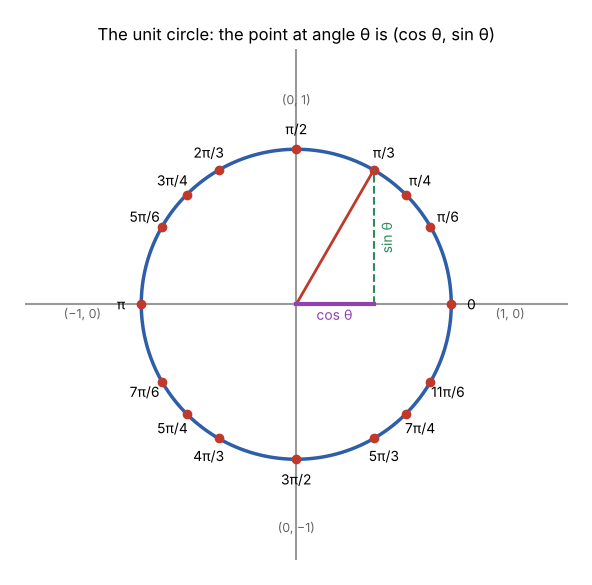
The unit circle is a circle with a radius of \(1\) centered at the origin. Because the radius is \(1\), the coordinate of any point \(P\) tells you the cosine and sine directly:\(P(\cos\theta,\sin\theta)\)

Quadrants and Symmetry
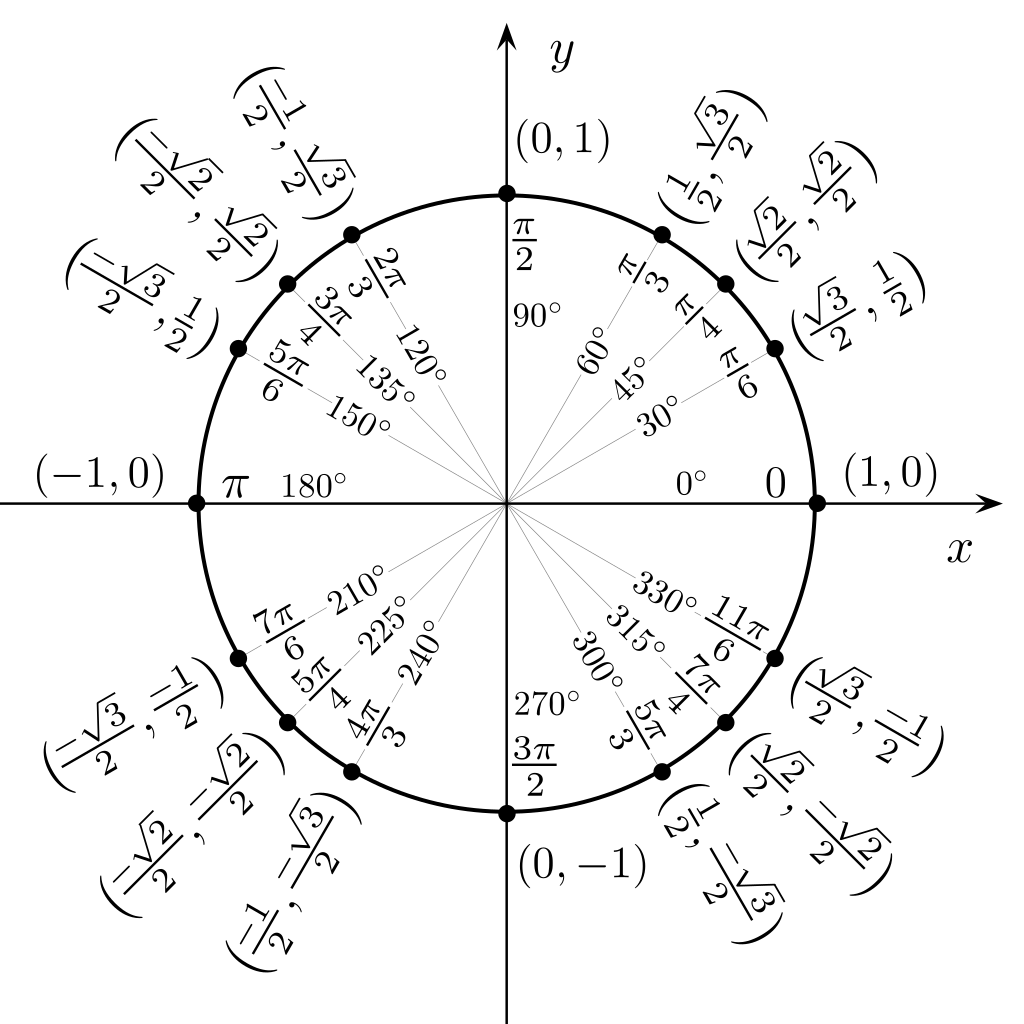
Angles start at the positive \(x\)-axis and move counter-clockwise:
- Quadrant I: \(0^\circ–90^\circ\) (all trig ratios are positive)
- Quadrant II: \(90^\circ–180^\circ\)
- Quadrant III: \(180^\circ–270^\circ\)
- Quadrant IV: \(270^\circ–360^\circ\)
However, symmetry means you can find one coordinate and mirror it.
Must-Know Angle Coordinates
| Angle | Coordinate (\(x, y\)) |
| \(0^\circ\) | \((1, 0)\) |
| \(30^\circ\) | \(\left( \frac{\sqrt{3}}{2} , \frac{1}{2}\right )\) |
| \(45^\circ\) | \(\left( \frac{\sqrt{2}}{2} , \frac{\sqrt{2}}{2} \right)\) |
| \(60^\circ\) | \(\left( \frac{1}{2} , \frac{\sqrt{3}}{2} \right)\) |
| \(90^\circ\) | \((0, 1)\) |
Likewise, reflect signs for other quadrants.
Memory Tricks
- Special triangles: \(45-45-90\) and \(30-60-90\).
- The phrase “All Students Take Calculus” tells which trig ratios are positive in each quadrant.
- Quadrant I: All trig functions
- Quadrant II: Only sine
- Quadrant III: Only tangent
- Quadrant IV: Only cosine
Example Problem
Find \(\sin 150^\circ\) using the unit circle.
Solution
- Notice \(150^\circ\) is in Quadrant II.
- Reference angle = \(180^\circ − 150^\circ = 30^\circ\).
- In Quadrant II, sine stays positive.
- \(\sin 30^\circ = \frac{1}{2}\) ⇒ therefore, \(\sin 150^\circ = \frac{1}{2}\).
Arc Length and Sector Area
Formulas in Radians
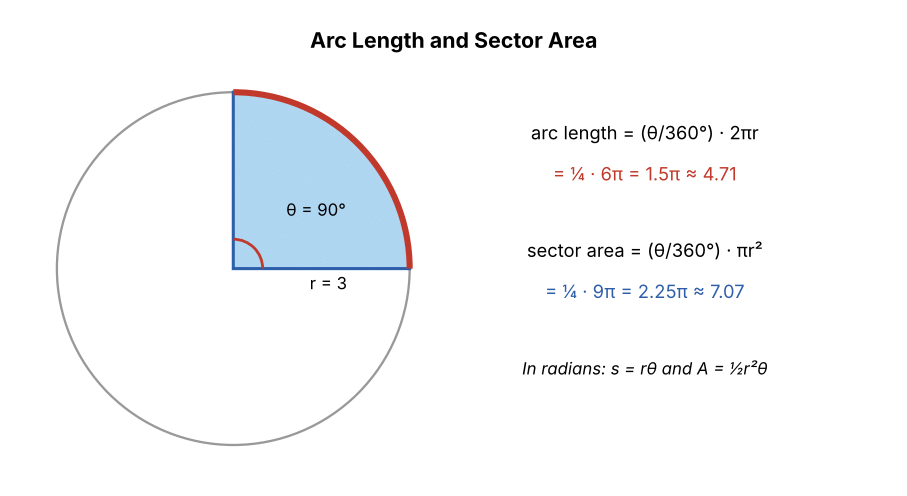
Given radius \(r\) and angle \(\theta\) (in radians):
Arc length: \(s = r\theta\)
Sector area: \(A = \frac{1}{2} r^2 \theta\)
Why Radians Are Cleaner
Notice that neither formula needs \(180\) or \(π\) when \(\theta\) is in radians. Degrees would force an extra conversion.
Example
A Ferris wheel has a radius of \(40\) m. It turns through \(\frac{\pi}{3}\) radians. Find:
a) Distance traveled by a rider (arc length).
b) Area swept by the seat (sector area).
Solution
a) \(s = 40 \times \frac{\pi}{3} = \frac{40\pi}{3}\ \text{m}\)
b) \(A = \frac{1}{2}\times 40^2 \times \frac{\pi}{3} = \frac{1}{2}\times 1600 \times \frac{\pi}{3}= \frac{800\pi}{3}\ \text{m}^2\)
Circle Equations in the Coordinate Plane
Standard Form
\((x-h)^2 + (y-k)^2 = r^2\)
\((h, k)\) = center, \(r\) = radius.
Connection to Unit Circle
The unit circle is simply the special case where \((h, k) = (0, 0)\) and \(r = 1\).
Example
Does point \((4, −1)\) lie on \((x-2)^2 + (y+1)^2 = 9\)?
Solution
- Substitute \(x = 4, y = −1\):
- \((4-2)^2 + (-1+1)^2 = 2^2 + 0^2 = 4\)
- Right side is \(4\), but circle’s \(r^2\) is \(9\). Therefore, the point is inside the circle, not on it.
Completing the Square to Reveal a Hidden Circle
General to Standard Form
Start with \(x^2 + y^2 + Dx + Ey + F = 0\). Complete squares for both variables.
Example
Rewrite \(x^2 + y^2 – 6x + 4y + 9 = 0\) and find center & radius.
Solution
1. Group: \((x^2 – 6x) + (y^2 + 4y) = -9\)
2. Complete squares:
\((x^2 – 6x + 9) + (y^2 + 4y + 4) = -9 + 9 + 4\)
- \(x\) part: take half of \(−6\) ⇒ \(−3\), square ⇒ \(9\).
- \(y\) part: half of \(4\) ⇒ \(2\), square ⇒ \(4\).
Add \(9\) and \(4\) to both sides.
3. Rewrite: \((x-3)^2 + (y+2)^2 = 4\)
Therefore, the center is at \((3, −2)\), radius \(\sqrt{4}=2\).
Transformations: How Equation Changes Affect the Graph
Shifts
Moving \((x-h)^2 + (y-k)^2 = r^2\) right or left changes h; up or down changes \(k\).
Dilation
Changing \(r\) scales the circle outward (larger \(r\)) or inward (smaller \(r\)).
Example
Original: \((x-1)^2 + (y+2)^2 = 16\). Move the circle \(3\) units up.
New \(k = −2 + 3 = 1\). The equation becomes:
\((x-1)^2 + (y-1)^2 = 16\)
Distance Formula: Verifying Points on a Circle
Formula Review
Distance between \((x_1, y_1)\) and \((x_2, y_2)\): \(\sqrt{(x_2-x_1)^2+(y_2-y_1)^2}\)
Example
Show that \((−2, 5)\) sits on a circle of radius \(\sqrt{29}\) centered at \((1, 1)\).
Distance:
\(\sqrt{(-2-1)^2 + (5-1)^2} = \sqrt{(-3)^2 + 4^2} = \sqrt{9+16} = \sqrt{25}=5\)
Since \(5 = \sqrt{25} \neq \sqrt{29}\), the point is inside the circle.
Quick Reference Chart: Essential Vocabulary & Formulas
| Term | Definition / Key Formula |
| Radian | Angle measure where arc length equals radius |
| Degree | \(\frac{1}{360}\) of a full rotation |
| Central Angle | Angle with vertex at the circle’s center |
| Arc | Curved segment of circumference |
| Arc Length | \(s = r\theta\) (\(\theta\) in radians) |
| Sector Area | \(A = \frac{1}{2}r^2\theta\) |
| Unit Circle | Circle with \(r = 1\), center \((0,0)\) |
| Standard Circle Equation | \((x-h)^2 + (y-k)^2 = r^2\) |
| Completing the Square | Process to convert general → standard form |
| Reference Angle | Acute angle formed with \(x\)-axis |
| Tangent Line | Touches circle at one point |
| Secant Line | Intersects the circle at two points |
SAT-Style Practice Questions
- Convert \(210^\circ\) to radians.
- Evaluate \(\cos\left(\frac{7\pi}{6}\right)\) using the unit circle.
- Find the arc length of a circle with radius \(6\) cm subtended by \(120^\circ\).
- Write the equation of a circle centered at \((−4, 2)\) that passes through \((−1, 2)\).
- Complete the square: \(x^2 + y^2 + 2x – 8y = 23\) and state the radius.
Solutions
- \(\frac{7\pi}{6}\)
- \(-\frac{\sqrt3}{2}\)
- \(4\pi\ \text{cm}\)
- \((x+4)^2 + (y-2)^2 = 9\)
- Radius = \(2\sqrt{10}\)
Final Tips & Takeaways
- Always convert degrees to radians before using \(s = r\theta\) or \(A = \frac12 r^2\theta\); it prevents careless errors.
- Drill the five special angles (\(0^\circ, 30^\circ, 45^\circ, 60^\circ, 90^\circ\)) until their coordinates pop into mind instantly.
- When stuck on a general circle equation, remember: complete the square, then read off the center and radius.
- On test day, sketch mini diagrams; even five-second drawings reduce mistakes.
Master these concepts, and circle problems will feel like—well—a walk in the park rather than a spin in circles. Good luck on the SAT!
Sharpen Your Skills for SAT® Math (Digital)
Are you preparing for the SAT® Math (Digital) test? We’ve got you covered! Try our review articles designed to help you confidently tackle real-world SAT® Math (Digital) problems. You’ll find everything you need to succeed, from quick tips to detailed strategies. Start exploring now!
Need help preparing for your SAT® Math (Digital) exam?
Albert has hundreds of SAT® Math (Digital) practice questions, free response, and full-length practice tests to try out.