

Maximize your score with these resources:
- Albert.io AP® US History question banks
- Free AP® US History cheat sheets
- Free AP® US History score calculator
What We Review
Market Revolution: Industrialization | AP® US History Study Guide
The Market Revolution of the early 1800s is one of the most heavily tested topics in AP® US History Period 4 (1800–1848). Short-answer questions will ask you to explain its causes or regional effects. Long essay questions will ask you to evaluate how it deepened sectional divisions. DBQs may include factory records, canal advertisements, or plantation accounts. The central argument the exam rewards: the Market Revolution transformed America unevenly, creating the regional specialization that planted the seeds of the Civil War. The North and Midwest industrialized rapidly with factories, canals, and wage labor; the South doubled down on slavery-based cotton production. This guide covers technological innovations, transportation networks, regional specialization, and the test-taking strategies you need to master this period.
Causes of the Market Revolution
Several forces combined to trigger the Market Revolution:
- Entrepreneur ambition: Business owners sought new ways to produce and sell goods for profit at scale
- Technological innovation: Machines and new business methods shifted production from small workshops to large factories
- Commercialization: Americans increasingly bought and sold goods for cash as towns and cities grew, replacing barter and subsistence farming
- Capital availability: Banks and wealthy merchants could fund factory construction, equipment, and transportation infrastructure
How Production Was Reorganized
In early America, shoes, textiles, and other goods were handcrafted at home or in small workshops, one at a time. The Market Revolution changed this fundamentally. Entrepreneurs opened factories where they divided labor: each worker focused on a single step in the production process, similar to an assembly line today. This approach dramatically increased production speed and volume.
Example: A shoemaker who once spent a week crafting one pair of shoes could now, as part of a factory team, help produce dozens of pairs daily. Production shifted from small-scale craftsmanship to industrial, profit-driven manufacturing that prioritized speed and volume over quality.
Technological Innovations That Transformed Production
Machines and new technologies made rapid, efficient production possible:
| Innovation | Impact |
|---|---|
| Cotton gin (Eli Whitney, 1793) | Dramatically increased cotton production; made slavery more profitable and expanded westward |
| Power loom | Increased textile and yarn production; enabled factories like those in Lowell, MA |
| Steam engine | Powered factories and enabled steamboats and railroads for transportation |
| Interchangeable parts | Identical, standardized components enabled mass production and easier repairs |
| Telegraph (Samuel Morse) | Sent messages instantly over long distances; enabled coordination of trade |
| Steel plow and mechanical reaper | Increased agricultural productivity, especially in the Midwest |


Why Interchangeable Parts Mattered
Before interchangeable parts, every product was handcrafted to fit its specific context. If a part broke, a skilled worker had to manually create a custom replacement. The Market Revolution changed this fundamentally:
- Manufacturers began producing parts to exact, standardized measurements
- Factories could then mass-produce thousands of identical components efficiently
- When a part failed, workers could swap in a replacement—no custom work needed
- Products became cheaper to produce, faster to repair, and more accessible to ordinary consumers
Transportation and Infrastructure Development
As production increased, moving goods became critical to profit. The government and courts supported building roads, canals, and later railroads. These transportation networks enabled goods to flow from farms and factories to towns and cities, expanding markets and creating regional interdependence.
| Region | Primary Transportation | Effect |
|---|---|---|
| North and Midwest | Canals and railroads | Connected to national markets; industrial growth; wage labor |
| South | Rivers (especially Mississippi) | Cotton shipped downriver; less reliant on national infrastructure; slavery expanded |
The Erie Canal (1825): Turning Point
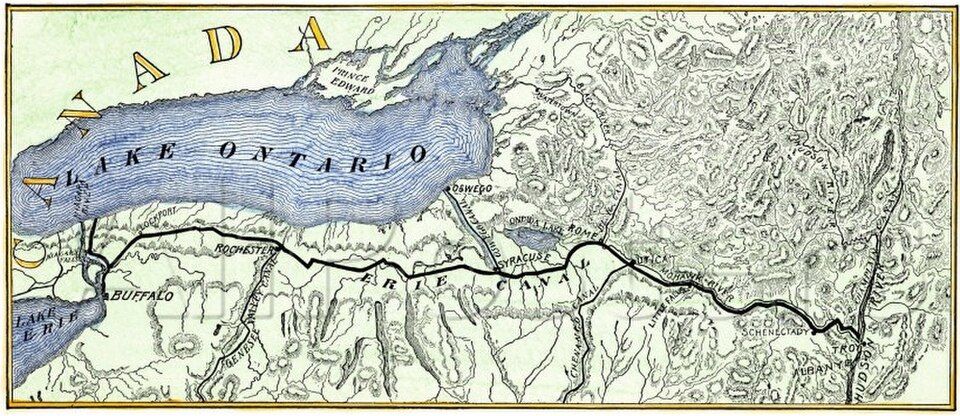
Completed in 1825, the Erie Canal linked the Great Lakes with the Hudson River, creating a water route from the Midwest to the Atlantic Ocean. This single project had profound effects:
- Midwestern farmers could ship crops east quickly and cheaply
- New York City became the dominant trade hub, with goods flowing to global markets
- The canal stimulated both urban and rural economies, extending trade across a much larger region
- The North and Midwest became economically integrated; the South remained more isolated from this network
Economic Growth and Regional Specialization
The Market Revolution affected regions very differently. This regional specialization created the sectional divisions that would define the rest of the antebellum period:
| Region | Specialization | Result |
|---|---|---|
| South | Cotton production using enslaved labor | Slavery expanded dramatically; economy became dependent on slave labor and cotton exports |
| North | Manufacturing, banking, shipping | Factories built; financial institutions grew; wage labor dominated |
| Midwest | Grain production and livestock | Became the nation’s agricultural heartland; connected to northern markets via canals and railroads |
The Cotton-Factory Connection: Regional Interdependence
Here’s the system: Southern plantations produced cotton using enslaved labor. This raw cotton was transported to northern textile factories, especially in Lowell, Massachusetts. Factories transformed cotton into cloth, which was sold domestically and internationally. The cloth trade fueled growth in northern banks and shipping industries.
Why this matters for the AP exam: This created strong economic ties between North and South even as slavery became increasingly divisive morally and politically. The North’s industrial growth was built directly on Southern slavery. This economic interdependence makes the lead-up to the Civil War more complex: regions were economically linked but ideologically and morally at odds.
Effects of the Market Revolution on American Society
Industrialization transformed how Americans lived and worked:
- Labor shift: More people worked for wages in factories instead of being self-employed farmers
- Consumer culture: Products became cheaper and widely available; ordinary people bought manufactured goods
- Urbanization: Factory towns and cities grew rapidly, especially in the North
- Regional specialization: Each region focused on what it produced most efficiently, creating interdependence and tension
- Social tensions: Wage labor, working conditions, child labor, and slavery expansion created new conflicts
Essential Vocabulary
| Term | Definition | AP Connection |
|---|---|---|
| Market Revolution | Period of rapid economic growth through industrialization, transportation, and commercialization (1800s) | Central to Period 4; directly connects to sectional tensions, slavery expansion, and Civil War causes |
| Industrialization | Development of industries on large scale using machines, factories, and wage labor | North industrialized rapidly; South did not—this fundamental difference fueled sectionalism |
| Interchangeable parts | Identical, standardized components usable in any product, enabling mass production | Revolutionary manufacturing concept; increased productivity and reduced costs dramatically |
| Telegraph | Communication device using coded signals to send messages instantly over long distances | Enabled coordination of trade and commerce across the nation |
| Erie Canal | Canal completed 1825 linking Great Lakes with Hudson River; connected Midwest to Atlantic markets | Transformed trade patterns; made New York City dominant; integrated North/Midwest economically |
| Cotton gin | Machine that separated cotton fibers from seeds; dramatically increased cotton production | Made slavery more profitable; expanded slavery westward; central to sectional conflict |
| Division of labor | Breaking production into specialized steps, each performed by different workers | Core innovation of factory system; increased production speed and volume exponentially |
Test-Taking Strategies
Mnemonics and Memory Shortcuts: Use two frameworks together. T-I-M-E covers the four key drivers of the Market Revolution: Technology (steam engines, cotton gin, power looms, telegraphs — transformed production), Infrastructure (canals, railroads, roads — moved goods and connected regions), Manufacturing (factories, division of labor, interchangeable parts — increased output), and Economic specialization (North = factories, South = cotton/slavery, Midwest = grain — created sectionalism). Supplement with the Regional Framework: South = cotton production + slavery expansion → economic dependence on slavery, resistance to federal interference; North = factories + wage labor + banking → industrial growth, support for tariffs; Midwest = grain production + canal/railroad access → connected to northern markets, aligned with the North. Together these two frameworks let you quickly answer any question about causes, regional effects, or consequences of the Market Revolution.
Cross-Topic Connections You Must Know: Market Revolution → Sectionalism: regional specialization (South cotton/slavery, North manufacturing/banking) deepened sectional divisions; the North’s industrial growth and the South’s dependence on slavery created fundamentally different societies with conflicting values and interests. Market Revolution → Slavery Expansion: the cotton gin made slavery far more profitable and planters demanded more enslaved labor to expand cotton production westward, directly connecting to territorial expansion and conflict over whether new states would allow slavery. Market Revolution → Westward Expansion: railroads and canals enabled settlement and commerce in western territories, driving territorial growth and intensifying conflicts over slavery’s expansion into new lands. Market Revolution → Reform Movements (4.11–4.14): industrialization and wage labor created new social problems (poor working conditions, child labor, urban poverty) that sparked reform movements including labor organization, abolitionism, and calls for women’s rights. Market Revolution → Tariff Debates: Northern manufacturers wanted protective tariffs to shield them from British competition; Southern planters opposed tariffs, which increased prices for imported goods and contributed to the Nullification Crisis.
Common Question Formats on the AP Exam: Cause-and-effect questions often ask “Which innovation most directly increased cotton production and expanded slavery in the South?” — answer: the cotton gin, a key turning point. Regional comparison questions ask “How did the Market Revolution affect the North differently than the South?” — answer: North industrialized with factories and wage labor; South expanded slavery and specialized in cotton. Document analysis questions may include factory worker letters, canal advertisements, plantation records, or tariff debates; be ready to explain how documents illustrate Market Revolution effects on different regions. Multiple causation questions ask “Which combination of factors best explains rapid industrialization in the North?” — answer: technology + capital + transportation networks + entrepreneurship + labor availability. Long essay questions often ask “Analyze the extent to which the Market Revolution unified or divided the United States” — recognize both the economic interdependence and the deepening sectional conflict.
Frequent Student Mistakes to Avoid: Don’t treat the Market Revolution as uniformly positive — it transformed the North but intensified slavery in the South, and regional effects were drastically different, creating conflict rather than unity. Don’t underestimate slavery’s role — the cotton gin and cotton production weren’t peripheral to the Market Revolution; slavery was central to it, and the entire system depended on enslaved labor for southern prosperity. Don’t confuse inventors with impact — you need to know not just who invented things (Eli Whitney) but how inventions transformed regions, labor patterns, and society; the cotton gin didn’t just increase production, it expanded slavery. Don’t forget transportation networks — canals and railroads were just as transformative as machines; they connected regions, created markets, and determined which areas industrialized. Don’t miss regional isolation — the South’s reliance on river transportation left it less connected to the North’s canal/railroad network, reinforcing regional differences. Don’t ignore the slavery-cotton-gin connection — always connect the cotton gin to slavery expansion; this link is fundamental to understanding sectional conflict.
Test-Day Shortcuts: “Market Revolution causes” — think TECH + BUSINESS + TRANSPORT: new Technologies, entrepreneurial Business models, and Transportation infrastructure investment. “Regional effects” — use the Regional Framework: South = agriculture/slavery/limited industrialization, North = manufacturing/banking/urban growth, Midwest = grain/connected to North; different paths led to conflict. When “cotton gin” appears, immediately think slavery expansion, sectional conflict, Civil War causes — this invention is a turning point for slavery’s profitability. When asked “Why did regions develop differently?” — answer: transportation networks (North = canals/railroads, South = rivers), technology adoption rates, and investment in manufacturing vs. slavery. For “integration” or “interdependence” questions, show that regions were economically linked through the cotton-factory system but morally and ideologically at odds.
Time Management: Market Revolution questions often appear in clusters on multiple-choice; answer them together for efficiency and topical momentum. For short-answer questions (about 5 minutes), create a quick T-chart (Causes | Effects) before writing to stay organized and specific. For long essays (40 minutes), use the T-I-M-E mnemonic as your roadmap — defining key terms strengthens your argument and always address regional differences. For regional comparison essays, structure around North vs. South specialization and show how the same Market Revolution created very different outcomes in different regions. Avoid spending too much time on a single innovation — the AP focuses on broader patterns and consequences, not technical details of how machines worked.