

Maximize your score with these resources:
- Albert.io AP® US History question banks
- Free AP® US History cheat sheets
- Free AP® US History score calculator
The Spanish–American War lasted less than four months in 1898. John Hay, then U.S. ambassador to Britain, called it “a splendid little war.” Yet by the time the treaty was signed, the United States controlled Puerto Rico, Guam, and the Philippines, and it soon found itself fighting a far longer and bloodier war against Filipinos who wanted independence. Topic 7.3 covers why the U.S. went to war, what it gained, and the fierce debate over whether a republic should rule an empire.
This article covers Topic 7.3: The Spanish–American War in Period 7, 1890 to 1945. The topic asks you to explain the causes and effects of the Spanish–American War and how it sparked debates over American imperialism and the country’s role in the world.
By the end, you should be able to:
- Explain the long-term and immediate causes of the war.
- Describe the territories the U.S. acquired.
- Compare the arguments of imperialists and anti-imperialists.
- Explain the effects of the war on U.S. foreign policy.

What We Review
Causes of the War
| Cause | Explanation |
|---|---|
| Cuban independence struggle | Cubans revolted against Spanish rule in 1895. Spain’s General Valeriano Weyler forced civilians into reconcentration camps, where many died of disease and starvation. |
| Yellow journalism | Newspapers owned by William Randolph Hearst and Joseph Pulitzer published sensational stories of Spanish cruelty to sell papers and stir public anger. |
| Economic interests | Americans had about $50 million invested in Cuban sugar and trade, and businesses wanted stable markets. |
| Strategic and imperial ambitions | Alfred Thayer Mahan’s The Influence of Sea Power upon History (1890) argued that great nations needed navies, coaling stations, and overseas bases. |
| The de Lôme letter | A leaked letter from the Spanish minister insulted President McKinley as weak. |
| The sinking of the USS Maine | The battleship exploded in Havana harbor in February 1898, killing 266 sailors. Newspapers blamed Spain. “Remember the Maine!” became a rallying cry. |
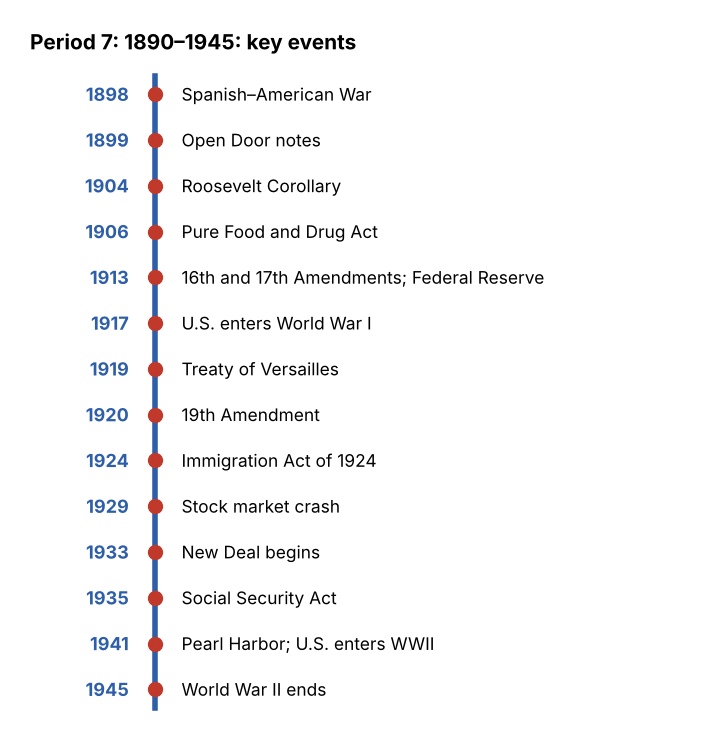
Congress declared war in April 1898. It also passed the Teller Amendment, promising that the U.S. would not annex Cuba.
The War Itself
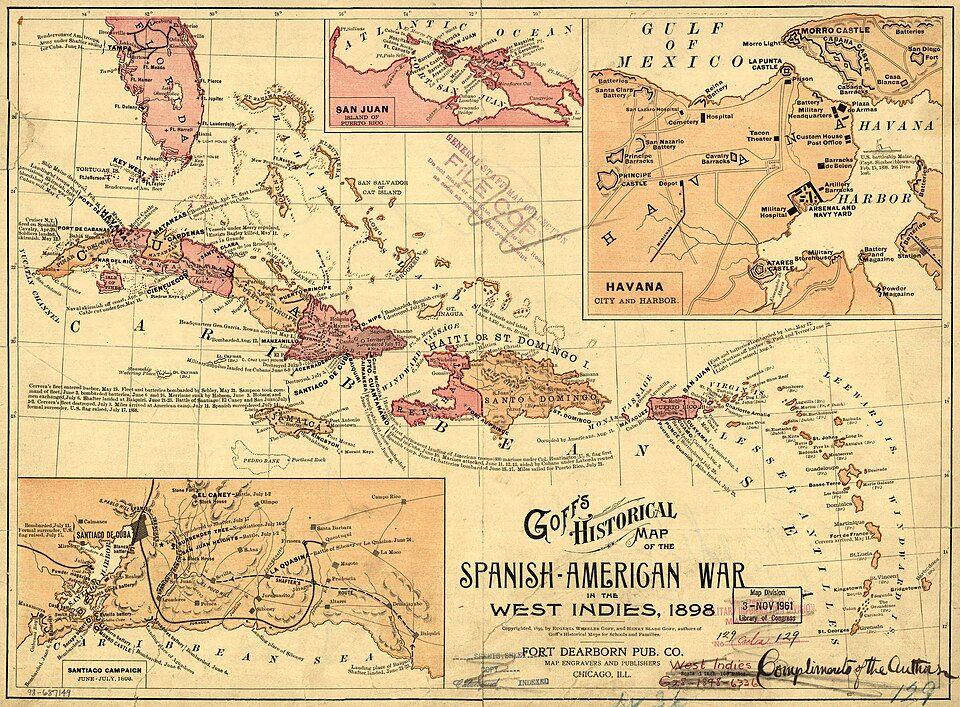
- The Philippines: Commodore George Dewey destroyed the Spanish fleet in Manila Bay on May 1, 1898.
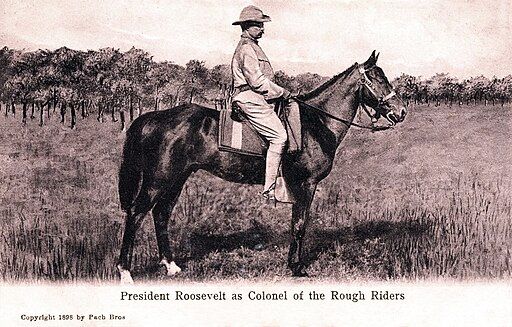
- Cuba: Theodore Roosevelt’s volunteer “Rough Riders,” along with Black regiments of “Buffalo Soldiers,” fought at San Juan Hill. The U.S. Navy then destroyed Spain’s Caribbean fleet at Santiago.
- Casualties: Fewer than 400 Americans died in combat, but more than 2,000 died of diseases like yellow fever and typhoid.
Results: An Overseas Empire
The Treaty of Paris (1898) ended the war.
| Territory | Outcome |
|---|---|
| Puerto Rico | Became a U.S. territory. Residents gained U.S. citizenship in 1917. |
| Guam | Became a U.S. territory and naval base. |
| Philippines | Purchased for $20 million, leading to the Philippine–American War. |
| Cuba | Nominally independent, but the Platt Amendment (1901) let the U.S. intervene and lease a naval base at Guantánamo Bay. |
The U.S. also annexed Hawaii in 1898, separately from the treaty, after American planters had overthrown Queen Liliuokalani in 1893.
The Philippine–American War
Filipino nationalists led by Emilio Aguinaldo had fought alongside Americans against Spain, expecting independence. When the U.S. kept the islands, they fought back. The war lasted from 1899 to 1902, officially, and cost the lives of about 4,200 American soldiers and at least 200,000 Filipinos, most of them civilians, from violence, famine, and disease.
The Debate Over Empire
| Imperialists | Anti-Imperialists |
|---|---|
| Colonies provide markets, raw materials, and naval bases | Ruling people without their consent violates the Declaration of Independence |
| If the U.S. didn’t take territory, other powers would | Empire is expensive and drags the country into foreign wars |
| Social Darwinism and the “White Man’s Burden” justified rule over “less civilized” peoples | Some feared that annexation would bring non-white peoples into the nation, a racist argument against expansion |
| Key voices: Theodore Roosevelt, Henry Cabot Lodge, Albert Beveridge | Key voices: Mark Twain, Andrew Carnegie, Jane Addams, William Jennings Bryan |
In the Insular Cases (1901), the Supreme Court ruled that the Constitution did not fully apply in the new territories. In effect, “the Constitution does not follow the flag.”
Why does this matter? The Spanish–American War marks the moment the U.S. became an imperial power with overseas colonies. It’s a turning point you can use in essays about American foreign policy, comparing it with earlier continental expansion or with later interventions in Latin America and Asia. Notice that both sides of the debate drew on racial ideas, which is a nuance that can earn complexity credit.
Test-Taking Strategies
Mnemonic Devices and Memory Shortcuts
- “PIG” for the treaty gains. Puerto Rico, the Philippines (the Islands), and Guam.
- “Teller told, Platt controlled.” Teller promised not to annex Cuba. Platt kept Cuba under U.S. influence.
- “Remember the Maine, blame the press.” Yellow journalism turned the explosion into a cause for war.
Cross-Topic Connections
- Topic 7.2: Debates over imperialism framed the war and its aftermath. See our review of Big Stick diplomacy.
- Topic 5.3: The Mexican–American War offers a comparison with earlier expansion. See our review of the Mexican–American War.
- Topic 6.12: Social Darwinism shaped arguments for empire.
- Topic 8.8: The Vietnam War raised similar questions about fighting nationalist movements in Asia.
Common Question Formats
- Stimulus MCQ. A yellow-journalism headline or cartoon, and you identify its effect on public opinion.
- Comparison SAQ. You compare imperialist and anti-imperialist arguments.
- Causation SAQ. You explain one cause and one effect of the war.
- LEQ. You evaluate how U.S. foreign policy changed from the 1890s to the 1920s.
Frequent Student Mistakes
- Saying the U.S. annexed Cuba. The Teller Amendment prevented annexation. The Platt Amendment created a protectorate instead.
- Forgetting the Philippine–American War. It lasted far longer and killed far more people than the war with Spain.
- Claiming Spain definitely sank the Maine. The cause was never proven, and later studies point to an internal explosion.
- Treating anti-imperialists as uniform. Their reasons ranged from democratic ideals to racism and economics.
Test-Day Shortcuts
- Look for “consent of the governed.” That phrase in a source signals an anti-imperialist argument.
- Connect Mahan to bases. Naval strategy explains why Guam, Hawaii, and the Philippines mattered.
- Use the Insular Cases. They’re precise evidence about the legal status of new territories.
Time Management Tips
- Multiple choice: Section IA has 55 questions in 55 minutes, about 1 minute each. Cartoons from 1898 often reward reading the labels closely.
- Short answer: Section IB has 3 required questions in 40 minutes, roughly 13 minutes each. Name a specific territory or law in every part.
- Essays: The DBQ gets 60 minutes, including a 15-minute reading period, and the single required LEQ gets 40 minutes. The war works well as a turning point in foreign policy arguments.
Check for Understanding
Think you’ve got it? Complete the quiz below to make sure. Download your results at the end.