

Maximize your score with these resources:
- Albert.io AP® US History question banks
- Free AP® US History cheat sheets
- Free AP® US History score calculator
On the morning of September 11, 2001, nineteen al-Qaeda terrorists hijacked four airliners and killed nearly 3,000 people at the World Trade Center, the Pentagon, and a field in Pennsylvania. Within a month, the U.S. was at war in Afghanistan. Within two years, it had invaded Iraq. The attacks reshaped American foreign policy, government, and debates over security and freedom. Then, in 2008, a financial crisis brought the worst economic downturn since the Great Depression. Topic 9.6 covers the challenges that defined the early 21st century.
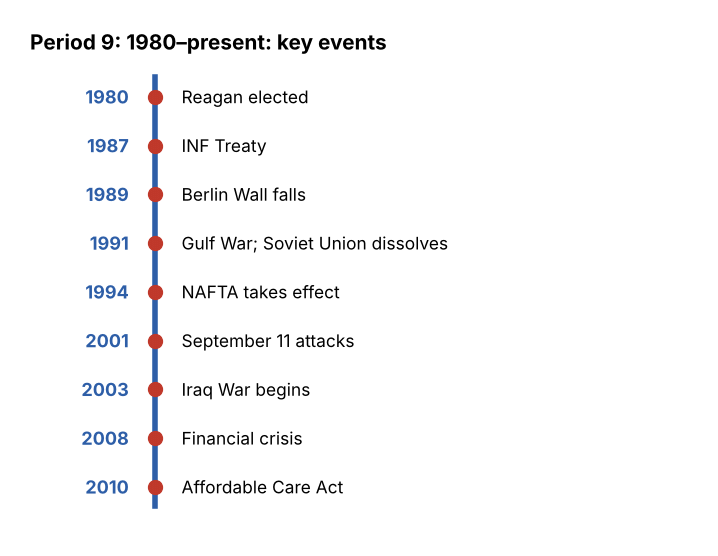
This article covers Topic 9.6: Challenges of the 21st Century in Period 9, 1980 to the present. The topic asks you to explain how the United States responded to terrorism, war, economic crisis, and new domestic challenges in the early 21st century, and how these responses sparked debates over the role of government and the balance between security and liberty.
By the end, you should be able to:
- Describe the U.S. response to the September 11 attacks.
- Explain the debates over the wars in Afghanistan and Iraq.
- Explain the causes and effects of the 2008 financial crisis.
- Describe ongoing debates over health care, climate change, and civil liberties.
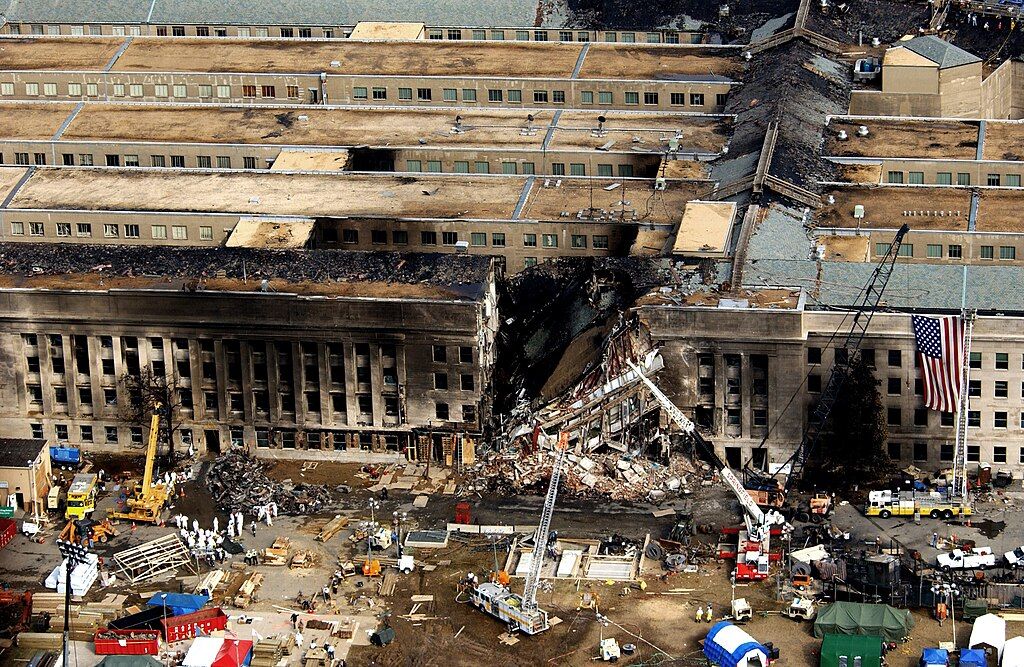
TSGT CEDRIC H. RUDISILL, USAF, Public domain, via Wikimedia Commons

What We Review
The War on Terror
| Event or Policy | Year | Significance |
|---|---|---|
| September 11 attacks | 2001 | Deadliest foreign attack on U.S. soil |
| War in Afghanistan | 2001 to 2021 | Toppled the Taliban, which had sheltered al-Qaeda. Became the longest war in U.S. history. The Taliban returned to power after U.S. withdrawal in 2021. |
| USA PATRIOT Act | 2001 | Expanded government surveillance and investigative powers |
| Department of Homeland Security | 2002 | Combined 22 federal agencies to protect against terrorism |
| The Bush Doctrine | 2002 | Claimed the right to strike first against potential threats, called “preemptive war” |
| Iraq War | 2003 to 2011 | Justified by claims of weapons of mass destruction, which were never found. Saddam Hussein was removed, but a long insurgency followed. |
| Death of Osama bin Laden | 2011 | Killed by U.S. forces in Pakistan |
Security vs. Liberty
The War on Terror raised old questions in a new form.
- Surveillance: The PATRIOT Act and later revelations about the National Security Agency’s collection of phone records, leaked by Edward Snowden in 2013, prompted debates about privacy.
- Detention: The U.S. held suspected terrorists at Guantánamo Bay, Cuba, without trial. In Boumediene v. Bush (2008), the Supreme Court ruled detainees had the right to challenge their detention in court.
- Interrogation: “Enhanced interrogation” methods, including waterboarding, and abuses at Abu Ghraib prison in Iraq were widely condemned as torture.
- Discrimination: Muslim and Arab Americans faced increased suspicion and hate crimes.
These debates echo earlier tensions over civil liberties in wartime, from the Sedition Act of 1918 to Japanese American internment and the Red Scare.
The Great Recession
| Cause | Explanation |
|---|---|
| Housing bubble | Home prices rose rapidly in the early 2000s, encouraged by easy credit |
| Subprime lending | Banks issued risky mortgages to borrowers who couldn’t afford them |
| Complex financial products | Mortgages were bundled into securities that spread risk throughout the financial system |
| Deregulation | Weakened oversight let banks take on huge risks |
When the bubble burst, major firms like Lehman Brothers collapsed in 2008. Unemployment reached 10% in 2009, and millions of families lost their homes to foreclosure.
Government Responses
- Troubled Asset Relief Program (TARP, 2008): Signed by George W. Bush, it provided up to $700 billion to stabilize banks and the auto industry.
- American Recovery and Reinvestment Act (2009): Barack Obama’s stimulus package of about $800 billion in spending and tax cuts.
- Dodd-Frank Act (2010): Tightened financial regulation and created the Consumer Financial Protection Bureau.
Anger at bank bailouts fueled movements on both the right, like the Tea Party, and the left, like Occupy Wall Street.
Other Domestic Challenges
- Health care: The Affordable Care Act (2010) expanded insurance coverage to millions and became one of the most debated laws of the era.
- Climate change: Scientists warned about rising global temperatures. Debates centered on regulation, energy policy, and international agreements like the Paris Agreement (2015).
- Political polarization: Partisan divisions grew sharper, shaped by cable news, the internet, and social media.
- Demographic change: Barack Obama’s election in 2008 as the first African American president reflected a more diverse electorate. Obergefell v. Hodges (2015) legalized same-sex marriage nationwide.
Why does this matter? The AP exam’s coverage of this topic focuses on broad patterns: how the U.S. responded to new threats and crises, and how those responses connected to long-running debates about government power, liberty, and America’s role in the world. On essays, link the War on Terror to earlier wartime limits on civil liberties, or compare the Great Recession with the Great Depression.
Test-Taking Strategies
Mnemonic Devices and Memory Shortcuts
- “9/11, PATRIOT, DHS.” The attack and the two major domestic responses.
- “Bubble, bust, bailout.” The sequence of the 2008 crisis.
- “Security vs. liberty, again.” The War on Terror repeated an old debate.
Cross-Topic Connections
- Topic 9.3: The end of the Cold War left the U.S. as the sole superpower.
- Topic 7.9: The Great Depression offers the key economic comparison.
- Topic 8.3: The Red Scare is an earlier example of security concerns limiting liberties.
- Topic 8.8: Vietnam raised similar questions about long wars abroad.
Common Question Formats
- Stimulus MCQ. An excerpt from a presidential speech after 9/11, and you identify its policy goals.
- Comparison SAQ. You compare the government’s response to the Great Recession with its response to the Great Depression.
- Continuity and change SAQ. You explain how the War on Terror changed U.S. foreign policy.
- LEQ. You evaluate how Americans have balanced security and civil liberties during wartime.
Frequent Student Mistakes
- Linking Iraq to 9/11. No evidence tied Saddam Hussein to the attacks.
- Crediting Obama with TARP. Bush signed it in 2008.
- Overloading essays with recent details. The exam emphasizes broad patterns, not memorized recent events.
- Treating 9/11 responses as unopposed. Debates over surveillance and detention were intense.
Test-Day Shortcuts
- Spot “preemptive.” It points to the Bush Doctrine.
- Use long comparisons. Linking 2001 to 1918 or 1942 shows course-wide understanding.
- Name one law per crisis. PATRIOT for terrorism, Dodd-Frank for finance.
Time Management Tips
- Multiple choice: Section IA has 55 questions in 55 minutes, about 1 minute each. Period 9 carries the smallest share of the exam, so focus on big patterns.
- Short answer: Section IB has you answer 3 questions (Questions 1 and 2, plus your choice of Question 3 or 4) in 40 minutes, roughly 13 minutes each. SAQs cover developments up to 2001, so pre-2001 evidence is safest there.
- Essays: The DBQ gets 60 minutes, including a 15-minute reading period, and the single required LEQ gets 40 minutes. Recent events work best as comparisons to earlier periods.
Check for Understanding
Think you’ve got it? Complete the quiz below to make sure. Download your results at the end.