

Maximize your score with these resources:
- Albert.io AP® Human Geography question banks
- Free AP® Human Geography cheat sheets
- Free AP® Human Geography score calculator
Agriculture didn’t originate everywhere at once. Roughly 10,000 years ago, in a handful of regions scattered across the globe, humans made a transformational shift from hunting and gathering to farming. This Neolithic Revolution changed everything: settlement patterns, population sizes, social organization, and the entire trajectory of human civilization. For AP® Human Geography, understanding where agriculture began, why farming succeeded in some locations and not others, and how agricultural practices spread across continents is essential to explaining modern settlement patterns, trade networks, and cultural landscapes.
Exam questions test your ability to identify major agricultural hearths, explain why crops spread through diffusion, and recognize how global crop exchange reshaped demographics and economies. This guide covers the origins of agriculture, the major hearths and their signature crops, the mechanisms of agricultural diffusion, and the world-changing impact of the Columbian Exchange.
The Neolithic Revolution: When Humans Started Farming
For most of human history, people were hunter-gatherers—moving seasonally following animal herds and gathering wild plants. This lifestyle worked, but it had hard limits: populations remained small because any given landscape could only support so many people through hunting and gathering alone.
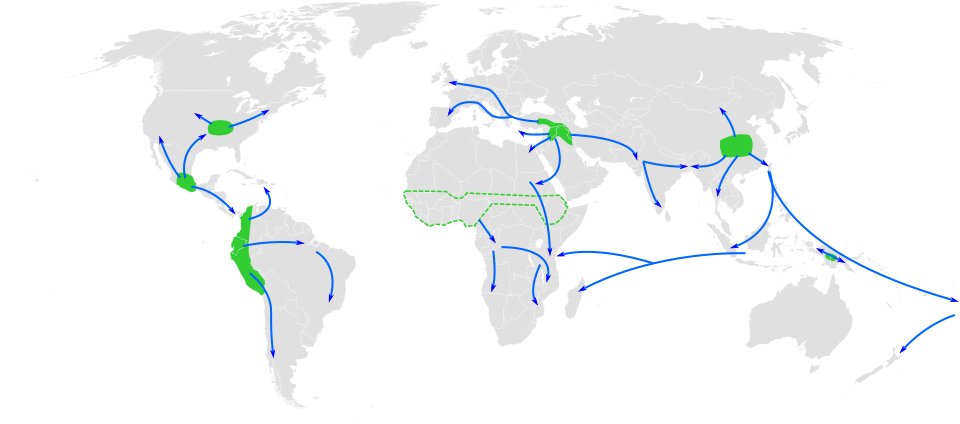
Around 10,000 BCE, something shifted. In a few scattered places on Earth, humans began deliberately planting seeds, tending crops, and domesticating animals. This transition is called the Neolithic Revolution (or First Agricultural Revolution). It wasn’t instantaneous—it unfolded over centuries in different regions. But once farming started, its advantages were undeniable: people could produce more food in smaller spaces, stay in one location permanently, and support larger populations.
Farming created surplus. For the first time in human history, one person could grow enough food to feed not just themselves, but others. That surplus enabled specialization: some people stopped farming to become artisans, priests, warriors, or administrators. Specialization led to complex societies, writing systems, governments, and eventually civilizations.
Agriculture had costs too. Farmers worked longer hours than hunter-gatherers. Domesticated animals and dense settlements created ideal conditions for disease transmission. Population growth stretched resources during droughts and crop failures. Yet the advantages were powerful enough that wherever agriculture took hold, it persisted and spread.
The Major Agricultural Hearths and Their Crops
Agriculture emerged independently in multiple locations—not just one. Geographer Carl Sauer identified several independent centers of agricultural origin, called hearths. Each hearth developed its own crop complex: the signature plants and animals that defined farming in that region. Knowing these hearths is essential for the exam because they explain global crop distributions, regional cuisines, and why certain plants are culturally associated with specific regions.
| Hearth | Location | Approx. Date | Primary Crops | Primary Animals |
|---|---|---|---|---|
| Fertile Crescent | Iraq, Syria, Lebanon, Israel, Jordan | 10,000 BCE | Wheat, barley, lentils, peas | Sheep, goats, cattle, pigs |
| East Asia | Yellow and Yangtze River valleys, China | 9,000 BCE | Millet (north), rice (south), soybeans | Pigs, chickens, water buffalo |
| Mesoamerica | Central Mexico and Central America | 8,000 BCE | Maize, beans, squash (“three sisters”) | Turkeys, dogs |
| Sub-Saharan Africa | Sahel region and Ethiopian highlands | 5,000 BCE | Sorghum, millet, yams, African rice | Guinea fowl, cattle |
| Andes and Amazonia | Highland Peru and Bolivia; southwestern Amazon lowlands | 8,000 BCE | Potato, quinoa, cassava | Llamas, alpacas |
| Eastern North America | Mississippi River valley | 4,000 BCE | Sunflower, squash, goosefoot (chenopod) | Dogs (no livestock domesticated) |
The Fertile Crescent: Wheat and Civilization’s Cradle
The Fertile Crescent—an arc of productive land stretching from the Persian Gulf through Iraq, Syria, and down toward Egypt—was likely the first place where agriculture developed independently. Around 10,000 BCE, people began cultivating wheat and barley, which already grew wild in the region. The Fertile Crescent also offered domesticable animals: sheep, goats, cattle, and pigs. The combination of grains and livestock created a robust agricultural system. Grain surpluses supported the rise of the world’s first cities, including Jericho and Uruk, and enabled the complex societies of ancient Mesopotamia and Egypt.
East Asia: Rice and Millet in Monsoon Lands
In China, agriculture emerged independently around 9,000 BCE in two regions with different climates. Along the Yellow River in the north, people grew millet, a hardy grain suited to cooler, drier conditions. In the Yangtze River valley to the south, farmers cultivated rice, which thrived in warm, wet monsoon climates. East Asia also domesticated pigs, chickens, and water buffalo—the latter invaluable for working in flooded rice paddies, making rice agriculture far more efficient. Rice farming required sophisticated irrigation systems and communal labor to build and maintain them, which influenced East Asian societies’ development of centralized governments.
Mesoamerica: The Three Sisters
In Mexico and Central America, agriculture developed around 8,000 BCE centered on maize (corn). Unlike wheat and barley, maize didn’t exist as a wild plant—it had to be domesticated from a wild grass called teosinte through selective breeding over thousands of years. This was a remarkable achievement in plant genetics.
Mesoamerican farmers paired maize with two companion crops: beans and squash. These three crops, called the “three sisters,” form a complementary agricultural system. Maize grows tall; beans climb the stalk and fix nitrogen in the soil; squash spreads along the ground, shading the soil and retaining moisture. Together they provide carbohydrates, protein, and essential nutrients. This crop complex supported the Aztec and Maya civilizations and remains the foundation of Mexican cuisine today.
Sub-Saharan Africa and the Andes: Diverse Centers
Agriculture emerged in Sub-Saharan Africa, particularly in the Sahel, around 5,000 BCE. Farmers domesticated sorghum and millet—grains perfectly adapted to semi-arid climates—along with yams and an indigenous form of rice. In the Andes Mountains, high-altitude farming began around 8,000 BCE. The signature crop was the potato: nutritionally rich and capable of growing in poor, cold soils where few other crops survive. Andean farmers also cultivated quinoa (cassava was domesticated in the Amazon lowlands), and domesticated llamas and alpacas—the only large animals domesticated in the Americas—for wool, meat, and transportation across difficult mountain terrain.
How Agriculture Diffused: From Hearths to the World
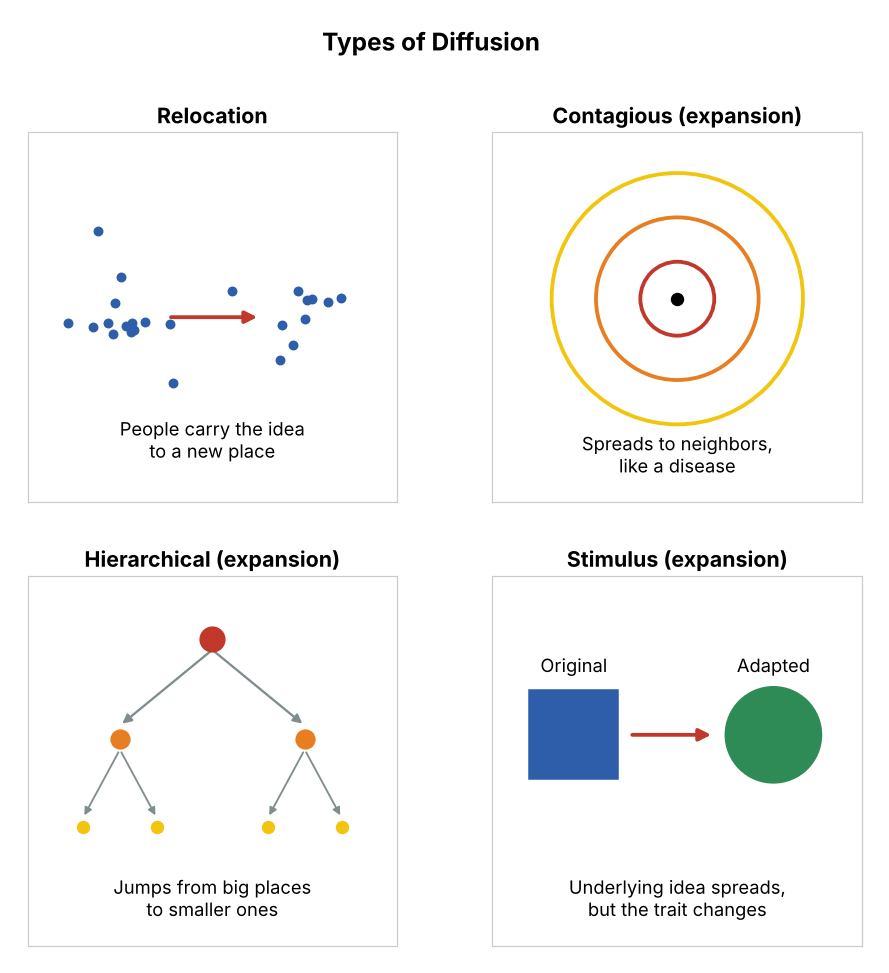
Agriculture didn’t remain confined to its original hearths. It spread through diffusion: the process by which an innovation, idea, or cultural practice spreads from one location to another. Agricultural diffusion occurred through multiple mechanisms:
- Migration of people: As populations grew in agricultural hearths, people migrated to new regions, bringing seeds and farming knowledge. Neolithic farmers from Anatolia carried wheat and barley farming westward into Europe.
- Trade and cultural contact: Merchants and traders carried seeds and knowledge between regions. The Silk Road facilitated crop exchange across Central Asia over centuries.
- Conquest and colonization: Empires imposed agricultural practices on conquered territories. Arab conquests in the 7th and 8th centuries spread sugar cane, citrus, and rice across the Mediterranean and into Spain.
- Adaptation and adoption: Farming communities learned from neighbors, adopting crops and techniques that worked in their environment.
For the exam: agricultural diffusion followed trade routes, migration patterns, and cultural networks. Similar climates made adoption more likely—but diffusion wasn’t automatic. Some cultures maintained hunting and gathering for thousands of years even after learning about farming, because their environments provided such abundant natural resources that agriculture wasn’t necessary. Understand diffusion as a process shaped by geography, culture, and economics, not an inevitable one-way march.
The Columbian Exchange: When Two Worlds Collided
For most of human history, the Americas were isolated from Europe, Africa, and Asia. Agriculture in the New World developed independently, with completely different crops, animals, and farming systems. The two hemispheres also evolved separate disease ecosystems.
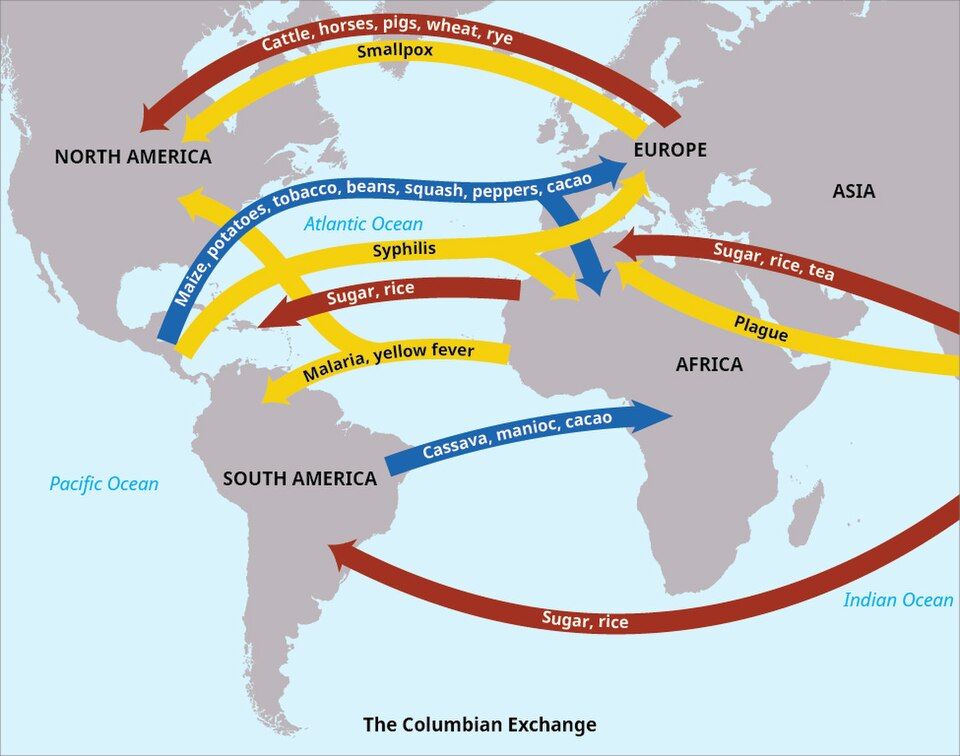
Starting in 1492, this isolation ended. The Columbian Exchange—the massive transfer of crops, animals, diseases, and ideas between the Old World and New World—reshaped global demographics, trade, and culture in ways almost impossible to overstate.
| Direction | Key Crops and Goods | Major Impact |
|---|---|---|
| New World to Old World | Maize, potatoes, tomatoes, squash, beans, chocolate, tobacco, sweet potatoes | Potatoes and maize became dietary staples across Europe, Africa, and Asia; global populations surged; tomatoes transformed Mediterranean cuisine; chocolate and tobacco became global commodities |
| Old World to New World | Wheat, barley, rice, sugar cane, cattle, pigs, chickens, horses | Transformed American ecosystems; livestock ranching displaced indigenous agriculture; horses revolutionized Plains Indians’ hunting and warfare; sugar plantations created demand for enslaved labor |
| Diseases (Old World to New) | Smallpox, measles, influenza | Approximately 90% of indigenous American populations died; fundamentally reshaped colonial dynamics and labor systems |
Why the Columbian Exchange Mattered So Much
The Columbian Exchange had three massive consequences for global human geography.
First, it greatly expanded the crop diversity available to each hemisphere. Each hemisphere gained access to the other’s crop staples. The New World received wheat, barley, and rice; the Old World gained maize, potatoes, and tomatoes. These weren’t just dietary novelties—they were transformative food sources.
Second, it triggered explosive global population growth. Potatoes and maize are calorie-dense and highly productive. Potatoes grow in marginal soils and cool climates where wheat and barley struggle. In Ireland, potatoes became the dietary foundation, supporting a population that tripled in two centuries. In China and sub-Saharan Africa, maize and potatoes expanded agricultural capacity into previously marginal lands, driving population booms. The global population roughly doubled between 1500 and 1800, driven in part by New World crops feeding Old World populations.
Third, it reshaped power dynamics and trade networks. European colonizers grew New World crops—especially sugar—for export. Sugar plantations, worked by enslaved Africans, became engines of Atlantic wealth. The transatlantic slave trade itself was economically tied to the need for labor to produce New World crops. The Columbian Exchange had devastating consequences alongside its role in expanding food supply.
Centers of Plant Genetic Diversity: Vavilov’s Legacy
In the early 20th century, Soviet scientist Nikolai Vavilov identified regions where crop genetic diversity concentrates. These centers of plant genetic diversity overlap with but extend beyond the original agricultural hearths—places where crop ancestors still grow wild and where traditional farmers maintain diverse seed varieties.
Today these centers are critical to global food security. They preserve genetic diversity that breeders use to develop new crop varieties resistant to pests, diseases, and climate stress. The Andes remains a center for potato diversity; the Mediterranean for wheat diversity. As agriculture industrializes and monocultures dominate, these centers become increasingly valuable and vulnerable.
Modern Implications: Monoculture vs. Genetic Diversity
Agricultural origins and diffusions aren’t merely historical—they shape modern food systems. Today’s farming is dominated by monoculture: planting one crop variety across large areas. Global agriculture relies on a handful of crops (wheat, rice, maize, soy) and on just a few genetic varieties within each species.
This efficiency creates serious vulnerability. Monocultures are susceptible to pests and diseases that can sweep through genetically identical crops. The Irish Potato Famine of 1845–1852 killed a million people and forced another million to emigrate because Ireland’s potatoes were genetically uniform—one pathogen destroyed the entire crop system.
Modern food security strategies emphasize maintaining crop genetic diversity. Seed banks and conservation organizations work to preserve traditional crop varieties and wild relatives of domesticated plants, especially in Vavilov’s centers. If a new pest or climate shift threatens modern wheat, breeders can cross it with hardy wild relatives to create resistant varieties. Understanding this historical background helps you see why geographic distribution of crop diversity remains a live issue in contemporary human geography.
Test-Taking Strategies
Agricultural geography questions appear in both multiple choice and free response on AP® Human Geography. These strategies address the most common question types and point-earning opportunities.
1. Memorize Hearths, Crops, and Locations as a Matched Set
The exam frequently asks you to match a hearth to its signature crops, animals, and location. Study them as connected units, not isolated facts: Fertile Crescent = wheat/barley/sheep/Middle East; East Asia = rice (south)/millet (north)/pigs/China; Mesoamerica = maize/beans/squash/Central Mexico; Sub-Saharan Africa = sorghum/millet/yams/Sahel; Andes = potato/quinoa/llamas/highland South America. A mnemonic: FEMSA (Fertile Crescent, East Asia, Mesoamerica, Sub-Saharan Africa, Andes) covers the five major hearths. Practice until you can recall each set in under 10 seconds.
2. Understand Why Diffusion Followed Specific Paths
The exam tests diffusion mechanisms, not just the fact that diffusion happened. When asked why a crop spread in a particular direction, think: ecological similarity (rice followed monsoon zones), trade routes (Silk Road), migration corridors (Indo-European movements westward), and colonial networks (Spanish spreading Old World crops into the Americas). If a question describes an arid region, you should anticipate sorghum or millet as likely to diffuse there, not rice. Geography constrains which crops can spread where.
3. Use the Columbian Exchange as Your Central Case Study
The Columbian Exchange is the most important diffusion example in all of human geography. Know the major crops flowing in each direction and be ready to explain consequences: population growth, ecological transformation, cultural change, and shifts in trade networks and labor systems (particularly the slave trade). Free response questions frequently ask you to analyze consequences of the Columbian Exchange—practice explaining why New World crops triggered Old World population booms, or how sugar production reshaped Atlantic labor systems.
4. Connect Agriculture to Settlement, Population, and Development
The exam integrates topics across units constantly. Why did cities emerge in the Fertile Crescent? Because reliable grain surpluses supported specialization and population density. Why did Ireland’s population triple between 1700 and 1840? Because potatoes are calorie-dense and productive in marginal soils. Why does sub-Saharan Africa have certain population distribution patterns? Partly because of which crops thrived there historically. Always ask: “What does this agricultural pattern imply about settlement, population, or economic development?”
5. Distinguish Origin from Diffusion Precisely
The exam distinguishes precisely between where a crop originated (first domesticated) and where it subsequently diffused (spread to). Maize originated in Mesoamerica but today feeds more people in Africa and Asia than anywhere in the Western Hemisphere. Tomatoes originated in the Andes but now define Italian cuisine. Read free response prompts carefully to determine whether the question asks about origin, diffusion, or both—your answer structure changes depending on which the rubric targets.
6. Know the Vavilov Centers for Food Security Questions
Vavilov’s centers of genetic diversity appear in contemporary questions about food security, genetic modification, and biodiversity conservation. Understand why these centers matter: they’re genetic insurance for modern agriculture. If a question asks about strategies for protecting global food security, connecting genetic diversity preservation to Vavilov’s centers demonstrates depth of understanding.
7. Recognize This Topic’s Connections to Colonialism and Development
Agricultural origins and diffusions connect to colonialism in important ways. Colonial powers introduced Old World crops to the Americas, transforming indigenous agricultural systems and landscape. The plantation agriculture system—sugar, cotton, tobacco—relied on enslaved labor and created the economic structures that shaped development inequality persisting today. When exam questions address development disparities between former colonies and colonizers, agricultural history is often part of the explanation.
8. Use Precise Vocabulary
Term precision earns rubric credit. Use: Neolithic Revolution (not “when people started farming”), agricultural hearth (not “origin place”), crop complex, Columbian Exchange, diffusion with the type (relocation, expansion, contagious, hierarchical), centers of plant genetic diversity, monoculture, domestication. These terms appear on scoring rubrics—use them explicitly and correctly in your responses.
Check for Understanding
Think you’ve got it? Complete the quiz below to make sure. Download your results at the end.