
Maximize your score with these resources:
- Albert.io AP® Art History question banks
- Free AP® Art History cheat sheets
- Free AP® Art History score calculator
African art has been one of the most misunderstood and appropriated bodies of work in Western art history. For centuries, European viewers filtered African artistic traditions through colonial frameworks, dismissing them as “primitive,” “ethnographic,” or “decorative” rather than seeing them as sophisticated aesthetic and intellectual systems. This misinterpretation shaped not only how Western museums and collectors approached African objects but also how the discipline of art history itself developed. Understanding how African art has been misinterpreted—and how scholars are now reinterpreting it—is crucial for AP® Art History success. Topic 6.3: Theories and Interpretations of African Art (Learning Objective THR-1.A) asks you to recognize when theories about African art are rooted in colonial bias versus when they emerge from authentic historical and cultural understanding. The AP® Art History exam tests your ability to understand the evolution of how African art has been understood, misunderstood, and reinterpreted across three centuries.
This article covers the major theoretical frameworks and their consequences: the colonial “primitivist” lens, modernist appropriation, the disciplinary shift from formalism to contextual analysis, postcolonial critique and repatriation debates, and the emerging voices of African scholars reclaiming their own aesthetic traditions. By the end, you’ll be able to identify the theoretical framework behind any argument about African art and understand why that framework matters.
The Colonial Framing: “Primitivism” and Aesthetic Dismissal
When European collectors first encountered African sculpture, masks, textiles, and architectural traditions in the 18th and 19th centuries, they did not see them as the products of complex societies with distinct aesthetic philosophies. Instead, they applied the framework of “primitivism”—the belief that non-Western cultures represented earlier, less “civilized” stages of human development. This wasn’t neutral observation. It was ideology built to justify colonialism itself. If African societies were “primitive,” the logic went, they were in need of European “civilization.”
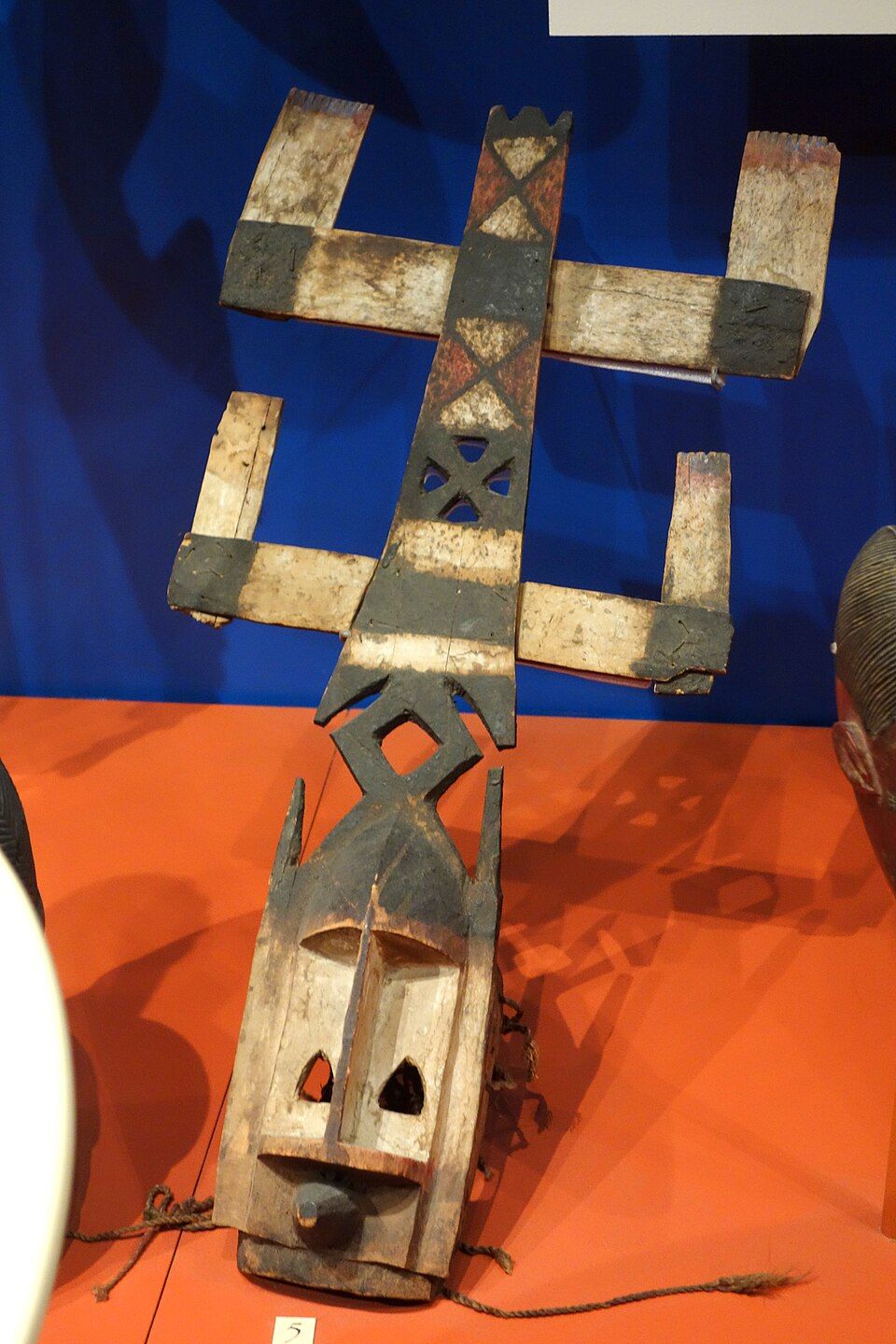
Primitivism had specific consequences for how African objects were displayed, collected, and valued:
- Ethnographic museums, not art museums. African objects were placed in natural history and ethnography collections alongside tools, weapons, and animal specimens. They were labeled by tribe or region, not by artist, date, or artistic school. The implication was clear: these were documents of a people, not creations of individual artists with technique and vision.
- Aesthetic dismissal justified by “simplicity.” European critics claimed African art lacked perspective, anatomical accuracy, and realistic representation—features valued in European Renaissance and academic traditions. This dismissal ignored the fact that African artists were pursuing completely different aesthetic goals: symbolic abstraction, spiritual expression, and formal balance rather than illusionistic mimesis.
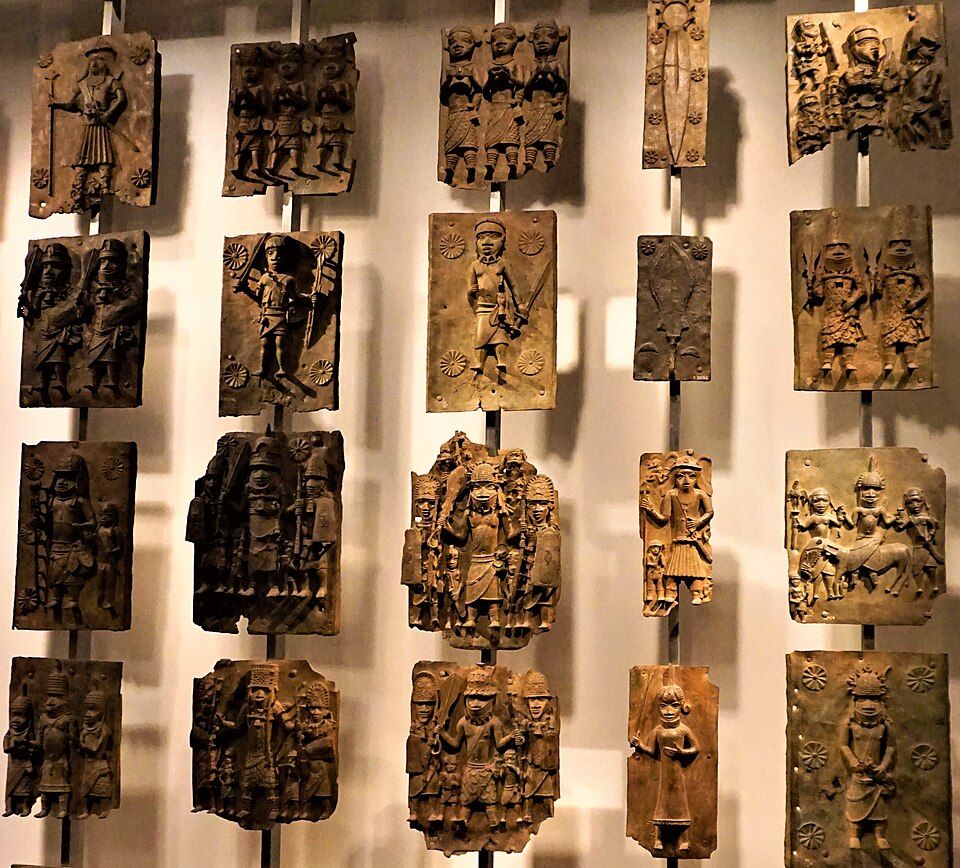
- Removed from their original contexts. A Benin Bronze plaque, originally mounted as architectural decoration in a royal palace, was displayed as a standalone sculpture. A Kongo power figure, created to bind a spiritual contract, was presented as a curious carved figure. The meaning of these objects depended entirely on their ritual, architectural, and ceremonial functions, yet Western collections stripped them of all that context.
- Attributed to “the tribe,” not the artist. A Western label might read “Yoruba mask” or “Dogon statue,” but never “carved by Babatunde in the city of Ife.” This collective attribution erased individual creativity and suggested that African art emerged from collective, unchanging tradition rather than from individual artists responding to patrons, religious authority, and aesthetic innovation.
Why does this matter? Because the primitivist framework had real power. It shaped which African objects entered Western collections (those that seemed “exotic” or visually striking), how they were valued (by rarity and size, not by artistic quality), and how they were interpreted (as ethnographic documents rather than works of art). Even today, when we see African art in a museum, we’re often looking at what survived European collecting practices—and that’s a biased sample.
Modernist Appropriation: Picasso and the Selective Eye
The early 20th century brought a paradox. European modernist artists—Picasso, Braque, Modigliani, the German Expressionists—became obsessed with African sculpture. They admired its abstraction, its distorted proportions, its spiritual power. They collected it, studied it, and let it fundamentally reshape their own practice. This sounds like a validation of African art, but it was something more complicated: appropriation without understanding.
Picasso’s relationship with African sculpture is the most famous case. His 1907 painting Les Demoiselles d’Avignon shocked the Paris art world with its fractured perspective, aggressive geometry, and the masklike faces of the two figures on the right. Picasso later gave conflicting accounts, at times denying that African masks influenced this work. Yet they clearly influenced his formal vocabulary—the flattened perspective, the distorted features, the raw emotional power. But Picasso didn’t study African art history, cultural meaning, or the specific traditions that produced those masks. He saw what he wanted to see: a visual language that validated European modernist experiment. He took the forms and left the context behind.
| Modernist Approach | What They Saw | What They Ignored | The Consequence |
|---|---|---|---|
| Formal/Aesthetic | Abstraction, geometric distortion, spiritual intensity | Historical period, cultural meaning, ritual function, artist identity | African art validated European innovation but remained “source material,” not equal art |
| Collecting | Visual power, rarity, display potential | Provenance, proper attribution, community claims | Fueled European demand that drove colonial looting and destabilized African communities |
| Exhibition | Objects as autonomous artworks in gallery space | Original architectural, ritual, and social functions | African art became “primitive modern”—aesthetically interesting but historically invisible |
Modernism’s appropriation of African art was not intentionally malicious, but it deepened a fundamental problem: African art was still defined by what Europeans wanted from it. Instead of studying African aesthetics on their own terms, modernists selectively borrowed what fit their own agenda. The formal revolution that Picasso achieved was real and important—but it didn’t include understanding or respecting African artistic traditions as living, coherent systems.
Formalism vs. Contextual Analysis: The Disciplinary Shift
From roughly the 1950s onward, art historians began to ask: what if we analyze African art not only by asking “what does it look like?” but also by asking “what did it mean in its original context?” This shift from formalism to contextual analysis was revolutionary, but it emerged unevenly and incompletely.
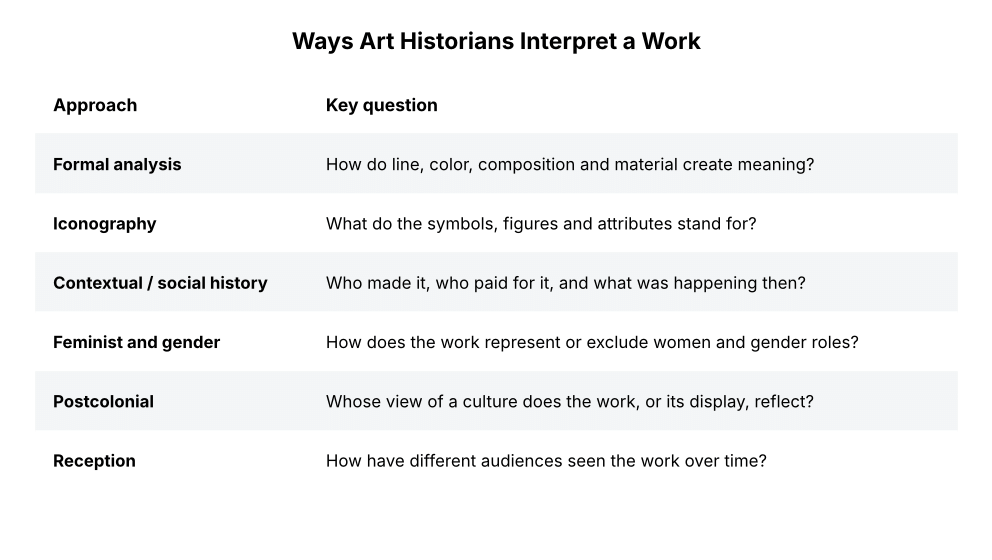
Formalist analysis (the older approach) focuses on visual form: composition, color, line, proportion, balance. A formalist looks at a Yoruba mask and notes its geometric abstraction, its vertical emphasis, its integration of face and coiffure. This is valuable—it explains what makes the mask visually powerful. But formalism is also limiting. It treats an object as an autonomous artwork detached from use, meaning, and history.
Contextual analysis asks what the object did in the society that created it. The same Yoruba mask was worn during ceremonies, danced by trained performers, seen by candlelight in the plaza, associated with specific deities or social roles, sometimes destroyed after its ceremonial purpose was complete. Understanding these contexts changes how you interpret the mask entirely. The abstraction isn’t an aesthetic preference for modernist reasons—it’s a way of representing spiritual presence. The proportions aren’t “distorted”—they emphasize the features that connect the wearer to divine power.
- Why contextual analysis matters for African art: Many African artistic traditions were fundamentally functional. Sculptures served as power objects, ancestral presences, containers for spiritual force. Textiles marked social status and ritual participation. Architecture organized political authority and communal life. Removing these objects from their contexts doesn’t just lose information—it fundamentally misrepresents what the art is.
- The discipline of African art history emerged from this shift. Scholars developed methods to study African art on its own terms, informed by anthropology, oral history, and close collaboration with African communities. They examined materials, techniques, artist training, patron-artist relationships, and the evolving meanings of objects over time.
- Formalism hasn’t disappeared—but it’s been reframed. Today, art historians can appreciate the formal beauty of African art without stripping away its meaning. A Senufo mask can be formally sophisticated and spiritually significant. These aren’t contradictory observations.
This methodological shift had a crucial side effect: it required listening to African voices. You can’t do contextual analysis without engaging with the communities that created the art, learning their aesthetic categories, understanding their intellectual frameworks. This opened the door to the next phase: African scholars speaking for themselves.
Postcolonial Critique and the Question of Repatriation
By the 1980s and 1990s, a more pointed critique emerged. Even well-intentioned contextual analysis from Western scholars was still Western scholarship—still filtered through institutions, funding, and voices based in Europe and North America. Postcolonial critics asked sharper questions: Who has the right to interpret African art? How did African objects end up in Western museums in the first place? What does it mean that the world’s greatest collections of African art are in London, Paris, Berlin, and New York—not in Africa?
This critique crystallized around specific, high-profile cases. The most famous is the Benin Bronzes.
In 1897, British forces invaded the Kingdom of Benin (in present-day Nigeria) and looted approximately 4,000 brass plaques, sculptures, and decorative objects that had adorned the royal palace in Benin City for centuries. These weren’t portable artworks—they were architectural elements integral to the palace structure, ceremonial objects inseparable from the royal court’s authority. The British military commander shipped them to London, where they were dispersed to the British Museum and dozens of other European and American institutions. They became one of the crown jewels of Western collections, prized for their technical sophistication and aesthetic power.
For decades, this was simply how the story was told: the Bronzes were “rescued” from Africa, preserved in Western institutions, and made accessible to the world. But by the 1970s, Nigerian scholars, artists, and government officials began to reframe this narrative. The Benin Bronzes weren’t rescued—they were stolen. They weren’t being preserved—they were being displayed as trophies of imperial conquest. Most fundamentally, they didn’t belong in the British Museum. They belonged in Benin.
The repatriation movement raised profound questions:
- Ownership and authority. Who has the right to hold and interpret African objects? Is it the institution that currently possesses them (and has the resources to conserve them), or the community that created them and has the deepest stake in their meaning?
- Colonial complicity in Western museums. Every major Western museum built its African collection through colonialism—either directly through military looting (like the British Museum), through colonial trading networks, or through exploitation of power imbalances. Can these institutions be trusted custodians of objects taken under these conditions?
- What repatriation actually means. Repatriation isn’t just about physical return. It’s about restoring interpretive authority. When Benin Bronzes are returned to Nigeria, Nigerians get to decide how they’re displayed, interpreted, and integrated into contemporary cultural life—not Western curators.
- The broader pattern of Western museums. The Benin Bronzes are one case, but thousands of African objects in Western institutions have similar colonial histories. The question of what belongs where and who has the authority to hold it extends far beyond African art.
Why is this central to understanding African art? Because it reveals that theories about African art are never just aesthetic or scholarly—they’re bound up with power, property, and who gets to tell the story. When you analyze a Benin Bronze in a Western museum, you’re not just looking at an artwork. You’re looking at an object whose location, interpretation, and meaning have all been shaped by colonial violence and Western institutional authority.
African Voices: Insider Perspectives and Contemporary Reinterpretation
The most important theoretical development of recent decades has been the emergence of African scholarship, criticism, and artistic practice reclaiming interpretation of African art. This isn’t a new development—African scholars have been working in this field for decades—but it’s only recently become central to how the discipline understands itself.
African scholars bring what outsiders cannot: deep knowledge of local languages, oral traditions, community relationships, and lived experience of how historical objects fit into contemporary African life. A Yoruba art historian writing about Yoruba sculpture isn’t starting from scratch or approaching the tradition as exotic. They’re working within a living tradition, often in dialogue with artists, elders, and communities who maintain knowledge of those practices.
This perspective transforms analysis in concrete ways:
- Aesthetics are articulated in local frameworks. Western art history talks about “composition” and “form,” but African aesthetic systems have their own vocabularies. Yoruba aesthetics emphasize clarity, luminosity, and a particular kind of proportion that isn’t reducible to Western categories. Understanding this means learning a different language, not just applying Western concepts to African objects.
- Change and innovation are recognized as core to African traditions. A Western observer might see African art as “timeless tradition,” but African scholars know that these traditions have always evolved in response to patronage, external contact, new materials, and individual creativity. A Yoruba artist in the 19th century wasn’t just copying ancient templates—they were innovating within a tradition.
- Contemporary African artists engage with and reinterpret historical traditions. Artists work directly with African artistic heritage, asking how historical forms and techniques speak to contemporary concerns. Their work is both rooted in African traditions and thoroughly modern—and African scholarship recognizes this continuity where Western frameworks sometimes separate “traditional” and “contemporary.”
This insider perspective also demands accountability from Western institutions. If a Western curator claims expertise about Yoruba sculpture, why isn’t that curator in dialogue with Yoruba scholars? Why are African voices underrepresented in Western museum catalogs, publications, and exhibitions? These aren’t just professional courtesy—they’re questions about interpretive authority and intellectual responsibility.
Colonial Looting and How It Shaped Western Collections
You cannot understand theories of African art without understanding how Western collections were built. The single most important fact: almost no major Western institution acquired African art through ethical purchase or gift. The overwhelming pattern was extraction under colonial conditions.
| Collection Method | How It Worked | Examples | Contemporary Implications |
|---|---|---|---|
| Military looting | Colonial military forces invaded, conquered territories, and seized objects as spoils of war | Benin Bronzes (British invasion 1897); Ethiopian treasures (Italian invasion 1936); Congo artifacts (Belgian conquest) | Clear theft; increasingly recognized as grounds for repatriation. Some institutions have begun returning looted objects. |
| Colonial trading networks | Colonial administrators and merchants exploited power imbalances, trading manufactured goods for valuable objects, sometimes under duress | Masks and sculptures acquired by German colonists in Cameroon and German East Africa in the 1890s-1910s | More complex than military looting, but still involves inequality and unequal exchange. Communities often didn’t understand objects were being permanently removed. |
| “Salvage collecting” | European collectors claimed they were “saving” objects from destruction or neglect, acquiring them at low cost from communities experiencing poverty or disruption due to colonialism | Early 20th-century collecting by Paris museums and private collectors in French West Africa | Paternalistic framing that justified extraction. Objects acquired cheaply from impoverished communities displaced by colonial disruption. The Western collector becomes the “hero” of the story. |
| Antiquarian markets | Once objects entered colonial trade networks, dealers and collectors bought and sold them across Europe and America. Original context was obscured; provenance became murky. | Most major Western collections contain objects with incomplete or falsified provenance because they passed through multiple dealers | Legitimate scholarly questions about where objects came from, how they were acquired, and whether current institutions have clean title to them. |
This history has an obvious consequence: the objects that ended up in Western museums are not a representative sample of African art. They represent what European colonizers valued (size, visual drama, technical sophistication), what fit in ships and boxes (portable sculpture rather than architecture), and what powerful communities were forced to part with. We have extensive Benin Bronzes, Ethiopian manuscripts, and West African sculpture in Western institutions partly because these were objects of high value that colonial powers prioritized looting. Meanwhile, entire traditions of African art—performance-based art, ephemeral art, art embedded in architectural or landscape contexts—are almost entirely absent from Western collections because they couldn’t be extracted and shipped abroad.
Contemporary art historians are grappling with a hard question: if your institution’s collection is built on colonial dispossession, how do you responsibly study and exhibit that collection? Some museums are beginning to address this by: (1) researching provenance thoroughly, including acknowledging gaps and unknowns; (2) displaying objects alongside explanations of how they were acquired; (3) entering into collaborative relationships with African institutions and communities; (4) actively pursuing repatriation when claims are substantiated. These responses aren’t universal, but they represent a shift in how Western institutions are thinking about their responsibilities.
Test-Taking Strategies
Mnemonic devices and memory shortcuts: Remember EFCAP to organize the historical phases of interpretation: Ethnography (colonial anthropology and early museums), Formalism (modernist appreciation), Context (1950s-onward shift in scholarship), African scholars (insider voices), Postcolonial critique (repatriation, critique of Western institutions). This progression shows how understanding of African art has evolved from dismissal to appropriation to genuine engagement. You can also remember “PMC” for the three major theoretical frameworks: Primitivism (colonial dismissal), Modernism (European appropriation), Contextual analysis (contemporary scholarship).
Cross-topic connections: African art theories appear alongside discussions of other non-Western traditions affected by colonialism. You might see African masks paired with Southeast Asian sculpture (both appropriated by modernists), or African repatriation cases connected to questions about the Parthenon Marbles or Egyptian mummies. Look for the pattern: how did colonialism shape what we have in Western museums, and who has the authority to interpret what we have? Also connect to Unit 7 (Islamic world) and Units 8 and 5 (Asia and the Americas) where similar questions about colonial collecting and interpretation appear.
Common question formats: The AP exam tests this topic through: (1) image analysis with historical context—”This mask is from the Kingdom of Benin. Explain how European interpretations of this object changed from the 19th to the 21st century”; (2) historiographical questions—”Compare formalist and contextual approaches to African sculpture”; (3) institutional critique—”How did colonialism shape what African art objects are present in Western museums?”; (4) repatriation scenarios—”Explain arguments for and against returning the Benin Bronzes to Nigeria.” Always be ready to connect the object to a theory of interpretation.
Frequent student mistakes: (1) Treating “African art” as a monolith. Africa is a continent of thousands of distinct cultures, each with its own artistic traditions. Never say “African masks in general”—specify Yoruba, Dogon, Kongo, etc. The AP exam rewards specificity. (2) Assuming that contextual analysis is obviously correct. While contextual analysis is more sophisticated than dismissal or appropriation, the AP exam wants you to understand why context matters and what it reveals that formalism alone cannot. (3) Treating repatriation as a simple issue of “returning stolen goods.” The real complexity involves questions of conservation, access, authority, and who benefits—your analysis should be nuanced. (4) Forgetting the colonial context. Primitivism, modernist appropriation, and Western museum collections don’t make sense without understanding that they emerged from and served imperial power.
Test-day shortcuts: When you see an African artwork in the exam, immediately ask: In what context was this created and used? How would a formalist interpret this? How does that differ from what we know about its actual function? Who is doing the interpreting now? These questions will guide you toward the kind of analysis the AP exam is looking for. Also develop speed in recognizing which theory of interpretation is being referenced. If the question uses words like “primitive,” “tribal,” or “ethnographic,” it’s likely describing colonial-era interpretation. If it mentions “function,” “ritual,” or “community,” it’s probably asking about contextual analysis.
Time management tips: Repatriation and institutional critique questions can feel open-ended and might tempt you to write everything you know. Resist this. Organize your response clearly: (1) identify the specific historical claim, (2) explain the theory of interpretation at stake, (3) present evidence or specific examples, (4) conclude with the broader significance. For image analysis questions involving African art, spend your time on context and interpretation rather than describing surface features. The AP exam doesn’t reward detailed formal description the way it does for European art. Instead, focus on explaining what the context reveals that wouldn’t be apparent from looking alone.
Check for Understanding
Think you’ve got it? Complete the quiz below to make sure. Download your results at the end.