
Maximize your score with these resources:
- Albert.io AP® Art History question banks
- Free AP® Art History cheat sheets
- Free AP® Art History score calculator
Pacific art from 700-1980 CE represents one of the most geographically dispersed and materially diverse artistic traditions in world history. Island communities across Polynesia, Melanesia, and Micronesia developed sophisticated techniques that transformed local materials into objects of profound spiritual, social, and ceremonial significance. Understanding how geography shaped artistic materials and processes is tested directly on the AP® Art History exam through image identification, comparative analysis, and questions about cultural context. By recognizing the relationship between landscape, available resources, and artistic innovation, you’ll be able to distinguish Pacific artistic traditions and connect objects to specific regions.
This article covers Topic 9.1: Materials, Processes, and Techniques in Pacific Art (Learning Objective MPT-1.A). You’ll learn how island environments determined available materials, why certain techniques became central to cultural identity, and how to analyze Pacific artworks by understanding the intersection of environment, resources, and artistic innovation.
Tapa Cloth Production: From Bark to Ceremonial Textile
Tapa cloth (also called bark cloth) is one of the most distinctive materials in Pacific art, created by beating the inner bark of the paper mulberry tree into thin, flexible sheets. This process, practiced across Polynesia, Melanesia, and parts of Micronesia, produced fabric without weaving or spinning—a technology Pacific peoples shared with parts of Southeast Asia, where barkcloth was also made.
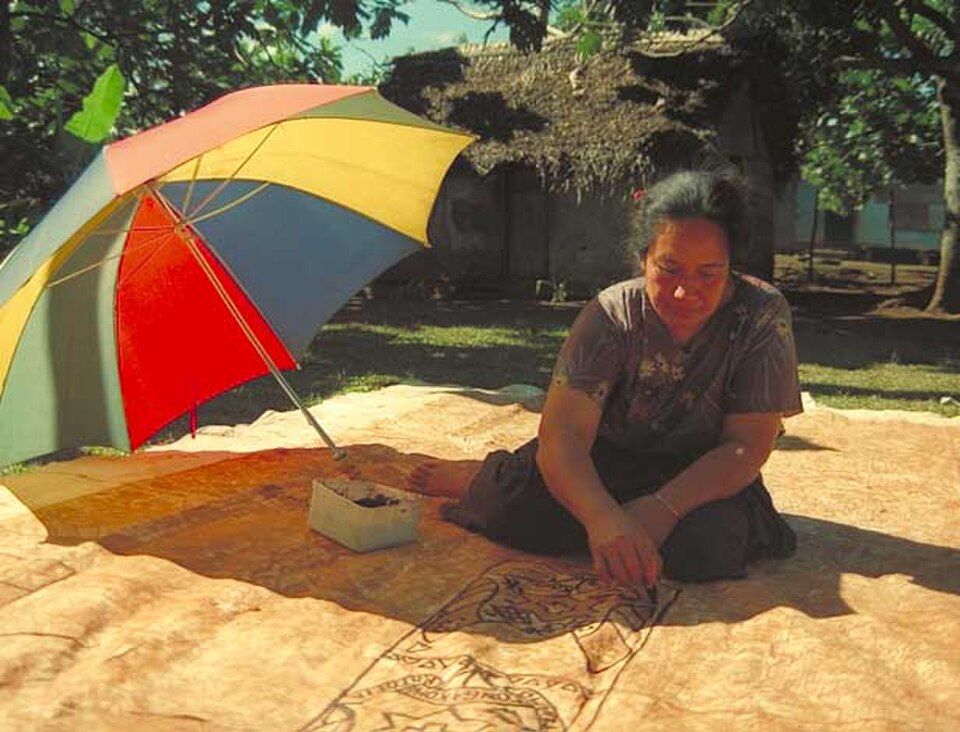
- Harvesting and preparation: Artists selected paper mulberry branches, stripped the bark, and soaked it in water to soften the fibers. The resulting bark sheets were layered and beaten with wooden mallets (called beaters) on a wooden anvil, causing the layers to adhere and compress into a unified cloth.
- Scale and decoration: Individual sheets could be combined into large cloths used for clothing, ceremonial wrapping, and trade goods. Artists added decoration using plant-based dyes and carved beaters that left patterns on the cloth surface as they struck it, creating geometric designs integral to the object itself.
- Social and ceremonial significance: Tapa cloth marked status and wealth. Fine, large sheets were gifted to seal alliances, commemorate important events, and assert power. In Samoa, ‘ie toga (fine mats woven from pandanus, not tapa) were considered the most valuable movable property a family could own.
- Regional variation: Hawaiian tapa incorporated intricate geometric patterns and vibrant colors; Samoan tapa emphasized large-scale production and trade. Each region’s decorative vocabulary reflected local plant materials available for dyes and the ceremonial uses most important to that community.
Tapa production demonstrates how Pacific cultures engineered solutions to material scarcity. Without access to sheep’s wool, silk, or cotton, islanders transformed abundant bark into a textile that served the same social functions as woven cloth in other cultures. This process-driven innovation shows how environment shapes not just what materials are available, but what technologies become culturally central.
Wood Carving: Architecture, Sculpture, and Social Hierarchy
Wood carving in the Pacific served different purposes across regions, from functional architecture to spiritual representation. The materials available—specific tree species with different strengths, grain, and cultural meanings—directly shaped what artists could create.
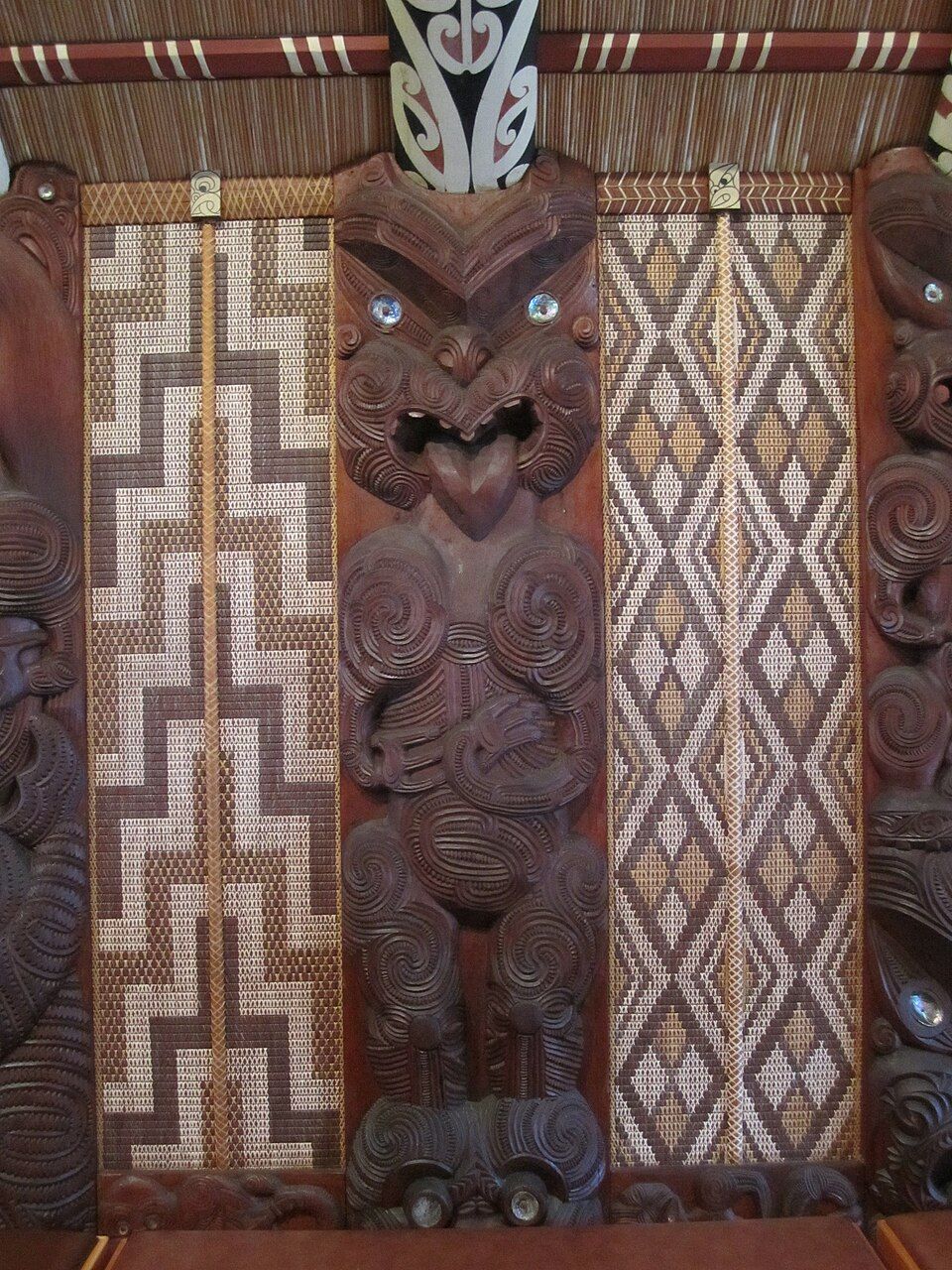
Maori meeting houses (wharenui) in New Zealand combined wood carving with architectural function. Master carvers produced elaborately carved posts, rafters, and wall panels that told genealogical narratives and represented ancestral figures. The wood used (typically totara or kauri) was selected for durability and symbolic meaning. Each carved figure had specific spiritual significance: ancestors watched over gatherings, and the act of carving was itself a sacred practice that required specialized training passed through family lines.
Easter Island moai represent a different carving tradition entirely. These massive stone figures (moai) were carved from volcanic tuff, a soft stone that allowed large-scale sculpture but required sustained labor forces and sophisticated understanding of quarrying. Carvers used basalt adzes to shape the stone, leaving the figures with blank eyes until final ceremonies installed white coral and obsidian pupils—a practice suggesting the final ritual was as important as the carving itself. The moai weren’t finished sculptures standing alone; they represented ancestors and were integrated into family shrines on platforms called ahu. When rivalry between clans intensified, many moai were toppled, showing how artistic objects reflected and reinforced social power.
Regional carving techniques and materials: Marquesan artisans carved bone, wood, and shell into intricate war clubs, fishhooks, and ornamental objects. The skill required to carve functional fishing hooks from bone—curved and weighted for effectiveness—combined artistic vision with practical engineering. In Melanesia, elaborate carved male figures adorned men’s houses and displayed through their size and ornamentation the wealth and power of the clan that commissioned them.
Wood and stone carving connected art directly to social structure. Only wealthy individuals or communities could commission large carvings; the carver’s skill was valued and protected through restricted knowledge. The durability of carved wood and stone meant these objects outlasted their creators, embedding ancestral presence in physical space—a crucial function in cultures where oral tradition and physical objects together conveyed history.
Body Adornment: Tattooing, Feathers, and Shell
Pacific cultures developed sophisticated traditions of body decoration that announced identity, status, and genealogy. Unlike clothing, which could be removed, body adornment was permanent or semi-permanent, making it a declaration of identity integrated into the body itself.
Polynesian tattooing (tatau/tatoo) used sharpened bone or shell needles to imprint pigment into skin, creating complex geometric patterns. Each pattern carried meaning: location on the body, density of marks, and specific motifs communicated lineage, rank, and personal history. In Samoan culture, the pe’a (male tattoo covering roughly the waist to the knees) required months of painful ritual work and marked a man’s passage into full social status. Women’s tattoos (malu) covered the thighs in similar geometric designs. The process was so central to identity that an untattooed person of adult age occupied an ambiguous social position.
Tattooing technology reveals environmental adaptation: bone needles were carved from local bird or fish bone; pigment came from plant materials (charcoal mixed with coconut oil or other plant-based bases) or was imported through trade networks. The pattern vocabulary varied by island group, allowing skilled observers to identify a person’s origin by reading their tattoos.
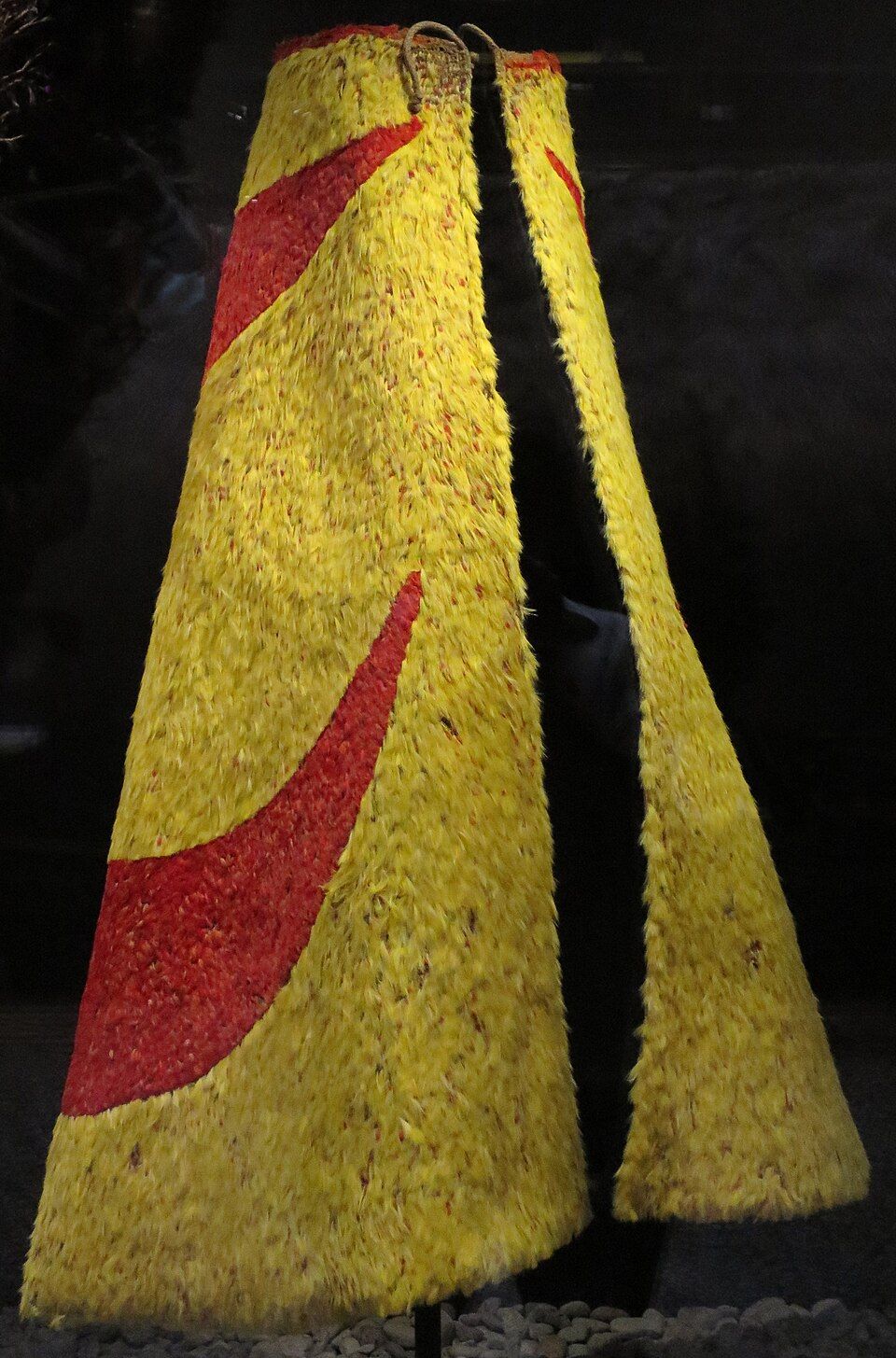
Feather and shell work created prestige objects and insignia of rank. Hawaiian ali’i (chiefs) wore feather cloaks and helmets that required thousands of hours of labor. The rarest feathers—yellow from the ‘o’o bird and red from honeycreepers—were most valuable. Gathering, storing, and working these feathers was a specialized craft. Similarly, shell ornaments (cut and polished from pearl shell, cone shell, or other species) served as currency, trade goods, and insignia of status across Melanesia and Micronesia.
| Body Adornment Type | Materials and Process | Social Function | Regional Example |
|---|---|---|---|
| Tattooing | Bone or shell needles; pigment from charcoal and plant oil. Applied in ritual ceremonies lasting months for major pieces. | Marked genealogy, rank, and adult status. Permanent identification of identity and lineage. | Samoan pe’a and malu; Maori moko patterns unique to individuals |
| Feather cloaks and helmets | Feathers from rare birds, attached to fiber backing. Hundreds or thousands of feathers per garment; months of labor. | Display of chiefly power and wealth. Worn only by highest-ranking individuals in ceremonies and battles. | Hawaiian ali’i regalia; most valuable objects in chiefly collections |
| Shell ornaments | Shell cut and polished using stone tools. Created as pendants, breastplates, or trade rings. | Signaled wealth, trade connections, and status. Also used as currency in some systems. | Melanesian shell valuables (tambu); Polynesian fish-hook pendants in bone and shell |
Body adornment in Pacific cultures turned the human body itself into a canvas for displaying identity and status. Unlike objects that could be hidden or lost, these marks and ornaments were portable, permanent (or renewable through ritual), and universally readable within the culture. For the AP exam, remember that body adornment wasn’t decorative luxury—it was a social and political tool that made hierarchy and genealogy visible.
Navigation, Canoe Construction, and Maritime Technology
The vast distances between Pacific islands required canoes of extraordinary sophistication. Unlike European boats, which relied on nails and saws, Pacific canoe builders used traditional joinery, lashing, and an intimate understanding of wood properties to create vessels that could travel hundreds of miles in open ocean.
Double-hulled canoes, particularly important in Polynesian expansion, consisted of two hulls lashed together with a deck platform between them. This design provided stability, cargo capacity, and the ability to beach the vessel without damage. The hulls were carved from single logs or constructed from planks fitted and lashed together. Navigators used star paths, ocean swells, bird behavior, and other non-instrument methods to navigate—knowledge systems that were encoded in chants and oral traditions, not written charts.
Canoe construction materials varied by region. In Hawaii, koa wood (a dense, durable native species) was preferred for its strength. In Melanesia, outrigger canoes used lighter construction techniques suited to shorter-distance inter-island travel. The process of selecting trees, seasoning wood, and carving hulls was knowledge jealously guarded by family guilds. A single canoe required hundreds of hours of labor and represented a community’s investment in capability and trade.
Canoe technology embodied innovation under constraint. Without metal tools, Pacific builders used stone adzes and fire to fell trees, developed sophisticated lashing techniques to replace nails, and created vessels that navigated one-third of Earth’s surface. The canoe itself was art, technology, and symbol of cultural achievement combined.
Stone and Ceremonial Landscapes: Nan Madol and Monumental Architecture
Nan Madol, located in Micronesia (Pohnpei), represents monumental stone construction unmatched elsewhere in the Pacific. Built between roughly 1200-1600 CE, Nan Madol consisted of nearly 100 artificial islands constructed from basalt columns and coral rubble, connected by canals. The columnar basalt came from a quarry and was transported by canoe and human labor—a logistical feat requiring centralized authority and resource management.
The construction technique involved stacking basalt columns (some weighing 2-5 tons) without mortar, relying instead on careful fitting and gravity to hold walls in place. Walls faced the ocean, suggesting defense and display were equally important. Nan Madol served as the ceremonial and administrative center of the Saudeleur dynasty and symbolized the power to command labor, resources, and landscape itself.
Easter Island’s moai platforms (ahu) represent another form of monumental stone work, though using different materials and techniques. The ahu were built with fitted stone without mortar, creating altars on which moai stood. This combination of carving and architecture made ancestor representation literally monumental—visible from far across the island and built to endure for generations.
Monumental stone architecture required surplus resources, centralized authority, and long-term commitment to projects. These structures weren’t purely utilitarian; they were visual assertions of power and symbols of connection to supernatural forces. The scale and durability of these monuments reflected and reinforced social hierarchies.
Woven Mats, Baskets, and the Transformation of Plant Materials
Weaving traditions in the Pacific produced functional objects that were also aesthetically sophisticated. Unlike tapa cloth (which involved felting rather than weaving), these traditions used techniques of interlacing fibers.
Woven mats made from pandanus leaf (a long, strong plant fiber) served as flooring, bedding, and formal gifts. Different weaving patterns indicated origin and quality; tightly woven mats from Samoa were particularly valued for trade. The process involved harvesting leaves, drying them, and weaving by hand on a simple frame. A fine mat could take weeks to complete and would last generations, becoming more valuable with age and use as it gained patina and provenance.
Baskets and containers woven from coconut fronds, pandanus, or other plant fibers served daily needs while displaying regional artistic traditions. In Melanesia, large woven baskets held valuables and were themselves valuable objects. The basket maker’s skill was recognized and compensated; baskets bore maker’s marks and signatures woven into the pattern.
Weaving connected daily utility to artistic identity. Unlike prestigious prestige objects (carved clubs, feathered cloaks), woven mats and baskets were used continuously, handled by many people, and integrated into everyday life. Yet they carried the same markers of quality, maker’s identity, and regional origin as objects reserved for elites. This shows that Pacific artistic production valued skill and aesthetics across both elite and everyday domains.
Environmental Constraints and Artistic Innovation: The Broader Pattern
Across all these traditions—tapa, carving, tattooing, canoes, and weaving—a pattern emerges: island environments limited material options, which drove innovation. Pacific cultures didn’t have access to iron, extensive forests of large trees, herds of animals for wool, or silk production. Instead, they maximized local resources:
- Abundant plant fibers became textile, basket, and tool materials through sophisticated processing.
- Limited high-quality wood became precious and was used for objects representing power and ancestry.
- Shell and bone, easily available on islands, became media for carving and decoration.
- Stone became monumental when quarried and transported by organized labor—a display of power itself.
When you see a Pacific object on the exam, you should be able to identify its material, understand the process that created it, and explain why that material and process made sense given the island environment and cultural priorities.
Test-Taking Strategies
Mnemonic devices and memory shortcuts: Create the acronym TCWSBN to remember the major material categories in Pacific art: Tapa cloth, Carving (wood/stone), Weaving/mats, Shell and bone, Body adornment (tattoos/feathers), and Navigation/canoes. When you encounter a Pacific artwork, identify which category it falls into, then recall the environmental and cultural contexts that shaped that tradition.
For remembering specific objects and processes: Moai = Monumental, carved from volcanic stone, represent ancestors, toppled in warfare. Tapa = Tree bark, beaten flat, decorated with carved patterns, used for prestige exchange. Pe’a = Polynesian tattoo, bone needles, covers waist to knees, marks adult male status. These concise descriptions help you quickly identify objects and explain their significance.
Cross-topic connections: Topic 9.1 connects most directly to Form and Aesthetics in Pacific Art because understanding materials and processes directly shapes how you interpret the visual form and design of objects. A heavily tattooed figure (form) only makes sense if you understand the tattooing process and its social meaning (9.1 materials/processes). Additionally, Topic 9.1 connects to oceanic trade systems—many Pacific artworks (particularly tapa and shell valuables) functioned as trade goods, meaning their material properties and prestige value were inseparable from their role in economic exchange. Finally, cross-unit connections link to Unit 6 (African art, including masking traditions) in that both cultures used masks and body adornment to transform social identity, though the materials and techniques differ significantly.
Common question formats: The AP exam tests Materials, Processes, and Techniques primarily through: (1) Image identification—you’re shown a photograph of a Pacific artwork (e.g., a moai, a tapa cloth, a feathered cloak) and asked to identify the material and explain how the process of creation relates to its cultural function; (2) Comparative analysis—you compare two Pacific artworks from different regions (e.g., Maori carved house panels vs. Easter Island moai) and explain how different available materials led to different techniques and cultural meanings; (3) Process-to-function essays—you’re given a brief description of how an artwork was made and asked to explain what that process reveals about the culture’s priorities, environment, or social organization. For example: “Explain how the labor-intensive process of creating Hawaiian feather cloaks reflects the political structure of Hawaiian chiefly society.”
Frequent student mistakes: First, students often confuse tapa cloth (bark cloth, beaten flat, specific to Polynesia and parts of Melanesia) with woven textiles (interlaced fibers, different technologies). Tapa is NOT woven—it’s made through felting/beating, which is a distinct process. Second, students underestimate the significance of scale and labor in monumental stone structures like Nan Madol and moai platforms. These aren’t just “big rocks”—their size is deliberately political, demonstrating a chief’s ability to command resources and labor. Third, students miss that body adornment (particularly tattooing) wasn’t optional decoration—it was a permanent, ritualized declaration of identity and status equivalent to modern citizenship documents. An untattooed adult was socially incomplete.
Test-day shortcuts: When you encounter a Pacific artwork question, immediately ask: “What material is this made from, and why would that material be available in a Pacific island environment?” This grounds your answer in environmental logic. Second, connect the process to the object’s social function: “This required months of labor, so it was likely a prestige object” or “This material is durable and portable, so it functioned in trade.” Third, if you’re comparing two Pacific regions, notice that material availability drove technique, and technique shaped the aesthetic and cultural meaning. Maori carvers had access to strong, straight-grained wood, so they carved elaborate architectural panels. Polynesians had paper mulberry and pandanus, so they mastered textile-adjacent technologies like tapa and weaving. These material differences explain regional artistic variation.
Time management tips: If the AP exam includes a long-form question on Pacific materials and processes, organize your answer around a single Pacific artwork or region to maintain depth rather than surveying everything superficially. For example, spend three paragraphs explaining moai production (carving from volcanic tuff, installation on ahu platforms, social meaning as ancestor representation) rather than one paragraph each on moai, tapa, and tattoos. The exam rewards detailed understanding of process-to-culture connections over broad coverage. For multiple-choice questions, the answer is usually the one that explicitly connects material, process, and cultural function—answers that mention only the object (e.g., “moai are statues”) without explaining the process or meaning are typically distractors.
Check for Understanding
Think you’ve got it? Complete the quiz below to make sure. Download your results at the end.