
Maximize your score with these resources:
- Albert.io AP® Chemistry question banks
- Free AP® Chemistry cheat sheets
- Free AP® Chemistry score calculator
Why does a sparingly soluble salt dissolve even less when you drop it into a solution that already contains one of its ions? Why do buffers resist pH changes? Both phenomena trace back to a single concept: the common-ion effect. This review breaks down exactly how it works — for solubility, for weak acids, and for the buffer calculations that show up on nearly every AP® Chemistry FRQ.
What Is the Common-Ion Effect?
The common-ion effect is Le Châtelier’s Principle applied specifically to solubility and weak acid/base equilibria. When you add an ion that already appears in a solution’s equilibrium expression, the equilibrium shifts to consume that ion — reducing solubility or suppressing dissociation.
Core result: Adding a common ion to an equilibrium system always shifts the equilibrium away from that ion, reducing the extent of dissolution or ionization.
Common-Ion Effect on Salt Solubility
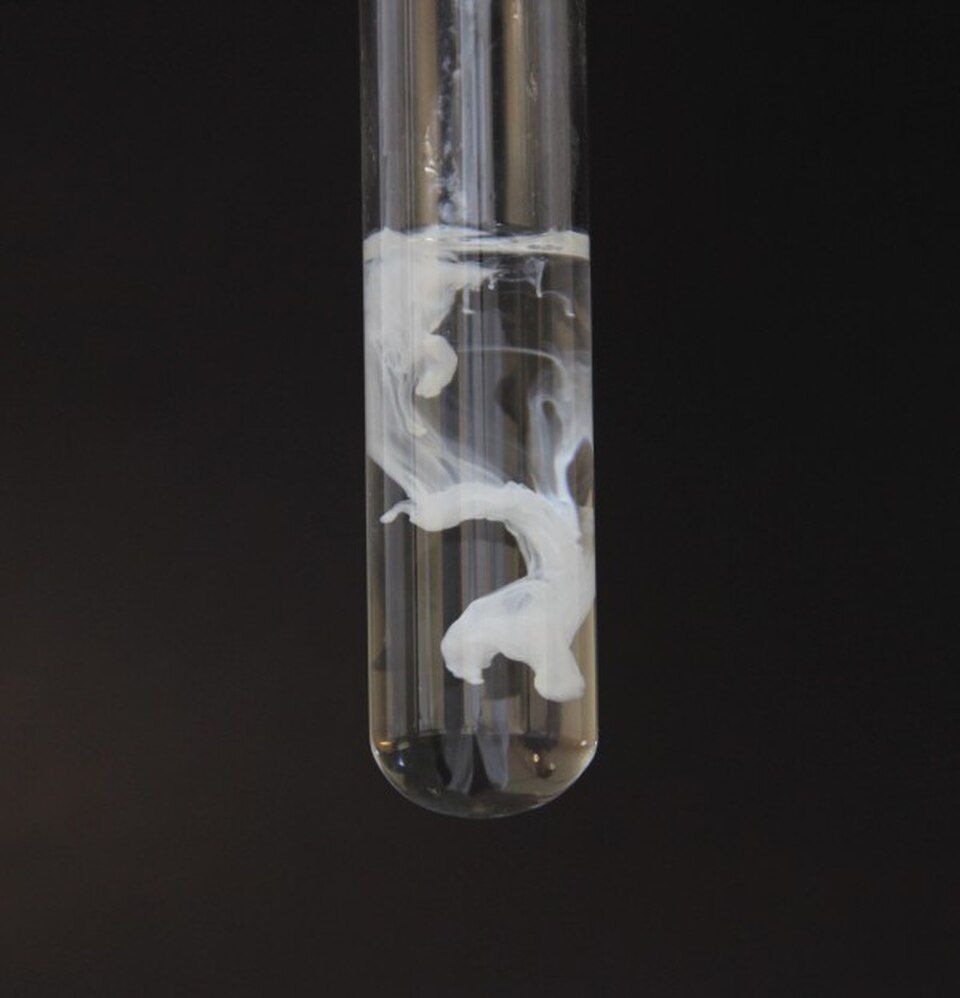
Consider AgCl dissolving in water: AgCl(s) ⇌ Ag⁺(aq) + Cl⁻(aq), Ksp = 1.8 × 10⁻¹⁰
In pure water: s = √Ksp = √(1.8 × 10⁻¹⁰) = 1.3 × 10⁻⁵ M
In 0.10 M NaCl (which provides a common Cl⁻ ion): The initial [Cl⁻] = 0.10 M — far more than AgCl would dissolve on its own. Setting up the ICE table:
| [Ag⁺] | [Cl⁻] | |
|---|---|---|
| Initial | 0 | 0.10 |
| Change | +s | +s |
| Equilibrium | s | 0.10 + s |
Ksp = (s)(0.10 + s) ≈ (s)(0.10) = 1.8 × 10⁻¹⁰
s = 1.8 × 10⁻⁹ M
Solubility dropped from 1.3 × 10⁻⁵ M to 1.8 × 10⁻⁹ M — a reduction by a factor of ~7,000. The common Cl⁻ ion nearly completely suppressed AgCl dissolution.
Common-Ion Effect on Weak Acid Dissociation
For acetic acid: CH₃COOH(aq) ⇌ CH₃COO⁻(aq) + H⁺(aq), Ka = 1.8 × 10⁻⁵
In pure water, 0.10 M acetic acid dissociates slightly: [H⁺] = √(Ka × [HA]) ≈ √(1.8 × 10⁻⁵ × 0.10) = 1.3 × 10⁻³ M, pH ≈ 2.87
If you add sodium acetate (CH₃COONa, a source of the common ion CH₃COO⁻) to the same acetic acid solution, the extra acetate ion shifts the equilibrium left, suppressing dissociation. The resulting [H⁺] is much lower and pH is higher.
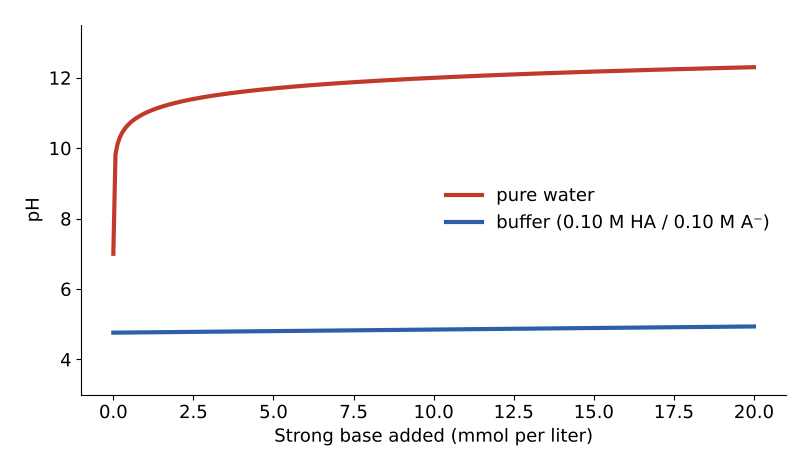
This is exactly how buffer solutions work: the common acetate ion from sodium acetate suppresses acetic acid’s dissociation, keeping pH stable near pKa.
Common-Ion Effect on Weak Base Ionization
The same logic applies to bases. For ammonia: NH₃(aq) + H₂O(l) ⇌ NH₄⁺(aq) + OH⁻(aq)
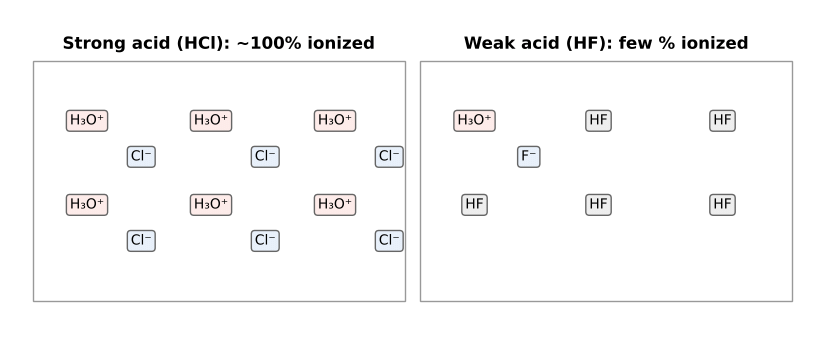
Adding NH₄Cl (ammonium chloride) introduces NH₄⁺ ions — the common ion. The equilibrium shifts left, reducing [OH⁻] and lowering pH. This again creates a buffer — this time a basic buffer.
Connection to Buffer Solutions
The Henderson-Hasselbalch equation is derived directly from the Ka expression under common-ion conditions:
pH = pKa + log([A⁻] / [HA])
The [A⁻] in the formula is precisely the common ion. Without the common-ion effect, there would be no buffer action. Understanding that buffers work because of the common-ion effect gives you a deeper foundation for all acid-base calculations.
Calculating the Solubility of a Salt in a Solution Containing a Common Ion
Step-by-step procedure:
- Write the dissolution equilibrium and Ksp expression.
- Set up an ICE table. The initial concentration of the common ion is the concentration from the added soluble salt.
- Express the equilibrium concentrations in terms of s (solubility).
- Use the approximation: if the common ion concentration >> s, then (common ion + s) ≈ common ion.
- Solve for s. Always verify the approximation (s should be << common ion concentration).
Test-Taking Strategies
Key Mnemonics
- “More ion, less dissolving”: When you add a common ion, solubility decreases and ionization is suppressed. The equilibrium shifts away from the added ion.
- “Buffers = common-ion effect in action”: Every buffer is a weak acid with its common conjugate base. Henderson-Hasselbalch applies because the common ion suppresses dissociation.
- “Common ion shifts left”: Adding an ion that already exists in the equilibrium always shifts the equilibrium to the left (less product/dissolution).
Cross-Topic Connections
- Le Châtelier’s Principle (Topic 7.9): The common-ion effect is Le Châtelier’s applied to a specific case. Adding an ion = adding a product = backward shift.
- Solubility (Topic 7.11): Ksp problems involving two different ionic compounds sharing an ion always invoke the common-ion effect.
- Buffers and Henderson-Hasselbalch (Topic 8.9): The entire concept of buffering depends on the common-ion effect suppressing weak acid dissociation.
- Titration curves (Topic 8.5): In the buffer region, the conjugate base formed by partial neutralization acts as a common ion, explaining the gradual pH change.
Common Question Formats and Pitfalls
- “Find solubility of AgCl in 0.10 M NaCl”: Set up ICE table with [Cl⁻]₀ = 0.10, solve for s using Ksp. Approximation is valid when common ion >> s.
- “What is the pH of acetic acid + sodium acetate?”: Use Henderson-Hasselbalch with the acetate concentration as [A⁻].
- “Will a precipitate form?”: Calculate Q = [ion 1][ion 2] using the actual concentrations (including the common ion). If Q > Ksp, a precipitate forms.
- Pitfall — Not including initial common ion concentration in ICE table: The most common error. If [Cl⁻]₀ = 0.10 M, write 0.10 in the initial row, not 0.
- Pitfall — Applying common-ion logic to the wrong K: Use Ksp for solubility and Ka/Kb for acid/base dissociation. Don’t mix them.
- Pitfall — Forgetting that Q vs. Ksp predicts precipitation: When both ion concentrations are given, calculate Q first. If Q > Ksp, a precipitate forms. Le Châtelier’s shifts backward — the salt comes out of solution.
Time Management on Test Day
- Solubility problems with common ions: Use Henderson-Hasselbalch for acid/base versions; use the direct approximation (s << [common ion]) for salt solubility. These should take under 2 minutes each.
- Precipitation prediction: Calculate Q first, compare to Ksp, state your conclusion. 30–60 seconds.
- FRQ context: Common-ion problems often appear as part (b) of a larger solubility or buffer FRQ. They reward knowing the ICE table setup with a nonzero initial ion concentration.
Check for Understanding
Think you’ve got it? Complete the quiz below to make sure. Download your results at the end.