

Maximize your score with these resources:
- Albert.io AP® Physics 1 question banks
- Free AP® Physics 1 cheat sheets
- Free AP® Physics 1 score calculator
A clock pendulum swings in the same arc, at the same pace, for hours on end. A mass dangling from a spring bounces up and down with unwavering regularity. A guitar string vibrates at exactly the same frequency every time you pluck it. What ties all of these together? Simple harmonic motion — the most predictable, repeatable, and mathematically elegant form of oscillation in all of physics.
This article covers Topic 7.1: Simple Harmonic Motion from the AP® Physics 1 Course and Exam Description. By the end, you’ll understand what makes motion “simple harmonic,” how restoring forces work, and how to connect the motion of springs and pendulums to the mathematical relationships that describe SHM. You’ll also learn how these concepts appear on the exam and the most efficient strategies for solving SHM problems under time pressure.
| Formula | Variables | When to Use |
|---|---|---|
| F = −kx | k = spring constant (N/m), x = displacement from equilibrium (m) | Restoring force in SHM; confirms proportional relationship |
| T = 2π√(m/k) | T = period (s), m = mass (kg) | Period of mass-spring oscillation; amplitude-independent |
| T = 2π√(L/g) | L = string length (m), g = 9.8 m/s² | Period of simple pendulum (small angles only) |
| f = 1/T | f = frequency (Hz) | Converting between period and frequency |
| ω = 2π/T = 2πf | ω = angular frequency (rad/s) | Expressing oscillation rate; used in x(t), v(t), a(t) |
| Etotal = ½kA² | A = amplitude (m) | Total mechanical energy; set equal to ½mv² at equilibrium |
What Makes Motion “Simple Harmonic”?
Simple harmonic motion is motion in which an object oscillates back and forth about an equilibrium position, where the net force (and acceleration) is always proportional to the displacement from equilibrium and directed opposite to that displacement. This is not just any oscillatory motion — it’s a specific, predictable type.
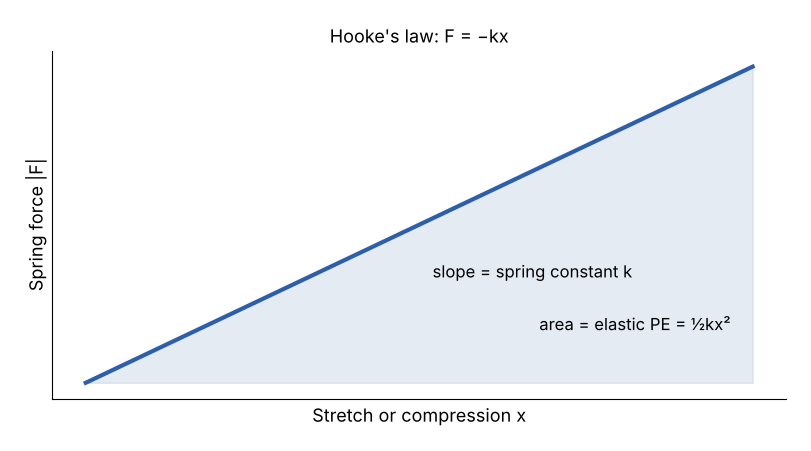
The defining feature of SHM is the relationship between force and displacement. In SHM, the restoring force always obeys this rule:
F = −kx
where:
- F is the restoring force (in Newtons)
- k is the spring constant or equivalent restoring constant (in N/m)
- x is the displacement from equilibrium (in meters)
- The negative sign indicates the force always points toward equilibrium
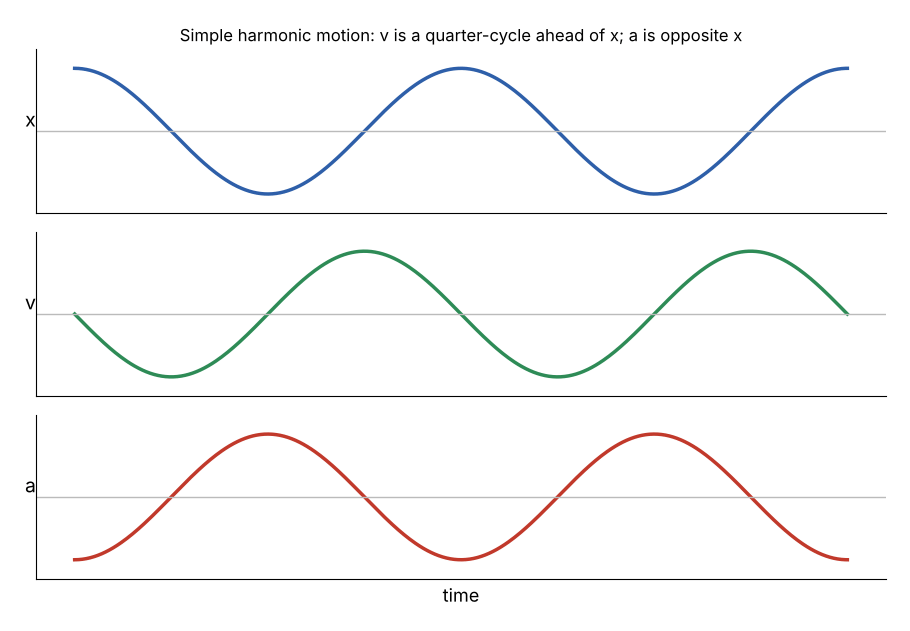
Why “simple” and “harmonic”? Simple because the relationship between force and displacement is linear — not curved, not exponential. Harmonic because the resulting motion repeats at perfectly regular intervals and can be described by sine and cosine functions. Plot the position of an object in SHM over time and you get a perfect sine wave — no more, no less.
Not all oscillatory motion is simple harmonic. A ball bouncing on the floor eventually stops because it loses energy in each inelastic collision with the floor. A swing gradually slows unless you keep pumping your legs. But a mass on a frictionless spring or a pendulum at small angles? Those are genuine SHM.
The Restoring Force and Equilibrium
The equilibrium position is where the net force on the object is zero. For a mass hanging from a spring, equilibrium is where the spring force exactly balances gravity. For a pendulum, equilibrium is at the bottom of the arc when the bob hangs straight down.
The restoring force always pulls or pushes the object back toward equilibrium — the name says exactly what it does. The key constraint: in SHM, the restoring force must be proportional to displacement from equilibrium.
| Scenario | Equilibrium Position | Restoring Force Source | Why Force Is Proportional to Displacement |
|---|---|---|---|
| Mass on a horizontal spring | Spring at natural length (x = 0) | Spring force: F = −kx | Farther from equilibrium → spring stretches or compresses more → stronger restoring force |
| Mass hanging vertically from a spring | Spring stretched to balance weight | Net of spring force and gravity | Displacement measured from equilibrium (not natural length), so net restoring force remains proportional to x |
| Simple pendulum (small angles) | Bob straight down | Component of gravity tangent to arc | For small θ, sin(θ) ≈ θ, so restoring force ≈ proportional to arc displacement from equilibrium |
This table highlights a critical insight: SHM requires the restoring force to be proportional to displacement. Add friction or air resistance (forces that don’t depend on displacement) and the motion becomes damped, not simple harmonic. Add an external driving force and you break the free-oscillation condition entirely.
Amplitude, Period, and Frequency
Amplitude (A) is the maximum displacement from equilibrium — the farthest the object ever strays. A mass on a spring pulled 0.1 m from equilibrium has amplitude A = 0.1 m. Amplitude sets the “size” of the oscillation.
Period (T) is the time for one complete oscillation — from a starting point, through the full cycle, back to the same position moving in the same direction.
Frequency (f) is the number of complete oscillations per second, measured in Hertz (Hz). Period and frequency are reciprocals:
f = 1/T or T = 1/f

For a mass on a spring, the period depends only on mass and spring constant:
T = 2π√(m/k)
A heavier mass oscillates more slowly. A stiffer spring (larger k) makes oscillations faster. But notice what’s absent: amplitude. Pull the spring 5 cm or 50 cm — the period is identical. This amplitude-independence is a hallmark of SHM.
For a simple pendulum (small angles only):
T = 2π√(L/g)
A longer pendulum swings slower. Stronger gravity means a faster swing. Again, amplitude and mass are absent from the formula.
Comparing Springs and Pendulums in SHM
Springs and pendulums are the two canonical SHM examples on the AP® Physics 1 exam. Both oscillate harmonically under the right conditions, but their physics differs in important ways.
| Property | Mass on Spring | Simple Pendulum |
|---|---|---|
| Restoring force source | Spring force (F = −kx) | Component of gravity tangent to arc (small angle approximation) |
| Condition for SHM | No friction, no external forces | Small angle (θ < ~15°), no air resistance |
| Period formula | T = 2π√(m/k) | T = 2π√(L/g) |
| What affects period | Mass and spring constant only | Length and local gravity only |
| What does NOT affect period | Amplitude, gravitational field orientation | Bob mass, amplitude (within small-angle limit) |
| Energy stored at amplitude | Elastic potential energy in the spring | Gravitational potential energy at maximum height |
| Common exam trap | Vertical vs. horizontal spring: same period (measure x from equilibrium) | Period is independent of bob mass even though gravity drives the motion |
The pendulum’s small-angle approximation is the most frequently tested condition. When sin(θ) ≈ θ breaks down (large angles), the restoring force is no longer proportional to displacement and the motion is no longer SHM. On the exam, assume small-angle conditions unless told otherwise.
Position, Velocity, and Acceleration in SHM
If a mass starts at maximum displacement x = A at time t = 0, its position at any later time is:
x(t) = A cos(ωt)
where ω (angular frequency, in rad/s) = 2πf = 2π/T. Taking derivatives:
v(t) = −Aω sin(ωt)
a(t) = −Aω² cos(ωt) = −ω²x(t)
The key relationship: acceleration is proportional to displacement, always opposite in sign. At maximum displacement, acceleration is maximum (opposite direction). At equilibrium, acceleration is zero — and velocity is maximum.
| Position in Cycle | Displacement (x) | Velocity (v) | Acceleration (a) |
|---|---|---|---|
| Maximum displacement (right) | x = +A | v = 0 | a = −Aω² (maximum, pointing left) |
| Equilibrium (moving right) | x = 0 | v = +Aω (maximum) | a = 0 |
| Maximum displacement (left) | x = −A | v = 0 | a = +Aω² (maximum, pointing right) |
| Equilibrium (moving left) | x = 0 | v = −Aω (maximum) | a = 0 |
Velocity is always 90° out of phase with position. Acceleration is 180° out of phase with position — they always point in opposite directions. These phase relationships are fixed properties of all SHM systems.
When Does Motion Fail to Be “Simple Harmonic”?
The AP exam frequently presents scenarios and asks whether they qualify as SHM. Know the failure conditions:
- Damping (friction or air resistance): Energy loss causes amplitude to decrease over time. The motion is damped oscillation, not SHM. A real pendulum in air is damped.
- Large-angle pendulum: When θ exceeds ~15°, sin(θ) ≠ θ, the restoring force is no longer proportional to displacement, and SHM breaks down.
- External driving force: Continuously pushing or pulling the object adds energy and disrupts the free-oscillation condition. This is driven (forced) oscillation, not SHM.
- Non-linear restoring force: If F ∝ x² or any power other than x¹, the motion is not simple harmonic. The sine/cosine solution no longer applies.
- Abrupt interruption: If the object hits a wall, collides with another mass mid-oscillation, or leaves the spring, SHM ends at that moment.
Energy in Simple Harmonic Motion
With no friction, mechanical energy in SHM is conserved. Total energy equals the maximum potential energy (at amplitude) or the maximum kinetic energy (at equilibrium):
Etotal = ½kA² (for a spring-mass system)
As the object oscillates, kinetic and potential energy continuously trade places — but their sum never changes. At maximum displacement, all energy is potential. At equilibrium, all energy is kinetic. Constant total energy and constant amplitude are both signatures of true SHM.
Test-Taking Strategies
Mnemonic Devices and Memory Shortcuts
“MAX v, ZERO a at x = 0; MAX a, ZERO v at x = A” — This captures the phase relationships in a single line. At equilibrium (x = 0), velocity is at its maximum and acceleration is zero. At maximum displacement (x = A), velocity drops to zero and acceleration peaks in the opposite direction. Write this on your scratch paper at the start of the exam and reference it for every SHM problem.
“Amplitude-free periods” — Neither period formula (T = 2π√(m/k) or T = 2π√(L/g)) contains amplitude. If a question asks how doubling the amplitude affects the period, the answer is always: it doesn’t. Amplitude affects maximum velocity and maximum acceleration, never period.
“Springs: mass and stiffness. Pendulums: length and gravity.” — These are the only variables that matter for period. Everything else (orientation, mass of pendulum bob, amplitude) is irrelevant. Commit this shortcut and you’ll identify the relevant variable in any ratio problem instantly.
Cross-Topic Connections
Unit 2 (Forces and Newton’s Laws): Every SHM problem starts by identifying the restoring force. Is it Hooke’s law (spring) or a component of gravity (pendulum)? Setting F_net = ma gives ma = −kx, which directly yields the period formula. Weak free-body diagram skills will cost you SHM points.
Unit 3 (Work-Energy Theorem and Conservation of Energy): Energy conservation in SHM is heavily tested. Problems involving maximum velocity, amplitude from initial conditions, or velocity at a given displacement all use ½kA² = ½mv² + ½kx². Energy is usually faster and less error-prone than kinematics.
Unit 1 (Kinematics): The SHM equations x(t), v(t), and a(t) are connected by derivatives. Recognizing that velocity is the derivative of position — and that maximum v occurs when position passes through zero — is the conceptual foundation for interpreting SHM graphs correctly.
Common Question Formats
Multiple Choice — “Identify SHM vs. not SHM”: Four scenarios, one question: which is simple harmonic? Damped pendulum (no), mass on frictionless spring (yes), pendulum at 60° (no — too large an angle), bouncing ball (no — floor collision). Test each scenario against the conditions: linear restoring force, proportional to displacement, no external forces.
Multiple Choice — “Period or frequency calculation”: Given m and k, or L and g, find T or f. Pick the right formula, plug in, convert if needed. The tricky part is recognizing which formula applies and whether to divide or multiply for the f-T conversion.
Free Response — “Mass-spring analysis”: Initial conditions given (initial displacement or velocity), asked for amplitude, velocity at a specific position, or period. Use the energy method first: E = ½kA². If given a position-time graph, read off T directly from the peak-to-peak distance.
Free Response — “Compare two systems”: “If the spring constant doubles, how does the period change?” Set up the ratio: T₂/T₁ = √(m/2k) / √(m/k) = 1/√2 ≈ 0.707. Period decreases by factor √2. No need to compute absolute values — ratios are faster and less error-prone.
Frequent Student Mistakes
Mistake: Including amplitude in the period formula. Amplitude does not appear in T = 2π√(m/k) or T = 2π√(L/g). Pull a spring 5 cm or 50 cm — the period is the same. Amplitude does affect v_max = Aω and a_max = Aω², but never the period. Confusing these costs easy points.
Mistake: Applying the small-angle approximation at large angles. sin(θ) ≈ θ only holds below about 15°. A 45° pendulum is not undergoing SHM. If the exam gives a large angle, the answer is not SHM. If the problem states “simple harmonic motion,” you can safely assume the angle is small.
Mistake: Measuring displacement from the spring’s natural length on a vertical spring. When a mass hangs from a vertical spring, it stretches to a new equilibrium where spring force balances gravity. All displacements in SHM are measured from this new equilibrium, not from the spring’s natural length. Gravity and the equilibrium stretch cancel each other, which is why T = 2π√(m/k) looks the same for vertical and horizontal springs.
Mistake: Assuming position, velocity, and acceleration peak together. They don’t. Maximum position (amplitude) occurs when velocity is zero and acceleration is at its maximum magnitude (opposite direction). Maximum velocity occurs at equilibrium, where acceleration is zero. Velocity is 90° out of phase with position and acceleration, while acceleration is 180° out of phase with position.
Test-Day Shortcuts
When a problem presents an oscillating system, identify the restoring force and write F = −kx (spring) or the equivalent before reading the specific question. This single step confirms SHM conditions and gives you the anchor equation. For pendulums: write T = 2π√(L/g) at the top of your work space immediately. For mass-spring: write T = 2π√(m/k). Having both formulas visible before you read the question prevents the common error of applying the wrong one under time pressure.
On MCQ questions asking whether a scenario qualifies as SHM, run a three-point mental checklist in under 10 seconds: (1) Is there a restoring force proportional to displacement? (2) Is the system free from friction or external driving? (3) Is the displacement small (for pendulums)? All three “yes” = SHM. Any “no” = not SHM. This eliminates wrong answers before reading the full explanation options.
For period comparison problems, set up the ratio T₂/T₁ and cancel common terms. T = 2π√(m/k): if m doubles, T₂/T₁ = √(2m/k) / √(m/k) = √2 ≈ 1.41. Period increases by factor √2. This ratio method delivers the answer in 20 seconds without computing absolute values. Memorize √2 ≈ 1.41, √3 ≈ 1.73 for the most common multipliers on ratio problems.
Time Management Tips
On multiple-choice SHM questions, identify the question type in under 10 seconds: Is it conceptual (“Is this SHM?”) or quantitative (“Find T”)? Conceptual questions require checking the restoring force condition. Quantitative questions require plugging into the period formula. Don’t waste time applying the wrong approach.
For free-response parts comparing two systems, write the ratio T₂/T₁ immediately. Cancel common terms and simplify. This takes 15–20 seconds and eliminates calculation errors from computing two full numerical answers. Examiners look for the ratio approach in scoring.
If you’re given a graph of position vs. time in SHM, read off amplitude and period directly from the graph before touching any formula. Amplitude is the peak value; period is the distance between two successive peaks. These two values unlock every other SHM quantity: f = 1/T, ω = 2π/T, v_max = Aω, a_max = Aω².
When a free-response problem has multiple parts building on each other, finish each part before moving on — even if your answer feels uncertain. Examiners award partial credit, and later parts often re-state the numerical answer you need (“assume T = 2.0 s from part (a)”), letting you continue even if part (a) was wrong.
Check for Understanding
Think you’ve got it? Complete the quiz below to make sure. Download your results at the end.