

Maximize your score with these resources:
- Albert.io AP® Physics 1 question banks
- Free AP® Physics 1 cheat sheets
- Free AP® Physics 1 score calculator
Density is one of the simplest ideas in physics, but it shows up constantly on the AP® Physics 1 exam — in buoyancy problems, material identification, pressure questions, and as a hidden variable in multi-step FRQs. You need to understand not just the formula, but the why behind it: how molecules pack differently in solids, liquids, and gases, and how that packing determines whether objects sink or float.
This article covers Topic 8.1: Internal Structure and Density from the AP® Physics 1 Course and Exam Description. You’ll master the definition, the physics of phase differences, real-world applications, and the exam strategies that save time and prevent careless errors.
| Formula | What It Represents | When to Use It |
|---|---|---|
| ρ = m/V | Density — mass per unit volume | Any density calculation or material identification; units are kg/m³ or g/cm³ |
| Vsub/Vtotal = ρobject/ρfluid | Fraction of a floating object submerged at equilibrium | Fastest route for floating problems — bypasses force calculations entirely |
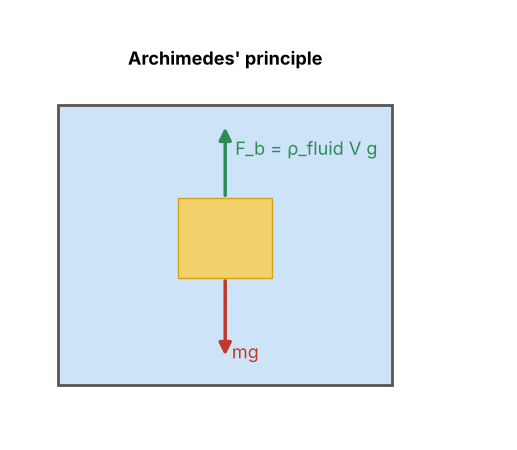
| Fb = ρfluid × Vsub × g | Buoyant force — connects density to Archimedes’ principle | When a numerical force value is required (FRQ or calculation MCQ) |
| 1 g/cm³ = 1000 kg/m³ | Unit conversion between CGS and SI density | Always convert to SI before substituting into Fb = ρVg or P = ρgh |
What Density Is and Why It Matters
Density is the amount of mass packed into a unit volume:
ρ = m / V
where ρ (rho) is density in kg/m³, m is mass in kilograms, and V is volume in cubic meters. The critical insight: density tells you how tightly molecules are packed. Lead feels heavy because lead atoms are crammed close together — high mass in a small volume equals high density. Styrofoam feels light because air fills most of the space — low mass in a large volume equals low density.
On the AP exam, density appears as a prerequisite for three categories of problems:
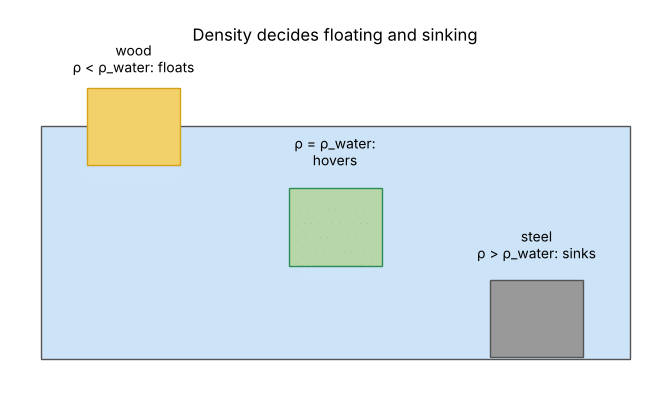
- Buoyancy and floating. An object floats if its density is less than the fluid’s density. This is the core principle behind Archimedes’ principle and shows up in at least one FRQ per year.
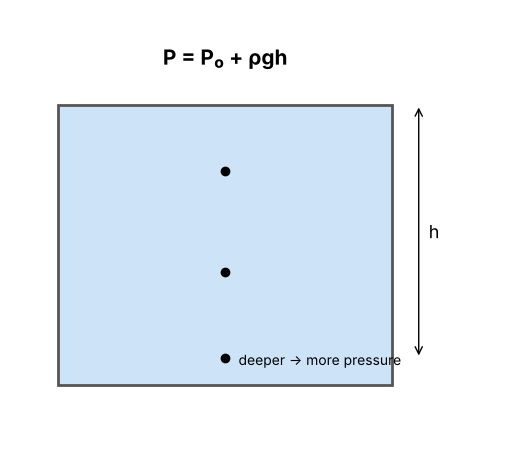
- Pressure in fluids. Denser fluids create greater pressure at depth. When you see a pressure problem, density is often part of the solution.
- Multi-step problems. Calculate density first, use it to determine if an object floats, then calculate buoyant force. Missing the density step means missing the whole problem.
How Internal Molecular Structure Determines Density and Phase
The reason solids, liquids, and gases have such different densities is molecular packing. This isn’t just memorization — it’s the foundation for every density problem you’ll encounter.
| Phase | Molecular Arrangement | Density Rank | Why Density Differs |
|---|---|---|---|
| Solid | Atoms locked in fixed lattice positions by bonds | Highest (varies by material) | Molecules are as close as chemical bonds allow; nearly all volume is occupied by matter |
| Liquid | Molecules in contact but free to move past each other; held loosely by intermolecular forces | Middle (typically 700–1600 kg/m³) | Nearly as close as solids, but thermal motion keeps them slightly farther apart; liquids are nearly incompressible |
| Gas | Molecules flying freely, separated by vast distances relative to molecular size | Lowest (air ≈ 1.2 kg/m³ at room temperature) | Most of the volume is empty space; molecules separated by ~10 molecular diameters on average |
Steam and liquid water consist of identical H₂O molecules — but steam is roughly 1000 times less dense than liquid water because the same molecules occupy ~1000 times more volume. If asked whether steam floats on water, the answer is yes: it’s far less dense.
One more crucial point: density depends on temperature. As solids and liquids heat up, they expand slightly (molecules vibrate more), so density decreases. Hot water is less dense than cold water and floats on top. If a problem gives you temperature information, check whether density change might matter — it’s a common trap for students who assume density is constant.
Comparing Densities: Solids, Liquids, and Gases
| Substance | Density (kg/m³) | Phase | Exam Insight |
|---|---|---|---|
| Hydrogen gas | 0.09 | Gas | Far less dense than air; hydrogen or helium balloons rise because they’re less dense than surrounding air (≈ 1.2 kg/m³) |
| Air (average) | ≈ 1.2 | Gas | Reference for whether gases float or sink in atmosphere |
| Ethanol | 789 | Liquid | Less dense than water; will float on water; common in layering problems |
| Water | 1000 | Liquid | The key reference: 1 mL of water = 1 g. Objects with ρ < 1000 float; ρ > 1000 sink |
| Aluminum | 2700 | Solid | Sinks in water, but aluminum boats float because hull shape displaces enough water volume |
| Iron | 7874 | Solid | Sinks in water; iron ships float via hull geometry (average density including air interior < 1000) |
| Mercury | 13,600 | Liquid | Extremely dense; objects sink in mercury only if ρ > 13,600 (essentially impossible for common materials) |
| Gold | 19,300 | Solid | Appears in material identification problems; sinks in all common fluids |
Key takeaway: most common metals are denser than water (ρ > 1000), though some solids such as wood and ice are not, nearly all gases are far less dense than liquids, and mercury is the exception that makes almost everything float. On the exam, if an object made of unknown metal sinks in water, you immediately know its density exceeds 1000 kg/m³.
Density and Buoyancy: Floating and Sinking
The connection between density and floating is the most tested concept in Topic 8.1:
- ρobject < ρfluid: object floats. At equilibrium, the submerged fraction equals the density ratio.
- ρobject = ρfluid: neutral buoyancy. Object hovers at any depth without accelerating.
- ρobject > ρfluid: object sinks.
Worked example: A wooden block with ρ = 700 kg/m³ is placed in water (ρ = 1000 kg/m³). Does it float? What fraction is submerged?
Step 1: 700 < 1000, so it floats.
Step 2: At equilibrium, Fb = W. Dividing both sides by g: ρwater × Vsub = ρblock × Vtotal. Therefore:
Vsub/Vtotal = ρobject/ρfluid = 700/1000 = 0.70
70% of the block is submerged, 30% is above water. This relationship — fraction submerged = density ratio — appears on nearly every AP® Physics exam that covers fluids. Ice floats in water with ~92% submerged because ice density is ~917 kg/m³.
Density Calculations and Composite Objects
The AP exam rarely asks a simple m/V division. Instead:
- Composite objects: two materials joined together; total mass and total volume determine average density.
- Hollow objects: metal shell with air inside; material density is high, but average density including empty space is low — why steel ships float.
- Rearranged objects: melted, compressed, or reshaped; mass stays the same but volume and density change.
Worked example — composite density: Aluminum block (ρ = 2700 kg/m³, V = 0.1 m³) glued to a wooden block (ρ = 700 kg/m³, V = 0.2 m³).
mAl = 2700 × 0.1 = 270 kg mwood = 700 × 0.2 = 140 kg
ρcombined = (270 + 140) / (0.1 + 0.2) = 410 / 0.3 ≈ 1367 kg/m³
Combined density > 1000 kg/m³, so the composite object sinks despite the wood alone being able to float.
Worked example — material identification: Unknown metal block: mass 500 g, volume 50 cm³.
ρ = 500 g / 50 cm³ = 10 g/cm³ = 10,000 kg/m³
Cross-referencing: gold (19,300), lead (11,340), copper (8960), iron (7874). The density of 10,000 kg/m³ doesn’t exactly match common pure metals — suggesting an alloy or measurement error. Always compare your calculated density to known reference values and flag mismatches.
Test-Taking Strategies
Mnemonic Devices and Memory Shortcuts
“Dens = Down, Light = Up” — Denser objects sink down; less dense objects float up. Apply this to the object–fluid comparison every time: ρobject > ρfluid → sinks. ρobject < ρfluid → floats.
“Fraction Submerged = Density Ratio” — Vsub/Vtotal = ρobject/ρfluid. Ice at 917 kg/m³ in water at 1000 kg/m³ floats 91.7% submerged. This formula skips intermediate force calculations and directly gives the answer in one step.
“Mass over Volume” — Density is strictly mass divided by volume. Not force, not energy, not momentum. Repeating this anchors the formula and prevents substitution errors.
Cross-Topic Connections
Topic 8.3 (Fluids and Newton’s Laws): Buoyant force Fb = ρfluidVsubg. Density comparison determines whether Fb at full submersion exceeds the object’s weight. Every FRQ on buoyancy begins here.
Topic 8.2 (Pressure in Fluids): Pressure at depth P = P₀ + ρgh depends on fluid density. A denser fluid exerts more pressure at the same depth. Mercury manometers exploit mercury’s extreme density (13,600 kg/m³) to measure gas pressures with a compact column.
Topics 2.1–2.2 (Forces and Newton’s Laws): If an object accelerates through a fluid, you apply ΣF = ma with buoyant force and weight. Density determines whether buoyancy helps or opposes gravity in that analysis.
Common Question Formats
Multiple choice — comparing densities: “Objects A, B, C are placed in water. A sinks, B floats 50% submerged, C floats 75% submerged. Rank their densities.” A: ρ > 1000; B: ρ = 500; C: ρ = 750. Rank: A > C > B. Uses the density ratio shortcut directly.
Multiple choice — pressure and density: “Identical containers filled to equal depth with mercury and water. Which has greater pressure at the bottom?” Mercury: ρ = 13,600 vs water ρ = 1000. Same h, so mercury pressure is 13.6× higher by P = ρgh.
FRQ — composite object in fluid: “A lead weight (ρ = 11,340 kg/m³) is glued to a cork float (ρ = 240 kg/m³). Calculate combined density and determine whether it floats in saltwater (ρ = 1025 kg/m³).” Two steps: (1) find combined ρ from masses and volumes, (2) compare to saltwater density. Show all work for full credit.
Frequent Student Mistakes
Mistake: Confusing “lower density” with “definitely floats.” An object floats only if its density is less than the fluid’s density. A hot block of lead has lower density than cold lead, but it still sinks in water because lead’s density (even hot) vastly exceeds 1000 kg/m³. Always compare object density to fluid density, not to the object’s density at a different temperature.
Mistake: Forgetting to convert units. A problem gives mass in grams and volume in cm³. Student calculates ρ = 500/50 = 10 and writes “10 kg/m³.” The actual answer is 10 g/cm³ = 10,000 kg/m³ — off by a factor of 1000. Convert units explicitly or remember: 1 g/cm³ = 1000 kg/m³.
Mistake: Using density as a proxy for mass. Object A is denser than Object B, so A must be heavier. Not necessarily — a small gold nugget has less mass than a large aluminum block, even though gold is 7× denser. Density tells you about packing efficiency, not total mass. Always use m = ρV when mass is needed.
Test-Day Shortcuts
Density comparison first, always. Before calculating anything, compare ρobject to ρfluid. Less dense → floats; more dense → sinks. This 5-second check resolves float/sink questions without equations and prevents the trap of computing a buoyant force before establishing direction.
Fraction submerged = density ratio. Vsub/Vtotal = ρobject/ρfluid is the fastest path to any floating equilibrium answer. Ice at 917 kg/m³ in water at 1000 kg/m³ floats 91.7% submerged — one division, no intermediate steps, full credit.
Unit conversion shortcut: 1 g/cm³ = 1000 kg/m³. When a problem gives density in g/cm³, multiply by 1000 to get kg/m³ before using any formula. A density of 10 g/cm³ is 10,000 kg/m³ — a factor-of-1000 error on this unit conversion is the most common source of wrong answers on density problems.
For composite objects: total mass ÷ total volume. Don’t average densities — calculate total mass (ΣρᵢVᵢ) and total volume (ΣVᵢ) separately, then divide. Two materials can combine to a density anywhere in range. Explicit mass/volume bookkeeping is the only reliable method.
Time Management Tips
Before any calculation, compare densities. ρobject vs. ρfluid gives you the outcome in 5 seconds. Only compute buoyant force explicitly if a numerical answer is required.
For floating objects, use Vsub/Vtotal = ρobject/ρfluid directly. Skip the intermediate step of calculating Fb and W separately unless the problem specifically asks for those forces.
On FRQs, write each step: (1) calculate density, (2) compare to fluid density, (3) calculate buoyant force if needed. Breaking multi-step density problems into labeled stages prevents losing track of which quantity you’re solving for and makes partial credit easy for graders to award.
Show unit conversions explicitly in FRQs. Writing ρ = 500 g / 50 cm³ = 10 g/cm³ = 10,000 kg/m³ earns method credit even if your final answer is wrong. Jumping straight to a number without units loses those points.
Check for Understanding
Think you’ve got it? Complete the quiz below to make sure. Download your results at the end.