
Maximize your score with these resources:
- Albert.io ACT® Enhanced English question banks
- Free ACT® Enhanced English study guides
- Free ACT® Enhanced English score calculator
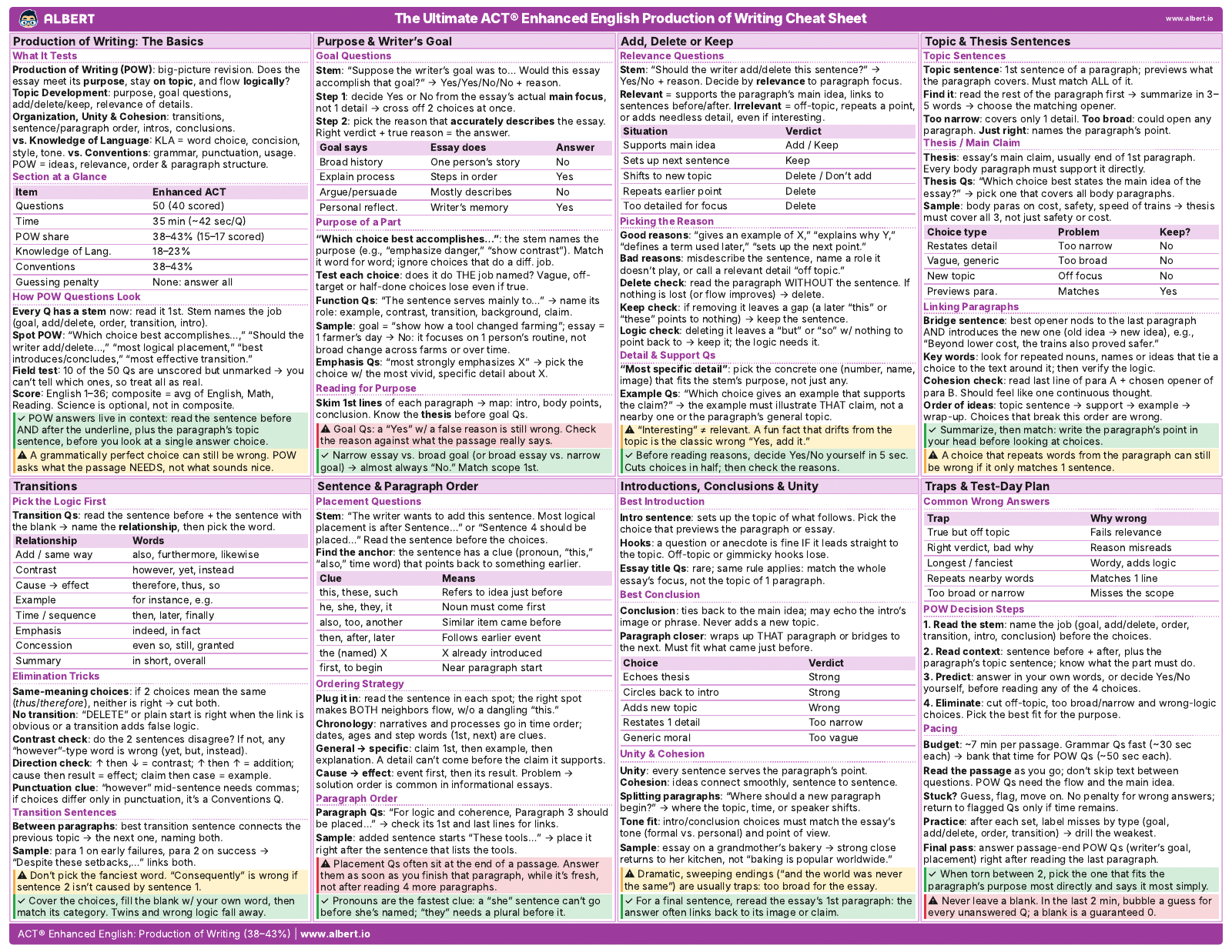
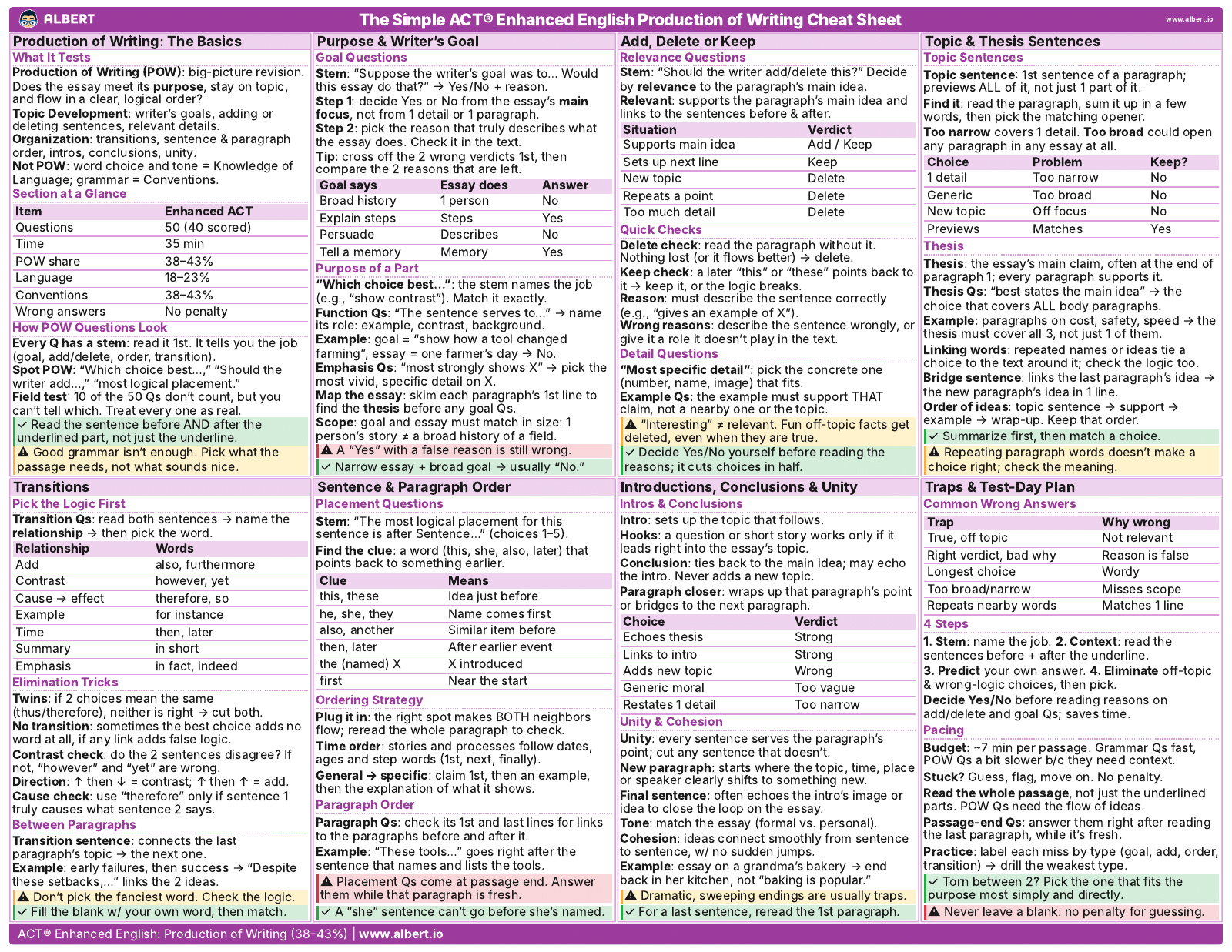
This ACT English Production of Writing cheat sheet covers the big-picture revision questions on the ACT® Enhanced English test: writer’s goal questions, add-or-delete decisions, transitions, and sentence placement. Production of Writing makes up 38–43% of the English score. Grab the Simple version for the core rules or the Ultimate version for every strategy and trap.
Practice ACT® Enhanced English questions on Albert
What’s on the ACT English Production of Writing Cheat Sheet?
Both versions use the same eight cards: the basics of the category, purpose and writer’s goal questions, add/delete/keep questions, topic and thesis sentences, transitions, sentence and paragraph order, introductions and conclusions, and a final card of traps and pacing.
The Simple version is for students who want the core moves: what each question type asks, a quick decision rule, and one tip and one warning per card. It works well for a first review or the night before the test.
The Ultimate version is for students chasing a high English score. It adds worked examples, clue-word tables for placement questions, elimination tricks for transitions, and a step-by-step routine for every Production of Writing question. Start with Simple, then switch to Ultimate once the question types feel familiar.
Production of Writing at a Glance
The enhanced ACT English test has 50 questions in 35 minutes, and 40 of them count toward your score. ACT groups the questions into three reporting categories. Production of Writing is tied for the largest.
| Category | Share of test | What it covers |
|---|---|---|
| Production of Writing | 38–43% | Purpose, relevance, organization, unity, cohesion |
| Knowledge of Language | 18–23% | Word choice, concision, style, tone |
| Conventions of Standard English | 38–43% | Grammar, punctuation, usage |
Production of Writing has two parts, according to ACT’s English test description. Topic Development asks whether a passage meets its purpose and whether a sentence belongs. Organization, Unity, and Cohesion asks whether the ideas are in a logical order and connected smoothly, including transitions, introductions, and conclusions.
Key Concepts in Production of Writing
Writer’s Goal Questions
These questions describe a goal and ask whether the essay meets it. The choices pair a verdict (Yes or No) with a reason. Decide the verdict first by asking what the essay as a whole focuses on, not what one paragraph says. Then pick the reason that accurately describes the passage.
Worked example: “Suppose the writer’s goal had been to explain how the printing press changed education across Europe. Would this essay accomplish that goal?” The essay tells the story of one printer’s workshop in Mainz. The answer is No, because the essay focuses on a single workshop rather than broad changes in education. A choice saying “No, because the essay never mentions books” would be wrong if books do appear.
Exam tip: A narrow essay paired with a broad goal (or the reverse) is almost always a No.
Add, Delete, or Keep
Here the question is relevance. A sentence belongs if it supports the main idea of its paragraph and connects to the sentences around it. It goes if it shifts to a new topic, repeats an earlier point, or adds detail the paragraph does not need, even when that detail is interesting.
Worked example: A paragraph explains how honeybees communicate through dances. The writer considers adding “Honey never spoils and has been found in ancient tombs.” It is true and memorable, but it has nothing to do with communication. Do not add it.
Exam tip: Read the paragraph without the sentence. If nothing is lost, delete. If a later “this” or “these” suddenly points to nothing, keep it.
Topic Sentences and Thesis Statements
A topic sentence previews everything in its paragraph. Wrong choices are usually too narrow (they cover one detail), too broad (they could open any paragraph), or off topic. The fix is to read the paragraph first, sum it up in a few words, and then find the choice that matches.
Worked example: A paragraph describes a city’s new bike lanes, then lower traffic injuries, then more people commuting by bike. The best opener is something like “The bike lanes changed how residents got around,” which covers all three. “The lanes were painted green” covers only one detail.
Exam tip: The best opener for a new paragraph often bridges from the last paragraph’s idea to the new one.
Transitions
Transition questions test logic, not vocabulary. Read the sentence before and the sentence with the blank, name the relationship (addition, contrast, cause and effect, example, time), and then choose the word that fits that relationship.
Worked example: “The first prototype failed every test. ____, the team kept the design and fixed one part at a time.” The second sentence pushes forward despite the failure, so the relationship is concession or contrast. “Even so” works. “Therefore” does not, because the failure did not cause them to keep going.
Exam tip: If two choices mean the same thing, such as “thus” and “therefore,” neither can be the single right answer. Cross both off.
Sentence and Paragraph Order
Placement questions ask where a sentence or paragraph belongs. Look for words that point backward: “this,” “these,” pronouns like “she” or “they,” “also,” “another,” and time words like “later.” Each one tells you what must come right before it.
Worked example: The sentence to place begins “These tools made the work faster.” It belongs immediately after the sentence that names the tools, not before it and not three sentences later.
Exam tip: Placement questions often sit at the end of a passage. Answer them as soon as you finish the paragraph they refer to.
Introductions, Conclusions, and Unity
Some questions ask for the best way to open or close a paragraph or the whole essay. A strong introduction sets up the topic that follows. A question or short anecdote is fine as a hook, but only if it leads straight into the subject. A strong conclusion ties back to the main idea and often echoes an image or phrase from the first paragraph. It never introduces a new topic.
Unity questions also ask where a new paragraph should begin. Look for the point where the topic, the time, or the speaker shifts.
Worked example: An essay about a grandmother’s bakery opens with the smell of bread in her kitchen and walks through her years running the shop. The best final sentence returns to that kitchen, for example by describing the writer baking her recipe today. A choice like “Baking remains popular around the world” is too generic, and a choice about the history of wheat adds a new topic.
Exam tip: Before choosing a final sentence, reread the first paragraph. The answer usually links back to it, and it matches the essay’s tone, personal or formal.
How Production of Writing Shows Up on the ACT
On the enhanced test, every English question has a question stem, so Production of Writing questions are easy to spot. Watch for stems like “Which choice best accomplishes this purpose?”, “Should the writer add the following sentence?”, “The most logical placement for Sentence 3 is…”, and “Which choice most effectively concludes the paragraph?” Each passage mixes these with grammar and word-choice questions.
The test does not reward the most impressive-sounding choice. It rewards the choice that fits the paragraph’s purpose most directly. With about 42 seconds per question on average, move quickly through grammar questions and give Production of Writing questions a little more time, since they require reading context. Ten of the 50 questions are unscored field-test items, but you cannot tell which, so treat every question as real. There is no penalty for wrong answers, so never leave one blank. For ACT English Production of Writing practice, work timed passages and label each miss by question type.
Common Mistakes in Production of Writing
- Choosing a true but off-topic sentence. Fix: ask whether it supports this paragraph’s main idea, not whether it is accurate.
- Picking the right verdict with the wrong reason. Fix: check the reason against the passage before choosing.
- Reading only the underlined part. Fix: read the sentence before and after, plus the paragraph’s first sentence.
- Choosing the fanciest transition. Fix: name the logical relationship first, then match the word.
- Ending with a sweeping, dramatic conclusion. Fix: pick the closer that ties back to the essay’s actual main idea.
Frequently Asked Questions
Can I use this cheat sheet on the ACT?
No. Notes are not allowed during the ACT. The ACT English Production of Writing cheat sheet is a study tool for review before test day.
Should I start with the Simple or Ultimate version?
Start with Simple to learn the question types and the basic rule for each. Move to Ultimate when you are consistently spotting question types and want the finer strategies and traps.
How many Production of Writing questions are on the test?
About 15 to 17 of the 40 scored English questions, or 38–43% of the English score.
How should I practice Production of Writing?
Do full timed passages rather than isolated questions, because these questions depend on context. After each set, sort your misses by type, such as goal, add or delete, order, or transition, and drill the weakest type first. Keep the cheat sheet open while you review your mistakes, then close it and try again.
Did Production of Writing change on the enhanced ACT?
Yes, in weight. On the older ACT, grammar and punctuation made up more than half of the English test. On the enhanced ACT, Production of Writing and Conventions share the top spot at 38–43% each, the test is shorter at 50 questions in 35 minutes, and every question now has a stem that tells you what it is asking. That makes big-picture revision skills worth more of your study time than before.
Is Production of Writing the same as grammar?
No. Grammar and punctuation fall under Conventions of Standard English. Production of Writing is about purpose, relevance, and organization, so the right answer depends on context.