

Maximize your score with these resources:
- Albert.io AP® Calculus question banks
- Free AP® Calculus cheat sheets
- Free AP® Calculus score calculator
You’ve confirmed that an alternating series converges — great. But how close is your partial sum to the actual answer? That’s where the alternating series error bound comes in. This formula tells you exactly how far off your approximation can be, using nothing more than the next unused term. It’s one of the most efficient tools in your BC Calculus toolkit, and the AP exam tests it directly.
What We Review
Key Definitions and Concepts
Recap of the Alternating Series Test
An alternating series has terms that flip between positive and negative. The general form is \(\sum_{n=1}^{\infty} (-1)^n a_n\), where \(a_n \geq 0\). The Alternating Series Test (AST) says the series converges if three conditions hold:
- \(a_n \geq 0\) for all \(n\)
- \(a_{n+1} \leq a_n\) — the terms decrease in absolute value
- \(\lim_{n \to \infty} a_n = 0\)
If all three conditions are met, the series converges. But convergence alone doesn’t tell you how good your partial sum is — that’s the job of the error bound.
Introducing the Alternating Series Error Bound Formula
The alternating series error bound formula states that when you approximate a convergent alternating series using \(N\) terms, the error is at most the absolute value of the next omitted term:
\(|R_N| \leq a_{N+1}\)Here, \(R_N\) is the remainder — the difference between the true sum and your partial sum. This bound is remarkably tight: it guarantees the error is no larger than the first term you didn’t include.
The Alternating Series Estimation Theorem
The alternating series estimation theorem formalizes the error bound and connects it to practical approximation problems.
Statement of the Theorem
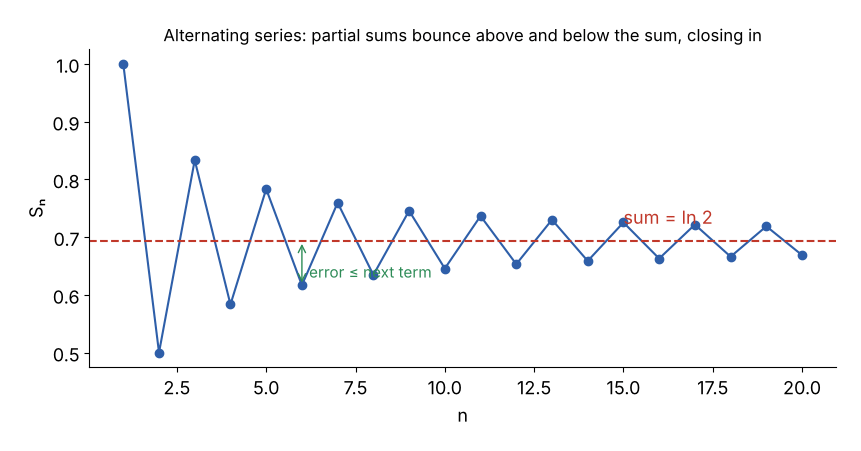
If the conditions of the Alternating Series Test are satisfied, then the error in using the partial sum \(S_N\) to approximate the true sum \(S\) satisfies:
\(|S – S_N| \leq a_{N+1}\)In words: the maximum error equals the absolute value of the very next term. You don’t need to compute complicated integrals or derivatives — just look at the next term in the sequence.
Conditions for Using the Theorem
Before applying the error bound, you must verify two things:
- Decreasing terms: \(a_{n+1} \leq a_n\) for all \(n\) beyond some point
- Limit to zero: \(\lim_{n \to \infty} a_n = 0\)
If either condition fails, the error bound doesn’t apply. Always check these first — it takes 10 seconds and prevents a wrong answer.
Connecting the Theorem to the Error Bound Formula
Once you’ve confirmed the conditions, the application is mechanical:
- Identify \(a_{N+1}\) — the first term you’re not including in your sum
- That term’s absolute value is your maximum error: \(|S – S_N| \leq a_{N+1}\)
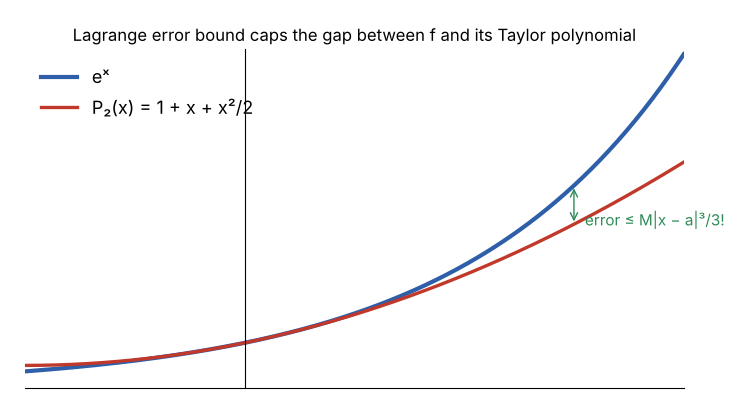
Unlike the Lagrange error bound (which requires finding maximum values of higher-order derivatives), the alternating series error bound hands you the answer directly from the next term.
Example 1: Applying the Alternating Series Error Bound
Consider the alternating harmonic series:
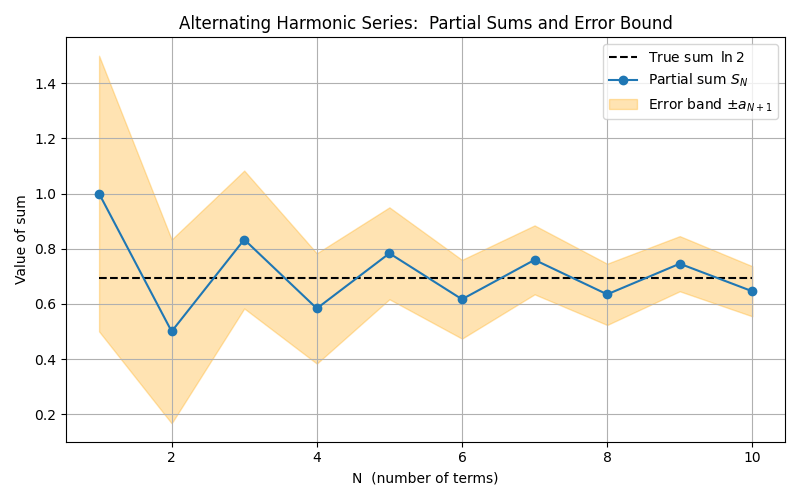
\(\sum_{n=1}^{\infty} \frac{(-1)^{n+1}}{n} = 1 – \frac{1}{2} + \frac{1}{3} – \frac{1}{4} + \cdots\)Find the error bound after summing the first four terms.
Step 1 — Check the conditions. The terms \(a_n = \frac{1}{n}\) decrease and approach zero. The AST conditions are satisfied.
Step 2 — Identify the next term. After four terms, the next term is \(a_5 = \frac{1}{5}\).
Step 3 — Apply the bound. \(|R_4| \leq \frac{1}{5} = 0.2\)
So the partial sum \(S_4 = 1 – \frac{1}{2} + \frac{1}{3} – \frac{1}{4} = \frac{7}{12} \approx 0.5833\) is within \(0.2\) of the true sum (\(\ln 2 \approx 0.6931\)).
Practical Strategies for Using the Error Bound
AP exam questions about the alternating series error bound typically take one of two forms: “what’s the error after N terms?” or “how many terms do you need for a given accuracy?” Here’s how to handle both:
| Question Type | What to Do | Time Budget |
|---|---|---|
| “Error after N terms?” | Compute \(a_{N+1}\) — that’s the max error | 30 seconds |
| “How many terms for error < \(\varepsilon\)?" | Solve \(a_{N+1} < \varepsilon\) for \(N\) | 1–2 minutes |
| “Approximate with error < 0.001" | Find smallest \(N\) where \(a_{N+1} < 0.001\), then compute \(S_N\) | 2–3 minutes |
Pro tip: When solving “how many terms” problems, start by isolating \(N\) algebraically if possible, then check integer values. For series like \(\frac{1}{n^2}\) or \(\frac{1}{n!}\), the algebra is clean. For messier terms, just test values starting from small \(N\) and work up.
Example 2: More Complex Series With Alternating Series Error Bound
Consider the series:
\(\sum_{n=1}^{\infty} (-1)^{n+1} \frac{\sqrt{n}}{n+1}\)How many terms are needed to ensure the error is below \(0.05\)?
Step 1 — Verify conditions. Here \(a_n = \frac{\sqrt{n}}{n+1}\). For large \(n\), the denominator grows faster than the numerator, so \(a_n\) eventually decreases. The limit:
\(\lim_{n \to \infty} \frac{\sqrt{n}}{n+1} = \lim_{n \to \infty} \frac{1/\sqrt{n}}{1 + 1/n} = 0\)Both conditions are satisfied.
Step 2 — Solve the inequality. You need \(\frac{\sqrt{N+1}}{N+2} < 0.05\), which means \(\sqrt{N+1} < 0.05(N+2)\). Testing values: at \(N = 399\), \(a_{400} = \frac{20}{401} \approx 0.0499 < 0.05\).
Step 3 — Interpret the result. You’d need the first 399 terms to guarantee error below \(0.05\). This demonstrates that some alternating series converge very slowly — when terms shrink gradually, you may need many terms for tight accuracy.
Quick Reference Chart: Vocabulary and Definitions
| Term | Definition |
|---|---|
| Alternating Series | A series whose terms alternate between positive and negative values |
| Alternating Series Test (AST) | If terms decrease in absolute value and approach zero, the alternating series converges |
| Alternating Series Error Bound | The maximum error after \(N\) terms is \(|R_N| \leq a_{N+1}\) |
| Estimation Theorem | Formal theorem stating error is at most the next omitted term in absolute value |
| Monotonic Decrease | A sequence where each term is less than or equal to the previous term |
| Remainder \(R_N\) | The difference between the true sum and the partial sum after \(N\) terms |
Test-Taking Strategies
Mnemonic: “NEXT term = MAX error.” That’s the entire alternating series error bound in five words. The error is at most the next term you didn’t use. This is the fastest error bound formula on the AP exam.
The DCL checklist before applying the bound:
- Decreasing — confirm terms decrease in absolute value
- Converges to zero — verify \(\lim_{n \to \infty} a_n = 0\)
- Look at the next term — that’s your error bound
Cross-topic connections:
- Taylor and Maclaurin series: Many Taylor series are alternating (like \(\cos x\), \(e^{-x}\), \(\ln(1+x)\)). When the exam asks you to approximate these with a polynomial and bound the error, the alternating series error bound is often faster than the Lagrange error bound.
- Lagrange error bound comparison: The Lagrange bound requires finding \(\max |f^{(n+1)}(c)|\) on an interval — much harder. If your series alternates and satisfies the AST conditions, use the alternating series bound instead.
- Power series endpoints: At the endpoints of a power series’ interval of convergence, you often get an alternating series. The error bound helps determine the accuracy of endpoint approximations.
Common question formats:
- “What is the maximum error using the first 5 terms?” — Find \(a_6\)
- “How many terms for error less than 0.001?” — Solve \(a_{N+1} < 0.001\)
- “Approximate \(\cos(0.5)\) using the first 4 terms of its Maclaurin series. Bound the error.” — Identify the next alternating term
Frequent student mistakes:
- Forgetting to verify conditions — The bound only works if AST conditions hold. Students lose points by jumping straight to \(a_{N+1}\) without checking.
- Confusing error with partial sum — \(a_{N+1}\) is the maximum error, not the sum itself. The sum is \(S_N\); the error is at most \(a_{N+1}\).
- Using this bound on non-alternating series — If the series doesn’t alternate, you need a different error bound (Lagrange, integral remainder, etc.).
- Off-by-one errors — After summing \(N\) terms, the bound uses \(a_{N+1}\) (the next term), not \(a_N\) (the last term you included).
Test-day shortcut: When a free-response question asks you to “show that the approximation is within \(\varepsilon\) of the true value,” write this template: “The series satisfies the conditions of the AST because \(a_n\) is decreasing and \(\lim a_n = 0\). By the Alternating Series Estimation Theorem, \(|R_N| \leq a_{N+1} = [\text{value}] < \varepsilon\)." This three-sentence answer earns full credit.
Time management: Error bound questions are 1–2 minute problems on the MC section. Don’t overthink — check conditions, compute the next term, move on. On the FRQ, budget 3 minutes if it’s part of a multi-part Taylor series question.
Check for Understanding
Think you’ve got it? Complete the quiz below to make sure. Download your results at the end.