
Maximize your score with these resources:
- Albert.io AP® African American Studies question banks
- Free AP® African American Studies study guides
- Free AP® African American Studies score calculator
Long before the transatlantic slave trade, Africa had gold empires, a university city, and trade networks reaching India and China, and this AP® African American Studies Unit 1 cheat sheet puts that history on one page. Origins of the African Diaspora is worth 20–25% of the AP® African American Studies exam. Start with the Simple version for core facts, then move to Ultimate for the full detail.
Practice AP® African American Studies Unit 1 questions on Albert
What’s on the AP® African American Studies Unit 1 Cheat Sheet?
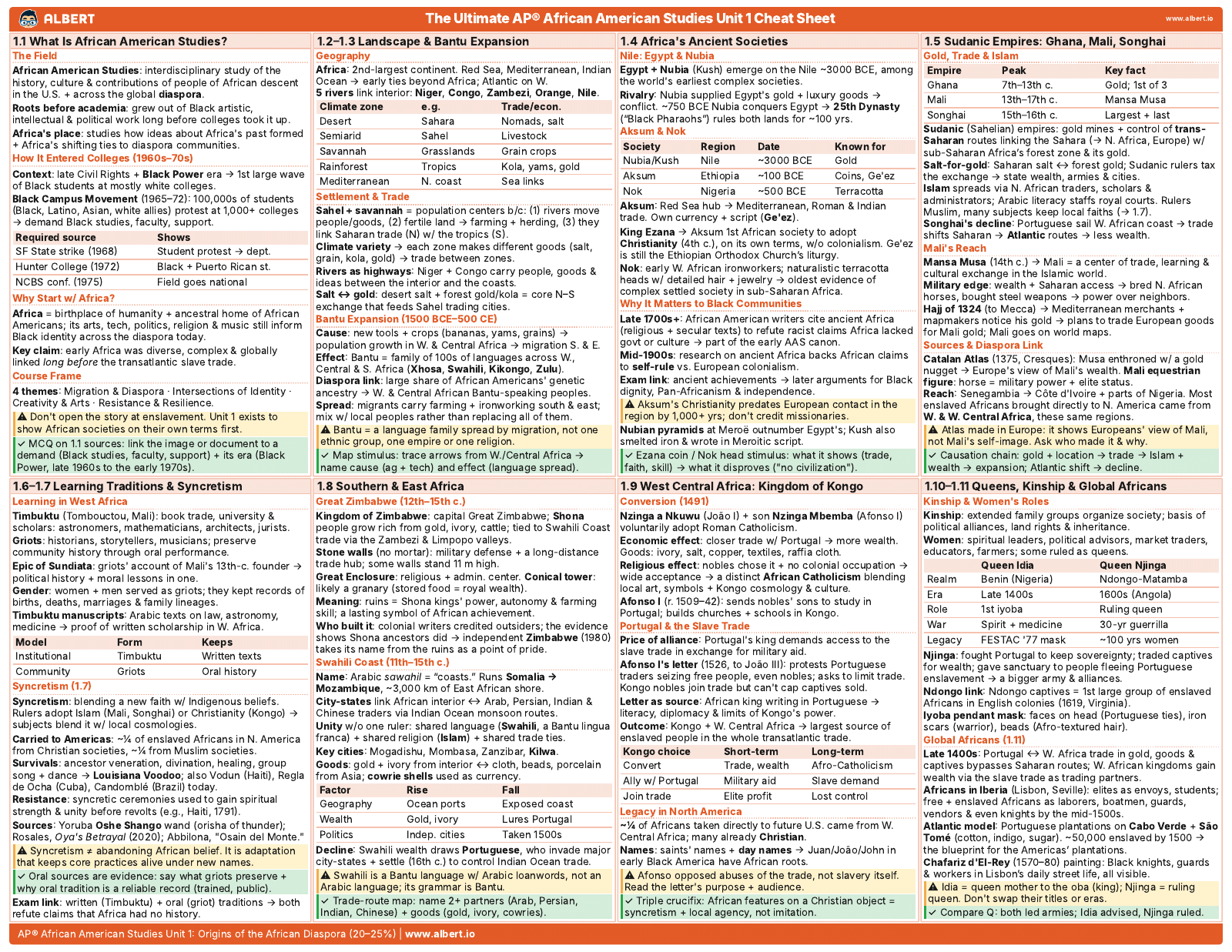
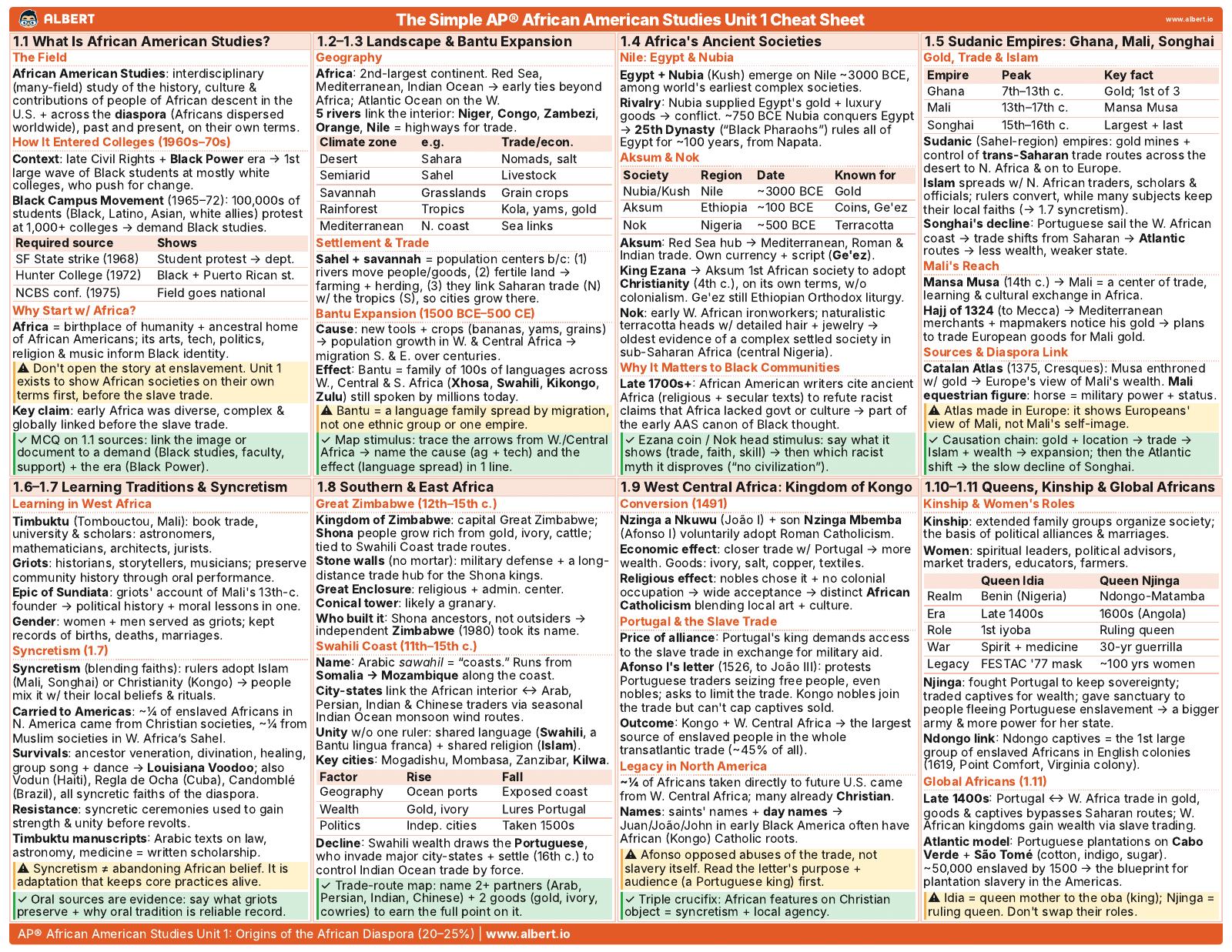
Both versions of the AP® African American Studies Unit 1 cheat sheet cover the same eleven CED topics on one landscape page, organized into eight cards that run from the founding of African American Studies as a college discipline to the Portuguese plantations on Cabo Verde and São Tomé. Every required source for the unit is named on the card where it belongs, so you can connect each image, map, or letter to the topic it is meant to teach.
The Simple version is the place to start if Unit 1 is new to you or you are reviewing it for the first time since fall. It keeps the core facts for each topic, a short table per card, and one warning or exam tip, with a few words of context the first time a term appears.
The Ultimate version is built for the last few weeks before the exam. It adds the details that separate a 3 from a 5: the dates of the Black Campus Movement, the three reasons population centers formed in the Sahel and savanna, the military side of Mali’s wealth, the Kongo chain from alliance to slave trade, a side-by-side comparison of Queen Idia and Queen Njinga, and specific multiple-choice and short-answer moves for the required sources.
AP® African American Studies Unit 1 at a Glance
Unit 1, Origins of the African Diaspora, spans roughly 900 BCE to the 16th century and accounts for 20–25% of the exam score. The College Board suggests about 18 class periods for it, which makes it the shortest unit in the course. It is still worth a full quarter of the exam, and its sources show up regularly in short-answer questions that ask you to connect early Africa to later diaspora communities.
| Topic | Name | Focus |
|---|---|---|
| 1.1 | What Is African American Studies? | The field and how it entered colleges in the 1960s–70s |
| 1.2 | The African Continent: A Varied Landscape | Climate zones, rivers, and how they shaped trade |
| 1.3 | Population Growth and Ethnolinguistic Diversity | The Bantu expansion and its linguistic legacy |
| 1.4 | Africa’s Ancient Societies | Egypt and Nubia, Aksum, Nok |
| 1.5 | The Sudanic Empires: Ghana, Mali, and Songhai | Gold, trans-Saharan trade, and Islam |
| 1.6 | Learning Traditions | Timbuktu and griots |
| 1.7 | Indigenous Cosmologies and Religious Syncretism | Blended faiths carried to the Americas |
| 1.8 | Culture and Trade in Southern and East Africa | Great Zimbabwe and the Swahili Coast |
| 1.9 | West Central Africa: The Kingdom of Kongo | Christianity, Portugal, and the slave trade |
| 1.10 | Kinship and Political Leadership | Women’s roles, Queen Idia, Queen Njinga |
| 1.11 | Global Africans | Africans in Iberia and Portugal’s Atlantic island plantations |
The full topic list, learning objectives, and required sources are in the official AP® African American Studies course page on AP Central.
Key Concepts in Unit 1: Origins of the African Diaspora
The Field Itself (Topic 1.1)
African American Studies is interdisciplinary: it draws on history, literature, the arts, sociology, and political science to study people of African descent in the United States and across the diaspora. The unit stresses that the field’s roots run much deeper than its arrival on campus. Black writers, artists, and activists were building this body of knowledge for generations before any university created a department.
What changed in the 1960s was access. As the Civil Rights Movement gave way to Black Power, Black students entered predominantly white colleges in large numbers for the first time. During the Black Campus Movement (1965–1972), students and their Latino, Asian, and white allies protested at more than 1,000 campuses, demanding Black history courses and more Black students, faculty, and administrators. The strike led by the Black Student Union at San Francisco State in 1968–69 produced the first Black Studies department.
Worked example: A question shows the 1972 Hunter College schedule of courses for Black and Puerto Rican Studies and asks what it reveals. A strong answer notes that the courses existed because students demanded them, and that pairing Black and Puerto Rican Studies reflects the multiracial coalitions of the Black Campus Movement.
Exam tip: If a question implies the field began in 1968, push back. Colleges formalized a tradition; they did not invent it.
Geography and the Bantu Expansion (Topics 1.2–1.3)
Africa is the second-largest continent and has five main climate zones: desert (the Sahara), semiarid (the Sahel), savanna, tropical rainforest, and Mediterranean. Five major rivers (Niger, Congo, Zambezi, Orange, and Nile) connect the interior to the coasts. Each zone supported a different economy: desert herders traded salt, the Sahel traded livestock, savanna farmers grew grain, and rainforest communities grew kola and yams and traded gold.
The CED gives three reasons population centers formed in the Sahel and savanna: rivers moved people and goods, fertile land supported farming and herding, and the region sat between Saharan trade to the north and the forest zone to the south.
The Bantu expansion (about 1500 BCE to 500 CE) began when new tools, iron weapons, and crops such as bananas, yams, and cereals drove population growth in West and Central Africa. Migrations carried farming, ironworking, and Bantu languages east and south. Hundreds of Bantu languages are spoken today, including Swahili, Kikongo, Zulu, and Xhosa, and much of African Americans’ genetic ancestry traces to Bantu-speaking peoples of West and Central Africa.
Worked example: Given the climate-regions map, you are asked why a trading city would form in the Sahel. Answer with the map: the Sahel lies between the Sahara and the forest belt, so it is where salt from the north met gold and kola from the south.
Exam tip: Bantu names a language family, not a single people or state.
Ancient Societies and the Sudanic Empires (Topics 1.4–1.5)
Egypt and Nubia (Kush) developed along the Nile around 3000 BCE. Nubia supplied Egypt with gold and luxury goods, and around 750 BCE Nubian kings conquered Egypt and ruled for about a century as the 25th Dynasty, the “Black Pharaohs.” In West Africa, the Nok society of present-day Nigeria was one of the region’s earliest ironworking societies and is known for its terracotta sculpture. In East Africa, Aksum used its Red Sea location to trade with the Mediterranean world and India, minted its own coins, and developed the Ge’ez script. Under King Ezana in the 4th century, Aksum became the first African society to adopt Christianity, long before European colonialism or the transatlantic slave trade.
The Sudanic empires followed one another: Ghana (7th–13th centuries), Mali (13th–17th centuries), and Songhai (15th–16th centuries). All three grew rich from gold and from controlling routes between the Sahara and sub-Saharan Africa. Trans-Saharan trade brought North African merchants and scholars who spread Islam. Mansa Musa’s 1324 pilgrimage to Mecca advertised Mali’s wealth so widely that European mapmakers put him on the Catalan Atlas of 1375, holding a gold nugget. Songhai, the largest of the three, declined after Portuguese ships shifted trade to the Atlantic coast.
Worked example: An Aksumite coin showing King Ezana appears with the question “What does this source suggest about Aksum?” Coinage points to a state with a centralized ruler and a trade economy large enough to need currency.
Exam tip: Keep the order straight: Ghana, then Mali, then Songhai. Mansa Musa belongs to Mali.
Learning, Faith, and Trade Networks (Topics 1.6–1.8)
West Africa had two models of education. Institutional learning was centered in trading cities like Timbuktu, which had a book trade, a university, and scholars of astronomy, mathematics, architecture, and law. Community-based learning ran through griots, the women and men who kept a community’s history, genealogies, and records of births, deaths, and marriages in story and song. The Epic of Sundiata, which tells of Mali’s founder, is the unit’s required griot source.
When rulers adopted Islam (Mali, Songhai) or Christianity (Kongo), ordinary people often blended the new faith with existing beliefs. That syncretism crossed the Atlantic: ancestor veneration, divination, healing practices, and communal song and dance live on in Haitian Vodou, Louisiana Voodoo, Cuba’s Regla de Ocha/Ifá, and Brazil’s Candomblé. Enslaved people sometimes held these ceremonies before revolts.
In southern Africa, the Shona built Great Zimbabwe (12th–15th centuries) on wealth from gold, ivory, and cattle. Its stone walls served defense and trade, the Great Enclosure held religious and administrative functions, and the conical tower was probably a granary. On the East African coast, Swahili city-states from Somalia to Mozambique linked the interior to Arab, Persian, Indian, and Chinese merchants, sharing the Swahili language and Islam until the Portuguese seized key ports in the 16th century.
Worked example: A question pairs Harmonia Rosales’s painting Oya’s Betrayal (2020) with a prompt about continuity. Name the African element (the Yoruba orisha Oya) and where she is still honored (Regla de Ocha in Cuba, Candomblé in Brazil), then explain that a contemporary artist drawing on her shows the tradition is alive.
Exam tip: Oral tradition is a historical record. Treat griots as sources, not folklore.
Kongo, Queens, and Global Africans (Topics 1.9–1.11)
In 1491, King Nzinga a Nkuwu and his son Nzinga Mbemba (later Afonso I) converted the Kingdom of Kongo to Catholicism by choice. Because elites adopted it voluntarily, a distinctly African Catholicism took hold. Ties with Portugal brought trade, but Portugal demanded captives in return for military help, and Kongo’s nobles could not control how many people were sold. West Central Africa became the largest source of enslaved people in the history of the Atlantic trade, and about a quarter of the Africans brought directly to what became the United States came from that region, many of them already Christian.
Women held real power across West and Central Africa as advisors, traders, spiritual leaders, and rulers. Queen Idia of Benin, the first iyoba (queen mother) in the late 15th century, advised her son and led armies using spiritual and medicinal knowledge. Queen Njinga of Ndongo-Matamba fought the Portuguese for about 30 years in the 17th century, both trading captives and sheltering people who escaped Portuguese slavery.
Before the transatlantic trade took off, Africans already lived in Lisbon and Seville as diplomats, students, laborers, and even knights. In the late 1400s, Portugal colonized Cabo Verde and São Tomé and built sugar, cotton, and indigo plantations worked by enslaved Africans. Those islands became the model for slave-based economies in the Americas.
Worked example: In Afonso I’s 1526 letter to King João III, he complains that Portuguese traders are seizing free people, including nobles, and asks for only priests and teachers. Read it as a protest against the trade’s abuses, not a rejection of Christianity or of Portugal.
Exam tip: When comparing Idia and Njinga, start with the similarity (both led armies), then the difference (Idia advised a king, Njinga ruled in her own name).
How Unit 1 Shows Up on the Exam
Section I has 60 multiple-choice questions in 70 minutes, worth 60% of the score. Questions come in sets of three or four built around a shared source, and many of those sources are the required ones listed in the CED. For Unit 1, that means you should recognize the Catalan Atlas, the Aksumite coin, the Nok sculpture, the Kongo triple crucifix, the Idia pendant mask, and the Chafariz d’El-Rey painting on sight and know what each shows.
Section II has three short-answer questions and one document-based question in 85 minutes. Unit 1 often appears in a short-answer question that starts with an early African source and then asks you to connect it to a later diaspora practice, so a later part might jump forward several centuries. A typical set might show the Mali equestrian figure, ask you to compare Mali with another African empire, and then ask you to link it to an artistic tradition in the diaspora.
Scorers reward specific evidence. “African kingdoms were wealthy” earns little; “Mali’s control of gold and trans-Saharan routes let Mansa Musa make the 1324 hajj that put Mali on the Catalan Atlas” earns the point. The College Board exam page lists the current format.
Common Mistakes in Unit 1
- Treating Africa as one place. The unit’s whole point is diversity of climate, language, economy, and government. Name the region and the society.
- Saying Europeans brought Christianity to Africa. Aksum adopted Christianity in the 4th century, and Kongo converted by choice in 1491.
- Mixing up the Sudanic empires. Ghana, Mali, Songhai, in that order. Timbuktu and Mansa Musa are Mali.
- Describing a source without explaining it. Say what the source shows, then why it matters for the question.
- Making Kongo either a victim or a villain. Its nobles took part in the slave trade but could not limit it. Show both the agency and its limits.
Frequently Asked Questions
Can I use this cheat sheet on the exam?
No. The AP® African American Studies Unit 1 cheat sheet is for studying only. The exam does not allow notes or reference sheets of any kind. This is a study tool for review before test day.
Should I start with the Simple or the Ultimate version?
Start with Simple if you need to rebuild the basics of the unit. Move to Ultimate once you can explain each topic without looking, since it adds the specific evidence that earns points on short-answer questions.
Do I need to memorize every required source?
You need to recognize each one and know what it shows. Many multiple-choice sets are built on required sources, so being able to identify the Catalan Atlas or the Idia mask quickly saves time.
How much of the exam is Unit 1?
About 20–25% of the score, according to the College Board.