
Maximize your score with these resources:
- Albert.io AP® Biology question banks
- Free AP® Biology study guides
- Free AP® Biology score calculator
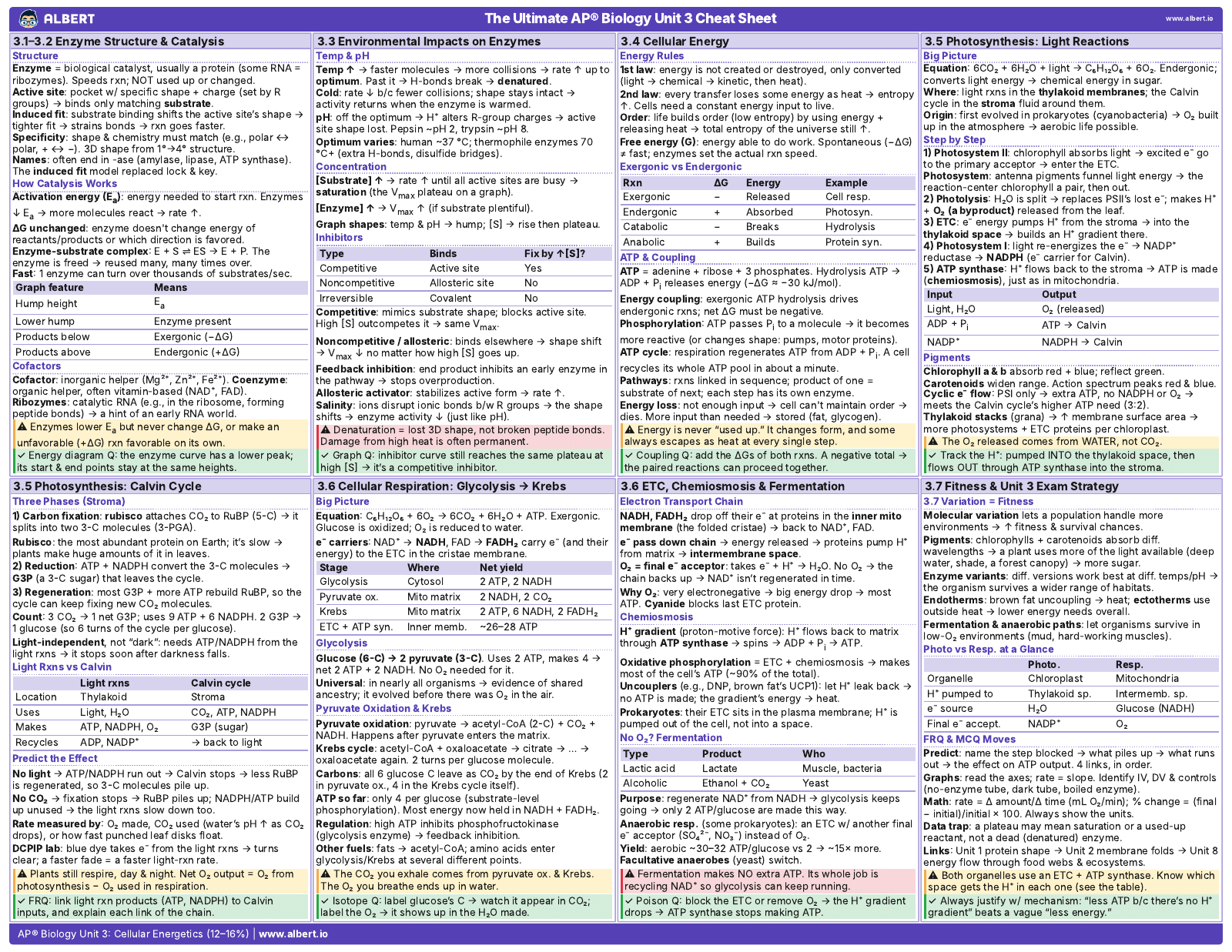
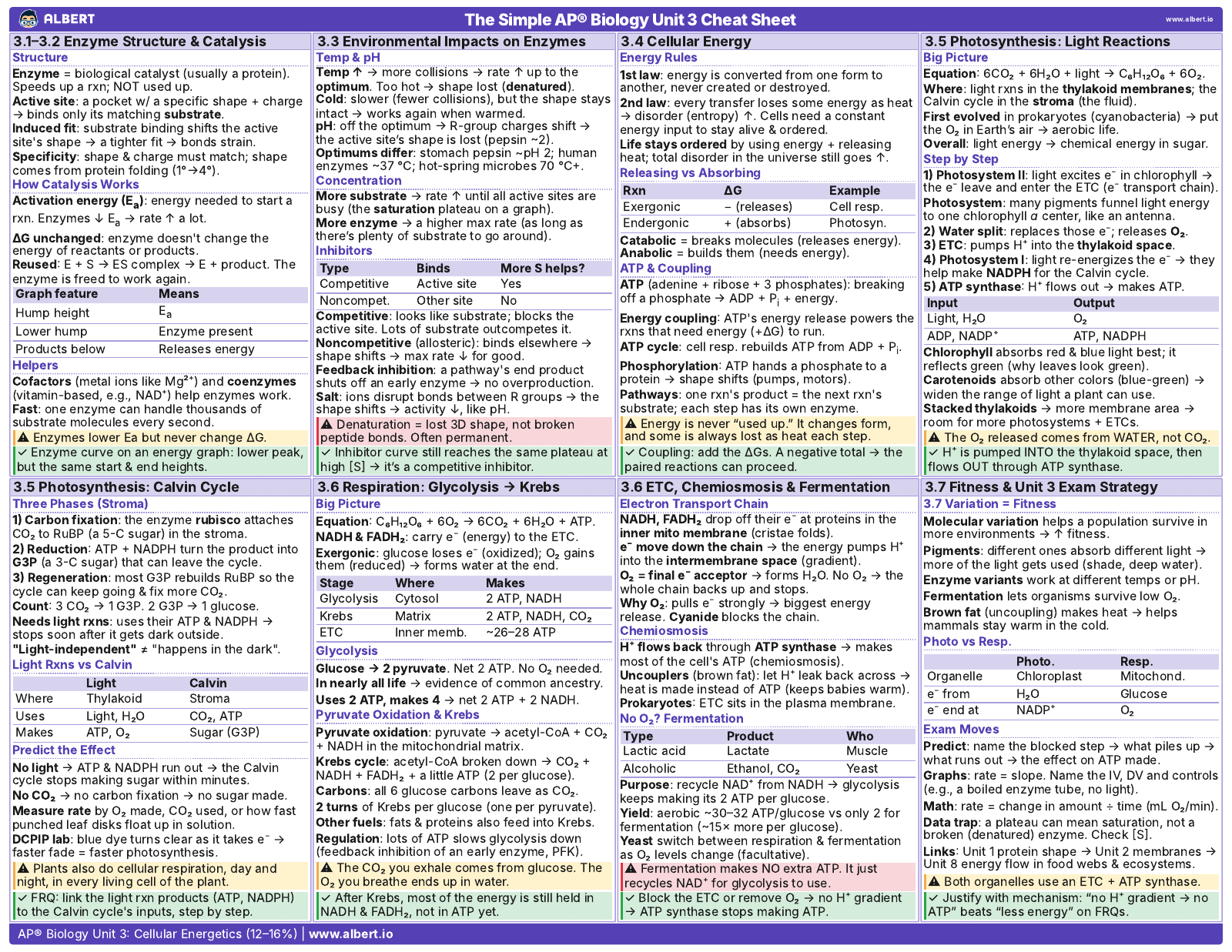
This AP Bio Unit 3 cheat sheet covers cellular energetics: how enzymes work, how cells manage energy, and the full path of photosynthesis and cellular respiration. Unit 3 is worth 12–16% of the AP® Biology exam, one of the heaviest units. Download it below in Simple for a first pass or Ultimate for full detail.
Practice AP® Biology Unit 3 questions on Albert
What’s on the AP Bio Unit 3 Cheat Sheet?
Both versions share the same eight cards: enzymes, environmental effects on enzymes, cellular energy, the light reactions, the Calvin cycle, glycolysis through the Krebs cycle, the electron transport chain and fermentation, and fitness with exam strategy.
- Simple is for students learning the unit or reviewing for a class test. It keeps each pathway to its main steps, inputs and outputs, with short notes on what each term means.
- Ultimate is for students aiming for a 4 or 5. It adds enzyme graph reading, competitive vs noncompetitive inhibition in detail, carbon and ATP counts, cyclic electron flow, uncouplers, isotope tracing, and predict-the-effect chains for the Calvin cycle and the electron transport chain.
Use Simple until you can redraw each pathway from memory, then move to Ultimate for the details exam questions test.
AP® Biology Unit 3 at a Glance
Unit 3 builds on the protein structure from Unit 1 and the mitochondria and chloroplasts from Unit 2. The College Board’s AP® Biology Course and Exam Description splits it into seven topics.
| Topic | Name | Focus |
|---|---|---|
| 3.1 | Enzyme Structure | Active site shape and specificity |
| 3.2 | Enzyme Catalysis | Lowering activation energy |
| 3.3 | Environmental Impacts on Enzyme Function | Temperature, pH, concentration, inhibitors |
| 3.4 | Cellular Energy | Energy laws, ATP, energy coupling |
| 3.5 | Photosynthesis | Light reactions and the Calvin cycle |
| 3.6 | Cellular Respiration | Glycolysis, Krebs cycle, electron transport, fermentation |
| 3.7 | Fitness | How molecular variation helps organisms survive |
At 12–16% of the score, expect roughly 7 to 10 multiple-choice questions on this unit, and it is a common setting for free-response lab questions.
Key Concepts in Unit 3: Cellular Energetics
Enzymes and Activation Energy (3.1–3.2)
An enzyme is a biological catalyst, usually a protein. Its active site has a specific shape and charge pattern, set by the R groups of the amino acids that line it, so it binds only substrates that match. When the substrate binds, the active site shifts slightly to grip it more tightly. This is the induced fit model.
Enzymes speed reactions by lowering activation energy, the energy needed to get a reaction started. They do not change the free energy of the reactants or products, so they never make an unfavorable reaction favorable.
Worked example: An energy diagram shows two curves for the same reaction. Both start at the same reactant energy and end at the same, lower, product energy. One has a tall hump; the other has a short hump. The short hump is the reaction with an enzyme. Because the products end lower than the reactants, ΔG is negative and the reaction is exergonic, with or without the enzyme.
Exam tip: If an answer choice says an enzyme “changes ΔG” or “shifts equilibrium”, eliminate it.
What Changes Enzyme Activity (3.3)
Raising temperature makes molecules move faster and collide more, so reaction rate rises up to an optimum. Beyond that, hydrogen bonds and other interactions holding the enzyme’s shape break, and the enzyme denatures. pH works the same way: away from the optimum, extra or missing H⁺ changes R-group charges and distorts the active site. Adding substrate raises the rate until every active site is busy, and then the rate levels off.
Inhibitors come in two main types. A competitive inhibitor resembles the substrate and blocks the active site; flooding the system with substrate can outcompete it. A noncompetitive inhibitor binds somewhere else, changes the enzyme’s shape, and lowers the maximum rate no matter how much substrate is added.
Worked example: A graph shows reaction rate against substrate concentration for three conditions: no inhibitor, inhibitor A, and inhibitor B. At high substrate, the curve with inhibitor A climbs to the same plateau as the control. The curve with inhibitor B levels off lower. Inhibitor A is competitive; inhibitor B is noncompetitive.
Exam tip: Denaturation means lost shape, not broken peptide bonds. The amino acid sequence is still there.
Energy Rules and ATP (3.4)
Energy is never created or destroyed, only converted (first law), and every conversion loses some energy as heat, raising entropy (second law). Living things stay organized only by taking in energy constantly. ATP is the cell’s energy currency. Removing its last phosphate releases energy, and cells use that release to drive reactions that need energy, a process called energy coupling.
Worked example: Joining glutamic acid and ammonia to make glutamine has a ΔG of about +3.4 kcal/mol, so it won’t happen on its own. ATP hydrolysis has a ΔG of about −7.3 kcal/mol. Coupled, the total is about −3.9 kcal/mol, so the combined process proceeds.
Exam tip: When asked whether coupled reactions can happen, add the ΔG values. A negative total means yes.
Photosynthesis (3.5)
Photosynthesis turns light energy into chemical energy in two stages. The light reactions happen in the thylakoid membranes. Photosystem II absorbs light and passes excited electrons to an electron transport chain. Water is split to replace those electrons, which releases O₂. The chain pumps H⁺ into the thylakoid space, and the H⁺ flows back out through ATP synthase to make ATP. Photosystem I re-energizes the electrons, which end up in NADPH.
The Calvin cycle happens in the stroma. The enzyme rubisco attaches CO₂ to a five-carbon sugar called RuBP. ATP and NADPH from the light reactions then convert the products into G3P, a three-carbon sugar. Most G3P is used to rebuild RuBP; the rest becomes glucose and other molecules.
Worked example: A plant is moved from light into darkness. The light reactions stop, so ATP and NADPH run out. Without them, the Calvin cycle can’t reduce its three-carbon molecules or rebuild RuBP. Those three-carbon molecules pile up while RuBP levels fall. Sugar production stops within minutes, even though nothing directly blocked the Calvin cycle.
Exam tip: The O₂ plants release comes from water, not CO₂. This is a favorite isotope question.
Cellular Respiration and Fermentation (3.6)
Glycolysis in the cytosol splits glucose into two pyruvate, netting 2 ATP and 2 NADH without O₂. In the mitochondrial matrix, pyruvate becomes acetyl-CoA and releases CO₂, and the Krebs cycle strips off the remaining carbons as CO₂ while loading electrons onto NADH and FADH₂. Those carriers drop electrons at the electron transport chain in the inner mitochondrial membrane. The chain pumps H⁺ into the intermembrane space, O₂ accepts the electrons at the end to form water, and H⁺ flowing back through ATP synthase makes most of the cell’s ATP.
Without O₂, the chain backs up and NAD⁺ runs out. Fermentation solves this by passing electrons from NADH to pyruvate (making lactate in muscle) or to a pyruvate breakdown product (making ethanol and CO₂ in yeast). This regenerates NAD⁺ so glycolysis can continue, but it adds no ATP.
Worked example: Cyanide blocks the last protein in the electron transport chain. Electrons can’t reach O₂, so H⁺ pumping stops and the gradient fades. ATP synthase slows and stops. NADH builds up and NAD⁺ runs low, so the Krebs cycle slows too. The cell is left with only the 2 ATP per glucose from glycolysis.
Exam tip: Compare chloroplasts and mitochondria by where H⁺ builds up: the thylakoid space in chloroplasts and the intermembrane space in mitochondria.
Fitness and Molecular Variation (3.7)
Variation in the molecules a population uses for energy helps it survive in more environments. Plants with several pigments, like chlorophyll a, chlorophyll b and carotenoids, absorb more wavelengths and can live in lower light. Organisms with enzyme versions that work at different temperatures survive a wider range of conditions. Fermentation lets organisms keep making some ATP when O₂ is scarce.
Exam tip: For a fitness question, name the molecular difference, the condition it helps with, and the result for survival or reproduction.
How Unit 3 Shows Up on the Exam
Multiple-choice questions on Unit 3 often come in sets built around one graph or diagram: an enzyme activity curve, an energy diagram, a figure of the electron transport chain, or data from a photosynthesis lab using floating leaf disks or DCPIP dye. Many ask you to predict what happens if one step is blocked.
On the free-response section, Unit 3 is a common choice for the long questions that interpret experimental data. A typical prompt describes an enzyme experiment or a respiration setup, asks you to identify the independent and dependent variables and the controls, and then to predict and justify a result.
Scorers reward mechanism. “Less ATP because the H⁺ gradient is gone” earns points that “less energy” does not. See the AP® Biology exam page for the current format.
Common Mistakes in Unit 3
- Mistake: Saying enzymes change ΔG. Fix: Enzymes lower activation energy only. Start and end energies stay the same.
- Mistake: Calling the Calvin cycle the “dark reactions” that happen at night. Fix: It doesn’t use light directly, but it needs ATP and NADPH from the light reactions, so it stops soon after dark.
- Mistake: Thinking plants don’t do cellular respiration. Fix: Plants respire all the time. Net O₂ release is photosynthesis minus respiration.
- Mistake: Saying fermentation makes ATP. Fix: Fermentation regenerates NAD⁺ so glycolysis can keep making its 2 ATP. It makes none itself.
- Mistake: Thinking the O₂ we breathe becomes CO₂. Fix: O₂ becomes water at the end of the electron transport chain. The CO₂ comes from the carbons in glucose.
Frequently Asked Questions
Can I use this cheat sheet on the exam?
No. Notes aren’t allowed on the AP® Biology exam. The AP Bio Unit 3 cheat sheet is a study tool for reviewing and testing yourself before exam day.
Should I start with the Simple or Ultimate version?
Start with Simple if you’re learning Unit 3 or have a class test coming. Switch to Ultimate once Simple feels easy, or if you’re aiming for a 5.
Do I need to memorize ATP counts for each stage?
Know the pattern: glycolysis and the Krebs cycle make only a few ATP each, and the electron transport chain with ATP synthase makes most of it. Exact totals vary by source (about 30 to 32 per glucose), and the exam focuses on where and why ATP is made.
How are photosynthesis and respiration connected?
The products of one are the inputs of the other. Photosynthesis uses CO₂ and water to make sugar and O₂; respiration uses sugar and O₂ to make CO₂, water and ATP. Both use an electron transport chain and ATP synthase.
How does Unit 3 connect to other units?
Enzyme shape builds on protein structure from Unit 1. The pathways run in the organelles from Unit 2. Energy flow through food webs in Unit 8 starts with the photosynthesis and respiration covered here.